zenpundit.com » law enforcement

Archive for the ‘law enforcement’ Category

Boyd and Beyond Local DC Event

Tuesday, December 18th, 2012

[by J. Scott Shipman]

Jim Hasik’s White Board Outline


At the suggestion of Adam Elkus, we were privileged to host our first “local” Boyd and Beyond event on 15 December. We had 14 attend, and five speakers. Logistically, we turned our family room in to a fairly comfortable briefing area, using a wall with Smart Sheets as a temporary white board. In keeping with our October events, we took up a collection and had pizza delivered for lunch. Coffee, soft drinks light snacks were provided. Each speaker was allotted 50 minutes, but given the participation of the audience, most talks lasted about 90 minutes. I should emphasize to those planning one of these events, to keep a lean speaker’s list, as the Q&A and discussion can easily double the time of a presentation—-and I believe all who attended would agree the comments/discussion made already great presentations even better.

My sincere thanks go out to my wife and partner, Kristen, for making this event look easy! She was the one who made sure everything was moving along and that folks felt at home. I would encourage others around the country to schedule and hold events through the year. We’re looking to do another in March 2013.

Our speakers were:

Jim Hasik, Beyond Hagiography: Problems of Logic and Evidence in the Strategic Theories of John Boyd

Francis Park, The Path to Maneuver Warfare in the U.S. Marine Corps

Robert Cantrell,  Which Card Will You Play?

Terry Barnhart, Designing and Implementing Maneuver Strategy in Transforming Major Organizations

Marshall Wallace, Theories of Change and Models of Prediction

I led off with a few comments on the military professional and intellectual rigor. I recommended the best book I’ve read this year: Inventing Grand Strategy and Teaching Command, by Jon Tetsuro Sumida, and the challenges he suggests in the realm of intellectual rigor. He writes:

“It remains to be seen whether readers exist with the mind and will to accept his guidance on what necessarily is an arduous intellectual and moral voyage into the realm of war and politics.” (emphasis added)

I followed with the example from An Unknown Future and a Doubtful Present: Writing the Victory Plan of 1941, by Charles E. Kirkpatrick. Mr. Kirkpatrick’s little book provides an excellent primer to the formulation of the United States’ WWII strategy and a refreshing insight into the education of an master strategist, then Major Albert C. Wedemeyer, attached to the War Plans Division, the Army chief of staff’s strategic planners, who wrote the Army strategy for WWII in 90 days. (read the review here) I suggested that military professionals should start something akin to a book club, where they can discuss and debate strategic issues and concept.

Following my comments, Jim Hasik offered his critique of John Boyd’s work. Adam tweeted that we were a “tough crowd,” but Jim was able to discuss his misgivings with respect to Boyd’s work and a lively discussion got us started. For those unfamiliar, Jim is the author of a paper called, Beyond Hagiography, which generated controversy in the Boydian community following this year’s October event at Quantico. (reviewed here and at zenpundit.comHere is a link to the paper. (see Hasik’s white board outline above).

According to Hasik, Boyd erred when extrapolating from physical processes/science to social processes. He reviewed Boyd’s use of science in his essay, Destruction and Creation, and suggested no literal correlation between Clausius’ Second Law of Thermodynamics (entropy), Gödel’s Incompleteness Theorem, and Heisenberg’s Uncertainty Principle and human behavior (on this I concur with Hasik, as analogy or metaphor these scientific principles enlighten).  Hasik asked if OODA scales from air-to-air combat to large scale events, and whether OODA was original (compared to PDCA, for example). One point that generated quite a bit of discussion was whether one could “like” Clausewitz or Sun Tzu and Boyd. Hasik questioned whether Boyd’s work should be judged as social science, history, or war studies, and suggested that further work was needed to fill in the gaps in his work. In October, someone suggested Boyd needed a “Plato,” someone to address Boyd’s work with less emphasis on science (as in Osinga’s book), thereby making Boyd’s work more accessible. The Strassler model was suggested; Strassler is an “unaffiliated scholar” who has written exhaustively referenced versions of ThucydidesHerodotus, and Arrian. [personal note: I believe a Strassler-like book on Boyd’s ideas would be a great resource] A great thought-provoking conversation.

Francis Park’s White Board


Francis Park’s talk on on maneuver warfare, the evidence of history began with “I’m a historian and I have a problem.” The irony wasn’t lost on the audience, as Francis is an active duty Army officer, speaking on the history of the USMC’s adoption of maneuver warfare (MW). Park called the Marine Corps “the most Darwinian of the services.” The venue for for the Corps discussion between MW advocates, and the “attritionists” was the Marine Corps Gazette. This venue was “unofficial,” otherwise the debate may have never happened. The Gazette’s forward-thinking editor made space and encouraged the debate, which was a “long, bitter, and complex fight.”

Park listed and discussed the champions of MW Michael D. Wyly, G.I. Wilson, William Woods, William Lind, and Alfred M. Gray. Park recommended Fideleon Damian’s master’s thesis, THE ROAD TO FMFM 1: THE UNITED STATES MARINE CORPS AND MANEUVER WARFARE DOCTRINE, 1979-1989. (Adam Elkus recommended Eric Walters essay in the Small Wars Journal, titled Fraud or Fuzziness? Dissecting William Owen’s Critique of Maneuver Warfare.)

Park called the USMC adoption of MW a “confluence of fortune” that may have never happened without the vigorous efforts of proponents.

Robert Cantrell’s Which Card Will You Play? was an instructive and interactive example of Robert’s strategy cards. Cantrell has two decks of strategy playing cards, one devoted to strategy, the other to sales strategy. The user’s guide is at www.artofwarcards.com.

Robert provided examples of how the cards are used to spark strategic thought and ideas. Volunteers pulled first one, then two cards from the decks, and read aloud and commented on how the statement(s) on the cards could be used in practice. For example, “Muddy The Water To Hide the Nets” was drawn (the 8 of clubs, a bit more on card suits from Robert below). The “strategy” is to “confuse your adversary so he cannot perceive your intentions. The “Basis” is “Confused adversaries make mistakes they would not make if they grasped your intentions.”

Longtime friend of this blog, Fred Leland at Law Enforcement Security Consulting is using the cards with success. Fred’s goal is “to get cops thinking more strategically and tactically in their work. I have been pulling a card from the deck and writing my thoughts and sharing them with cops who have been passing them along to their officers.” He is using Robert’s cards for “in-service” training, and providing a low cost entry into strategic thinking.

I followed up with Robert and asked for an explanation of the card suits. Here is his response:

Hi Scott – although they are gray delineations, the Hearts are oriented on the shaping self, the Clubs on shaping the field of contest…the diamonds are isolation strategies, and the spades are elimination strategies. This is the wolf pattern on the hunt: wolf becomes all the wolf it can be, shapes the hunt, isolates a member from the heard, brings that member down. With aces high – and again also gray – the higher cards tend to be strategies used from a greater abundance of strength and the lower numbers from comparative weakness in strength. Of course from here we can talk about gaining relative advantage if we cannot have absolute advantage to gain strength for a critical moment…and so on

Terry Barnhart spoke on Boydian organizational applications in a talk called Designing and Implementing Maneuver Strategy in Transforming Major Organizations. Terry said any organizational change had to be accomplished on the realms of the moral, mental, and the physical. With that in mind, he advised mapping the social networks of the organization and speaking in “the language of the culture” and “asking for what you need” when attempting to transformation. The end goal is “aligned autonomy,” and Terry’s recommended method of choice is taken from Boyd’s Patterns of Conflict,Slide 80:

Patterns of Conflict, Slide 80


Search out the “surfaces and gaps”, as reference from Slide 86, POC. In Boyd’s language:

•Present many (fast breaking) simultaneous and sequential happenings to generate confusion and disorder—thereby stretch-out time for adversary to respond in a directed fashion.

•Multiply opportunities, to uncover, create, and penetrate gaps, exposed flanks, and vulnerable rears. [emphasis added]

Create and multiply opportunities to splinter organism and envelop disconnected remnants thereby dismember adversary thru the tactical, grand tactical, and strategic levels. [emphasis added]

In Terry’s words, “be everywhere at once” and establish relationships that result in buy-in, avoiding “no,” as Terry advised it can take a couple of years to overcome an objection. As aligned autonomy is reached, word will get around about the successes, and all of sudden what was a single agent of change becomes a movement. So Terry is recommending methods in maneuver warfare as a method in transforming organization culture.

During Terry’s talk, Dave recommended Orbiting the Giant Hairball, by Gordon MacKenzie as a guide in navigating the bureaucracy and obstacles often found in large organizations.

Marshall Wallace’s White Board


Marshall Wallace’s Theories of Change and Models of Prediction was our final presentation. Marshall has emerged as one of the leading thinkers among Boydeans. Wallace said, “people are lazy” as he led off his discussion of change models. [personal note: I’ve come to refer to this laziness as “neurological economy”] His thinking was influence by Daniel Kaneman’s Thinking, Fast and Slow and the Heath brother’s Switch: How to Change Things when Change is Hard. When change is desired, clarity is an absolute must have. Wallace offered the four models above as example of change. He said we must ask: “What is the change we want to see?” and ” What are the pre-conditions?”—instead of this model, most people begin with the idea, which more often than not, fails.

Wallace walked our group through the models and emphasized the importance of tempo and used his wife’s efforts to establish dog parks in their city. Everything in government has a process, and Wallace said in this case “going slower than the politicians” paid off. Also, for programs of change, it is best if there is 100% transparency of goals. Both Marshall and Terry recommended a book called The Progress Principle, by Teresa Amabile and Steven Kramer. The most powerful model for me was the one in the lower right corner—particular the use of “more people” and “key” people in any effort to affect change.

Post meeting, Wallace posted the following to our Facebook group wall, that rounds out and expands his thinking:

I was on the plane back to Boston yesterday morning, deeply engrossed in Terry’s book [Creating a Lean R&D System] when a phrase leapt into my head: “Target the whole organism”.

As the Michaels in our lives (Moore and Polanyi) remind us, “we know more than we can say”. I feel that quite clearly and I constantly struggle with language. I am never satisfied with any presentation I give because I know that, due to failures on my part to use the perfect word at the right moment, I left some understanding on the table.

Somehow the weekend, with spectacular conversation, a good night’s sleep, the enforced idleness of air travel, and Terry’s superb book, shook something loose.

Target the whole organism.

What flashed through my mind at that moment were pieces of the talks.

Jim prompted discussion of what the next set of books about/on/adding to Boyd should look like.

Francis drew a pie wedge with “firepower” on one edge of the pie and “maneuver” on the other. He was describing two schools of thought on conflict as represented by these extremes. Everybody seemed to agree that the balance lay somewhere in the middle and was definitely related to the context.

Robert’s exercises with his strategy decks shook countless examples of strategic action and insight loose in our minds. The combination of cards, taking one from each of the competition and collaboration decks, was especially exciting.

Terry laid out his plan to blitzkrieg his company, and invited us to make it better.

I ended with a 4-cell matrix demonstrating the four basic categories under which all Theories of Change operate (more on this later). Experience has shown that most people operate out of an implicit Theory that traps them in one quadrant, whereas social change only occurs if all four quadrants are affected.

Target the whole organism.

I got home and opened up “The Strategic Game of ? and ?”. Interaction and Isolation.

Firepower and maneuver – at the same time. Competition and collaboration at the same time.

Boyd side-by-side with his sources and several commentators. CEO, discouraged middle-managers, and the line at the same time. More People and Key People at both the individual level and the structural level all at the same time.

Target the whole organism.

A force that uses maneuver to confuse and firepower to destroy will dominate. A force that can swing rapidly between extremes and also find balance is even more slippery than one that acknowledges the “necessary” balance. The two practices can be in separate parts of the battlespace (context matters), but because both are occurring, the confusion generated may well be more intense. It looks as though the force is two distinct armies and communication among the enemy may be unintelligible because the threats being faced are so different.

Bringing collaborative concepts into competitive spaces or vice versa while not abandoning the underlying logic of the space opens up more options, challenges notions, and expands horizons. Can we interact and isolate at the same time? What does that snowmobile look like?

If we want to effect social change, we need to target the whole system. We can sequence our efforts in time, though we can’t forget to move as quickly as the circumstances allow. At the same time, every effort must be connected to the whole organism.

The target is not the target. I do not aim at the eye of the fish. I don’t wan’t to hit the bullseye.

I want to pick up the whole madding crowd of intense archers, cynical kings, and wildly cheering spectators and move them.

This was the first “local” event, and based on the response, we’ll be doing these a few times a year. Many thanks to all who participated, and Merry Christmas and a Happy New Year to  you all!

UPDATE: Dave shared these with our group. Francis said, “We live and die by bumper stickers.” Here is a good example:


Here is Dave’s interpretation of the Sufi elephant:


Cross-posted at To Be or To Do.

Madness, Mass Shootings and an Open Society

Monday, December 17th, 2012


Everyone in America has seen the latest results of another dangerously mentally ill loner with family members who were in denial about the severity of his condition or disconnected from him. The killer, Adam Lanza, shot shot his own mother in the face before slaughtering twenty elementary school children and the heroic teachers and their principal who had sought to protect them, belonged in an institutional setting. The same can be said for homicidal schizophrenic Jared Loughner who shot Congresswoman Gabby Giffords, James Holmes, the Colorado shooter, has a gag order on his murder trial but his defense lawyers have already disclosed that their client is mentally ill in blocking access to his diaries under physician-client privilege. Seung-Hui Cho, who committed the Virginia Tech massacre, had previously stalked women, made suicidal threats and been ruled “an imminent danger to himself and others” was set free and unwell to be treated on “an outpatient basis” that never happened.

Predictably, a debate about gun control has erupted in the aftermath of senseless deaths. However, other countries are as heavily armed as the United States (in a few cases, more so). These countries also have severely mentally ill people, yet they don’t have the mass shootings that have become a dark cultural phenomenon we see here in America.  Or when on the rare occasions they do, the shooter is likely not to be insane, but a professional terrorist.

There have also been calls for improved school security ( the Obama administration and Congress cut school security grant funds in 2010 and 2011), stationing policemen in schools and even arming teachers, citing the example of Israeli schools and the Pearl High School shooter who was stopped by an assistant principal with a .45.  While more security is a reasonable precaution and a good idea, short of turning our schools into windowless, prison-like, fortresses and giving the staff AK-47’s,  anybody utterly willing to die in order to kill someone else stands a pretty good chance of success. If all guns vanished tomorrow, the crazies will use car bombs and IEDs instead; mass shootings are a “motivated crazy person” (or terrorist) problem – criminals with economic motives do not carry out these kinds of attacks.

There is no perfect answer here, but here are a few suggestions:

  • We need to revise our attitude toward mental illness with greater public education and access to mental health treatment, especially emergency treatment. Most mentally ill people are NOT dangerous but the warning signs of psychotic breakdown should become as widely recognized as the dangers of cigarette smoking.
  • For the very few people who are mentally ill and violent, we need to have public heath authorities accept that some degree of active supervision is required to ensure they receive treatment and take their medication if they are to live independently, and if they refuse, to institutionalize them temporarily until they do so. The key variable here is *violence* not just mental illness and strong due process safeguards must be in place to protect the individual and ensure they receive appropriate treatment with dignity.
  • Schools need much better training and planning for “active shooter” situations. At present, most schools have safety plans that emphasize locking students in enclosed rooms from which there seldom are any escape routes and the staff passively waiting for instructions from higher school authorities or police. While these plans may be good for unarmed intruders of unknown intent, they are dangerously counterproductive for heavily armed active shooters. Schools generally lack  enough secure rooms with doors that can delay such intruders for more than a few seconds and the standard emergency plan emphasis on “sitting tight” discourages the staff from engaging in reasonable risks to quickly evacuate students when the intruder is elsewhere in the building, or if possible, tactics to evade or if need be, resist, the shooter.

An Insurgency Coming to a Place Near You?

Tuesday, October 2nd, 2012

Mayor Rahm Emanuel has taken criticism for Chicago’s skyrocketing homicide rate which stands this year at a shocking 19.4 per 100,000 residents. This is roughly triple the murder rate in New York City, is worse than in perennially crime-ridden Oakland and is within shouting distance of  war-torn Afghanistan and Mexico, which are fighting vicious insurgencies. Even for Chicago, the current level of street violence is unusually brazen.

Chicago has always taken an ambivalent attitude toward it’s enormous, 100,000 strong, network of rival street gangs. Traditionally, part of the social fabric of Chicago’s ethnically divided wards, Chicago’s street gangs were far better organized and more ruthlessly disciplined than street gangs elsewhere, which allowed them a limited entree into participation in local politics. The Chicago Outfit from Al Capone’s day on controlled the votes in the old 1st Ward, ran several near suburbs like Cicero and recruited especially brutal sociopaths from the Forty-Two gang; the legendary Mayor Richard J. Daley in his youth had been a thug for the Hamburg Athletic Club, the Democratic Party’s election-time enforcers in the 11th Ward. In more recent decades, the Black P. Stone Nation/El Rukns were Federal grantees and a number of powerful street gangs today use the Black United Voters of Chicago as a front group and cut-out to make deals with local politicians and swing aldermanic races.

However disturbing the status quo may have been in Chicago, it is potentially changing for the worse. Much worse.

DEA BOSS: MEXICAN DRUG CARTELS ARE SO DEEPLY EMBEDDED IN CHICAGO, WE HAVE TO OPERATE LIKE WE‘RE ’ON THE BORDER’ 

The city may be nearly 2,000 miles from Mexico, but the country’s drug cartels are so deeply embedded in Chicago that local and federal law enforcement are forced to operate as if they are “on the border,” according to Jack Riley, special agent in charge for the Chicago Field Division of the Drug Enforcement Administration (DEA).

Because of Chicago’s location in the heart of the United States, its large Mexican population and its abundance of street gang activity, drug cartels have designated the city as one of its main hubs of operation in America, Riley told TheBlaze in an exclusive interview. Inevitably, the increasing presence of cartels has also contributed to the Windy City’s skyrocketing violent crime rates, the DEA boss revealed.

“My opinion is, right now, a number of the Mexican cartels are probably the most organized, well-funded, vicious criminal organizations that we’ve ever seen,” said Riley.

Right now, at least three major Mexican cartels are fighting for control of billions of dollars worth of marijuana, cocaine and heroin in Chicago. That includes the ruthless Zetas and the powerful Sinaloa cartel, run by Joaquin “El Chapo” Guzman, arguably the most wanted man in North America, and perhaps the entire world….

….“If I pitted the Italian organized crime groups against for instance, ‘Chapo’ Guzman and the Sinaloa Cartel, it wouldn’t be a fight,” he told TheBlaze. “In my opinion, Chapo Guzman is the new Al Capone or Scarface to Chicago. His ability to corrupt, his ability to enforce his sanctions and to really do with an endless supply of revenue is in my opinion far greater than older Italian organized crime.”

….The drug trafficking organizations are based in Mexico but, he explained, they have operatives in various cities across the nation. In Chicago, local gangs are used by cartels as a means to get their products onto the streets without putting their operations at risk, all the while raking in massive profits from drug sales. Cartels move every drug you can think of, including cocaine, marijuana, heroin and methamphetamines.

Overall, police records indicate Chicago’s murder rate is up 31 percent from 2011. Further, Mayor Rahm Emanuel in August requested federal assistance to combat violence and drugs. The Chicago Sun-Times reported on Aug. 31 that at least 82 people were injured or killed in shootings within a one week period, 10 in one night alone. Additionally, as of Aug. 23, there had been 351 shooting deaths so far in 2012….

Read the rest here.

The vast profit margin in illegal drug sales and the formidable manpower of Chicago street gangs have led the Mexican cartels to make a strategic choice to stay in the background, as hegemonic partners with local gangbanger street crews and not make the kind of flamboyantly ghoulish “narcocultas” attacks or DIY militarization typical of the Mexican criminal insurgency.  Sharing profits and letting locals run the major risks with law enforcement is a cartel strategy to avoid antagonizing the Federal government into treating their drug operations as ” international terrorism” with the draconian response that would imply, here, inside Mexico and further abroad. The same reason the cartels do not try to kill large numbers of American tourists or assassinate prominent Americans in Mexico, which they could easily do.

However, the cartels could shift from transnational organized crime activities to exporting narco-insurgency to America under a number of scenarios:

  •  Cartel vs. Cartel – a cartel losing to rivals in Mexico breaks the informal rule against high profile attacks inside the US by striking it’s enemies here, inviting a cycle of severe retaliation and drawing in local allies – Mexican Mafia, MS-13 etc.
  • Federal Squeeze – law enforcement gets really serious about systemically destroying a particular cartel, rooting out it’s illicit money stashed in the US banking system and legal investments and jailing everyone in sight under RICO and extraditing everyone else from Mexico. The narcos will employ “silver or lead” tactics to intimidate and co-opt local officials and whole communities and then escalate into symbolic terrorism.
  • US Intervention – American assistance to the government of Mexico against the cartels tips the balance in Mexico’s civil war to what the cartels see as an existential threat ( i.e. drone targeted killings) and the narcos respond with furious attacks against American soft targets intending to create high body count events.

There is nothing magical about the US-Mexican border that prevents the ghastly violence in Mexico from occurring here – it is a rational calculation by cartel leaders that such behavior is not worth the risk of a stand-up fight with the US military and intelligence agencies – the cartels are only just holding their own against the lesser capabilities of the government of Mexico However, if cornered and desperate, the cartels are capable of rapidly escalating the violence in specific American communities to 2006 -2007 Iraq insurgency levels – in places like Chicago. It could happen faster than anyone believes possible.

The political effect of this will be a riptide – and none of it to the good.

Pussy Riot V: Kasparov

Tuesday, August 21st, 2012

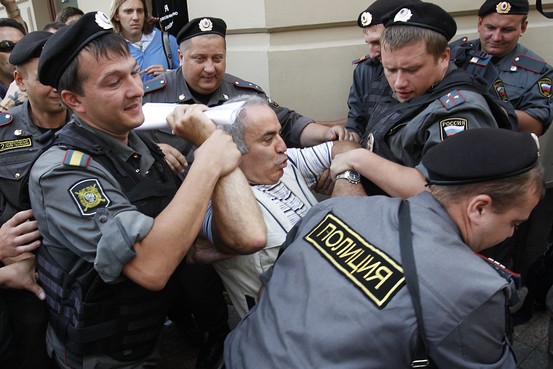
[ by Charles Cameron — the Garry Kasparov arrest ]
.

It isn’t chess. It isn’t, as we’d say in England, cricket. It besmirches the good name athletes like Arsen Galstyan brought Russia in the London Olympics.

It is Garry Kasparov, arrested for protesting the trial of Pussy Riot.

photo credit: Reuters

.

In yestrdays Wall Street Journal, under the title When Putin’s Thugs Came for Me, Kasparov — Russia’s one-time youngest ever undisputed World Chess Champion — wrote:

The men refused to tell me why I was being arrested and shoved me into a police van. When I got up to again ask why I had been detained, things turned violent. I was restrained, choked and struck several times by a group of officers before being driven to the police station with dozens of other protesters. After several hours I was released, but not before they told me I was being criminally investigated for assaulting a police officer who claimed I had bitten him.

It would be easy to laugh at such a bizarre charge when there are already so many videos and photos of the police assaulting me. But in a country where you can be imprisoned for two years for singing a song, laughter does not come easily. My bruises will heal long before the members of Pussy Riot are free to see their young children again. In the past, Mr. Putin’s critics and enemies have been jailed on a wide variety of spurious criminal charges, from fraud to terrorism.

But now the masks are off. Unlikely as it may be, the three members of a punk band have become our first true political prisoners.

**

If it was chess, here’s what we’d have to call it: a knight hustled into a van by pawns.

Prophecy, Poetry and Prediction

Tuesday, July 17th, 2012

[ by Charles Cameron — personal preference, gangs, Chicago, insurgency, Afghanistan, and admitting the uncomfortable ]
.

Albrecht Durer, The Blessed Virgin enthroned on the crescent moon

**

Poetry, on the whole, has a liking for prophets. Thus Sylvia Plath writes:

By the roots of my hair some god got hold of me.
I sizzled in his blue volts like a desert prophet.

There’s an undeniable affinity there, the sense of giving voice to a lightning strike. Or as Randall Jarrell puts it:

A good poet is someone who manages, in a lifetime of standing out in thunderstorms, to be struck by lightning five or six times; a dozen or two dozen times and he is great.

**

Okay. I’m a poet, I think, partly because I have such a damnably literal mind that I need to break out in metaphor the way athletes break out in a sweat.

And the trouble with prophecy, from my point of view, is that it’s all too often read in damnably literal-minded ways, as though:

And there appeared a great wonder in heaven; a woman clothed with the sun, and the moon under her feet, and upon her head a crown of twelve stars

wasn’t clearly poetry. Let me clarify: it is.

And it is because prophecy (not “false prophecy”) is all too often read literally that the end of the world is so regularly promised, without once having come to pass thus far.

Even though the scriptures proclaim, But of that day and hour knoweth no man, no, not the angels of heaven

**

I suppose it goes along with being a poet rather than a statistician that I’m far more interested in qualitative than in quantitative approaches to modeling — or understanding, as we used to call it.

There are times, though, when it’s advisable to acknowledge the approaches most different from one’s own — for they too have their moments.

**

A Reporter’s Notebook entry yesterday on Fox News titled Chicago gang database intends to predict and prevent further violence tells us “One shooting sets the next shooting in motion.” That’s poignant even if a tad banal. But what comes next is interesting:

In an attempt to predict the next violent act, Chicago police are turning to technology. They have established a database that includes information on more than 100,000 known gang members. Even the lowest members of the gangs are entered as soon as police become aware of them. Their arrest records and affiliations are all entered and cross-referenced and available to the cop on the street. This is the kind of information a good beat cop would keep in his head; now it’s available to every cop on every beat. Sgt. Tom Ryan is in the gang unit on the South Side. “This is just a great way that we can look at all the information gathered because it is hard for the detectives to talk to all the different units. This is a good way of filtering down data through the departments to each other.

Probably of greatest use to the officers, when a guy gets shot, police see who his buddies are. “We can make predictions about where retaliations might be likely to happen,” says Commander Jonathan Lewin.

**

And I bring this to your attention because today I ran across an article in Wired’s Danger Room with the headline Study: WikiLeaked Data Can Predict Insurgent Attacks which resonated with yesterday’s Chicago gang report:

Insurgencies are amongst the hardest conflicts to predict. Insurgents can be loosely organized, split into factions, and strike from out of nowhere. But now researchers have demonstrated that with enough data, you might actually predict where insurgent violence will strike next. The results, though, don’t look good for the U.S.-led war.

And they’re also laden with irony. The data the researchers used was purloined by WikiLeaks, which the Pentagon has tried to suppress. And the Pentagon has struggled for years to develop its own prediction tools.

That data would be the “Afghan War Diary,” a record of 77,000 military logs dated between 2004 and 2009 that were spilled onto the internet two years ago by WikiLeaks. In a paper published Monday by the Proceedings of the National Academy of Sciences, a team of researchers used the leaked logs to (mostly) accurately predict violence levels in Afghanistan for the year 2010. (Behind a paywall, alas, but a summary is available for free in .pdf.)

**

I’m focused on minds and hearts, as the saying goes — but I’ll admit that mines and HK417s are also significant.

If the quant side of the house can reduce casualties, I’m all for that.


Switch to our mobile site