zenpundit.com » Glass Bead Game

Archive for the ‘Glass Bead Game’ Category

Game on!

Tuesday, June 16th, 2015

[ by Charles Cameron — a computer “plays” Mario Bros while a robot demonstrates “Bushido” ]
.

Two stunning videos:

and:

**

Justin Seitz turned me onto the Super Mario World video with this tweet:

I’m one of those obstructionists who wouldn’t say the AI was “playing” — but that’s the hard problem in consciousness for you. I wonder what my friends Mike Sellers and Chris Bateman would have to say..

And no, I wouldn’t call the robotic slicing and dicing “Bushido” either. From the Hagakure:

There is something to be learned from a rainstorm. When meeting with a sudden shower, you try not to get wet and run quickly along the road. But doing such things as passing under the eaves of houses, you still get wet. When you are resolved from the beginning, you will not be perplexed, though you will still get the same soaking. This understanding extends to everything.

Has the Yaskawa Bushido Project learned from rainstorms?

Indirectly, I suppose. But there you go.

**

Interesting that John Holland, the “father of genetic algorithms”, described his life’s work as a Glass Bead Game, eh?

Sunday second surprise: Ferdinando Buscema

Sunday, January 25th, 2015

[ by Charles Cameron — from Tesla to St Augustine is a short creative leap ]
.

I recently received a LinkedIn invite from one Ferdinando Buscema, who described himself to me as a Glasperlenspieler, a player of the Glass Bead Game. I must say that pleased me, there’s a quiet humility there that calling oneself Magister Ludi or Master of the Game would lack. He’s a player, I’m a player, let’s play.

Here’s the BoingBoing video he sent me when I accepted his invite:

Not for nothing does Ferdinando call himself a Magic Experience Designer.

**

As you’ll see, in the video Ferdinando very warmly recommends Erik Davis‘ book TechGnosis: Myth, Magic & Mysticism in the Age of Information — which has also been highly praised by the likes of Howard Rheingold, Hakim Bey, Mark Dery, Bruce Sterling, Terence Mckenna, and Mark Pesce, to which intriguing list you may add myself.

Erik and I began a never-completed HipBone game many years ago — it was around the topics of Hanibal Lecter, his recreational collection of church collapses, and the origins of the Memory Palace in Simonides‘ encounter with the gods Castor and Pollux — and Erik mentions the HipBone Games briefly in his book. At the moment, I owe him an update on the games, which I’ll post here at Zenpundit in due course.

It was a particular delight for me, then, to see Ferdinando’s obvious and full-throated praise of Erik’s stunning book in his video, followed up by equal praise of Ramon Llul — one of those writers in the Hermetic tradition whose work precedes not just the Bead Game but much of today’s science, from digital computers via genetics to genetic algorithms and cryptography.

**

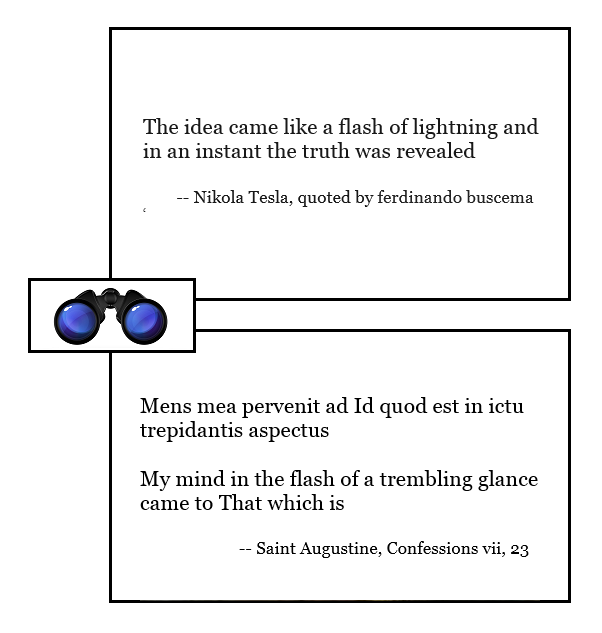
Ferdinando’s third treasure turned out to be Nikola Tesla, and in particular the remark he made about his mode of creativity. I hadn’t come across this remark before, but it cried out for DoubleQuotation with a remark of St Augustine’s, which I have carried with me since I first read of it in Dom Cuthbert Butler‘s book, Western Mysticism, back in my teens better than half a century ago.

Here, then, are the two luminous / numinous quotes, from Tesla and Augustine, DoubleQuoted by me for Ferdinando as an offering on first meeting:

SPEC DQ Tesla Augustine

**

It doesn’t hurt, of course, that the word “ictus” which Augustine uses also features in the context of Gregorian Chant, where it indicates the almost simmultaneous touchdown of a bird on a branch and its takeoff on a new curve of flight. I had the honor to learn the word from Dom Joseph Gajard, choirmaster at the Abbey of St Pierre de Solesmes — then and I suspect now the center of the world’s musical paleography and liturgical perormance of the chant, and in my teens my favorite vacation and retreat — under whose cheironomic hand I had the good fortune, once, albeit without much skill, to sing..

And so the beads are dropped into the lake: we watch as their ripples ripple out and intersect..

Sunday surprise: De Niro’s recommended reading

Sunday, January 25th, 2015

[ by Charles Cameron — preferring Jarmusch’s Hagakure in Ghost Dog to Grovic’s Hesse and Sunzi in Bag Man ]
.

In a film that the critics panned, Netflix offered, and I watched without much comprehension, Robert De Niro, playing the part of Dragna — “a dude who wears plaid jackets, thick glasses, and his grey hair in a swoopy high pompadour” who has assembled a motley team of killers in a seedy Bayou motel — educates John Cusack as his fav killer, Jack, by recommending he read certain books — notably Hermann Hesse‘s Glass Bead Game aka Magister Ludi:

De Niro goes Magister Ludi

De Niro goes Magister Ludi 2

Magister Ludi means Master of the Game.

Dragna apparently believes Hesse’s Game is best played by pitting assassins, here including cops, a “whore” and a dwarf as well as Jack, against one another in that seedy motel.. and is not altogether satisfied with the result, which shoots him shortly after he announces his own mastery of the game.

De Niro goes Magister Ludi 3

**

Zenpundit regulars who lack my enthusiasm for Hesse’s Game — quite different in style and tone from the one writer-director David Grovic proposes in his film — may at least be gratified to see his other recommendation:

De Niro goes Sunzi

**

I would have done better to re-watch Jim Jarmusch‘s Ghost Dog: The Way of the Samurai with Forest Whitaker, with its extensive quotations from the Hagakure:

That’s what I’ll watch tonight.

Creating a web-based format for debate and deliberation: discuss?

Friday, December 12th, 2014

[ by Charles Cameron — Talmud, hypertext, spider webs, Indra’s net, noosphere, rosaries, renga, the bead game, Xanadu, hooks-and-eyes, onward! ]
.

Let me firmly anchor this post and its comments, which will no doubt shift and turn as the wind wishes, in discussion of the possibility of improving on current affordances for online deliberation.

Let’s begin here:

**

There are a variety of precursor streams to this discussion: I have listed a few that appeal to me in the sub-head of this post and believe we will reach each and all of them in some form and forum if this discussion takes off. And I would like to offer the immediate hospitality of this Zenpundit post and comment section to make a beginning.

Greg’s tweet shows us a page of the Talmud, which is interesting to me for two reasons:

  • it presents many voices debating a central topic
  • it does so using an intricate graphical format
  • The script of a play or movie also records multiple voices in discourse, as does an orchestral score — but the format of the Talmudic score is more intricate, allowing the notation of counterpoint that extends across centuries, and provoking in turn centuries of further commentary and debate.

    What can we devise by way of a format, given the constraints of screen space and the affordances of software and interface design, that maximizes the possibility of debate with respect, on the highly charged topics of the day.

    We know from the Talmud that such an arrangement is possible in retrospect (when emotion can be recollected in tranquility): I am asking how we can come closest to it in real time. The topics are typically hotly contested, patience and tolerance may not always be in sufficient supply, and moderation by humans with powers of summary and editing should probably not be ruled out of our consdierations. But how do we create a platform that is truly polyphonic, that sustains the voices of all participants without one shouting down or crowding out another, that indeed may embody a practic of listening..?

    Carl Rogers has shown us that the ability to express one’s interlocutor’s ideas clearly enough that they acknowledge one has understood them is a significant skill in navigating conversational rapids.

    The Talmud should be an inspiration but not a constraint for us. The question is not how to build a Talmud, but how to build a format that can host civil discussion which refines itself as it grows — so that, to use a gardening metaphor, it is neither overgrown nor too harshly manicured, but manages a carefully curated profusion of insights and —

    actual interactions between the emotions and ideas in participating or observing individuals’ minds and hearts

    **

    Because polyphony is not many voices talking past one another, but together — sometimes discordant, but attempting to resolve those discords as they arrive, and with a figured bass of our common humanity underwriting the lot of them.

    And I have said it before: here JS Bach is the master. What he manages with a multitude of musical voices in counterpoint is, in my opinion, what we need in terms of verbal voices in debate.

    I am particularly hoping to hear from some of those who participated in tweeted comments arising from my previous post here titled Some thoughts for Marc Andreessen & Adam Elkus, including also Greg Loyd, Callum Flack, Belinda Barnet, Ken (chumulu) — Jon Lebkowsky if he’s around — and friends, and friends of friends.

    What say you?
    The White House, Games, and HipBone/Sembl — today

    Thursday, January 2nd, 2014

    [ by Charles Cameron — a project of keen interest to me, and a request for your support ]
    .

    Something is going on in one corner of the White House that has me agog in a pleasant way.


    .

    Mark DeLoura, Senior Advisor for Digital Media at the WH Office of Science and Technology Policy is soliciting ideas about Games that Can Change the World. I’ve jumped in, and so have some old friends, one auld acquaintance and one new…

    **

    The home page for this project is hosted on its own Games for Impact site, and I’d invite you to take a look, and note in particular…

  • Games where ideas collide (& create new ideas)
  • This is my own page, for the HipBone / Sembl games and DoubleQuotes — and if you have found my style of analysis valuable, you may want to go there, (take the trouble to) log in, and upvote my idea — making a comment too, should you so wish.

  • Positive Impact and Game Evangelism
  • Similarly, you can log in and upvote the whole idea by supporting this proposal, the current “leading” concept…

    Part of what makes this entry so interesting is the fact that Chris Crawford, game designer and thinker non pareil, is discussing his own long-hoped-for paradigm shift in game design in this thread. Chris is the “auld acquaintance” I mentioned, and I met him via the good services of my old friend Mike Sellers late in the last century. It is good to read him again in the new millennium.

  • Games to increase understanding about emergent social systems
  • Mike’s own offering is this one, which I also highly recommend. Mike is one of the founding fathers of multiplayer games with graphical architecture, and has more recently been working to bring human psychology into gameplay with increasing subtlety. By all means give him a vote up if that sounds good.

  • Knecht/Connect – a playable version of the Glass Bead Game
  • As you know, my own games attempt to bring the game concept embedded in Hermann Hesse’s great novel, The Glass Bead Game / Magister Ludi into playable form, and my friend Paul Pilkington has been doing the same in a series of books [1, 2, 3] and a Twitter stream. Let’s help him get some recognition, too…

  • Try the Poietic Generator
  • This one’s a game concept I like, too — it’s based on Conway‘s Game of Life… and brings it alive!

    It was submitted by Olivier Auber, whom I hadn’t previously met — so he’s my new acquaintance, and I’m hoping his game ideas will flourish and that acquaintance will grow into friendship in as things unfold…

    **

    So that’s the overall project, along with a sampling of specific ideas that I admire and would invite you to support. I hope you’ll find (and support) some other game concepts of interest, too.

    In a follow up post honoring Chris Crawford — which may still take a while to write and post — I’ll be looking at some of the historical background of “serious games” — and of the HipBone / Sembl style of thinking in particular.


    Switch to our mobile site