zenpundit.com » 2010 » August

Archive for August, 2010

Recommended Reading

Sunday, August 8th, 2010

I have but two recommended readings this week but they are both very good. I say “week” because I am going to be mostly offline for the next seven to ten days and will only have time to sporadically check in, so posting will be extremely light. My email response will also be, I say with all candor, very poor except for the most urgent business.

Scholar’s StageNotes on the Dynamics of Human Civilization: The Growth Revolution, Part I

My primary historic interest lies with the civilizations of the classical age. The world of Asoka, Shi Huangdi, and Scipio Africanus is a fascinating one, and the modern world would be a better place if our current caste of world leaders studied the lessons of these ancient days. However, the more I study these periods the more I realize that the world we live in is a fundamentally different place than that of our axial forbearers. This fact is little appreciated and (most likely) little understood by most commentators. There are clear limitations to the lessons we can learn from times past. If we do not understand the dynamics by which these societies operated and the ways in which these dynamics differ from those of the modern world, comparisons between the two will do more harm than good. 

On the broadest terms, the history of humanity can be divided into three periods. The first begins with the evolution of modern humans c. 50,000 years ago and ends with the advent of sedentary society (c. 11,500 years ago – Gobelki Tepe being the marker of this first transition). This was a world without civilization. Complex societies (used interchangeably with “civilization” in this post) have only existed for a fifth of humanity’s existence. While but a small part of human history in toto, it is these last 11,500 years that are the object of our study.

Human civilization has gone through two stages. The first of these stages is the longest, beginning with the emergence of complex societies in the Near East c. 11,500 years ago and ending only at the beginning of the 19th century. I submit that every society of this period- from the first chiefdoms to the great empires of Rome and China – operated under the same basic structural constraints. The rules and limitations were the same; the differences were a matter of emphasis and scale. This changes at the turn of the 19th century. Humanity’s third great period begins here (it has not yet ended). The rules by which the modern world operates are incredibly different from those of the old order. The transformation wrought by modernization was no less revolutionary than that wrought by the advent of complex society 11,000 years previous.

This revolution is widely recognized, but also grossly mischaracterized. The standard label for this transition is the “Industrial Revolution.” This title is misleading. The industrialization of the world economy was the result, not the cause of modernization. The nature of this radical transformation is captured better by a different title: The Growth RevolutionThe info graphics tell the story better than I do….

A tour de force post by T. Greer ( Hat tip to Joseph Fouche)

The Glittering Eye:

Dave Schuler is one of my oldest (and smartest) blogfriends and we have here from him a series on the struggling economy and contours of American society

The Breakdown
The Breakdown: The Young Aren’t Getting Enough Education
The Breakdown: Education Is More Necessary Than Ever
The Breakdown: Baby Boomers Have Higher Incomes

The Breakdown: Age and Employment

….Since the start of the current recession (or previous recession if you’re in the financial industry), we’ve read an almost constant stream of analyses, critiques, prognostications, and laments on the state of the economy. The preponderance of these took a sort of econophysics point of view, a view from 30,000 feet in which forces applied had deterministic outcomes. Local, regional, cultural, or demographic differences tend to be ignored.

I don’t think this view of behavioral or social phenomena is realistic and over the last few years I’ve repeatedly emphasized the local variants in the economic downturn and how that tends to obscure what’s actually going on nationally. Today I’m going to try to come up with an explanation of the changes in the economy that focuses on our changing demographics, particularly the differences among age cohorts. We’ll see how far I get.

A good place to start is with the graphic above. That’s what’s called the “age pyramid” for 2010. There are bars for each five year age cohort. The number of men for each cohort is shown on the left and the number of women on the right. It’s a straightforward visual snapshot that captures the country’s age and gender demographics in an eye-catching manner….

RECOMMENDED VIEWING:

The Strategist as Demiurge

Saturday, August 7th, 2010

“Genius is above all rules” – Carl von Clausewitz

“Creativity is the ability to introduce order into the randomness of nature.” – Eric Hoffer

An intriguing, thought-provoking and frequently on-target paper by Dr. Anna Simons of SSI  (hat tip to SWJ Blog). First the summary excerpt and then some comments:

Got Vision? Unity of Vision in Policy and Strategy: What It Is and Why We Need It (PDF)

….Moving beyond “unity of effort” and “unity of command,” this monograph identifies an overarching need for “unity of vision.” Without someone at the helm who has a certain kind–not turn, not frame, but kind–of mind, asymmetric confrontations will be hard (if not impossible) to win. If visionary generals can be said to possess “coup d’oeil,” then unity of vision is cross-cultural coup d’oeil. As with strategic insight, either individuals have the ability to take what they know of another society and turn this to strategic–and war-winning–effect, or they do not. While having prior knowledge of the enemy is essential, strategy will also only succeed if it fits “them” and fits “us.” This means that to convey unity of vision a leader must also have an intuitive feel for “us.”

[ For the readers for whom military strategic terminology is unfamiliar, “coup d’ oeil” is an instant, intuitive, situational understanding of the military dynamics in their geographic setting. The great commanders of history, Alexander, Caesar, Belisarius, Napoleon – had it]

The key concept  here is “visionary generals” creating a mutually shared “general vision” of policy and its strategic execution. While military figures who hold high command – Eisenhower, MacArthur, Petreaus – are obvious examples, technically, it doesn’t have to be a “general” in immediate combat command, so much as the final “decider”. A figure whose authority is part autocrat and part charsmatic auctoritas. Abraham Lincoln and Winston Churchill epitomized this role, as did George Marshall, the orgainizer and architect of the Allied victory in WWII. On a less exalted scale, we see Edward Lansdale (cited by Simons) or Thomas Mann, LBJ’s behind the scenes, Latin America “policy czar” during the Dominican Crisis of 1965

Simons is arguing for finding “great men” of strategy rather than explaining how to contruct a strategic vision per se. There is a very strong emphasis here of successful strategy as an act of great creativity, with the strategist as a master artist of force and coercion, imposing their will on allies and the enemy to shape the outcome of events. Colonel John Collins, wrote of this article by Dr. Simons at his Warlord Loop:

Be aware that the following article is NOT about unity of vision. It is about visionaries who convinced a majority that their vision was the best available policy at a given time and place in a certain set of circumstances. Implementing plans, programs, and operations follow. Most successful visionaries indeed must be supersalespersons, because priceless theories and concepts otherwise gather dust.  

I agree. There’s a combination of actions here – strategic thought, proselytizing the vision, competent execution, empirical assessment and strategic adjustment – that feeds back continuously (or at least, it should). While Simons argues her point well and draws on several case studies from India from which I learned new things, there is a flaw in one of her premises:

Take Andrew Krepinevich’s and Barry Watts’s recent assertion that it is “past time to recognize that not everyone has the cognitive abilities and insight to be a competent strategist.”4 As they note, “strategy is about insight, creativity, and synthesis.”5 According to Krepinevich and Watts, “it appears that by the time most individuals reach their early twenties, they either have developed the cognitive skills for strategy or they have not.”6 As they go on to write:

If this is correct, then professional education or training are unlikely to inculcate a capacity for genuine strategic insight into most individuals, regardless of their raw intelligence or prior experience. Instead, the best anyone can do is to try to identify those who appear to have developed this talent and then make sure that they are utilized in positions calling for the skills of a strategist.7

Mark Moyar concurs. The point he makes again and again in his new book, A Question of Command: Counterinsurgency from the Civil War to Iraq, is that “counter-insurgency is ‘leader-centric’ warfare, a contest between elites in which the elite with superiority in certain leadership attributes usually wins.”8

Watts and Krepinevich are statistically correct regarding the rarity of strategic thinking and are probably largely correct regarding the effects of professional military education and the career path of most military officers. They are most likely wrong on the causation of the lack of strategic thinking ability. It is not exclusively a matter of winning the genetic lottery or losing it at age thirty, cognitively we are what we frequently do. Discourage a large number of people by regulation or culture from taking the initiative and making consequential choices and you will ultimately have a group bereft of strategic thought. Or possibly, thought.

As with most professionals, military officers tend to be vertical thinkers, or what Howard Gardner in Extraordinary Minds calls “Masters” – as they rise in rank, they acquire ever greater expertise over a narrower and more refined and esoteric body of professional knowledge. This tendency toward insularity and specialization, analysis and reductionism is the norm in a 20th century, modern, hierarchical institutional culture of which the US military is but one example.

However, if you educate differently, force officers out of their field (presumably into something different from military science but still useful in an adjunctive sense), the conceptual novelty will promote horizontal thinking, synthesis and insight – cognitive building blocks for strategic thinking. While we should value and promote those with demonstrated talent for strategic thinking we can also do a great deal more to educate our people to be good strategists.

Reminder: Chicago Boyz Roundtable – Defeat in Afghanistan? The View from 2050

Thursday, August 5th, 2010


From Lexington Green:

Defeat in Afghanistan? The View from 2050

As previously announced, ChicagoBoyz will be hosting a roundtable discussion of the American campaign in Afghanistan, looking back from a forty year distance, from 2050.

In the few weeks since the initial post went up, we have had several dramatic events occur: The end of Gen. McChrystal’s command, the rise of Gen. Petraeus for a historic second command of a very troubled war, the apparent abandonment of President Obama’s timetable, the appearance of the Wikileaks document trove … . These are major developments.

Yet, looking back at any historical events from a long enough distance, all the details get ironed flat, the granularity milled to smooth powder, the larger patterns emerge, while the roles of key individuals sometimes come into clearer focus.

But for now, we don’t know how this war is going to play out. We are doomed to live history marching backward, facing only the past, and not knowing what we will trip over next.

Imagining possible outcomes, and possible explanations for those outcomes, can help us understand what is happening now, and help to clarify what we should be doing.

Our Roundtable contributors will publish their posts and responses during the third and fourth weeks of August, 2010.

Excessive Complexity = FAIL

Tuesday, August 3rd, 2010

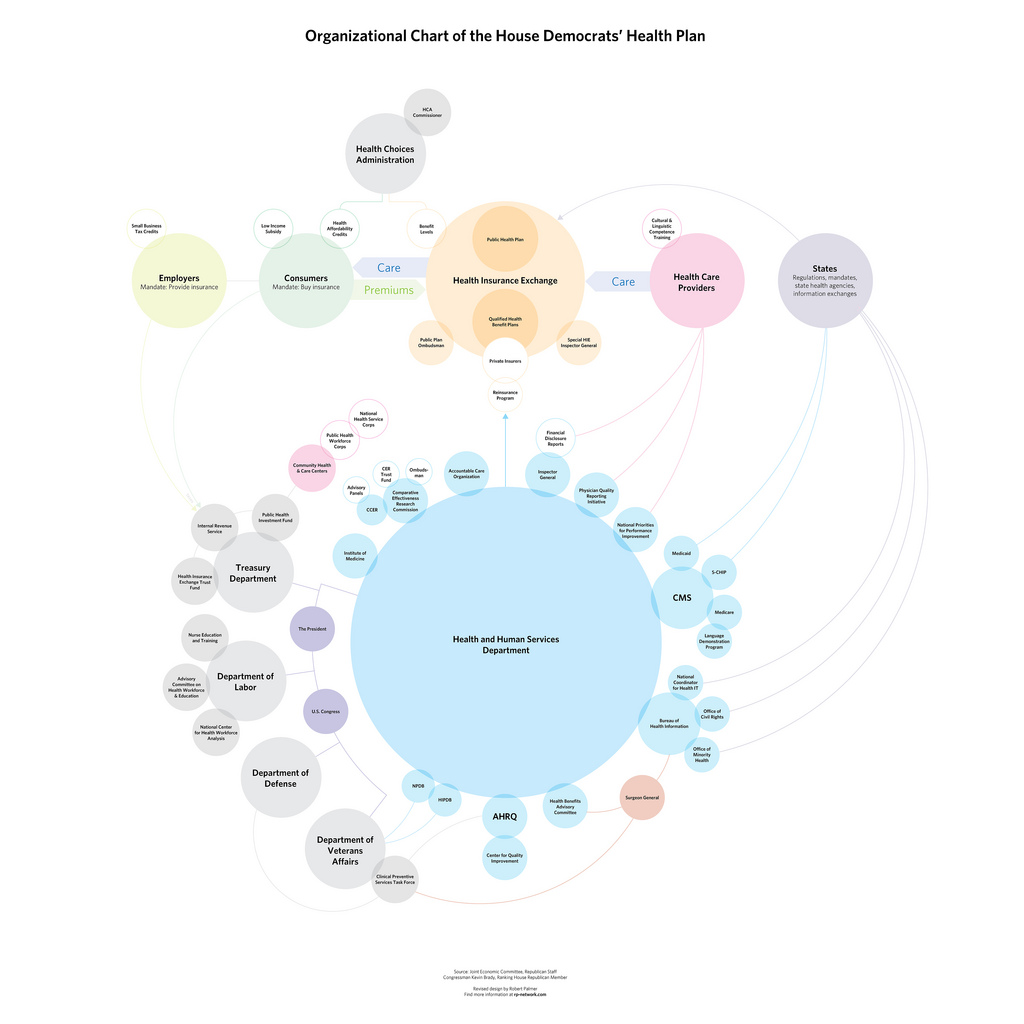
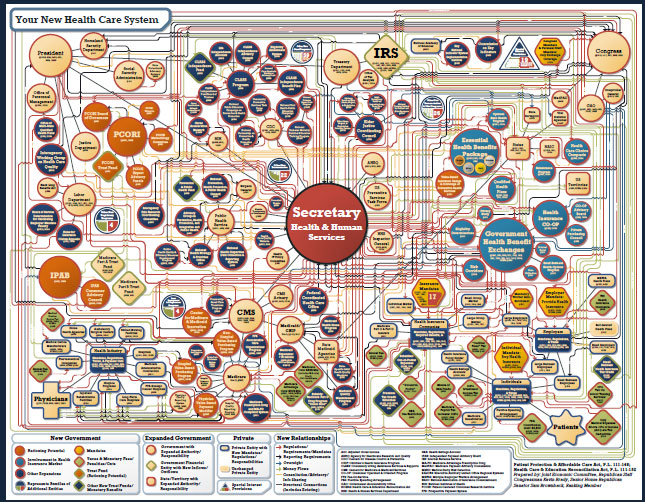
Remember this ?

Now try this:

obama_chart.jpg

Simple, focused and profound trumps ridiculously complex systems designed from technocratic hubris. Even if everything here worked according to plan in these charts, the intrinsic “friction” is a colossal waste of resources.

ADDENDUM:

In the interest of evenhandedness – and because it doesn’t matter in terms of the point of my post – here’s a Democratic take on the House Democratic plan for health care provided by Curtis Gale Weeks in the comments section. While this was not the same as the final Obamacare bill, there’s some congruence. If anyone has a link to a Democratic-produced chart of the final bill, I’ll post that:

demobamaplan.jpg

Some New Additions…..

Tuesday, August 3rd, 2010

To the ominously increasing antilibrary and the waning summer reading bookpiles:


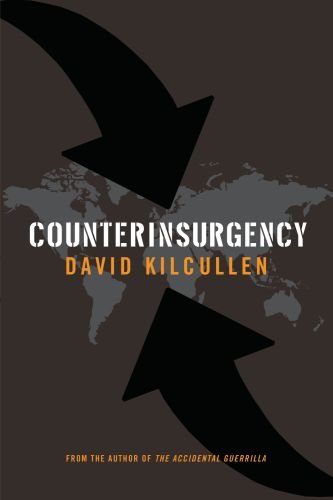
Counterinsurgency by David Kilcullen

The Grand Strategy of the Byzantine Empire by Edward Luttwak

Spook Country by William Gibson

Hope to start  a couple of these by the end of the month. A number of other books to be finished first.

I have a new decentralized reading strategy that seems to be helping me wad through books faster. Books that I am reading are distributed to be read in different places – one in my gym bag for the treadmill; one in my car in case there’s time to kill at an appointment or at a restaurant; one or two books downstairs to read on the couch or outside on the deck; one to take to the pool with the kids and four of five on my bedstand. There are also a store of books on my iPad, “just in case”.

The strategy allows me to concentrate on finishing several books – my “primary” reads – even as I steadily chip away at the rest and there are enough choices available to suit my mood on any given day so it doesn’t feel like I am doing a literary marathon. Books that I am focusing on, usually histories, strategic studies and social science works, I will mark up with marginalia and the others are just read without recourse to notation.

How do you handle your reading time?


Switch to our mobile site