U.S. officials couldn’t believe their luck last week when a suspected Taliban commander who heard there was a $100 reward for his whereabouts turned himself into authorities.
Perhaps misunderstanding the meaning of ‘wanted’, Mohammad Ashan sauntered up to police in Sar Howza, Paktika province, with a poster bearing his own face – and demanded the finder’s fee.
There are two things to note here — a parallel, and a pattern.
I was also struck by an anecdote Tom Ricks told Fareed Zakariah on the latter’s show recently. He recounted a story first told by John Masters in his book “Bugles and a Tiger”, the memoir of a British officer serving with the Gurkhas in Waziristan in the 1930s. At the end of the war, so the story goes, some Afghans approach the British soldier and ask, “Where are our medals?” “You were the enemy,” he replies. And here’s the punchline, the Afghan respose to that: “No, no. You gave medals to the Pashtuns on your side. We want our medals, too. You couldn’t have had a good war without us.”
Tom Ricks comments, “This is very much the Afghan attitude. This is a kind of sporting event for them in many ways.”
Food for thought.
2.
The pattern is self-reference. Again,it’s something I’ve touched on here before, because it’s always of interest when it crops up:
there’s a special place in my analytic thinking for those representables which are self-referential – the category that gave rise to Douglas Hofstadter’s celebrated book, Gödel, Escher, Bach.
Indeed, I have a special glyph that I use in my games to notate ideas that are self-referential:
We don’t learn anything new about the particular instance of the Taliban walking in to claim his award for identifying himself by noting that it’s self-referential — but it intrigues us because it is, and that’s actually a sign that paradoxes of self-reference are significant at an unconscious level: that they’re a pattern worth watching for, and one that will play a role in the generation of aha! moments — whether they be analytic insights, creative breakthroughs, or (as in this case) just strange and amusing.
Kekulé von Stradonitz‘s basic insight into the structure of the benzene molecule was that it might be a serpent eating its own tail. That’s self-referential paradox at it’s finest — and a key aha! moment in the history of Chemistry.
It is also an archetypal image — the self-devouring serpent (ouroboros) crops up in alchemy (see image above) and in the Norse myth of Jörmungandr, the serpent who encircles Yggdrasil, the world tree.
Such images are important to the care and feeding of the creative mind.
I think I’ve mentioned that I can’t find a good operational history of the Afghan war so far that covers it from 2001 to the present. (I actually recently sat on the floor of a military library and basically went through everything in its stacks about Afghanistan that I hadn’t yet read.)
Here are some of the questions I would like to see answered:
–What was American force posture each year of the war? How and why did it change?
–Likewise, how did strategy change? What was the goal after al Qaeda was more or less pushed in Pakistan in 2001-02?
–Were some of the top American commanders more effective than others? Why?
–We did we have 10 of those top commanders in 10 years? That doesn’t make sense to me.
–What was the effect of the war in Iraq on the conduct of the war in Afghanistan?
–What was the significance of the Pech Valley battles? Were they key or just an interesting sidelight?
–More broadly, what is the history of the fight in the east? How has it gone? What the most significant points in the campaign there?
–Likewise, why did we focus on the Helmand Valley so much? Wouldn’t it have been better to focus on Kandahar and then cutting off and isolating Oruzgan and troublesome parts of the Helmand area?
–When did we stop having troops on the ground in Pakistan? (I know we had them back in late 2001.) Speaking of that, why didn’t we use them as a blocking force when hundreds of al Qaeda fighters, including Osama bin Laden, were escaping into Pakistan in December 2001?
–Speaking of Pakistan, did it really turn against the American presence in Afghanistan in 2005? Why then? Did its rulers conclude that we were fatally distracted by Iraq, or was it some other reason? How did the Pakistani switch affect the war? Violence began to spike in late 2005, if I recall correctly — how direct was the connection?
–How does the war in the north fit into this?
–Why has Herat, the biggest city in the west, been so quiet? I am surprised because one would think that tensions between the U.S. and Iran would be reflected at least somewhat in the state of security in western Afghanistan? Is it not because Ismail Khan is such a stud, and has managed to maintain good relations with both the Revolutionary Guard and the CIA? That’s quite a feat.
Ricks of course, is a prize winning journalist and author of best selling books on the war in Iraq, including Fiasco and he blogs primarily about military affairs, of which Ricks has a long professional interest and much experience. Ricks today is a think tanker, which means his hat has changed from reporter to part analyst, part advocate of policy. That’s fine, my interest here are in his questions or rather in how Ricks has approached the subject.
First, while there probably ought to be a good “operational history” written about the Afghan War – there’s a boatload of dissertations waiting to be born – I think that in terms of history, this is the wrong level at which to begin asking questions. Too much like starting a story in the middle and recounting the action without the context of the plot, it skews the reader’s perception away from motivation and causation.
I am not knocking Tom Ricks. Some of his queries are important – “What was the effect of the war in Iraq on the conduct of the war in Afghanistan?” – rises to the strategic level due to it’s impact and the light it sheds on national security decision making during the Bush II administration, which I suspect, will not look noble when it is revealed in detail because it almost never is, unless you are standing beside Abraham Lincoln as he signs the Emancipation Proclamation. Stress, confusion, anger and human frailty are on display. If you don’t believe me, delve into primary sourcesfor the Cuban Missile crisis sometime. Or the transcripts of LBJ andNIxon. Exercise of power in the moment is uncertain and raw.
But most of the questions asked by Ricks were “operational” – interesting, somewhat important, but not fundamental. To understand the history of our times, different questions will have to be asked in regard to the Afghan War. Here are mine for the far off day when documents are declassified:
What was the evolution of the threat assessment posed by Islamist fundamentalism to American national security by the IC from the Iranian revolution in 1979 to September 11, 2001? Who dissented from the consensus? What political objections or pressures shaped threat assessment?
What did American intelligence, military and political officials during the Clinton, Bush II and Obama administrations know of the relationship between the ISI and al Qaida and when did they know it?
What did American intelligence, military and political officials during the Clinton, Bush II and Obama administrations know of the relationship between Saudi intelligence, the House of Saud and al Qaida and when did they know it?
What did American intelligence, military and political officials during the Clinton, Bush II and Obama administrations know of the relationship between the Taliban and al Qaida and when did they know it?
In the aftermath of 9-11, how did Saudi leverage over global oil markets effect American strategic decision making?
In the aftermath of 9-11, how did Pakistani nuclear weapons effect American strategic decision making?
In the aftermath of 9-11, how did the “Iraq problem” effect American strategic decision making?
In the aftermath of 9-11, how did nuclear terrorism threat assessments effect American strategic decision making? Did intelligence reports correlate with or justify the policy steps taken?
Who made the call on tolerating Pakistani sanctuaries for al Qaida and the Taliban and why?
Was there a net assessment of the economic effects of a protracted war in Afghanistan or Iraq made and presented to the POTUS? If not, why not?
Why was a ten year war prosecuted with a peacetime military and a formal declaration of war eschewed?
How did the ideological convictions of political appointees in the Clinton, Bush II and Obama impact the collection and analysis of intelligence and execution of war policy?
Who made the call for tolerating – actually financially subsidizing – active Pakistani support for the Taliban’s insurgency against ISAF and the Government of Afghanistan and why?
What counterintelligence and counterterrorism threat assessments were made regarding domestic Muslim populations in the United States and Europe and how did these impact strategic decisions or policy?
What intelligence briefs or other influences caused the incoming Obama administration to radically shift positions on War on Terror policy taken during the 2008 campaign to harmonize with those of the Bush II administration?
What discussions took place at the NSC level regarding the establishment of a surveillance state in the “Homeland”, their effect on our political system and did any predate September 11, 2001 ?
What were the origins of the Bush administration’s judicial no-man’s land policy regarding “illegal combatants” and “indefinite detention”, the recourse to torture but de facto prohibition on speedy war crimes trials or capital punishment?
[ by Charles Cameron — religious resonances of the Tupac video, from the Drachenloch cave bears to today ]
.
1.
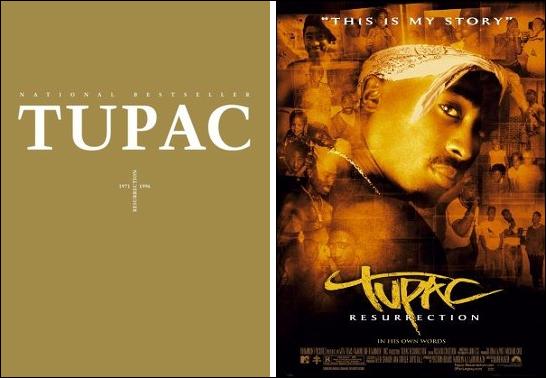
As the 2006 book and DVD covers above suggest, the themes of crucifixion and resurrection have been associated with Tupac Shakur for a while.
R.N. Bradley blogs at Red Clay Scholar and is a doctoral candidate in African American Literature and Culture at Florida State University. She makes the same connection clear in a post titled Smilin’ Serpent: the Violent Passion of Tupac Shakur on September 13, 2010:
Projects revealed Shakur’s pseudo-schizophrenic obsession with death and resurrection. These tropes manifested in videos like “I Ain’t Mad Atcha” or the collabo featuring Scarface “Smile,” and the coverart of The Don Illuminati: the 7 Day Theory(1996).
2.
Death comes before resurrection: Tupac Shakur died of gunshot wounds in 1996, after completing his final album, Makaveli — which was posthumously released:
3.
What may be more surprising is that he was brought back to something approximating life — in a holographic performance that included a duet with a decidedly non-holographic Snoop Dogg— just this week…
4.
But then, that’s religion.
Time-bound, mortal and frankly disintegrating as we are, we’d like there to be more to the story after death, and that yearning is something that religion addresses.
Perhaps to get the point across in an interesting way you’ll allow me to quote from a move in a game I played some years back:
Exploring the Drachenloch cave in Switzerland, Emil Bachler found cave bear skulls arranged in wall niches in one part of the cave, and stone tombs in another chamber containing cave bear skulls and bones. Ursus spelaeus, the cave bear, has now been extinct 10,000 years, while the Neanderthal inhabitants of the caves appear to have ceased as a species themselves about 40,000 years ago.
In Shepard and Sanders’ book, The Sacred Paw, which deals with both the natural history of the bear and its appearances in myth and ritual, Bachler surmises that his finds provide “the first evidence in man of an already awakened higher spiritual life.”
But why the bear in particular? What could we learn from the bear that we couldn’t learn anywhere else? Shepard and Sanders’ answer is that the bear seemed able to teach us how to survive bodily death. Hibernation isn’t just a “natural” phenomenon — it’s also a “spiritual” revelation… I’ll let them explain in their own words:
The bear, more than any other teacher, gave an answer to the ultimate question… an astonishing, astounding, improbable answer, enacted rather than revealed. Its passage into the earth, winter’s death, and burial under the snow was like a punctuation in the round of life that would begin again with its emergence in the spring…
The miracle was double, for the bear burst out with young — birth and rebirth. Somehow the bear knew when to reenter the world again, emerging just ahead of the snowmelt, as though its very heat set the new year in motion… Clearly the bear was master of renewal and the wheel of the seasons.
The bear ‘knows’ about death and how to survive it… She is therefore seen by traditional peoples as a guide to the movement between worlds.
So the bear is not only the first shaman, s/he’s also the first dying and rising God, and the first divine “Mother and Child” — teaching us two things that are still at the heart of religion 40,000 years later: nativity and resurrection!
5.
Death and resurrection certainly date back quite a ways. Attis, Osiris and Odin are only a few of those thought to have died and been resurrected — and indeed the early Christian writer Justin Martyr confirms (In his First Apologia XXI), the similarities between Christian and pagan teachings when he writes:
In saying that the Word, who is the first offspring of God, was born for us without sexual union, as Jesus Christ our Teacher, and that he was crucified and died and after rising again ascended into heaven we introduce nothing new beyond those whom you call sons of Zeus. You know how many sons of Zeus the writers whom you honor speak of — Hermes, the hermeneutic Word and teacher of all; Asclepius, who was also a healer and after being struck by lightning ascended into heaven –as did Dionysus who was torn in pieces; Heracles, who to escape his torments threw himself into the fire; the Dioscuri born of Leda and Perseus of Danae; and Bellerophon…
6.
Here’s the video:
7.
Max Eddy, blogging at The Geeoksystem today, not only describes the technology used to bring Tupac back to artificial life, but gives us a feel for the event:
The Tupac Hologram put on an eerie performance. When it appeared, the crowd became noticeably quiet while the show continued so achingly aware of its strangeness. The CG simulacrum even declared “I’m a ghost” during a rendition of “Hail Mary.” The ghostly, semi-transparent image went on to do two more numbers – one opposite a likely perturbed Snoop Dogg – before, no kidding, dissolving into triangles in a blaze of otherworldly light.
He also gives us an overview of the endurance of the resurrection motif within the music biz. He writes:
While I must confess ignorance to the life and body of work of Tupac, the resurrection obsession is part and parcel of the music industry. We can get specific: Back in 1995, the surviving Beatles recorded two new tracks along with unreleased demos recorded by John Lennon in 1977. Lennon had been dead since 1980. For his 75th birthday in 2010, Elvis Presley netted $60 million despite having been dead since 1977. Deceased in 2004, Ol’ Dirty Bastard still managed to appear on 2009?s “Blackroc,” a rap album put together by the Black Keys.
Though resurrections are a phenomenon that is particularly common in the music industry, it’s notable that CG recreations of dead actors haven’t broken into mainstream film. Perhaps it’s because fooling the ear is easier than fooling the eye.
Posthumous musical careers are clearly not unique to Tupac, but Shakur’s has been particularly lively. Since his death, seven albums have been released under the rapper’s name. For Forbes’ 2002 edition of the magazine’s annual list of top-earning dead celebrities, Shakur came in at number ten. A 2003 documentary about Shakur’s life, titled Tupac: Resurrection, was narrated entirely by Shakur. From 1997 on, Shakur has made 49 guest “appearances” on the tracks of other recording artists.
All of this is not to mention the rumors held by some ardent fans that Shakur is, in fact, still alive and in hiding somewhere.
8.
I don’t know whether this image is taken from an early archaeological report on the Drachenloch caves, or is just a reconstruction of what those first bear-altars with their carefully arrange skulls and bones might have looked like. I don’t really know if the dying-and-rising-god meme has been overblown or not — or the circumpolar bear cult for that matter.
But bears hibernating and coming back to life, Attis and Adonis, Christ, Arthur, the Once and Future King, more recently, Elvis sightings — and now Tupac coming back, as a hologram — it makes me wonder.
9.
I’ll give Max Eddy the final word:
When a singer is on stage, he or she is mostly their celebrity, with their humanity tucked safely away for later. At home, they are someone else, but on stage they fill a role assigned to them by their fans and perhaps by themselves. Some take it to an extreme – Ozzy bit the head off a bat. For others, it’s subtle – Roy Orbison’s dark glasses, for instance.
Unlike them, the Tupac Hologram has no humanity; it is only celebrity. The Tupac Hologram will not go home and read Shakespeare, as Shakur did. The Tupac Hologram will not make controversial political statements. The Tupac Hologram will not visit Tupac’s mother, Afeni Shakur Davis. The Tupac Hologram is empty, and we made it.
[ … ]
When we look into the Tupac Hologram, we see ourselves reflected brightly on a thin Mylar screen.
_________________________________________________________________________________________________________
A hat tip to Doug Breitbart, for suggesting I check out the Tupac video and nudging me along the way. The details of Crucifixion and Resurrection are from the superlative Isenheim Altarpiece by Matthias Grunewald (ca. 1510).
While both of these are thought-provoking, strategic theorist types will prefer the former while the national security/historically minded will gravitate to the latter. An excerpt from “Hacking”:
….Going from narrative to Grand Narrative is a scaling problem. There are conceptual issues as well as pure scale issues.
I first encountered a good characterization of this individual-to-collective scaling problem in the philosophy of action/AI literature around intentions.
The classic Bratman Belief-Desire-Intention model is great for thinking about individual decision makers, but there are tricky problems when you jump to collectives, especially if you are trying to define things with sufficient formal rigor to support AI projects. Here is a good 1992 paper by Bratman if you want a starting point for exploration. I am sure there’s been more in the 20 years since.
Two solutions that have been pursued by the philosophy/AI community (I haven’t kept up) are the following. The first is to think in terms of the abstraction of “collective intentions.” The second is a trickier approach that relies on the distinction between “Intent To” and “Intent That.” The former refers to intentions to be pursued by the agent holding the intention, while the latter is a sort of supporting intention. I intend to make dinner tonight, I intend that X is the next President.
….The problem of scaling intention theory and notions of agency to collectives is one of the conceptual challenges for a theory of Grand Narrative as well. I am inclining towards the former strategy. I think it is safe to reify “nation” or “business” into collective constructs and apply archetype-thinking to them. So Uncle Sam might be the hero of the Manifest Destiny Grand Narrative that spanned the century between the Civil War and World War II. There are of course serious and tricky traps hidden in this process, but it is somewhat useful most of the time.
A must read piece by one of the world’s noted scholars on Islamist politics
….The debate over Islam and democracy used to be a chicken-and-egg issue: Which came first? Democracy has certainly not been at the core of Islamist ideology. Egypt’s Muslim Brotherhood has historically been strictly centralized and obedient to a supreme guide, who rules for life. And Islam has certainly not been factored into promotion of secular democracy. Indeed, skeptics long argued that the two forces were even anathema to each other.
But the outside world wrongly assumed that Islam would first have to experience a religious reformation before its followers could embark on political democratization — replicating the Christian experience when the Protestant Reformation gave birth to the Enlightenment and then modern democracy. In fact, however, liberal Muslim intellectuals had little impact in either inspiring or directing the Arab uprisings. The original protesters in Cairo’s Tahrir Square referred to democracy as a universal concept, not to any sort of Islamic democracy.
The development of both political Islam and democracy now appears to go hand-in-hand, albeit not at the same pace. The new political scene is transforming the Islamists as much as the Islamists are transforming the political scene.
On Jan. 16, Gelareh Bagherzadeh, a 30-year-old Iranian medical student, was shot and killed while sitting in her car outside her parents’ home in Houston. Neighbors heard three quick shots in the night. Her purse and cellphone were found in the car, the engine still running.
No suspects have been apprehended and no motive for the murder has been established at this writing. But Bagherzadeh was politically active in the Iranian green movement and women’s causes, and the execution-style killing of a young Iranian dissident in the U.S. should ring some alarm bells
Gulliver is leveling a Clausewitzian criticism of the use of Frank Hoffman’s “Hybrid” concept (though not only his use of the term) – I have some disagreements but Gulliver also makes some solid points.
Nearly all wars are a strategic hybrid: a mix of violent action, diplomacy, and messaging, combining destruction, coercion, and persuasion. The modern hybrid war construct implies that future conflict will take on a more tactically hybrid character: that states will employ guerilla tactics in concert with heavy weapons, or that sub-state groups will use sophisticated weapons hand-in-hand with terrorism and insurgency.
You see, as Conrad Crane has said before (and as I love to repeat), there are only two kinds of war: asymmetric and stupid. Capable adversaries will always seek to capitalize on their own strengths and focus on our weaknesses. The hybrid concept simply tells us that violent actors will seek to diversify their capabilities and become less predictable by employing weapons and tactics more frequently associated with different parts of the sophistication and organization spectrum.
Dr. Charli Carpenter of Duck of Minerva has a visually stunning presentation about the impact of social media on IR as a discipline, injecting a burst of creativity and relevancy into a field that can be at times – well – a little insular and arid – and made it cool. Dr. Charli also has commentary here. Hat tip to Dr. Drezner:
One of the nice things about this blog is that periodically, smart folks will send me their unpublished material for feedback and private commentary. This comes in a wide variety of formats – manuscripts, articles, book chapters, powerpoint, sometimes an entire book or novel! It is flattering and almost always informative, so I try to help where I can or at least point the sender in the direction of someone more appropriate.
Recently, I was given a peek at a very intriguing paper on “Transition Operations” by Dr Rich Ledet, LTC Jeff Stewart and Mr. Pete Turner, who blogs occasionally at quesopaper. Pete has spent a good chunk of the past ten years in a variety of positions and capacities in Iraq and Afghanistan, where he currently is with American troops in a remote rural district and it was he who passed their draft to me. They have taken a fresh look at the subject.
While I can’t give away their “secret sauce” in detail, I particularly liked the fact that while the focus and advice for executing transition operations is aimed at field grade officers and their civilian agency counterparts, their vision is in sync with the ideal of having policy-strategy-operations and tactics as a seamless “whole-of-government” garment. If only we could get our politicians to think in these terms, half the battle would be over.
Their paper is now headed to a professional journal; when it is published ( as I think it will be), I will definitely be linking to it here and hopefully, that will be soon.
My reason for my bringing this up – I have the permission of the authors to do so – is that the trio have put their finger on the major doctrinal problem faced by the United States military in Afghanistan – “transition operations” being a politically charged topic, laden as it is with implied foreign policy decision making by heavyweight policy makers, is treated in very scanty fashion by FM 3-24. Compared to other aspects of COIN, very little guidance is given to the the commander of the battalion or brigade in the effort to coordinate “turnover” of responsibilities and missions to their Afghan Army, police and government allies.
This at a time when the “readiness” of Afghan units and officials to accept these burdens in the midst of a war with the Taliban is questionable, variable, controversial at home and politically extremely sensitive in Afghanistan.
And at a point where, ten years after September 11, the US State Department is no more able in terms of personnel and vision or sufficiently funded by Congress, to step up their game and take the lead role in Afghanistan from the Pentagon than it was on September 10, 2001. SECSTATEs Condi Rice and Hillary Clinton deserve great praise for making State do more with less, but State needs wholesale reform to fit the needs of the 21st century and the money and budgetary flexibility to split foreign policy tasks more equitably with the Defense Department.
State is not going to be playing a major role on the ground in our transition out of Afghanistan, which makes guidance to our majors and colonels – and in turn to their company and platoon leaders stationed there- all the more important.
Zenpundit is a blog dedicated to exploring the intersections of foreign policy, history, military theory, national security,strategic thinking, futurism, cognition and a number of other esoteric pursuits.