June 14th, 2011
From Thomas P.M. Barnett:
Wikistrat’s Grand Strategy Competition – Week One
Greetings from the Wikistrat team!
In the last 7 days we’ve had 44,097 actions within the wiki with new information being added at an average rate of once every 10 minutes.
The Week 1 Challenge
Competitors, organized into 38 teams by school or institution, have been assigned either one of 13 possible actors. They were tasked with writing position papers on the following five issues:

- Global Energy Security;
- Global Economic “Rebalancing” Process;
- Salafi Jihadist Terrorism;
- “Chimerica” – China-US Relationship; and
- Southwest Asia Nuclear Proliferation.

The standard of work has been outstanding and Dr. Barnett and the judging panel are hard at work preparing feedback and scores. We’ll announce some of those next time
Posted in geopolitics, strategist, strategy, Wikistrat | 2 Comments »
June 14th, 2011
“Criminal Insurgency” is becoming a preferred term of art to describe entities like the Narco-cartels of Mexico that have evolved from transnational criminal organizations into groups with paramilitary and intelligence capabilities or Colombia’s FARC which formerly was a model Marxist insurgency but devolved downward into a drug trafficking army. The term is used partly to placate doctrinaire purists among defense intellectuals who see insurgency definitively as armed political movements following Mao’s three stages or bust. After all, they have only had since the late 80’s and early 90’s, when Bill Lind and Martin van Creveld warned them this was coming, to get used to the idea.
Colonel Robert Killebrew, a smart fellow at CNAS, has an article in NDU‘s PRISM that puts the problem of criminal insurgency into a hemispheric context:
Criminal Insurgency in the Americas and Beyond
….Essentially, the United States faces external and internal challenges in reorienting to more effectively fight the cartels and their allies. Refocusing U.S. policy from a “war on drugs” to a more comprehensive fight against the cartels and gangs is essential if the United States and its allies are to prevail. Since the basis of the cartels’ survival lies in the control of regions where governmental control is nonexistent and populations may be impoverished and alienated, successful counter-cartel strategies are fundamentally counterinsurgency strategies developed by the concerned states themselves and supported by the United States. Counter-cartel strategies must first be political strategies, integrating military and police activity into a broader political approach that emphasizes the rule of law as an alternative to the rule of force. Four aspects of a Western Hemisphere counter-cartel strategy follow.
First, step up the direct attacks on the cartels. Over the past decades, U.S. law enforcement professionals have developed successful operational techniques that cartel leaders fear: partnerships with effective local police (often with U.S. training), expertise with judicially approved wiretaps and electronic surveillance, rewards programs that make criminal bosses vulnerable to betrayal, and, above all, when local laws permit, extradition to U.S. courts and prisons. The United States and its allies should increase the capability for multiagency field operations in all these dimensions, as well as the professionalization of host country military forces for operations requiring holding ground while the rule of law is reinstituted by other national agencies. DEA already operates throughout the region and has solid relationships with counterpart agencies; additionally, the agency has worked closely with U.S. combatant commands, notably U.S. Southern Command, where its powerful extraterritorial jurisdiction authority supplemented the military’s own programs to help U.S. allies in the region. DEA should continue to advise and assist host country police and counternarcotics forces, but the size of the agency must be greatly increased. With 5,500 agents spread over the hemisphere-including the United States-the agency that plays such a key role in the ongoing war with the cartels is spread too thin.
Second, the U.S. and its allies must continue to attack the cartels’ financial networks and money-laundering capabilities-a key strategy that requires more resourcing at Treasury. Cartel leaders fear U.S. indictments and extradition to American courts; extradition, exposure, and seizure of “dirty” money from criminal operations are all effective strategies that identify kingpins and threaten them with trials in U.S. courts and long terms in U.S. prisons. The United States has learned to use financial analysis and indictments as weapons against the cartels, even when they are beyond the immediate reach of U.S. law. Their use should be expanded.
Third, help our neighbors build more functional state institutions, particularly courts, and stimulate economic growth. In terms of the U.S. role and our assistance to allies, our understanding of security assistance must be broadened to include effective assistance to police and courts. For example, as part of Plan Colombia-a Colombian-developed counter-cartel strategy-the United States provided the Colombian National Police (CNP) with telecommunications-intercept equipment and, working through the Department of Justice, helped the CNP build a judicial process to support wiretap investigations. The result was a powerful tool that assisted indictments against cartel leadership and extraditions to the United States for prosecution. Likewise, assisting host nations to build strong, noncorrupt judicial systems is critical to assisting or restoring stable governments in areas threatened by cartel or other insurgent violence; courts, appellate courts, and efficient prisons are key pieces. Other U.S. agencies and contractors can provide other materiel assistance, training, partnership, and, when authorized, direct help in specified areas such as the collection of certain kinds of strategic intelligence. The U.S. Department of Defense can provide advisors and trainers on the Colombia model to supplement local military and law enforcement efforts, and occasionally direct aid in the form of helicopter transportation and naval support.61
Posted in 21st century, 3 gen gangs, 4GW, academia, America, analytic, black globalization, CNAS, COIN, conspiracy, counterinsurgency, criminals, dystopia, extremists, Failed State, foreign policy, gangs, government, ideas, insurgency, intellectuals, Latin America, Mexico, military, national security, networks, non-state actors, organizations, politics, social networks, social science, state failure, strategist, strategy, Strategy and War, Tactics, transnational criminal organization | 3 Comments »
June 12th, 2011
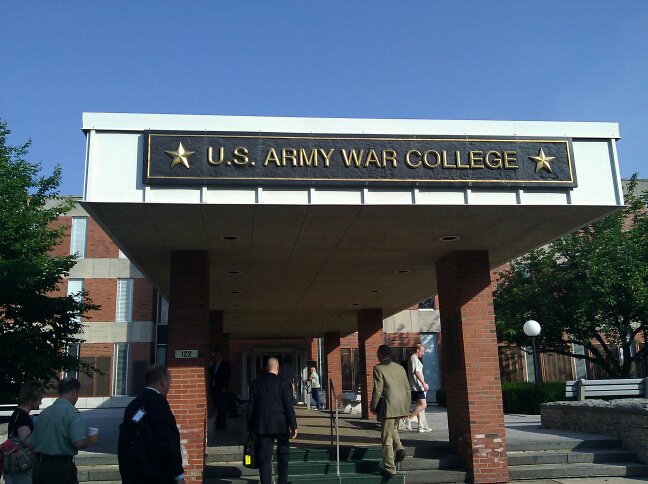
As noted previously, I was fortunate to attend the National Security Seminar at the the US Army War College this year and wanted to relay my impressions while they were still fresh.
First, in terms of reception and cordiality, I have rarely experienced such an extensive and personal outreach as was demonstrated by the War College staff, faculty, administration and students. Every new member had a “sponsor” – a student, usually a colonel or Navy captain, who acted as a liason and personal guide from the time their plane touched down until the moment they returned to the airport. My sponsor, the former commander of the Wolfhounds, Colonel Richard “Flip” Wilson, whom I consider a friend, really extended himself on my behalf, making me feel welcome and a full member of Seminar Group 20. Most of the students have multiple tours of duty in Iraq and Afghanistan under their belt and many can report the same for the first Gulf War, Panama, Bosnia or Kosovo.
The War College, the Commandant and the Seminar Group all hosted receptions and dinners designed to get students and civilian new members to mix and further discuss issues raised in the seminar sessions or lectures. At these events I had the opportunity to meet and talk to the leadership of the Army War College including the Commandant Major General Gregg Martin, the Deputy Commandant for International Affairs, Ambassador Carol Van Voorst, the Executive Director of the Army Heritage Foundation, Mike Perry, the Director of SSI, Dr. Douglas Lovelace, the Chief of Staff and numerous faculty and seminar members. The New Members such as myself were exceedingly well fed at these events as I suspect the Army was attempting to prove that it really does march on it’s stomach.

The serious business of the National Security Seminar was divided into two segments, the talks given by distinguished speakers to the entire class of 2011 and the New Members and the Seminar Group sessions of approximately twenty students, New Members, academics and foreign visitors. We received a brief on the war in Afghanistan from the ISAF Chief of Staff, who was standing in last minute for General Petraeus who was called to meet with senior adminstration officials; and a very interesting concluding talk by Foreign Affairs Editor Gideon Rose, author of How Wars End, which covered issues of strategy, grand strategy and the disconnect with policy.
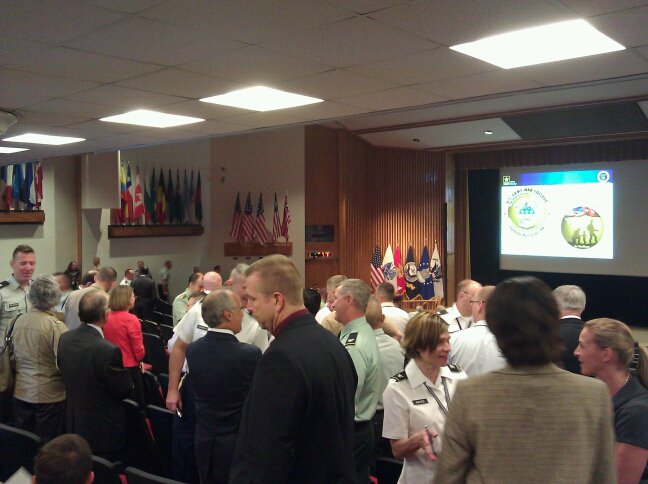
The National Security Seminar is run strictly on a non-attribution basis, in order to encourage candor and frank exchange of views, which handicaps my ability to discuss specifics here. I can say that my views on Pakistan ( which I compared to “North Vietnam” ) riled more than a few people – Pakistan is the only country in the world given 2 exchange student slots at the Army War College at the request of the most senior leadership of the US Army – and several students and faculty members took the time, outside of seminar sessions, to make certain I heard countervailing POV regarding Pakistan’s value as an ally. Other topics included, but were not limited to:
Defense budget cuts and force structure
Narco-cartels in Mexico: Insurgency or No?
Civil-Military Relations
Repeal of DADT
AfPak War
al Qaida and GWOT/US Strategy
COIN
Critical thinking and Leadership
Logistics
Libya and NATO
AWC Strategy Curriculum/Program
What the US public expects from their military
China as a peer competitor
Effects of ten years of war on officer corps/military
Illegal combatants and international law
PTSD
Battle of Gettysburg and Grand Strategy
Cyberwar
Differences in Armed Services strategy, command climate, discipline, leadership
The Arab Spring
US Global leadership and Economics
Interagency Operational jointness
Most of the discussion took place in the seminar groups, with Q&A periods in the mass sessions with featured speakers. I came away deeply impressed with the seriousness and insights as practitioners that AWC students brought to the table. The AWC strategic studies program seeks to broaden students who are assumed to arrive with tactical expertise and prepare them for higher command that carries operational, strategic and even policy responsibilities (at least in terms of interpreting and executing within policy guidelines). Many students were articulating ideas associated with Thomas P.M. Barnett, the “mission order” and “commander’s intent” style of leadership or Clausewitzian strategic premises during debates and discussion.
The National Security Seminar Week was for me, an enlightening and exceptionally enjoyable experience, one I would highly recommend to readers who may have such opportunities in future years.
Posted in 19th century, 2011, 20th century, 21st century, 3 gen gangs, 4GW, academia, Afghanistan, Air Force, al qaida, America, army, barnett, Clausewitzian, cognition, COIN, counterinsurgency, Cyberwar, defense, DIME, diplomacy, diplomatic history, education, Epistemology, foreign policy, government, historians, history, ideas, insurgency, intellectuals, intelligence, leadership, metacognition, military, military contractor, military history, military intelligence, military reform, national security, Network-centric Warfare, organizations, security, social science, strategist, strategy, Strategy and War, Tactics, theory, war, warriors | 12 Comments »
June 12th, 2011
[ by Charles Cameron – comparative eschatologies ]
.
FYI or A:
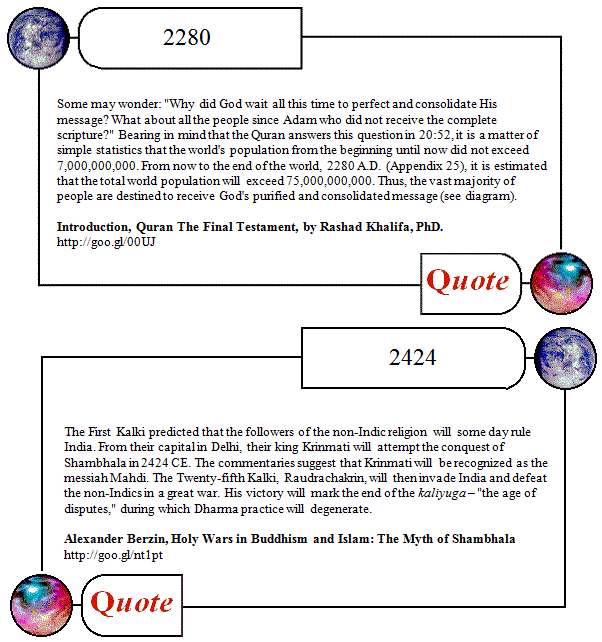
Sources: Khalifa — Berzin
*
Seriously, though…
Alexander Berzin has been tutored by HH the Dalai Lama and HHDLs own tutors on the interpretation of the Kalachakra Tantra, and served for some years as HHDL’s translator when HHDL was giving the Kalachakra initiation: indeed his book on the Kalachakra initiation carries a Foreword by HHDL. His writings are thus among the most scholarly and trustworthy available in the western world on the topic of the initiation which the Dalai Lama will impart for world peace again this July.
Berzin’s words introducing the topic of Holy Wars in relation to the Kalachakra, Buddhism and Islam, are therefore important:
Often, when people think of the Muslim concept of jihad or holy war, they associate with it the negative connotation of a self-righteous campaign of vengeful destruction in the name of God to convert others by force. They may acknowledge that Christianity had an equivalent with the Crusades, but do not usually view Buddhism as having anything similar. After all, they say, Buddhism is a religion of peace and does not have the technical term holy war.
A careful examination of the Buddhist texts, however, particularly The Kalachakra Tantra literature, reveals both external and internal levels of battle that could easily be called “holy wars.” An unbiased study of Islam reveals the same. In both religions, leaders may exploit the external dimensions of holy war for political, economic, or personal gain, by using it to rouse their troops to battle. Historical examples regarding Islam are well known; but one must not be rosy-eyed about Buddhism and think that it has been immune to this phenomenon. Nevertheless, in both religions, the main emphasis is on the internal spiritual battle against one’s own ignorance and destructive ways.
Specifically, he writes:
In The Abridged Kalachakra Tantra, Manjushri Yashas explains that the fight with the non-Indic people of Mecca is not an actual war, since the real battle is within the body. The fifteenth-century CE Gelug commentator Kaydrubjey elaborates that Manjushri Yashas’s words do not suggest an actual campaign to kill the followers of the non-Indic religion. The First Kalki’s intention in describing the details of the war was to provide a metaphor for the inner battle…
To provide a metaphor…
Posted in Apocalyptic, Charles Cameron, Doublequotes, humor, Religion | Comments Off on Apocalypse Not Yet?
June 11th, 2011
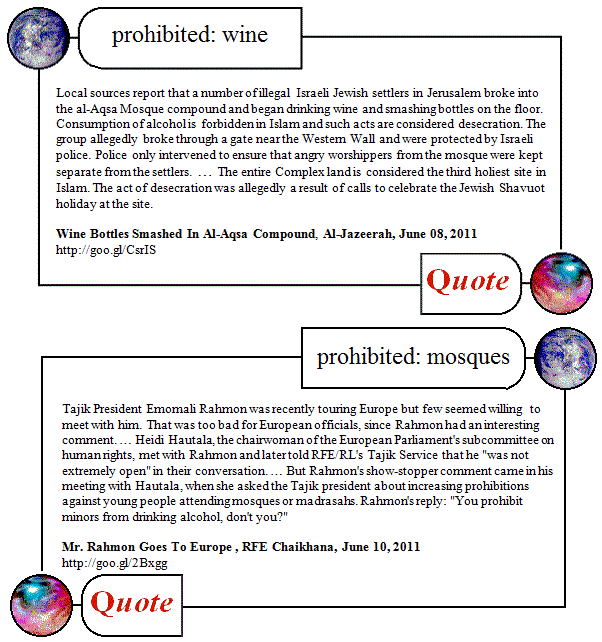
[ by Charles Cameron — quirky world news ]
.
Posted in 21st century, Charles Cameron, cultural intelligence, humor, mideast, Religion | 1 Comment »


