zenpundit.com

Time In all his tuneful turning (i)

March 15th, 2018

[ by Charles Cameron — Stephen Hawking, RIP, and synchronicity? ]
.

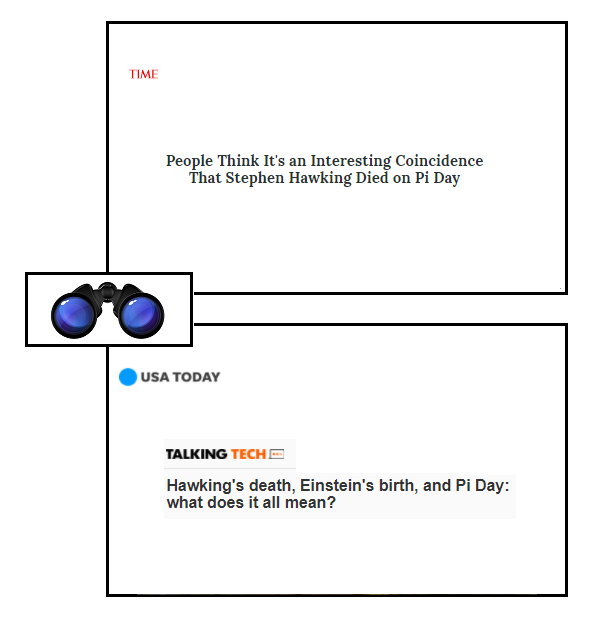
Connsider these high-popularity responses to Stephen Hawking‘s death:
Sources:

  • USA Today, Hawking’s death, Einstein’s birth, and Pi Day: what does it all mean?
  • Time, People Think It’s an Interesting Coincidence That Stephen Hawking Died on Pi Day
  • **”

    The Time article focused on the internet:

    Some people on the internet think Stephen Hawking couldn’t have calculated a better day to die.

    Calculated. Like it.

    The 76-year-old theoretical physicist, one of science’s most famous luminaries died on March 14, also known as National Pi Day — an annual day for scientists and mathematicians around the world to celebrate the value of pi that even includes deals on pizzas and actual pies. Suffice it to say that the noteworthy coincidence was not lost on the internet.

    The date of Hawking’s death — 3/14 — is significant because 3.14 are the first three digits of pi, a bedrock of geometry. Specifically, it’s the ratio of a circle’s circumference to its diameter. Naturally, the fact that science’s big celebration overlapped with the day the life of the party left us is making people geek out about the details.

    As soon as news spread that Hawking died early Wednesday morning in London, people were quick to connect the dots.

    Connect the dots, eh?

    **

    And here’s the complete USA Today article:

    So, is there some mystical theory explaining how noted astrophysicist Stephen Hawking died on the same day Albert Einstein was born, which also happens to be the day we honor the mathematical constant Pi?

    Nope. It’s just all one giant coincidence.

    Hawking died at 76, his family confirmed early Wednesday. He was considered one of the world’s foremost theoretical physicists, developing critical theories on black holes and writing A Brief History of Time to explain complex scientific concepts to the masses.

    That’s it. Nope, in a word. Nope. There is no “mystical theory explaining how noted astrophysicist Stephen Hawking died on the same day Albert Einstein was born, which also happens to be the day we honor the mathematical constant Pi”.

    That’s decided without consulting Pythagoras, Newton, Johann Valentin Andreae, Hermann Hesse‘s Joseph Knecht, or any of a dozen other worthies I might name..

    **

    But note: Warren Leight adds another datapoint and brings the circuit to completion:

    Galileo, ooh.

    It seems worth recalling at this point that pi is an irrational number.

    **

    Where do we go from here?

    First, note that Warren Leight posts that Hawking died on the 14th, in a tweet dated the 13th.

    One of Leight’s commenters challenges the whole coincidence chain:

    He died March 13th

    Leight’s response to that challenge could also serve as a response to mine:

    It depends on how and where you measure time

    Time is circular, date is relative..

    **

    God save us, here’s a game ref:

    Is that Johann Sebastian Bach?

    Kidding.

    **

    May the extraordinarily, ceaselessly curious mind of Stephen Hawking rest at last in the balm of peace.

    **

    And my title, Time in all its tuneful turning?

    It’s from Dylan Thomas, approximately. He wrote, in this masterpiece, Fern Hill:

    And nothing I cared, at my sky blue trades, that time allows
    In all his tuneful turning so few and such morning songs
    Before the children green and golden
    Follow him out of grace…

    I want to suggest that Dylan Thomas is at least as great a thinker about time as Stephen Hawking, and Fern Hill is my proof text to that effect. I’ll explain why in part ii of this post.

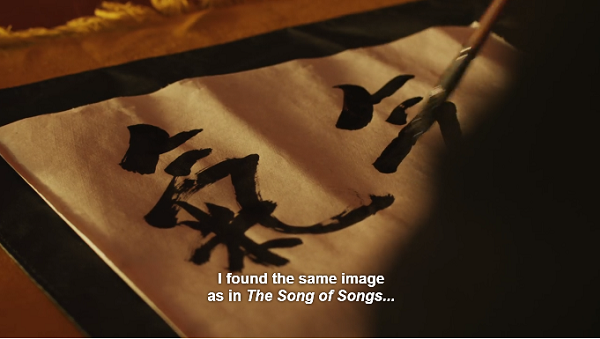
    Sunday surprise — Li Bai and the Song of Songs

    March 11th, 2018

    [ by Charles Cameron — it’s all about a scarlet thread and some corks in a current ]
    .

    I have plenty of idle time between naps, and was binge watching The Churchmen on Netflix. Plus it’s a Sunday..

    **

    As you know, I track “twins” in events and quotations, mainly for sheer aesthetic pleasure, but also partly as an analytic tool — believing as I do that “two is the first number” and often a leading-edge clue to pattern, meaning, significance.

    I’m used to finding others who have noted these twins or “DoubleQuotes” as I call them — “DoubleQuotes in the Wild” — but I’m not sure I’ve ever run across a clear description of someone else noting them, let alone in a scholarly manner that bridges the secular west and spiritual east — but lookee here!

    **

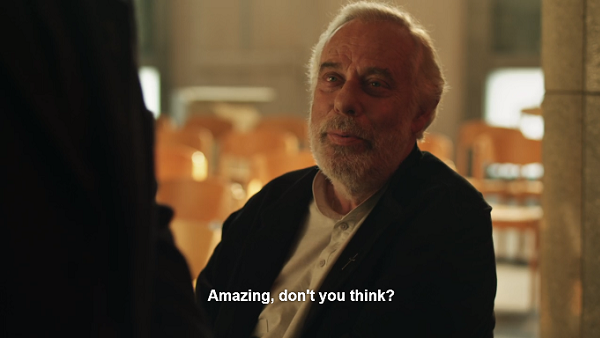
    Amazing indeed! And what a line! Your lips are like a thread of scarlet! worthy of Li Po, worthy indeed of the Song of Songs!

    I’d have been very chuffed if I’d run across the same doublet between Li Bai – better known to me as Li Po — and the Song of Songs — which, by the way, is Solomon’s.

    **

    Li Po, who, drunk and out in a shallow boat, saw the moon reflected in the Yellow River, leaned over to kiss it, and drowned..

    Solomon — but you know the story — seated in judgement, ordered a child be cut in two when two women claimed to be its mother — then commanded it be given to the one whose shocked pure love begged him to deliver it to the other.. wisdom as the test of love!

    **

    The discoverer of the binary “Your lips are like a thread of scarlet!” is a brilliant, generous-hearted, flawed founder and leader of a seminary in France who displeases ambitious Vaticanisti, is offered a choice of disgrace (on account off his flaws) or (as an “out”) a posting to an obscure but copacetic position in Shanghai..

    A conversation ensues, in which he discusses his options with the nun who serves as his assistant:

    The nun ancourages him to consider the Shanghai option..

    That option has a certain seductive charm — following that scarlet thread.. but it represents being “bought off” rather than sticking by one’s guns come what may, and somehow weathering the consequences.

    **

    Our nun reflects:

    And that’s an interesting idea.

    At first glace it seems fatalistic — but that current moving the corks — the seminarians, the nun herself, the priest she serves, an ambitious president of the Franch bishops, various monsignori and a pope – maybe Christ, too? — has its own flows and undertows — a priest’s flaws included. It’s a complex system.

    The corks are afloat in a complex system. A scarlet thread traces its curve in the complex system, from contemporary France to eighth- century China.

    **

    And when you’re afloat in a complex system — as we all are — “go with the flow” may be sound advice. That’s why the “corks in a current” idea seems so interesting to me. Sunday surprise!

    “They” are taking over, are they?

    March 11th, 2018

    [ by Charles Cameron — might be of interest to John Robb & Adam Elkus ]
    .

    Whoever “they” may be, they’re taking over all over:

    **

    Sources:

  • Washington Post, MS-13 is ‘taking over the school,’
  • South China Morning Post, Wild boars are taking over Japan’s small towns
  • **

    Two things:

    One. In each case, we have a well-studied context — education, Japanese urban living — invaded by an unexpected “alien” force — a virulent gang, wild boars — which will easily blindise students of the context, resulting in unanticipated consequences..

    And two. there seems to be enough parallelism between the two instances on “taking over” that we should be able to abstract a rule from the pair of examples — though I’m terrified to think what the implications of such a rule might be..

    **

    Also:

  • Global warming may be a factor in the exploding Japanese wild boar population
  • Some of the wild boar in Japan are radioactive thanks to Fukushima
  • **

    Pamplona, the Running of the Bulls; Tokyo, the Running of the Boars:

    Voluntary (above); involuntary (below).

    How the hell can Un trump Trump

    March 10th, 2018

    [ by Charles Cameron — a face-off between two impulsives, and thoughtful planning at a tabletop exercise ]
    .

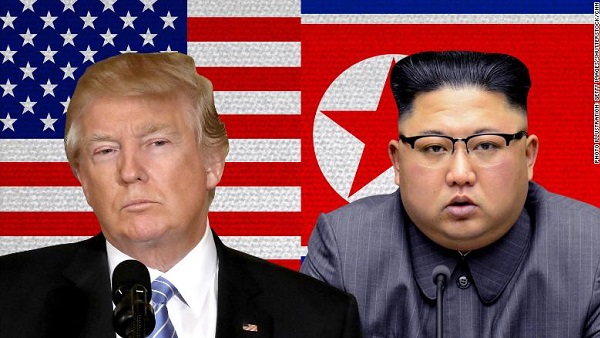
    How the hell can Un, with one star and no stripes, hope to trump Trump, with fifty stars and thirteen stripes backing him up?

    **

    Or:

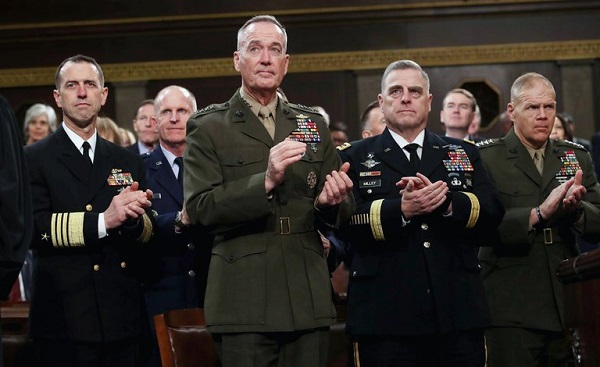
    How the hell can Un, with maybe a dozen nukes, one of which might be a hydrogen bomb, and some untested missiles designed to reach anywhere in the continental US, hope to trump Trump, with a stockpile of 1,411 nuclear warheads deployed on 673 ICBMs, SLBMs, and strategic bombers [Wikipedis] and an impressive array of generals, admirals and such, one of whom — Gen. Dunford, Chairman of the Joint Chiefs — is positively pushing his way out of the photo-frame into at least simulated warfare with North Korea:

    **

    The simulation in question was described, as far as is visible under a cloak of secrecy, in a recent NYT article titled U.S. Banks on Diplomacy With North Korea, but Moves Ahead on Military Plans:

    A classified military exercise last week examined how American troops would mobilize and strike if ordered into a potential war on the Korean Peninsula, even as diplomatic overtures between the North and the Trump administration continue.

    The war planning, known as a “tabletop exercise,” was held over several days in Hawaii. It included Gen. Mark A. Milley, the Army’s chief of staff, and Gen. Tony Thomas, the head of Special Operations Command.

    Anything that occupies two generals “over several days” plus planning and debriefing is serious business — especially those two generals.

    War with North Korea — Hawaii their nuclear targets.

    **

    Oops, the NYT article also features some awkward questions commanders of the US battleforce would face:

  • How many conventional and Special Operations forces could be deployed, in phases, to target North Korean nuclear sites.
  • Whether the Army’s 82nd and 101st Airborne Divisions could be charged with fighting in tunnels
  • Exhaustive plans to take down North Korea’s integrated air defenses, allowing American manned and unmanned aircraft into the reclusive country.
  • Plans for the morbid but necessary details of personnel recovery plans, such as if pilots are shot down, and the evacuation of the dead and wounded.
  • **

    And Un considers the very fact of the US President agreeing to meet with the dictator of N Korea, ie Donald Trump with himself, to be a clear and unequivocal demonstration of parity. As CNN puts it:

    with the simple fact of the meeting, Kim has already achieved his objective: he’s at the table on the world stage, being taken seriously.

    Or MSNBC, in a piece titled On North Korea, Trump gambles from a position of weakness:

    Trump has agreed to give Kim Jong-un exactly what he wants. North Korean leaders have sought this kind of meeting for decades because it would necessarily elevate the rogue state: it would show the world that North Korea’s leader is being treated as an equal by the Leader of the Free World.

    Equal? Mirror image?

    **

    Nota bene:

    China, Japan and Russia have cheered an impending meeting between United States President Donald Trump and North Korean leader Kim Jong Un as a “significant first step” towards the de-nuclearization of the Korean Peninsula.

    China, Japan and Russia, India, and obviously South Korea, are all actors with significant interesta in any US – North-Korean diplomacy — giving us a seven-node tug-of-war for our planners to map — and Donald Trump to intuitively grok.

    Of steel, low-background steel, and my father’s bones

    March 10th, 2018

    [ by Charles Cameron — low-background steel is no longer so necessary, but the remains of naval lives lost at sea are still of passionate concern ]
    .

    With all this talk of tariffs on steel, I was reminded of the rare steel salvaged from sunken warships at Scapa Flow, in Indonesia and elsewhere. I read about “low background steel” in this Guardian title: Lost bones, a mass grave and war wrecks plundered off Indonesia. As you’ll note, bones — the long-inaccessible remains of sailors — are also part of the story.

    **

    Let’s tackle the steel first. Here’s how the Guardian explained it:

    As well as brass, copper, and bronze, one reason the salvaging has gone wholesale is the ships are a source of “low background steel” – produced before the first atomic bomb was detonated in 1945.

    Virtually radiation-free, low-background steel is used in sensitive medical and scientific instruments. These old sunken warships are among the few remaining sources.

    Cecil, however, knowledgeable as ever, tells us that supposedly rare and invaluable subset of steel isn’t anything we need to concern ourselves with:

    Sorry, the market for old steel is now pretty much sunk. Reduced radioactive dust plus sophisticated instrumentation that corrects for background radiation means new steel can now be used in most cases. There’s some lingering demand for really old maritime metal, though. When researchers at one national lab wanted shielding that emitted no radiation whatsoever, they used lead ballast retrieved from the Spanish galleon San Ignacio, which had been lying on the bottom of the Caribbean for 450 years.

    **

    That more or less leaves the bones..

    The Guardian has been following different aspects of the story, and the bones come in focus in their article, The world’s biggest grave robbery: Asia’s disappearing WWII shipwrecks:

    Dozens of warships believed to contain the remains of thousands of British, American, Australian, Dutch and Japanese servicemen from the second world war have been illegally ripped apart by salvage divers, the Guardian can reveal.

    An analysis of ships discovered by wreck divers and naval historians has found that up to 40 second world war-era vessels have already been partially or completely destroyed. Their hulls might have contained the corpses of 4,500 crew.

    Governments fear other unmarked graves are at risk of being desecrated. Hundreds more ships – mostly Japanese vessels that could contain the war graves of tens of thousands of crew killed during the war – remain on the seabed.

    And from the first article:

    “You can imagine the massive outrage if someone drove a bulldozer through the big first world war Commonwealth war grave at Saint Symphorien,” [British naval historian Phil Weir] says, referring to a military cemetery in Belgium. “But taking apart a shipwreck doesn’t seem to have the same effect. It is kind of out of sight, out of mind, I fear.”

    Let’s put it this way. I don’t care.

    But if HMS Sheffield had been sunk with my father aboard by the Hipper’s superior guns [8″ vs Sheffield’s 6″] at the Battle of the Barents Sea — a not implausible alternate history — you can bet I’d be up in arms if divers harvested Sheffield for its steel, with my father’s remains trashed as worthless in the process..

    Oh, except that if my father had gone down with the Sheffield, I’d never have been conceived. Thank God, things didn’t work out that way.


    Switch to our mobile site