zenpundit.com

DoubleTweeting moolah

March 8th, 2018

[ by Charles Cameron — somewhere between Lietaer, Bitcoin and a leisure-driven future ]
.

Please note, I am not using moolah in the sense in which Arthur Conan Doyle used it in A Desert Drama:

The squat lieutenant, the moolah, and about a dozen Dervishes surrounded the prisoners.

**

There’s a quality of surprise to the two tweeted stories that follow, which highlights our usual acceptance of the idea that money is value. Consider:

And then, from a different angle:

**

Conan Doyle again:

But I am ordered to gather you together, for the moolah is coming to convert you all.

Getting religion, forgetting circumcision

March 8th, 2018

[ by Charles Cameron — some characteristicc lacunae in journalisti praxis ]
.

As you know, I used to work for Lapido Media, which in turn used to be a media-eductional outlet that emphasized the major role of religion(s) in world affairs, so often overlooked by typically skeptical, secular journos.

Get religion is a fine site with a similar purpose, and today it has a fine article titled With Russia all over U.S. news map right now, how fares its huge Orthodox Church? For instance:

In addition to politics, there’s a historic religious turnabout in Russia that stateside reporters could well develop through interviews with the experts. The dominant Orthodox Church, which managed to survive Communist terror and regained freedom, has latterly emerged as a strategic prop for Putin’s Kremlin.

If that election day peg doesn’t work for your outlet, another signal event comes July 17. That’s the Orthodox feast day of the doomed final czar, Nicholas II, and his family, shot to death by Bolshevik revolutionaries in 1918 and canonized by the national church in 2000 as saints and “passion-bearers.”

**

It’s not just journos who forget / don’t get religion — pols in the extreme north do it, too. How else explain this header from Iceland: Iceland male circumcision ban: MP behind plan ‘didn’t think it was necessary to consult’ Jewish and Muslim groups, amid growing anger. The subhead is (from my POV) idf anytbing even more mind-boggling:

‘I don’t see it as a religious matter,’ insists Silja Dögg Gunnarsdóttir

What does Silja Dögg Gunnarsdóttir imagine the origin of the practice was?

**

What else do journos tend to miss?

Well, there’s female obits, for onr thing — although things may be improving in that regard. Here’s a New York Times’ obit, belated but in a good faith effort to catch and patch up: 1932-1963 Sylvia Plath –A postwar poet unafraid to confront her own despair. It begins:

She made sure to spare the children, leaving milk and bread for the two toddlers to find when they woke up. She stuffed the cracks of the doors and windows with cloths and tea towels. Then she turned on the gas.

And it quotes her poetry:

Dying
Is an art, like everything else.
I do it exceptionally well.
I do it so it feels like hell.

Okay, it’s International Women’s Day 2018.

Thank you, Anemona Hartocollis and the NYT editors. We mourn you, Mrs easily forgotten behind your husband Hughes.

Shorts 5: Apocalypse to Almond blossoms

March 7th, 2018

[ by Charles Cameron — mostly about beauty — let’s start with apocalypse and end with the blossoms, eh? reverse engineering! ]
.

Hey!

Putin’s apocalyptic blackmail

In the Orthodox tradition, the Book of Revelations has not been among the most important texts. Yet there is something positively apocalyptic about the recent speech of the Russian Orthodox Church’s most important convert, Russian President Vladimir Putin. A nuclear-powered and nuclear-armed cruise missile that could circumnavigate the planet avoiding US missile defenses! A nuclear-powered and nuclear-armed submarine drone! And, most of all, a hypersonic “meteorite” too fast for American interceptors, a mighty ognennyi shar, a great “ball of fire”! (Jerry Lee Lewis was not credited, but then Putin’s Russia is not known for overly scrupulous honoring of property rights.)

**

Jerry Lee Lewis ? That’s a pop refeerence in an otherwise serious context. Let’s see..

Pop paradise:

Religion (Zen??) in games:

Following the massive initial success of Alto’s Adventure, the team released a major update that added a Zen Mode to the title in 2016, which removed obstacles to create a more relaxing experience for players who simply wanted to drift off into the game world. It was around that time that Cymet moved his family from Vancouver to Toronto to work more closely with the team at Snowman, and he said that the ordeal helped “give me a sense of groundedness in this emotion we’ve tried to capture with the game, of going outside your comfort zone and putting yourself somewhere completely new that’s beautiful and interesting, and trying to find the beauty there.”

IMO, and with ref to the above and to zen, seeking beauty leads to prettiness, whereas seeking truth leads to beauty.

**

Placing that game art in a binary context:

Adorno:

Like many émigrés, Adorno was initially disoriented by US mass culture, which had not yet overrun Europe as it would after the war. This disorientation became a principled distrust. He claimed that capitalist popular culture – jazz, cinema, pop songs, and so on – manipulates us into living lives empty of true freedom, and serves only to distort our desires. Popular culture is not the spontaneous expression of the people, but a profit-driven industry – it robs us of our freedom and bends us to conform to its needs for profit.

Scruton:

When Metallica appeared at the 2014 Glastonbury festival there was a wake-up moment of this kind – the recognition that these guys, unlike so many who had performed there, actually had something to say. Yes, there are distinctions of quality, even in the realm of pop.

**

Okay, and to close with authentic beauty, art, culture….

A brilliant DoubleQuote in a single tweet:

Encouragingly, there are just such blossoms outside my window.

Break it Down Show – Deep Cover KGB Spy, “Jack Barsky”

March 6th, 2018

[Mark Safranski / “zen“]

See the source image

In this episode, Jon and Pete interview “Jack Barsky“, a former Soviet deep cover KGB officer in Europe and the United States and author of Deep Undercover. From the Break it Down Show intro:

The American – Jack Barsky’s given name is Albrecht Dittrich. Jack’s tale is incredible. He was a German born KGB spy who assumed the identity of Jack Barsky, a deceased American boy. Jack,s cover established, he embedded into the US and lived as a US citizen all the while, reporting back to Russia. Jack’s life as a spy is captured in his book, Deep Under Cover. On this episode, our own in-house spy Pete breaks down different elements of the spy game with Jack. Where else is it possible for 2 seasoned spies from the opposite side to interact, talk shop and blow our collective minds?
#BIDS #SpyvsSpy #Espionage #podcast #podcastfriday 

To listen to the interview go here.

Shorts 04: Books, and a personal pic

March 4th, 2018

[ by Charles Cameron — a quick treasury of treasures, what else? ]
.

Robert Irwin, The Arabian Nights: A Companion

Abbasid Baghdad did produce its own semi- legendary criminals. Many tales were told of the ingenious exploits of the ninth-century master-thief, al-Uqab (‘the Eagle’), among them the story of a bet he had with a certain doctor that within a set period of time alUqab could steal something from the doctor’s house. Although the house was closely guarded, alUqab drugged the guards. Then, posing as an apparition of Jesus and making use of hypnotism, he succeeded in stealing off with the dcotor himself.

Robert Irwin was an Oxford contemporary & fellow-traveller.

**

Kim Wagner, The Skull of Alum Bheg: The Life and Death of a Rebel of 1857

In 1963, a human skull was discovered in a pub in south-east England. The handwritten note found inside revealed it to be that of Alum Bheg, an Indian soldier in British service who had been blown from a cannon for his role in the 1857 Uprising, his head brought back as a grisly war-trophy by an Irish officer present at his execution. The skull is a troublesome relic of both anti-colonial violence and the brutality and spectacle of British retribution.

Ooh, grue! Cf. the food of that served in the Arkansas penal system.

^^

Simon Armitage, Sir Gawain and the Green Knight: an introduction
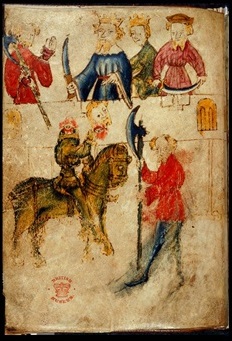
We know next to nothing about the author of the poem which has come to be called Sir Gawain and the Green Knight. It was probably written around 1400. In the early 17th century the manuscript was recorded as belonging to a Yorkshireman, Henry Saville of Bank. It was later acquired by Sir Robert Cotton, whose collection also included the Lindisfarne Gospels and the only surviving manuscript of Beowulf . The poem then lay dormant for over 200 years, not coming to light until Queen Victoria was on the throne, thus leapfrogging the attentions of some of our greatest writers and critics. The manuscript, a small, unprepossessing thing, would fit comfortably into an average-size hand, were anyone actually allowed to touch it. Now referred to as Cotton Nero A X, it is considered not only a most brilliant example of Middle English poetry but also as one of the jewels in the crown of English Literature; it now sits in the British Library under conditions of high security and controlled humidity.

Hat-tip: Hanne Elisabeth Storm Ofteland

**

Rennie Davis, The New Humanity: A Movement to Change the World (Volume 1 of 3)
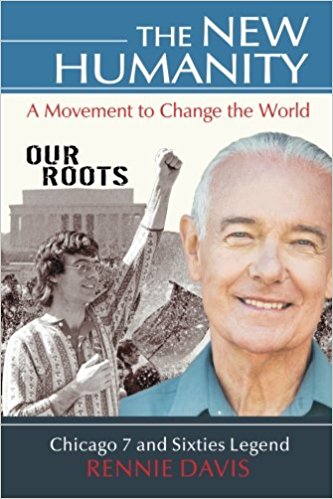
This first book returns to ‘Our Roots’ with a behind-the-scenes look straight from the eye of the social-change hurricane that swept North America during the turbulent times of the 1960s. Rennie Davis was the coordinator of the largest coalition of anti-war and civil rights organizations during that era. Now in vivid detail, he explains how the Sixties movement ignited and expanded, growing in strength and staying power. A compelling, riveting story, it was written to inspire today’s generation to stand on the shoulders of those who came before and arise again to change the world. Like a snowball tumbling down the mountain to become an avalanche that takes out the concrete wall of fear and divide, today’s movement will not be ignored or stopped.

This book is today’s must-read gift to yourself and your friends to uplift humanity and change the world.

Rennie is an old friend, story for another day. Hat-tip: Rennie Davis.

**

This just in:

Bernard Faure, The Fluid Pantheon: Gods of Medieval Japan, Volume 1
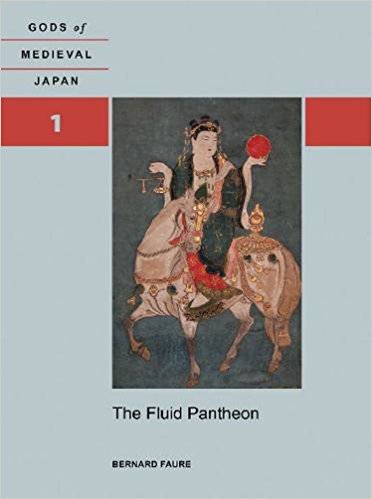
Written by one of the leading scholars of Japanese religion, The Fluid Pantheon is the first installment of a multivolume project that promises to be a milestone in our understanding of the mythico-ritual system of esoteric Buddhism—specifically the nature and roles of deities in the religious world of medieval Japan and beyond. Bernard Faure introduces readers to medieval Japanese religiosity and shows the centrality of the gods in religious discourse and ritual; in doing so he moves away from the usual textual, historical, and sociological approaches that constitute the “method” of current religious studies. The approach considers the gods (including buddhas and demons) as meaningful and powerful interlocutors and not merely as cyphers for social groups or projections of the human mind. Throughout he engages insights drawn from structuralism, post-structuralism, and Actor-network theory to retrieve the “implicit pantheon” (as opposed to the “explicit orthodox pantheon”) of esoteric Japanese Buddhism (Mikky?).

Hat-tip: just in from friend Gilles Poitras.

**

Enough of books — heres a personal photo — friend Neil Ayer with a Rothka at the Museum of Fine Arts, Boston:

Au ‘voir!


Switch to our mobile site
