zenpundit.com » war

Archive for the ‘war’ Category

Two Cheers for the State?

Wednesday, December 12th, 2012

An excellent post from Adam Elkus – strongly recommended!

The State Problem In National Security Policy

….The report makes a lot of comments about the rise of individual autonomy, the empowering of regional network-cities, and technology’s acceleration of the power of non-state actors. Wired interpreted part of this as signaling a decline of the statewhich has been a popular theme since Martin van Creveld’s work on theTransformation of War. I think that is an accurate characterization of the parts of the 2030 report that talk about the empowerment of non-state actors and the rise of international networks. I’m less interested in the report, though, than in the general narrative of state decline in national security policy discourse.

We’ve heard that states are in decline, and both benign and malign networks and private actors are on the rise. This isn’t a new theme—if you look back a few decades the rise of multinational corporations and the multilaterals prompted a similar debate about sovereignty and power in the modern world. The state-centric defense practitioner is enjoined to move beyond caring about states and embrace a new reality.

…. What we have been dealing with, however, is an unfortunate tendency to write the non-state actor and transnational network out of the last few centuries of history. But he (or she) stubbornly refuses to go away. We can talk about some of the reasons why this might be the case in the international environment but it is also worth talking about why we often assume much more coherence and cohesion in our domestic environment than reality may justify.

….In Charles Tilly’s book Democracy, he argues that four processes are necessary to create and sustain a democratic state: the growth of state capacity by suppressing alternative sources of power, the reduction of categorical inequalities, and the integration of strong tie-based trust networks into public life. Warlords and kingpins that predate make it difficult for rights to be guaranteed. Categorical inequality lessens the ability of the people to meaningfully control their own destiny. And strong trust networks that cannot express themselves in political and social life also have the potential for predation and the erosion of state authority. Tilly casts these processes as never-ending in scope, and states are capable of backsliding on any one of them.

Very rich food for thought.

Trust networks are an interesting way to look at broader social networks and discern, at times, the presence of modularity (and therefore specialized skills, capacities, knowledge etc.) within a looser network structure (weak ties and links vs. highly interconnected sets of hubs with strong ties). We tend to graph these things in simple diagrams, like concentric circles with “al Qaida hard core” in the center, but really, they are more akin to clumping or clotting or uneven aggregation within a less dense field of connections.

Adam is also right that the irregular, the illegal, the tribal, the secret society, the rebellious peasant was largely ignored by nationalistic  historians in the late 19th and early to mid 20th century – and when they came back in vogue in the 1960’s with revisionist, labor, social, cultural etc. schools of historians, they tended to groan under the heavy yoke of dogmatic Marxist class analysis and then later the radical academic obsessions with race, gender and sexual orientation “oppression”. Too seldom, were these people and their doings found to be interesting in themselves so much as puppets for a very tortured, abstract passion play to exorcise demons and pursue petty grudges against other scholars.

In any event, Adam is worth reading in full.

 

Point and Counterpoint in Defining Warfare II.

Monday, December 10th, 2012

A few comments on the article by Lt. Col. Jill Long at SWJ and the hardheaded critique by Jason Fritz of Inkspots to which I linked yesterday.

First, the attempt that Long was making in posing an alternative to Clausewitz was a laudable one, in the sense that every serious student who picks up a classic text, Clausewitz, Thucydides, Sun Tzu, Marx, Plato, Machievelli, Musashi and so on, should do more than simply try to understand the author and accept their views uncritically. Doing so would make you a parrot, not a scholar. Instead, we need to wrestle with and challenge the text; try to poke holes in the argument, turn it inside out and break it apart, if we are able. Sometimes we can make a legitimate chip or dent but most of the time, we are going to fail – the reason people have read these books for two or twenty centuries is because the arguments of brilliant minds within them continue to have enduring relevance.

I don’t think Long succeeded in her effort here, but if every officer had as part of their PME to formally construct an alternative to Clausewitz as she tried, we’d have a more strategically informed military and arguably one that better understood Clausewitz. If nothing else, Long was intellectually more courageous than the majority of her brother officers to make the attempt in the full glare of public scrutiny and that is praiseworthy

That said, “What is War? A New Point of View” is problematic. In my view, there are three major structural flaws in Long’s article: first, I don’t think she wrestled with On War  to plausibly justify her opening claim that that Clausewitz’s definition of war was obsolete. As Colonel David Maxwell pointed out at SWJ, that kind of bold discussion requires some reference to CvC’s “remarkable trinity”. Jason Fritz was probably speaking for a Clausewitzian legion when he, quite correctly, jumped on her argument for using dictionary definitions(!),  not tackling Clausewitz’s actual definition of war in asserting it was an anachronism or that such a definition can and does apply to non-state actors making war as well as states. You can’t make sweeping claims as a declaratory preface to the subject you’d really like to talk about – your audience will demand proof of your claim first.

The second major problem, is Long similarly dismisses the accepted definition of war under international law which is not only as equally large a field as Clausewitzian thought, it’s far larger and more important – being, you know – binding international law!  Disproving either of these alone is a fit subject for a dissertation or a book, not a paragraph. Sometimes we must learn how to construct a melody before we attempt to write a symphony.

The third structural problem is one of basic epistemology. Long’s assertion that Clausewitz’s (or any ) definition is not sufficiently broad because it is simple and that her definition is because it is complex is fundamentally ass-backwards. The question of definitions is one of the oldest ones in Western philosophy and we know that simple and profound definitions are by nature broadly stated while the negative dialectical process of qualifying them narrows their scope of application by revising the definition in a more complex form.

Jason Fritz raised a very interesting objection in his rebuttal:

….Long fails to adequately describe how the world has changed or how the “Global Era” plays into this. She states that the terrorist attacks on September 11, 2001 have changed how we should perceive the world. It seems that the she believes that that day should have awakened Americans to the threat of non-state actors. Long also states that “‘interconnected systems of trade, finance, information, and security’ demand a larger perspective when considering the engagement of imposing national will on others.” Both of these points are stated in defiance of history. Globalists enjoy selling the greatness and threats of our “interconnected systems” in the modern day, but that presumes that the world is newly interconnected. We know this is not true. Interconnection in today’s world may be faster and easier, but it is not new. States and other political groups have interacted over the elements listed for millennia – look only to the period of global colonization to see how long we as humans have been at this. Long does not describe how today’s globalization is unique and why that changes how we define war.

There are important distinctions to be made here but my short comment would be that globalization has had a significant effect upon warfare but not upon war.

As Jude Wanniski once pointed out, there is and has always been only one “system” – the whole world. What globalization has changed among the constituent parts is the velocity of transactions, their frequency, the potential number of players making transactions, where the system has degrees of transparency and opacity, the incentives and capabilities of political “gatekeepers” to control exchange of information or goods among other things. It is a different global economy than the one under the auspices of Bretton Woods or the quasi-autarkic decade of the Great Depression or the first globalization that died in August 1914.

Most of these things have direct bearing on economics, politics or policy but indirectly on the conduct of warfare as well. Balance of comparative advantages can be altered, situational awareness of conflicts can be heightened and the line between de jure war and “mere violence” uncomfortably blurred. Generally, statesmen have reacted to globalization by imposing greater political constraints – usually more than would be tactically wise or efficient –  on their own use of military force in less than existential conflicts. Generally, this is perceived as an aversion to taking or inflicting casualties and a legalistic-bureaucratic micromanaging of  military commanders and troops.Whether such politically self-imposed limits are useful in pursuing a strategy for military victory is another question, one that can only be answered in specific contexts. Sometimes restraint and de-escalation is the best answer on the strategic level.

What was good in the Long article? In my view, the root idea of conceptualizing of war on a spectrum; it is a useful cognitive device that could accommodate nuances, ideal for examining case studies or changes in warfare over time. But would be more persuasive if developed with accepted definitions.

Point and Counterpoint on Defining War

Saturday, December 8th, 2012

A quick note. There’s a provocative article at SWJ by a USAF Lt Col., Jill Long that attempted to pose an alternative definition of war and Jason Fritz at Inkspots has written a tough rebuttal; both are worth reading:

Jill Long – What is War? A New Point of View

….The Spectrum of War in the Global Era

Michael Howard summarizes the changing environment as shifting from one centered on the control of territory, to one focused not only on territorial control but the effective exploitation of the resources of that territory.[8]  This concept leads to a new approach to view and define war…within the context of globalization.  As the global finance crisis illuminated, economies can no longer be managed/controlled internally but in fact are impacted by events and decisions made across the world.[9]  One only needs to reference the so called “CNN effect,” the Arab Spring or current anti-American protests to understand the impact digital communications and the 24-hour news cycle have had on regional and world affairs.[10]  The bottom line: “interconnected systems of trade, finance, information, and security” demand a larger perspective when considering the engagement of imposing national will on others.[11]

One method to approach this broader perspective is to view war as a spectrum of discord, a continuum where unrestrained armed conflict and world peace are at opposing ends.  By establishing this graphic scale, it is relatively easy to conceptualize that as a nation approaches peace (or harmony) with other entities’ values, objectives, and ideals, there is an abeyance of hostilities.  War is not over, a nation’s desire to impose its will remains; it simply does not require the use of armed conflict to achieve its goals.  What might appear on the surface to be the age old argument between Thomas Hobbes’ theory of man’s natural state as one of war and John Locke’s more peaceful perspective, is actually providing the answer to that debate…both may be right.  If a nation’s will is in harmony with other entities’ then the natural tendency will lean towards world peace.  As discord develops between a nation’s will and other nation-states or non-state actors the natural tendency will increasingly lean towards more aggressive national engagement and armed conflict.  This theory purposefully focuses on nation-states and/or non-state actors versus the individual.  While one may argue it can be applied to individual interaction, this is not the author’s intent. 

This spectrum facilitates understanding that the art of war encompasses much more than the concept of armed conflict and acknowledges a nation’s capability to change their “natural state” based on the will of the people, political landscape, as well as a nation’s strength, ability, and desire to project power. […]

And now, from the other side……

Jason Fritz–  Our definition of war is pretty good as it is

…..Long fails to adequately describe how the world has changed or how the “Global Era” plays into this. She states that the terrorist attacks on September 11, 2001 have changed how we should perceive the world. It seems that the she believes that that day should have awakened Americans to the threat of non-state actors. Long also states that “‘interconnected systems of trade, finance, information, and security’ demand a larger perspective when considering the engagement of imposing national will on others.” Both of these points are stated in defiance of history. Globalists enjoy selling the greatness and threats of our “interconnected systems” in the modern day, but that presumes that the world is newly interconnected. We know this is not true. Interconnection in today’s world may be faster and easier, but it is not new. States and other political groups have interacted over the elements listed for millennia – look only to the period of global colonization to see how long we as humans have been at this. Long does not describe how today’s globalization is unique and why that changes how we define war.The issue of state versus non-state actors, as pertains to the definition of war, is a silly discussion. The idea that this new “globalization” has resulted in the rise of non-state actors is also historically inaccurate and is prima facie absurd.  Civil wars have raged as long as long as humans have fought wars (indeed, civil war comprise a significant proportion of the wars humans have fought). Who are these wars supposed to have been fought by if not by non-state actors? Insurgencies and terrorism are also not new to the 21st Century (or even the Common Era) and it would take a peculiar interpretation of history to argue otherwise.

It is important to note that in his definition, Clausewitz does not describe war as act of force between states. War is engaged between enemies as the means to achieve political objectives. Of course, political objectives are not the sole purview of states as many non-state groups have exhibited and Mao so logically codified. This is not to say that Clausewitz did not intend his definition and the rest of the book to discuss war between states in the best traditions of the post-Westphalian world. He clearly speaks of states throughout the book, as indicated in the parenthetical comment in his definition of war (I did say I would return to that point). But this does not limit On War solely to war between states as mean scholars have, most prominently historian John Keegan and strategist Martin van Creveld to name a couple. It does not take that large of a leap of thought to read On War and understand that states can be any organized political group, that princes can be any leaders of those political groups, and armies can be the armed elements of those political groups. A literalist reading of Clausewitz would be as unwise as a literalist reading of Plato or Aristotle and saying their writings do not apply to the modern world because we are no longer city-states. A non-literalist exegesis of On War easily provides for the incorporation of non-state war into Clausewitz’s thesis. As a last point on non-state actors, Long indicates that these offspring of globalization are driving this need for a new definition of war and yet her new definition specifies that means required are to bring about “sufficient adherence to a nation’s will.” This suggests that only nations have wills or that the means of war could only be used to achieve national wills. Ergo, only nations can be at war. I suspect that non-state actors would like to know how to label their activities if “war” is closed to them. [….]

I am pressed for time, as usual, this morning, but i will try to offer my own comments later tonight.

Seal Team Six: asymmetries and symmetries

Thursday, November 22nd, 2012

[ by Charles Cameron — we just might want to understand the Quranic ROE — or at least its OBL and SK Malik versions ]
.

.

I was watching Seal Team Six: The Raid on Osama Bin Laden, the TV movie aka Code Name: Geronimo last night [okay, okay], and one phrase early on caught my attention and sent me, first to the OBL Letters from Abbottabad and Nelly Lahoud‘s commentary, and then to the always useful Brig. SK Malik‘s Quranic Concept of Power.

**

Here then, from Prof: (Brig: Retd.) S.K. Malik’s The Quranic Concept of Power, published in an edition of 500 by Progressive Publishers, Lahore, in 1991, pp. 303-04, is a brief outline of the Rules of Engagement for jihad as presented in the Quran and Sunna, and understood by the late Pakistani Brigadier and professor in the Defence & Strategic Studies department of Quaid-i-Azam University, Islamabad:

The Holy Quran also directs us to observe its ethics during the application of the military instrument. The divine ethics are gracious, liberal and generous. With regards to fighting in the Prohibited Months and in the Sacred Area, our Lord has prescribed for us a law based on quality and reciprocity, We are forbidden from fighting in this period and place for as long as the enemy also observes these limits. If the enemy transgresses these limits, we are permitted to transgress the limits to the extent he does. Even I such situations, our Mighty Lord has commanded us to prefer patience and restraint. Under no circumstances, however, can we transgress the clear and well-defined limits set forth for us by our Lord.

According to the studies carried out by the Muslim jurists on the subject, we are prohibited from cruel and torturous ways of killing the enemy during war. The killing of women, minor, servants and slaves is also forbidden. We are also to spare the blind, the monks, the hermits, the old, the physically-deformed and the insane or mentally-deficient. For bidden for us also is the decapacitation of the prisoners; the mutilation of the men and the beasts; devastation and destruction of harvests; excesses and wickedness; and adultery or fornification with captive women. We are also forbidden to kill hostages and taking to massacre to vanquish the enemy. Muslim soldiers are not permitted to kill their parents in the enemy forces except in absolute self-defence. Prohibited similarly is the killing of peasants, traders, merchants, contractors and the like who accompany the enemy forces to the battle field but do not take part in actual fighting.

The checks and controls imposed by the Holy Quran on the use of force have no parallel in the annals of human history In practice, there were very few occasions on which the Faithful transgressed these limits and they were duly reprimanded for it. It must, however, be understood that the exercise of restraint in the use of force in inter-state relations is essentially a two-way affair. It is not possible that one side goes on exercising restraint while the other goes on committing excesses. Nor doe the Holy Quran approve of such a restraint. In such situations, the very injunction of preserving peace demands the use of limited force. The Holy Quran commands us to use force for just such a purpose.

**

I am sure Brig. Malik’s work [most accessible: his Qur’anic Concept of War] is only the tip of the iceberg here, and I’d certainly advise reading western analysts (eg Cook, Firestone, and Bonner) on the topic, too — but it would surely be helpful to know what ROE jihadists are in fact supposedly following.

A Meditation In Time of War: security

Thursday, November 22nd, 2012

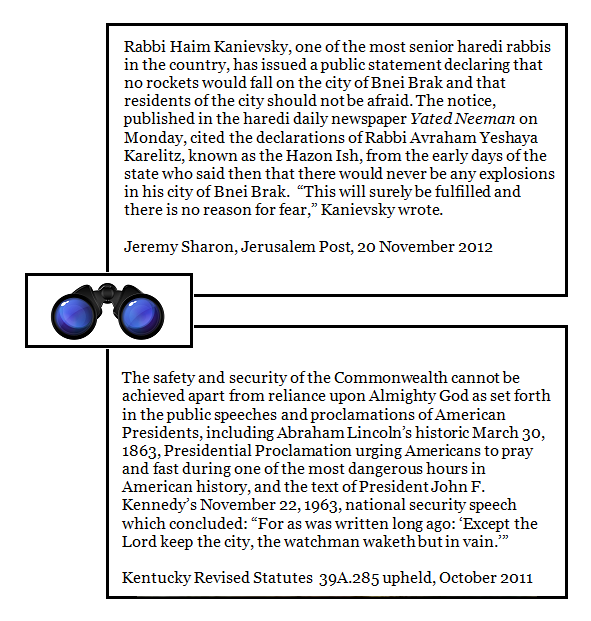
[ by Charles Cameron — divine protection in Israel and Kentucky ]
.


.

So who needs an Iron Dome, or Star Wars?

I really don’t have access to the Rabbi’s full and detailed views on the matter, but based on what the Jerusalem Post reports, he appears to be advocating that divine intervention is both a necessary and sufficient form of defense against Hamas missiles.

The Kentucky legislature’s position is somewhat different. The two paragraphs immediately preceding the one I’ve quoted here read:

No government by itself can guarantee perfect security from acts of war or terrorism.

and:

The security and well-being of the public depend not just on government, but rest in large
measure upon individual citizens of the Commonwealth and their level of understanding, preparation, and vigilance.

So Kentucky suggests an admixture of government security measures, public vigilance and divine protection.

**

Let’s skip around a bit. I’m reminded of Abraham‘s discussion of divine judgment and protection in Genesis 18, which begins —

And Abraham drew near, and said, Wilt thou also destroy the righteous with the wicked Peradventure there be fifty righteous within the city: wilt thou also destroy and not spare the place for the fifty righteous that are therein? That be far from thee to do after this manner, to slay the righteous with the wicked: and that the righteous should be as the wicked, that be far from thee: Shall not the Judge of all the earth do right? And the Lord said, If I find in Sodom fifty righteous within the city, then I will spare all the place for their sakes.

Abraham then quizzes God with incrementally lowering figures until God says:

I will not destroy it for ten’s sake.

Scriptures tend to describe acts of God as, well, acts of God – and that’s a category which can include the fall of sparrows, let alone a rain of missiles, a parting of waves, or a pillar of cloud.

Modernity tends to regard missiles, inbound, as acts of human agency, and likewise with missiles sent up to intercept them.

**

Kurt Vonnegut pretty much opens his book, Cat’s Cradle, with the statement:

No names have been changed to protect the innocent, since God Almighty protects the innocent as a matter of Heavenly routine.

I’m sure he meant it with a wink and a nod, but I take some comfort from it all the same. You see, I live in a world of both human and mysterious agency — a world of grace and science, science and grace.

Call me confused, tell me I contradict myself. I can only say with Walt Whitman:

Do I contradict myself? Very well, then I contradict myself, I am large, I contain multitudes.

Oh — and in fact it’s more complex, more nuanced than that.


Switch to our mobile site