zenpundit.com » anthropology

Archive for the ‘anthropology’ Category

Human Sacrifice and State-Building

Tuesday, April 5th, 2016

[by Mark Safranski / “zen“]

A while back I had a longish post that argued that the mass executions practiced by ISIS drew from the long pagan tradition of ritualistic human sacrifice. Today in the news, some social scientists see evidence of human sacrifice as the catalyst for establishing and maintaining stratified, hierarchical and (usually) oppressive societies:

Human sacrifice may seem brutal and bloody by modern social standards, but it was a common in ancient societies.

Now, researchers believe the ritualised killing of individuals to placate a god played a role in building and sustaining stable communities with social hierarchies.In particular, a study of 93 cultures across Asia, Oceana and Africa, has found the practices helped establish authority and set up class-based systems.

Human sacrifice was once widespread throughout these Austronesian cultures, which used it as the ultimate punishment, for funerals and to consecrate new boats.Sacrificial victims were typically of low social status, such as slaves, while instigators were of high social status, such as priests and chiefs, installing a sense of fear in the lower classes.

….Analysis revealed evidence of human sacrifice in 43 per cent of cultures sampled.

Ritualistic killing of humans was practiced in 25 per cent of egalitarian societies studied, 37 per cent of moderately stratified societies and 67 per cent of highly stratified societies.The researchers constructed models to test the co-evolution of human sacrifice and social hierarchy and found that human sacrifice stabilises social hierarchy once the system has arisen. They said it also promotes a shift to strictly inherited class systems, so that people of a high social class will continue to stay important over time, because of ritualistic killing.

‘In Austronesian cultures human sacrifice was used to punish taboo violations, demoralise underclasses, mark class boundaries, and instill fear of social elites  – proving a wide range of potential mechanisms for maintaining and building social control,’ they wrote. ‘While there are many factors that help build and sustain social stratification, human sacrifice may be a particularly effective means of maintaining and building social control because it minimises the potential of retaliation by eliminating the victim, and shifts the agent believed to be ultimately responsible to the realm of the supernatural.’

Supernatural forces….like for example, because Allah wills it.

This Austronesian study conclusions sounds remarkably similar to the role of (allegedly) Sharia sanctioned horrific punishments meted out by ISIS and fetishistically recorded and widely disseminated in video propaganda. A religiously ritualistic rein of terror as a mechanism to reengineer Sunni Arab society in areas under the group’s control and cement the state-building efforts of ISIS.

For details of ISIS use of extremely ghoulish violence for propaganda and state-building, I heartily recommend ISIS: the State of Terror by Jessica Stern and J.M. Berger.

Contrapuntal video, fugal braiding

Friday, March 11th, 2016

[ by Charles Cameron — from Trumpery to Altman’s Nashville ]
.


Tufte’s illustration of the Kathasaritsagara or Ocean of the Streams of Story

**

Wired had a piece titled Never Mind Trump. The Internet Wants to Watch What’s Behind Him a couple of days ago, and it contained a sentence that caught my attention:

Like a Bach fugue, the counterpoint rivaled, and then overtook, the original melody.

**

I’m always interested in non-musical forms of counterpoint, whether we’re talking Glenn Gould‘s radio dramas, Claude Levi-Strauss‘s structure for his Mytholoogiques, Tufte‘s Rushdie‘s Kathasaritsagara, or the various attempts to make Hermann Hesse‘s Glass Bead Game playable. Hesse himself invokes both fugue and counterpoint in the passage in which he describes actual moves in his game about as clearly as anywhere:

A Game, for example, might start from a given astronomical configuration, or from the actual theme of a Bach fugue, or from a sentence out of Leibniz or the Upanishads, and from this theme, depending on the intentions and talents of the player, it could either further explore and elaborate the initial motif or else enrich its expressiveness by allusions to kindred concepts. Beginners learned how to establish parallels, by means of the Game’s symbols, between a piece of classical music and the formula for some law of nature. Experts and Masters of the Game freely wove the initial theme into unlimited combinations. For a long time one school of players favored the technique of stating ide by side, developing in counterpoint, and finally harmoniously ombining two hostile themes or ideas, such as law and freedom, individual and community. In such a Game the goal was to develop both themes or theses with complete equality and impartiality, to
evolve out of thesis and antithesis the purest possible synthesis.

**

I was accordingly interested to read this paragraph, ending as it does with the sentence I quoted above:

The Christie videos were just the latest installment in what might be the defining video format of this election. Call it marginal media, in which background activity overwhelms the intended subject. Most candidates have found themselves inadvertently sidelined at some point. Hillary Clinton was overshadowed by the surreal stylings of “Sticker Kid,” who mugged, jerked, and danced throughout her stump speech. Another short video treated Bernie Sanders’ endorsement of marijuana decriminalization as a preamble to an audience member’s startled reaction. Another Trump rally was undercut when a member of the crowd behind the lectern began reading a copy of Claudia Rankine’s Citizen. The drama unfolded over the course of Trump’s speech, as the reader’s neighbors began to argue with her, then brought their neighbors into the fray. Soon, the tension made it impossible to pay attention to Trump at all. Like a Bach fugue, the counterpoint rivaled, and then overtook, the original melody.

**

We need, it seems to me, to get used to thinking contrapuntally — and accordingly it is instructive to see just how many of the great artists of recent times have employed some measure of contrapuntal thinking in their work. From the same Wired piece:

The frames of Robert Altman’s Nashville are packed with overlapping dialogue and activity—it’s often hard to determine which storyline should dominate—granting his aspiring losers the same weight as the country-music superstars they idolize. Tom Stoppard applied the same lens to Hamlet when he made two lackeys — whose off-stage death was barely remarked upon in Shakespeare’s play — the heroes of his fan-fic spin-off, Rosencrantz and Guildenstern Are Dead.

Okay, I’m off to see Nashville if I can find it..

Guest Post: Duncan Hunter and Human Terrain System by Turner

Sunday, February 14th, 2016

[by Mark Safranski / “zen“]

ZP is pleased to bring you a guest post by Pete Turner, co-host of The Break it Down Show and is an advocate of better, smarter, transition operations. Turner has extensive overseas experience in hazardous conditions in a variety of positions including operations: Joint Endeavor (Bosnia), Iraqi Freedom (2004-6, 2008-10), New Dawn (Iraq 2010-11) and Enduring Freedom (Afghanistan 2011-12).

ON REPRESENTATIVE DUNCAN HUNTER’S QUESTIONS ABOUT HTS

by Pete Turner

Today I was sent this USA Today article about Rep. Duncan Hunter (R-Ca) and Human Terrain System with a request for comments. An excerpt:

….A critic of the program, Rep. Duncan Hunter, a California Republican and member of the Armed Services Committee, demanded answers about the program from Acting Army Secretary Patrick Murphy in a letter sent Monday. Hunter noted “striking similarities between the two programs” and called on the Army to explain how the Global Cultural Knowledge Network differed from Human Terrain System. He also asked for an accounting of its cost and the number of people it employs.

“Unless the Army can show real differences between programs, then there should be no doubt that this constitutes a blatant attempt to rebrand and reboot a failed program under another name and a launch it with a reworded mission statement,” Hunter told USA TODAY on Tuesday. “What’s obviously lost on the Army is that it wasn’t just the implementation of HTS that was the problem, it was the whole thing, to include the program’s intent and objective.”

I have no faith in TRADOC’s ability to get Human Terrain System or HTS 2.0 any more right than last time.  The program was full of prima donnas, liars and academics who lacked the ability to relate to the military and commanders.  Also, commanders aren’t trained in how to best use HTS assets either – and that matters. For example:

COL: “Pete, I want you to tell me who the most influential person in our region is….can you do that?”  

Pete: “Yes Sir, I have the answer already…it’s you…until the people recognize their own governmental leaders, police and military, our focus has to be in ramping your influence down while we enable them to ramp up, Sir.”   

That statement is the essence of what an HTS does – we identify and translate the intersection of the ramps.  There is no book on how to do it well. The ground truth is where the best work is done.  It’s a shame that Rep Duncan Hunter and DoD cannot see that.

For those who aren’t familiar with my work, I have 70+ months of time working in combat zones.  I’ve worked most of this time at the lowest level interacting with locals on well over a 1000 patrols.  A great deal of this time I worked in the HTS program mentioned in the article.

Rep D. Hunter questioned the need and was critical of the original HTS program.  Like any program we absolutely had our share of fraud, waste and abuse.  Here’s the thing…the HTS program even when legitimately run is expensive.  Units work hard, long hours and a relentless schedule.  On numerous occasion, I’d work a 20 hour day followed by an 18 hour day followed by a string of 16 hour days.  An 84 hour week is the minimum I’d work.  Working at the minimum pace of 12 hours a day 7 days a week, a person will “max out” on their federal pay for the year and accumulate “comp time” or paid days off.

Since there are always things to do, lives at stake, command directives to pursue…missions to go on, planning to complete, analysis to run, reports to write, meetings to attend…it’s not hard to work 90+ hours a week and be seen as not doing enough.  How about this – some units will practice for a meeting for hours prior to the actual meeting?  If a unit is going to spend 6 hours prepping for and executing a meeting, that’s just ½ of a day…yes, legitimate work will result in paid leave.

If my patrol leaves at 3AM because there is a full moon and we move up and over a mountain arriving at a village before dawn…then spend the rest of the morning patrolling more and finally return to base at 2 in the afternoon…I still have to report on what I saw, a report may take 3-4 hours to write….and then prep for the next day’s patrol…unless your unit is doing 2 patrols a day.

I recall one specific time when a brigade from the 82nd that I was attached to was going to rotate home.  The brigade commander wanted to provide the new unit with the best possible handoff in terms of data, relationships etc.  To facilitate this handoff, my team was tasked to improve a “smart book” of dossiers on prominent Iraqis.  At one point I sat in the same chair for 24 hours writing, rewriting and then updating the book…simply because we HAD to work – the books weren’t getting better, just being constantly reworked.

Why do I bring this up?  Two reasons: First, the 82nd works HARD and if one is attached to them, that person works hard too, or suffers from irrelevance.  The 82nd spent a lot of taxpayer money on HTS people writing those books with the best intentions.  Secondly, the next unit came in and literally, never used the books.  When I asked why,  the new unit said, “we really don’t do that.”

When Rep Hunter originally questioned, the need for the program, I reached out to him to illustrate how when done properly, HTS work saves money and creates the kind of wins that unit’s cannot do without a HTS capability.  I also sent several notices to the my district’s congressional rep Mr. Mike Thompson.  Both he and Mr Duncan are veterans; I thought, surely they’d value my unique “ground truth” based knowledge.  I was wrong, both representatives ignored my offer to provide feedback.

The answer to Rep Duncan’s question about the need for this program is this:

Commanders need an outside element to translate what the US is doing for locals; in this case Afghans.  Meanwhile the HTS person also translates back to the US military what the locals are experiencing.  What an HTS person really does is works as a cultural translator allowing the different sides to understand the reality of their “partner.”

I worked in a valley that had a steep narrow canyon.  The local US Army agricultural development team (ADT) a truly myopic, xenophobic program that commonly created instability more than anything else, decided to build a check dam.  The dam was supposed to elevate the water in the river high enough to charge the irrigation ditches that ran the length of the river valley.  Over the course of 18 or more months the ADT fought with locals to improve the dam, while the locals rejected it and attempted to destroy it on several occasions.

The Dam Project

I was able to talk to locals who reasonably explained why the dam was an issue.  Simply put, they didn’t want it – and it was predicted to fail as soon as the first rain came.  Further, the region had an Afghan leader chosen to handle water issues for the families.  He agreed that the dam was a bad idea; and also predicted it would fail with the first rain.  We never effectively engaged the water elder–instead the ADT insulted this person and ignored his position and influence with the farmers.  A commander can’t know these things without an HTS person on the ground studying the human terrain.

I spoke with the ADT engineer responsible for the final “upgrade” to the dam.  I mentioned the concerns of the people and the water elder about the long term viability of the dam, which was visibly failing – the ADT hydrologist said, the elder may be right. Exacerbating this further, the dam project was done, updated and repaired all without any planning with the local Afghan governor.  All in all, the dam cost well in excess of $100k

Then the first rain came…

If one was to look at the ADT reporting, the dam was a hit.  It was accomplishing great things for the valley’s farmers.  Without an human terrain operator like myself, the ADT and the local US commander likely would never have found out how miserably they’d failed.  Rep Duncan, you want to fix things? Give me a call and I’ll show you where the money is really being wasted.

It gets worse…not only did the dam fail; when locals began to engage the governor about his plan to deal with the dam (this BTW is a small win, as most farmers a month prior saw no benefit from the government) the governor had no capacity to change anything.  This in effect confirmed for many locals that the governor had no ability to help them and therefore,  the Taliban would remain the dominant force in the region.  Ultimately, the ADT had closed the books on the region and meanwhile security further eroded.  Our efforts to create capacity resulted in us undermining the fledgling power of the governor.  Within a few months of my leaving the region, a district once considered to be a model of stability, had three service members assassinated by their Afghan partners.

Without an HTS asset, we never learn these lessons.  This is one of dozens of tales I was able to illustrate as an HTS operator.  Of course, since Reps Duncan and Thompson can’t be bothered with the ground truth – its all fraud waste and abuse, isn’t it?

Lexington Green Interviewed on Against the Current

Thursday, September 10th, 2015

[by Mark Safranski, a.k.a. “zen“]

America 3.0 : Rebooting Prosperity in the 21st Century by James C. Bennett and Michael Lotus

Lexington Green” of Chicago Boyz blog, a.k.a Michael Lotus, co-author of America 3.0 was interviewed recently by Chicago talk radio host and TV commentator Dan   Proft, on Proft’s video podcast, Against the Current.

I heartily approve of the cigars.

Tune in for approximately fifty minutes of conversation regarding national and local politics, futurism, economics and political philosophy through the analytic prism of America 3.0 (a book I warmly endorse):


No man’s land, one man’s real estate, everyone’s dream?

Monday, August 17th, 2015

[ by Charles Cameron — borders and distinctions from Trump to Revelation, plus one ]
.

Donald Trump‘s “three core principles of real immigration reform”:

1. A nation without borders is not a nation.

**

G Spencer-Brown wrote of his book. Laws of Form, “The theme of this book is that a universe comes into being when a space is severed or taken apart” — or as Heinz Von Foerster rephrased him, “Draw a distinction and a universe comes into being”. Indeed, his book opens with the words:

We take as given the idea of distinction and the idea of indication, and that we cannot make an indication without drawing a distinction.

He writes:

Distinction is perfect continence.

That is to say, a distinction is drawn by arranging a boundary with separate sides so that a point on one side cannot reach the other side without crossing the boundary. For example in a plane a circle draws a distinction.

Similarly, Gregory Bateson defines an idea as “A difference or distinction or news of differences”.

**

Borders are both physical and metaphysical: the border between the physical and the metaphysical passes through human beings, who are themselves both metaphysical and physical.

Borders may thus be heeded or ignored.

Smugglers don’t necessarily ignore them, they may take them very seriously, as do those who police them. Birds, however, ignore them, fishes, lizards, languages..

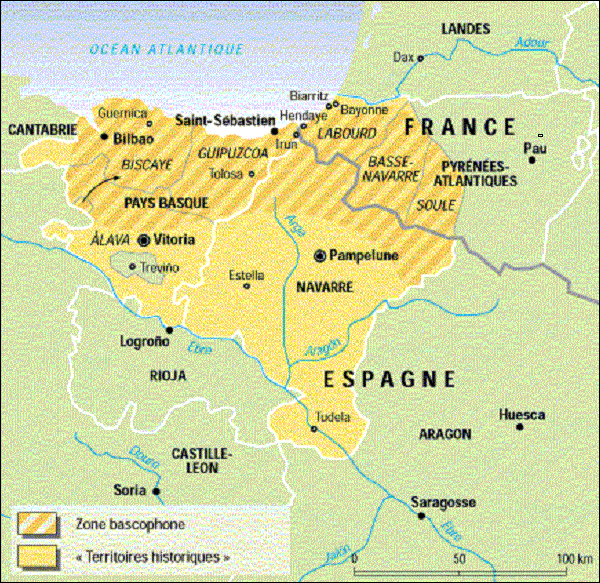
There are would-be states that straddle national borders, as the Basque peoples straddle the border between France and Spain:

Basque France Spain 600

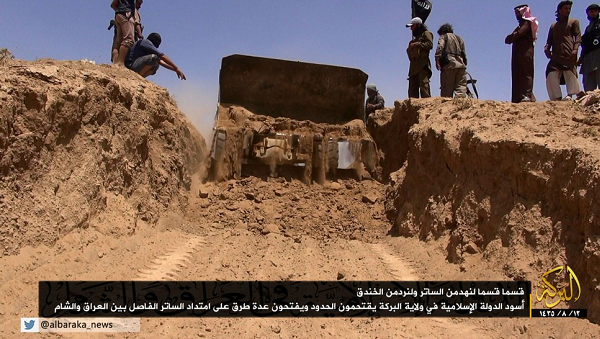
There are also would-be states that literally erase national borders, as in the case of IS bulldozing thw border between Iraq and Syria:

Iraq Syria Border 600

Thus while borders may be tidy in separating one from a second, they are also untidy in straddling them, neither one nor two, yet (like Janus) both.. They are, in short, thresholds, limina. And so wahat we know of liminality applies to them. I have discussed tthis previosuly on Zenpundit in Liminality II: the serious part — suffice it to say here that limiality is a condition that exacerbates, intensifies.

**

The anthropologist Mary Douglas, in her book Purity and Danger: An Analysis of Concepts of Pollution and Taboo, quotes Leviticus 19.19:

You shall keep my statutes. You shall not let your cattle breed with a different kind; you shall not sow your field with two kinds of seed; nor shall there come upon you a garment of cloth made of two kinds of stuff.

Why these disjunctions? Dougles notes the repeated refrain in just such contexts:

Ye shall therefore be holy, for I am holy

and points out that Ronald Knox correctly — if “rather thinly” — translates this:

I am set apart and you must be set apart like me

She then tells us:

Holiness means keeping distinct the categories of creation. It therefore involves correct definition, discrimination and order.

noting that:

The word ‘perversion’ is a significant mistranslation of the rare Hebrew word tebhel, which has as its meaning mixing or confusion.

and concludes

ideas about separating, purifying, demarcating and punishing transgressions have as their main function to impose system on an inherently untidy experience. It is only by exaggerating the difference between within and without, above and below, male and female, with and against, that a semblance of order is created.

**

The upper image, below, is taken from my recent post on Matrioshka cartography, and waas taken in turn from Say goodbye to the weirdest border dispute in the world in the Washington on August 1st..

SPEC DQ maps

… while the lower image is from Welcome to Liberland, the World’s Newest Country (Maybe) in the New York Times Magazine, dated Aug 11

**

Lydia Kiesling, in her post Letter of Recommendation: Uzbek in the NYT magazine today, writes:

National borders can be risibly at odds with reality, especially in Central Asia, where Turks, Mongols, Persians and others roved and mingled, where ‘‘Uzbek’’ was, for a time, more of a descriptive antonym of ‘‘Tajik’’ — no­­madic versus settled — than an ethnic classification.

And why not?

They are, after all, distinctions drawn in the mind, lines drawn on paper. Thus the Sykes-Picot map:

Sykes_Picot_Agreement_Map_signed_8_May_1916 600

Sykes was quite clear about the “lines dorawn on paper” part. He is reported to have said:

I should like to draw a line from the e in Acre to the last k in Kirkuk

The map, in other words, is not the territory: the map is a map.

To take another instance of importance in today’s world, the Durand Line:

Durand_Line_Border_Between_Afghanistan_And_Pakistan 600

Not only is the map not the territory in this case — it can be seen, as one-time Afghan president Hamid Karzai said, as “a line of hatred that raised a wall between the two brothers” — Afghanistan and Pakistan.

**

Sympathies which exist across borders can be potent forces for their dissolution. In a poem titled “Their Eyes Confer Fire” written in the 1980s about Basque country, I wrote

We have
little time,
Marie explained,
for those
who, because
it is hard
to draw
lines
across actual
mountains,
carve up
this earth on
paper.

France, Spain:
we disdain
boundaries, borders,
and border guards.

A canny reader noted that the entire poem could be read not as a description of the Basques as they exist in reality, but as a paean to the corpus callosum joining the two hemispheres of the brain — and thus the two modes of cognition of which I so recently wrote.

**

Returning to Lieberland, or Gornja Siga as the locals call it, we learn:

Gornja Siga has come, over the last few months, to assume an outsize role in the imagination of many — not only in Europe, but also in the Middle East and in the United States. Its mere existence as a land unburdened by deed or ruler has become cause for great jubilation. There are few things more uplifting than the promise that we might start over, that we might live in the early days of a better nation. All the most recent states — South Sudan, East Timor, Eritrea — were carved from existing sovereignties in the wake of bitter civil wars. Here, by contrast, is a truly empty parcel. What novel society might be accomplished in a place like this, with no national claim or tenant?

Consider one sentence alone as the key to that “outsize role in the imagination”:

There are few things more uplifting than the promise that we might start over, that we might live in the early days of a better nation.

The apocalyptic yearning here and its kinship with the Amrican dream are hard to miss — it is like a conflation of Matthew 5.14:

A city that is set on an hill cannot be hid.

with Revelation 21.1-2:

And I saw a new heaven and a new earth: for the first heaven and the first earth were passed away; and there was no more sea. And I John saw the holy city, new Jerusalem, coming down from God out of heaven, prepared as a bride adorned for her husband.

**

Plus:


Switch to our mobile site