zenpundit.com » al qaida

Archive for the ‘al qaida’ Category

The Controversial CTC Report

Friday, January 25th, 2013

The Center for Combating Terrorism at West Point released a report on domestic terrorism that raised hackles for a number of reasons. Despite the dismissals of liberal political pundits, the reasons for objections to the CTC report are legitimate but they did not need to arise in the first place and might have been avoided with a slightly different editorial approach or appropriate caveats (I just finished reading the report, which is primarily focused on the usual suspects). Here’s why I think the normally well-regarded CTC stumbled into a hornet’s nest:

First, in this foray into domestic terrorism analysis, the center chose to concentrate only on the threat of violence of the Far Right while ignoring other threats coming from the Far Left, infiltration by criminal insurgent networks from Mexico, notably the ultraviolent Zetas whose reach has stirred gang violence in Chicago and Islamist terrorism, either homegrown “lone wolves” or from foreign infiltration or subversion. In itself, this is understandable if the CTC plans a series of reports with a separate focus on different domestic threats; but without that context, it is a myopic analytic perspective, particularly given the demonstrated capabilities of various AQ affiliates or just south of the border, the criminalinsurgency of  the narco-cartels. Had all of these been addressed in one omnibus report, any complaints from conservatives were likely to have been muted or nonexistent. This is not to say that the radical American Far Right does not have a violent threat potential of it’s own worth studying; it does and it is real. But available evidence indicates it to be the least organized, least operationally active and least professionally competent in terms of terrorist “tradecraft” of the three.

The second and most problematic aspect of the report is an intellectually sloppy definition of a dangerous “antifederalist movement”  where noxious concepts like “white supremacy” and wacko conspiracy theories are casually associated with very mainstream conservative (or even traditionally bipartisan !) political ideas – coincidentally, some of the same ideas that contemporary “big government” liberal elites tend to find irritating, objectionable or critical of their preferred policies. Part of the equation here is that American politics are evolvng into a very bitterly partisan, “low trust” environment, but even on the merits of critical analysis,  these two passages are ill-considered and are largely responsible for most of the recent public criticism of the CTC:

….The antifederalist rationale is multifaceted, and includes the beliefs that the American political system and its proxies were hijacked by external forces interested in promoting a “New World Order” (NWO) in which the United States will be absorbed into the United Nations or another version of global government.  They also espouse strong convictions regarding the federal government, believing it to be corrupt and tyrannical, with a natural tendency to intrude on individuals’ civil and constitutional rights.  Finally, they support civil activism, individual freedoms, and self government

….In contrast to the relatively long tradition of the white supremacy racist movement, the anti-federalist movement appeared in full force only in the early to mid-1990s, with the emergence of groups such as the  Militia of Montana and the Michigan Militia. Antifederalism is normally identified in the literature as the “Militia” or “Patriot” movement. Anti-federalist and anti-government sentiments were present in American society before the 1990s in diverse movements and ideological associations promoting anti-taxation, gun rights, survivalist  practices,and libertarian ideas 

This is taxonomic incoherence, or at least could have used some bright-line specifics ( like “Posse Commitatus” qualifying what was meant by “anti-taxation” activists) though in some cases, such as “libertarian ideas” and “civil activism”, I’m at a loss to know who or what violent actors they were implying, despite being fairly well informed on such matters.

By the standard used in the first paragraph, Glenn Greenwald, Ralph Nader and the ACLU would also be considered “far right antifederalists”. By the standards of the second, we might be in physical danger from Grover Norquist,  Congressman John Dingell and Penn Jillette. No one who opposed the recent increases in income tax rates, dislikes gun-control or thought the DOJ may have abused it’s power in the prosecution of Aaron Swartz or in their stubborn refusal to prosecute Bankster racketeering is likely to welcome a report under the auspices of West Point that juxtaposes such normal and perfectly valid American political beliefs with neo-Nazism. A move that is simply going to – and quite frankly, did – gratuitously irritate a large number of people, including many in the defense and national security communities who are a natural “customer base” for CTC reports.

As I said previously, this could easily have been completely avoided with more careful use of language, given that 99% the report has nothing to do with mainstream politics and is concerned with actors and orgs with often extensive track records of violence. As the CTC, despite it’s independence, is associated so strongly with an official U.S. Army institution, it needs to go the extra mile in explaining it’s analysis when examining domestic terrorism subjects that are or, appear to be, connected to perfectly legitimate participation in the political process. This is the case whether the subject is on the Left or Right – few activists on the Left, for example, have forgotten the days of COINTELPRO and are currently aggrieved by the activities of Project Vigilant.

I might make a few other criticisms of the report, such as the need for a better informed historical perspective, but that is hardly what the recent uproar was about.

At first glance, I thought it was Santa

Monday, January 21st, 2013

[ by Charles Cameron — lightweight, feel free to ignore ]
.


.

It isn’t Santa. It’s the image from Raffaello Pantucci‘s piece, Islamists in Africa emerge as threat to West, for the BBC. Raff’s a recently-minted Senior Research Fellow of the Royal United Services Institute.

Cognitive #FAIL on my part. Wishful thinking, perhaps?

Three from the avatar… Aaron Zelin

Friday, November 16th, 2012

[ by Charles Cameron — keeping up with Aaron Zelin on a good day can be quite a feat — this post has taken me a few days to write! ]
.

Let’s start with this avatar business. I picked it up from Gregory Johnsen, who applied the term in a tweet a few days ago to Aaron Zelin:

I chuckled at the description and RT’d Johnsen’s tweet at the time — but a day later the full force of the words “more than just a high producing avatar” came back to me, when I took a look at the things I wanted to pass along here on Zenpundit from that day’s haul, and found that three of them came via Aaron.

**

First up on the 14th: Aaron’s own post on Foreign Policy‘s Middle East Channel, Maqdisi’s disciples in Libya and Tunisia.

This featured the Benghazi and Tunisian groups that share the name Ansar al-Sharia (ASB and AST), and points to the idea that:

much of the scope of their activities lies outside violence. A large-portion of the activities of these groups is local social service provision under their particular dawa (missionary) offices. This broader picture is crucial to better understanding emerging trends in societies transitioning from authoritarian to democratic rule.

This emphasis, Aaron suggests, derives from the writings of Sheikh Abu Muhammad al-Maqdisi:

One of the main critiques Maqdisi presents, and hopes to create a course correction within the jihadi movement, is his differentiation between the idea of qital al-nikayya (fighting to hurt or damage the enemy) and qital al-tamkin (fighting to consolidate ones power), which he expounds upon in his book Waqafat ma’ Thamrat al-Jihad (Stances on the Fruit of Jihad) in 2004. Maqdisi argues the former provides only short-term tactical victories that in many cases do not amount to much in the long-term whereas the latter provides a framework for consolidating an Islamic state. In this way, Maqdisi highlights the importance of planning, organization, education, as well as dawa (calling individuals to Islam) activities.

Finally, Aaron places ASB (Benghazi) and AST (Tunisia) in the wider context of Islamist movements, both Sunni and Shia, writing:

By providing charity, care, and aid ASB and AST are acting similarly in their operations (though should not be confused for allies with or having ideological connections) to the Muslim Brotherhood, Hamas, and Hezbollah. Providing social services has provided leverage for these groups to gain wider popularity and support within the local community.

For more detailed discussion of Maqdisi, Aaron points us to Joas Wagemaker‘s essay, Protecting Jihad: The Sharia Council of the Minbar al-Tawhid wa-l-Jihad.

By my count, therefore, we now have at least five tendencies to think about: (i) politically engaged Islamists, such as the Brotherhood and the Ennahda movement, (ii) jihadists who hope to topple the “near” enemy, ie local despotic rulers of Muslim-majority states, (iii) jihadists who hope first to cripple the “far” enemy, following bin Laden‘s doctrine, (iv) jihadists in the wake of Abu Musab al-Suri‘s nizam, la tanzim (system, not organization), with its implication of decentralized jihad and leaderless resistance, and (v) the distinctive approach to jihad that Aaron discusses, in which al-Maqdisi’s theories are implemented:

ASB and AST do not buy into the democratic process and in spite of it are attempting to consolidate their future Islamic State one small act of charity at a time.

**

Second, Aaron’s Jihadology blog the same day hosted a fascinating piece by Jack Roche, a former member of Jama’ah Islamiyyah, titled The Indonesian Jama’ah Islamiyyah’s Constitution (PUPJI).

One point of interest to me here was a version of the well-known “saved sect” hadith, which has been specifically viewed as referring to al-Qaida on occasion:

It was narrated from ‘Awf bin Malik that the Messenger of Allah said: “The Jews split into seventy-one sects, one of which will be in Paradise and seventy in Hell. The Christians split into seventy-two sects, seventy-one of which will be in Hell and one in Paradise. I swear by the One in Whose Hand is the soul of Muhammad, my nation will split into seventy-three sects, one of which will be in Paradise and seventy-two in Hell.” It was said: “O Messenger of Allah who are they?” He said: “Al Jama‘ah – The main body.” (Sunan Ibnu Majah 3992).

I’d seen versions of the hadith in which it is promised that one Islamic sect will endure to the end and be worthy of paradise, but I’m not sure I’d ever seen this version, with one Jewish and one Christian sect similarly treated.

I imagine the “three” sects are in fact the “one” sect of those who, in the different Abrahamic traditions, have remained faithful to the one truth taught by all the prophets from Moses via Jesus to Muhammad — but might there be some Christians faithful to this day, as is perhaps suggested by Qur’an 5.82 —

The nearest to the faithful are those who say “We are Christians.” That is because there are priests and monks among them and because they are free of pride.

The first part of that verse, be it noted, is less than flattering regarding the Jews…

Again, this post of Roche’s lead me to another source, in this case Nasir Abas‘ book, Exposing Jama’ah Islamiyah. This presumably belongs on the mental shelkf next to Muhammad Haniff Hassan‘s Unlicensed to Kill: Countering Imam Samudra’s Justification for the Bali Bombing [both links are to free, downloadable e-books].

There is much reading to be done…

**

Last, to return to the matter of Twitter, there was Aaron’s response to an FBI announcement —

The FBI tweet actually came after they had made the announcement Aaron was responding to, but his critique still stands…

**

There may be some flattery in this post, but if so, it’s not Aaron’s fault; there’s certainly a sincere compliment intended from my side. But what this post really is — and the length of time it’s taken me to write this has made the timing right — is a “Follow Friday” #FF for @azelin on Twitter, and the articles and resources his twitter feed will lead you to.

consider Aaron a friend in the digital way of things, but my point here is point you towards him if you do not already follow him, and to raise just a few of the issues that struck me in reading just one day’s worth of his output.

Cross-grain thinking, 2: mapping the jihadist mind & AQ’s #3 spot

Sunday, November 11th, 2012

[ by Charles Cameron — the different types of “leaders” should give us an idea of the different mental operations in play in the individual minds of the led, as well as the “mind” of the organization — plus fun ]
.

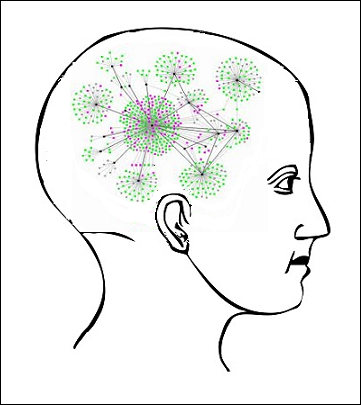
credit for mind map aspect of composite image to valdis krebs

.

Okay, I made my basic point here quite nicely in that little tag-line that gives you the brief overview of each of my posts right next to my name, so I’ll just repeat it here, very slightly amplified for focus:

The different types of “leaders” we identify in AQ should give us an idea of the different mental operations usually in play in the individual minds of jihadists, as well as within the “mind” of the organization itself.

I tried to show how cross-grain thinking in general, and thinking that includes both “subjective” and “objective” realities specifically, might play a considerable role in understanding some pressing contemporary issues in my recent post on Mozart — a figure so removed from those problems that some of you may have skipped it. Here’s my ending, with the Mozart details safely removed:

I think we should track that pattern, know as much as we can of that pattern, write the biography of the way in which some piece of music weaves between inspiration and thought, composer and instrument, mind and matter, performer and audience, studio and home digital music center…

Then, perhaps, we could begin to map other patterns – in some ways simpler and more urgent ones.

The sorts of “simpler and more urgent” patterns I was thinking of there include:

  • how discussions become deliberations and deliberations decisions
  • how scenarios are built and understood and sometimes poorly configured to our later detriment
  • how foreign policy plus feedback loops can create blowback and how to minimize it..
  • and specifically,

  • how the “jihadist” radicalization process moves from floating frustration and shame, via identification of a plausible “other” to rage against, to commitment, then via theology (!!) (for divine sanction of otherwise unpalatable acts) to the recognition of a binding moral obligation (fard ‘ayn in AQ terms) — and thence to camps for training in weaponry and the requirements and subtle limitations on Quranically sanctioned war…
  • **

    That last one has been an interest of mine, sitting in the back of my mind as an unanswered problem, quietly gathering data and forming insights for a while now, under a rubric along the lines of the question:

    Can we figure out a rough map of the workings of the “typical” mind of a potential jihadist as it radicalizes?

    It occurs to me that the leadership of an organization likely maps well to the organization’s functions, and those functions to the thought processes in which members are involved so a map of the aspects of leadership may well give us a rough draft of a mind-map for the individual member, including the passage from uninvolved observer to active participant: the process of radicalization.

    This may seem pretty obvious to some of you, but it’s a fresh idea for me, and to me it’s important because we already map communications networks and organizational flows, but the mind — the individual mind is one place we don’t seem to go.

    So I’m thinking in terms of sketching the mind of a “person” who is in some ways AQ as a whole, considered as if it were one sensate human-like being, filled with the usual variety of thoughts and emotions, ideals and pragmatisms, hopes and fears, hunches and hard data, clarities and confusions.. And I’m thinking of doing this by treating “leaders” as though they were distinct but coordinated processes in a single mind.

    We track and map people and their connections, we track and map groups and their connections, we track and map communications and their connections — are we tracking and mapping memes as such? ideas and their connections? minds?

    If we are already tracking ideas and minds — or if we aren’t doing that yet, but could — I’d be on the lookout for possible positive and negative feedback loops within the system, some that enhance the overall operation and could be disrupted, and some that fragment and damage it and could be amplified.

    So that, among other things, God willing, we could learn better ways to dampen some of the oscillations of hate…

    **

    I was looking at a comment in the recent ICSR report, Al-Qaeda at the Crossroads [h/t @azelin], and ran across this quote which struck me from an oblique angle:

    About ten core leaders have been subsequently killed, including Atiyah Abd al-Rahman, Abu Hafs al-Shahri, Samir Khan, Anwar al-Awlaki, and Abu Yahya al-Libi.

    Let’s take a look at these folk: Atiyah Abd al-Rahman was reported via Bill Roggio at Long War Journal as al Qaeda’s “operations chief” and a major planning a major attack on the US for the tenth anniverary of 9/11, as AQ’s “general manager” and bin Laden‘s “chief of staff”. Abu Hafs al-Shahri was another “operations chief”. Samir Khan was a publicist, the editor of the English-language magazine Inspire. Anwar al-Awlaki was a minor theologian with a talent for publicity and a decent understanding of his American audience…

    And as for Abu Yahya al-Libi, here’s an excerpt from an NYT piece about him:”I call him a man for all seasons for A.Q.,” said Jarret Brachman, a former analyst for the Central Intelligence Agency who is now research director of the Combating Terrorism Center at West Point. “He’s a warrior. He’s a poet. He’s a scholar. He’s a pundit. He’s a military commander. And he’s a very charismatic, young, brash rising star within A.Q., and I think he has become the heir apparent to Osama bin Laden in terms of taking over the entire global jihadist movement.”

    On that telling, al-Libi alone would be almost enough for my purposes — but let’s go with the whole list. The AQ mindset involves courage, poetry, scholarship, punditry and command and control. Specify that the scholarship needs to include theology (AQ at one point sent al-Libi to Mauretania for advanced Islamic studies) as well as strategy and guerrilla warfare (think Abu Mus’ab al-Suri, who was well-read in Taber’s The War of the Flea, Chairman Mao, Che Guevara, and Vo Nguyen Giap), and the significant influences on the jihadist mind begin to swim into focus.

    **

    See, I’m nudging my way to something fairly close to the Lincoln mention in Fred Kaplan‘s Slate piece about Petraeus the other day:

    Toward the end of the war, as the senior planning aide to Army Chief of Staff Gen. George Marshall, Lincoln realized that the Army needed to breed a new type of officer to help the nation meet its new global responsibilities in the postwar era. This new officer, he wrote to a colleague, should have “at least three heads—one political, one economic, and one military.” He took a demotion, from brigadier general to colonel, so he could return to West Point and create a curriculum “to improve the so-called Army mind” in just this way: a social science department, encouraging critical thinking, even occasionally dissent.

    How would we map these mental processes? How would we map the jihadist’s equivalent?

    **

    While I was fishing around for AQ leadership lists in search of an education, I ran across Robert Mackey‘s amusing piece on his NYT blog back in 2010, titled Eliminating Al Qaeda’s No. 3, Again, in which he mentioned as killed or captured claimants to the #3 spot Mustafa Abu al-Yazid, described as “a top financial chief for Al Qaeda” and quotes a colleague as saying “many of Mr. Yazid’s predecessors in Al Qaeda’s No. 3 slot” – from the Bush years alone, he lists Abu Zubaydah, Khalid Shaikh Mohammed, Abu Faraj al-Libbi, Hamza Rabia and Saif al-Adel.

    Okay, we should definitely add “financial chief” to my list above.

    The humorist and the artist in me often lead the more serious analyst in me to insights I’d not otherwise have access to, and since I’m worrying away at the notion that analysis needs to feature both “interior” (mind, heart) and “external” (world) realities, I keep the artistry and humor in my analyses, and hope that makes them more rather than less accessible — so let’s run with the AQ#3 nonsense for a bit.

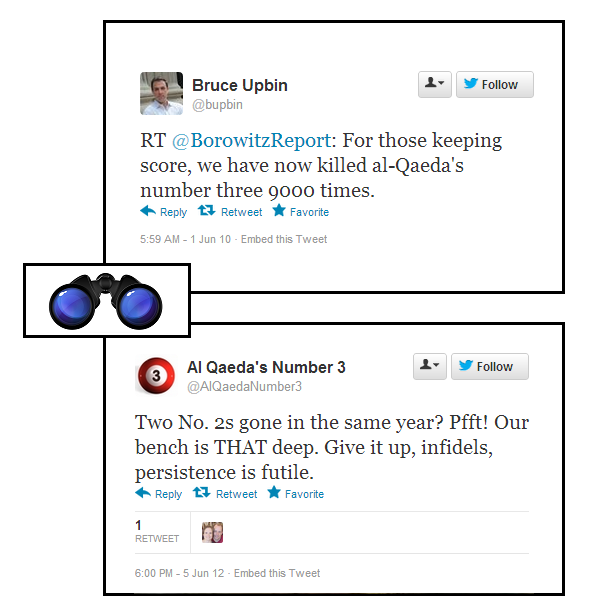
    Mackey’s is a slightly tongue in cheek treatment of a reasonably serious topic. On Twitter the humor gets more incisive, with Andy Borowitz claiming 9,000 AQ#3s have been killed, and AQ#3 in person setting up a twitter account and tweeting merrily away for a while, see the two sample tweets in this SPECS graphic:

    My sources for those two tweets were Bupbin and AlQaedaNumber3.

    To be honest, I find the AQ#3 business both irritating — since it shows how little depth our popular understanding of who we’re dealing with really has — and amusing — because it’s so very ripe for satire…

    **

    I’ve been working at this post so long I’m mentally cross-eyed, so feel free to fill me in or chew me out…

    Quick update / pointer: GR & AZ on prisoner release

    Friday, October 12th, 2012

    [ by Charles Cameron — prisoner releases in Arab springtime, abu Musab and Dr Fadl; Daveed G-R and Aaron Z; two major rules of expertise: detail and humility ]
    .

    video edit-bay photo credit http://www.cdmastercopy.com

    .

    When you watch a well edited movie, the experience is seamless — despite the fact that the film itself was made with hundreds of cuts and splices. Film critics, mavens and the director’s fellow auteurs who make close readings and detailed studies of the film will see and appreciate the juxtapositions and graphic matches, the fine-tuned timing of the edits and the rhythm they give the film — but for the regular viewer, one continuous fabric of story unspools from opening to final credits. The editor’s skill lies in getting the splices right to a degree beyond the perceptual acuity of the audience.

    Similarly, a fine carpenter will often want to make joints that are imperceptible to the client, seeking a sensitivity to changes in height that is an order of magnitude greater than that required for the quick, cheap performance of the same task.

    True expertise is at least one order of magnitude deeper and more self-critical than it needs to be to satisfy a cursory examination.

    **

    Thus when Daveed Gartenstein-Ross and Aaron Zelin tackle the important — and easily overlooked — question of How the Arab Spring’s Prisoner Releases Have Helped the Jihadi Cause in the Atlantic, they offer us both far more than we knew we needed to know, and yet less than they themselves know about the topic, let alone the broader current of jihadist movements of which this particular topic is a single strand.

    It’s a significant topic, though, as their opening paragraphs neatly show:

    The investigation of the devastating Sept. 11 attack on the U.S. consulate in Benghazi, Libya, that killed American ambassador Christopher Stevens — limited as it is by security concerns that hampered the FBI’s access to the site –has begun to focus on a Libya-based Egyptian, Muhammad Jamal (a.k.a. Abu Ahmad al Masri). As a detailed Wall Street Journal report explains, Jamal is notable not only for having fighters under his command and operating militant training camps in the Libyan desert, but also for having recently gotten out of Egyptian prison.

    This latter fact makes Jamal part of a trend that has gone largely unremarked upon in the public sphere since the beginning of the “Arab Spring” uprisings: prisons in affected countries have been emptied, inmates scattering after being released or breaking free. In many cases, it is a good thing that prisoners have gone free: the Arab dictatorships were notorious for unjustly incarcerating political prisoners, and abusing them in captivity. But jihadists have also been part of this wave of releases, and we are now beginning to see the fruits of the talent pool that is back on the streets.

    I recommend it highly, as does at least one other more knowledgeable than I.

    **

    A short piece in the Atlantic is just right for an overview, but not the place to lay out the next level of detail, though — and there are three people in particular whose names I am always on the lookout for, names of people who vanished from public view into some form of imprisonment, and who are of considerable interest to me personally — primarily for their theological significance.

    The first of these is the Imam Musa al-Sadr, whose “disappearance” in Gaddafi’s Libya at the age of 50 in 1978 deprived the Lebanon of an inspiring leader — in a manner that eerily paralleled the ghayba or “occultation” of the Twelfth Imam of the Ithna ‘ashariyah.

    The second would be Sayyed Imam Al-Sharif, aka Dr. Fadl, whose book The Essentials was one of the major works of AQ ideology and the #2 jihadist manual downloaded from the net according to the CTC Atlas (p.10), and who recanted it from Egyptian prison, writing his Rationalizing Jihad in Egypt and the World which so severely critiqued AQ-style jihad that al-Zawahiri felt obliged to pen a 200-page counter-argument. In Dr Fadl’s case, the interest would be to see what he would say if liberated now.

    And my third “person of interest”? That would be Mustafa Setmariam Nasar aka Abu Musab al-Suri, whose massive Call to Global Islamic Resistance is a key document that chides bin Laden for “leading them to the abyss”, says “Al Qaeda is not an organization, it is not a group, nor do we want it to be. It is a call, a reference, a methodology”, and calls for “terrorism created by individuals or small autonomous groups (see Lawrence Wright, The Master Plan). Abu Musab, who may have been released from prison in Syria recently, is of interest to others as potentially the jihadi’s foremost strategist — and to me chiefly because of his use of apocalyptic forecasting in his Call.

    **

    Since their Atlantic piece was a short context-setter rather than a longer analytic paper, I asked Gartenstein-Ross and Zelin — Daveed and Aaron — net acquaintance and friendship is a funny thing, we haven’t worked out the etiquette as yet — about Dr Fadl and Abu Musab, not mentioned in the piece itself but surely not far from their thoughts.

    Twitter, of course, is even more drastically reduced than a piece in the Atlantic, so you can think of their tweeted responses as something along the lines of snapshots of footnotes. Nevertheless, they give me, as an inquiring mind, a quick glimpse of what a couple of those at least an order of magnitude deeper into these things know or conjecture about two people whose names and potential activities we should all keep stashed quietly away on some easily accessible mental shelf.

    Three things emerge from these tweets — how little we actually know, how important what we don’t know may be, and how honest the best analysts are about the limits of their knowledge. I’d tweeted, congratulating them on their piece and saying:

    hipbonegamer: i note no mention of Musab a-S – any idea what’s up with Dr Fadl? Dead? Released? Still held?

    And they responded:

    Aaron Y. Zelin: Details still too murky on Abu Mus’ab and no info on Dr. Fadl.

    D. Gartenstein-Ross: However, I think the question “where is Dr. Fadl, and why haven’t we heard from him?” is important for many reasons.

    D. Gartenstein-Ross: But Aaron is right: I haven’t seen any open source info that speaks to his fate.

    That’s two things at once: not very much, and a great deal.

    **

    So if lesson #1 of this post is that True expertise is at least one order of magnitude deeper and more self-critical than it needs to be to satisfy a cursory examination, lesson #2 must be…

    True expertise never claims knowledge that is one order of magnitude deeper or more exact than is actually known.

    Putting that in other terms: having an accurate mapping of one’s archipelago of knowledges within one’s oceanic ignorance is a highly significant form of meta-knowledge, lacking which one’s knowledges have blurred edges and little definitional value.

    And that in turns means — especially in terms of human intelligence — humility.

    **

    It’s Follow Friday (#FF) on Twitter: @DaveedGR and @azelin are two folks you can follow and trust.


    Switch to our mobile site