zenpundit.com » islamist

Archive for the ‘islamist’ Category

Human Sacrifice and State-Building

Tuesday, April 5th, 2016

[by Mark Safranski / “zen“]

A while back I had a longish post that argued that the mass executions practiced by ISIS drew from the long pagan tradition of ritualistic human sacrifice. Today in the news, some social scientists see evidence of human sacrifice as the catalyst for establishing and maintaining stratified, hierarchical and (usually) oppressive societies:

Human sacrifice may seem brutal and bloody by modern social standards, but it was a common in ancient societies.

Now, researchers believe the ritualised killing of individuals to placate a god played a role in building and sustaining stable communities with social hierarchies.In particular, a study of 93 cultures across Asia, Oceana and Africa, has found the practices helped establish authority and set up class-based systems.

Human sacrifice was once widespread throughout these Austronesian cultures, which used it as the ultimate punishment, for funerals and to consecrate new boats.Sacrificial victims were typically of low social status, such as slaves, while instigators were of high social status, such as priests and chiefs, installing a sense of fear in the lower classes.

….Analysis revealed evidence of human sacrifice in 43 per cent of cultures sampled.

Ritualistic killing of humans was practiced in 25 per cent of egalitarian societies studied, 37 per cent of moderately stratified societies and 67 per cent of highly stratified societies.The researchers constructed models to test the co-evolution of human sacrifice and social hierarchy and found that human sacrifice stabilises social hierarchy once the system has arisen. They said it also promotes a shift to strictly inherited class systems, so that people of a high social class will continue to stay important over time, because of ritualistic killing.

‘In Austronesian cultures human sacrifice was used to punish taboo violations, demoralise underclasses, mark class boundaries, and instill fear of social elites  – proving a wide range of potential mechanisms for maintaining and building social control,’ they wrote. ‘While there are many factors that help build and sustain social stratification, human sacrifice may be a particularly effective means of maintaining and building social control because it minimises the potential of retaliation by eliminating the victim, and shifts the agent believed to be ultimately responsible to the realm of the supernatural.’

Supernatural forces….like for example, because Allah wills it.

This Austronesian study conclusions sounds remarkably similar to the role of (allegedly) Sharia sanctioned horrific punishments meted out by ISIS and fetishistically recorded and widely disseminated in video propaganda. A religiously ritualistic rein of terror as a mechanism to reengineer Sunni Arab society in areas under the group’s control and cement the state-building efforts of ISIS.

For details of ISIS use of extremely ghoulish violence for propaganda and state-building, I heartily recommend ISIS: the State of Terror by Jessica Stern and J.M. Berger.
Terror Is Glamour as War is Game

Friday, March 18th, 2016

[ by Charles Cameron — on the necessary simultaneity of temporal and eternal perspectives ]
.

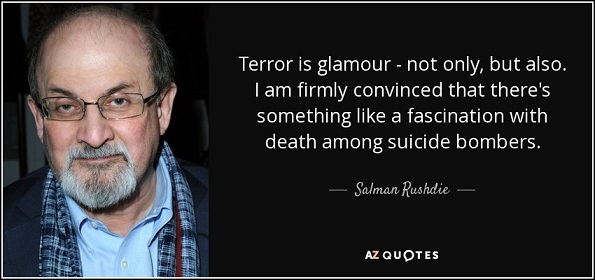
quote-terror-is-glamour-salman-rushdie

**

First as to glamour -– it may help to reflect that glamour, our word, comes not from Vogue but from the same origins as grammar (referring to languages) and grimoire (a book of spells, spelling also being a matter of language), and means something along the lines of “luminous illusion”. If we say terror is glamour, then, we mean that it “casts a spell” — and thus creates an appealing, indeed compelling, mirage. It lies, then, in the realm of magic, image, imagination, so ably delineated by Ioan Couliano in his great book, Eros and Magic in the Renaissance.

The best of contemporary advertising draws on precisely the same Renaissance principles of persuasion — principles of extraordinary power which we nowadays tend to dismiss as “magical thinking”.

**

Thus Virginia Postrel, in Terror Is Glamour:

Glamour can sell religious devotion or military glory as surely as it can pitch lipstick or island vacations. All promise a way to transcend our everyday circumstances, to experience more and become better than ordinary life allows. All invite us to imagine escape and transformation.

Postrel continues:

From Achilles and Alexander to “national greatness,” the glamour of battle is remarkably persistent. So is the glamour of martyrdom, as any trip through a Western museum or perusal of a Lives of the Saints (or its Protestant equivalent) will demonstrate. Nor is martyrdom’s appeal to Christians merely historical, as Eliza Griswold reported in this 2007 TNR piece.

Glamour appeals to our desires, whatever they may be, and Jihadi glamour offers something for everyone: from historical importance to union with God, not to mention riches and beautiful women.

Postrel then quotes Egyptian cleric Hazem Sallah Abu Isma’il, indicating that the “beautiful women” in question are “black-eyed virgins” from a world conceptually above our own:

If one of these virgins were to descend to this world, her light would extinguish the light of the sun and the moon. That’s how beautiful she is.

Yet as Postrel comments, “glamour proves perishable”:

As Rushdie suggests, of course, glamour always leaves something out, in this case the literally gory details of the act .. Either aspirations change, entropy and boredom set in, or the audience learns too much, destroying the mystery and grace on which glamour’s beautiful illusion depends.

She concludes with a significant question and preliminary response:

How do we puncture the glamour of Jihadi terrorism? The first step is recognizing that such glamour exists.

That may seem like CVE 101, but the deeper our understanding of magic, imagination, image — and hence the power of glamour — the deeper our understanding of the deep problem that CVE presents will become.

**

Next we turn to Richard Fernandez, writing in A Bellyful of War, picking up the themes of war’s attraction, and the carnage its glamour omits from mention, and tying both to the notions of war as game and war as brutal reality:

William Tecumseh Sherman understood what many modern theorists have forgotten: war can be attractive to young men for as long as long as it remains a game. War in small doses is supremely thrilling, even glamorous. It is peace which can be routine and boring.

And so it goes until war stops being a game and the going gets really rough. “Its glory is all moonshine,” said Sherman. “It is only those who have never heard a shot, never heard the shriek and groans of the wounded and lacerated … that cry aloud for more blood, more vengeance, more desolation.” To Sherman a “bellyful of war” was ironically the psychological foundation of generational peace.

Not only is that last sentence a profound statement worthy of the contemplation of all who love peace – it is also far more subtly convincing than the old Strategic Air Command motto, Peace is Our Profession, which sounds more like one of Rochefoucauld’s tributes that vice pays to virtue than anything, and yet is presumably intended to convey the same insight.

**

Finally we have Plotinus, for whom – in a manner richly echoed by Shakespeare — life itself is a dream, a play, a sport, a game:

Murders, death in all its guises, the reduction and sacking of cities, all must be to us just such a spectacle as the changing scenes of a play; all is but the varied incident of a plot, costume on and off, acted grief and lament. For on earth, in all the succession of life, it is not the Soul within but the Shadow outside of the authentic man, that grieves and complains and acts out the plot on this world stage which men have dotted with stages of their own constructing. All this is the doing of man knowing no more than to live the lower and outer life, and never perceiving that, in his weeping and in his graver doings alike, he is but at play; to handle austere matters austerely is reserved for the thoughtful: the other kind of man is himself a futility. Those incapable of thinking gravely read gravity into frivolities which correspond to their own frivolous Nature. Anyone that joins in their trifling and so comes to look on life with their eyes must understand that by lending himself to such idleness he has laid aside his own character. If Socrates himself takes part in the trifling, he trifles in the outer Socrates.

Plotinus is correct, I would suggest, sub specie aeternitatis, just as is Sherman sub specie incarnationis — and it is the role of the artist to hold both visions, trivial and eternal, as Koestler suggests.

**

I am again grateful to David Foster for his ChicagoBoyz post The Romance of Terrorism and War which triggered this exploration and the one on Getting Deeper into Koestler which preceded it.

New Book ! Global Radical Islamist Insurgency

Friday, February 19th, 2016

[by Mark Safranski / “zen“]

Torn from the pages of Small Wars Journal…..

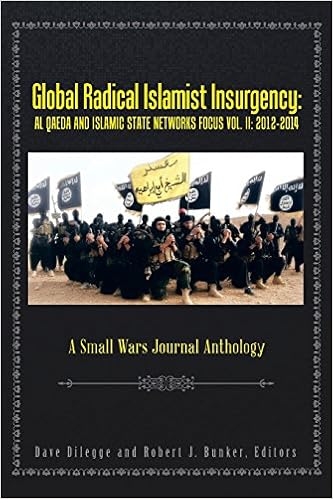
Global Radical Islamist Insurgency: al Qaeda and Islamic State Networks Focus Vol. II 2012-2014  edited by Dave Dilegge and Robert Bunker

New and looking to be very useful. Right up the alley for our own Charles Cameron and friends of ZP blog like Tim Furnish and Leah Farrell. Another one,  Daveed Gartenstein-Ross has written the foreword.

From SWJ:

….This anthology-the second of an initial two volume set-specifically covers Small Wars Journal writings on Al Qaeda and the Islamic State spanning the years 2012-2014. This set is meant to contribute to U.S. security debates focusing on radical Islamist global insurgency by collecting diverse SWJ essays into more easily accessible formats. Small Wars Journal has long been a leader in insurgency and counterinsurgency research and scholarship with an emphasis on practical applications and policy outcomes in furtherance of U.S. global and allied nation strategic interests. The site is able to lay claim to supporting the writings of many COIN (counterinsurgency) practitioners. This includes Dr. David Kilcullen whose early work dating from late 2004 “Countering Global Insurgency” helped to lay much of the conceptual basis focusing on this threat and as a result greatly helped to facilitate the writings that were later incorporated into these Al Qaeda and Islamic State focused anthologies. This volume is composed of sixty-six chapters divided into sections on a) radical Islamist OPFORs (opposition forces) and context and b) U.S.-allied policy and counter radical Islamist strategies.

The editors are well known to many ZP readers with Dave being SWJ Editor-in-Chief while Dr. Bunker is the Futurist in Residence for the Strategic Studies Institute. Somewhere along the line though, I somehow completely missed the roll-out for Volume I.  Guess my review copy was lost in the mail….cough 🙂 I will be ordering both.

In all seriousness, I’m very glad to see the valuable work done by the editors and contributors at SWJ compiled into book form. Small Wars Journal is literally a national resource of military thinking, theory and open debate that operates on a shoestring and love of country ( consider making a tax deductible donation here).

Quick note pending review: Tim Furnish

Monday, January 18th, 2016

[ by Charles Cameron — slowed down by health issues, but getting there ]
.

furnish x 2

A quick announcement from Tim Furnish:

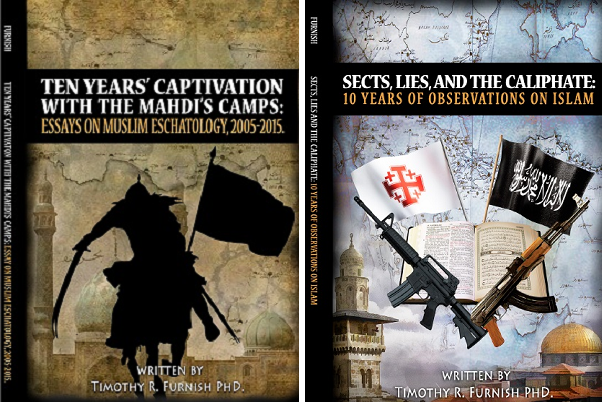
The second of my complementary volumes on Islam and Islamic world issues is finally up on Amazon, albeit at this point only in Kindle format. Sects, Lies, and the Caliphate: 10 Years of Observations on Islam is the follow-on to Ten Years’ Captivation with the Mahdi’s Camps, which came out in November 2015. The latter focused entirely on Islamic eschatology and apocalyptic movements (especially ISIS and Iran); the new one, on the other hand, deals with more mundane, but no less important, issues–such as the Islamic roots of ISIS and Muslim terrorism, how Christianity is indeed more peaceful and less problematic than Islam (not to mention being true), and, in the longest section (some 86 pages), on mostly failed US policies toward Islam and the Islamic world over the last decade.

I shall be reviewing both books when time permits, but wanted to let you know both are now available.

Tim’s previous book, Holiest Wars: Islamic Mahdis, their Jihads, and Osama bin Laden (Praeger, 2005) is more scholarly — it’s Tim’s doctoral dissertation-turned-book. These two books bring us up to date on Tim’s thinking since then.

Early notes on McCants’ The ISIS Apocalypse

Sunday, November 29th, 2015

[ by Charles Cameron — a couple of grace-notes while I’m working on my review of Will McCants‘ book, The ISIS Apocalypse ]
.

One:

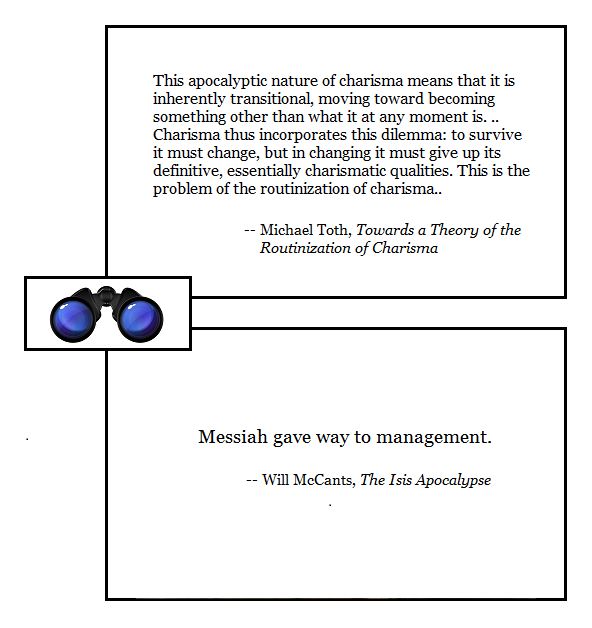
My first note concerns the elegant way in which McCants‘ view of the changing state of IS eschatology as it has developed in practice conforms to Max Weber‘s theory of the routinization of charisma:

SPEC DQ Weber McCants

Toth, Toward a Theory of the Routinizationnof Charisma
McCants, p 147

**

Two:

There are four sentences that fall in series in Will McCants’s Conclusion — three of a kind followed by one with a different quality to it. Each one ends a section, and the last ends the Conclusion as a whole:

  • This is not Bin Laden’s apocalypse.
  • This is not Bin Laden’s insurgency.
  • This is not Bin Laden’s caliphate.
  • This may not be Bin Laden’s jihad, but it’s a formula future jihadists will find hard to resist.
  • The relevant pages respectively are pp. 147, 151, 153, and 159.


    Switch to our mobile site