Five Questions: An Interview with Chief Ajmal Khan Zazai
Thursday, December 24th, 2009
Those of you who also regularly read Steven Pressfield’s site, It’s the Tribes, Stupid have come across his interview series with Ajmal Khan Zazai, elected paramount tribal chief of his home district in the Zazi valley of Paktia province in Afghanistan ( near Tora Bora and bordering Pakistani Waziristan). Chief Zazai fought in the Soviet War and at one time, was imprisoned by Pakistan’s ISI. On March 15, 2000, the Taliban assassinated Chief Zazai’s father, Chief Raiss Afzal Khan Zazai in his family house in Peshawar, Pakistan.
As paramount chief, Chief Zazai raised a Tribal Police Force that is presently working with the U.S. Army’s 10th Mountain Division to secure the Zazi valley. Chief Zazai’s force has come under attack, as insurgents have fought to stop his efforts. His commander, Amir Muhammad, has personally survived several assassination attempts in the last several months. On two occasions in 2008, warlord-financed hit men attempted to assassinate Chief Zazai. One attack nearly succeeded, leaving several wounded and one man dead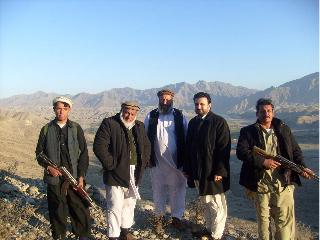
Steve cordially arranged for me to ask Chief Zazai a few questions via email regarding his perspective on the historical background of the war against the Taliban and the current situation in Afghanistan. My questions are in bold type and Chief Zazai’s answers are in normal text:
FIVE QUESTIONS: AN INTERVIEW WITH CHIEF AJMAL KHAN ZAZAI:
1. Some American academics have argued that the day of “the tribe” is long past in Afghanistan, having been battered by governmental intrusion and war since at least 1978, and that a better understanding of Afghan identity for Americans is to look at the “Qaum” and other very local loyalties. How accurate is that description?:
“Qaum” means “Tribe” in Pashtu and also in the Dari Language.
The 1978 coup was not the first bloody revolution Afghanistan saw, as I have said on many occasions, Afghanistan has gone through many turmoils and turbulences throughout its history and has survived as a nation and country. For one to get convinced that after the 1978 Red revolution that the tribal structure was gone for good, then one would also have to argue how this tribal structure survived till 1978 when Ghengis Khan burned almost half of Afghanistan? What about Hulagu Khan, Tamerlane, the Persian empire, the Mughals and prior to all that Alexander the Great? [The tribes ] having seen all these bloody empires and survive untill 1978 is amazing, isn’t it?
To justify the argument simply by referring to the 1978 bloody Red revolution and claim the tribal structure was gone, is dead and has vanished in Afghanistan, would simply be ignorance and a lack of understanding of the rich Afghan culture and Afghan way of life.
The Bonn Agreement appointed Hamid Karzai for 6 months as an interim President of Afghanistan back in 2002. When 6 months passed, did the UN or US call for election? No, of course not. Who then who appointed Mr. Karzai as a President for 2nd time to be the President of the transitional government? It was the “Loya Jirga” and not through the election process. A Loya Jirga is a pure Afghan Tribal process and procedure of making things happen!
Let’s take a look at how the current Afghan Constitution was approved and came into an effect:
The constitution of Afghanistan was not approved by the Afghan Parliament and Senate as the Parliament and Senate did not exist at the time. In fact the constitution was approved by the “Loya Jirga”; although there was a large presence of the Warlords and criminals in both those Loya Jirgas, nevertheless they served their purpose.
Now, why would one argue that the tribal structure does not exist in Afghanistan or it’s a thing of the past? Closing our eyes from the truth does not mean the truth would vanish. We have a phrase in Pashto which means “One can not hide the sun with just two fingers”.
If one believes they need to find local loyalties in Afghanistan, the locals are the tribes. Why would some go around in [semantic] circles and confuse themselves?
2. In your interviews with Steve Pressfield, you discussed the presence of warlords in the Afghan government of Hamid Karzai, men with very bad records. There have also been reports in the media, from time to time, of Ex-Khalqi Communists serving the regime. Are these men a similar problem to the warlords in your view?
When the Russians withdrew their forces in 1989 and left behind the Communist regime of Dr Najibullah, many thought that the regime would collapse in just days or in weeks, but Najibullah’s government survived for five long years despite the daily rains of rocket attacks on Kabul and only collapsed in 1992. Then the so-called Mujahideen took charge of Kabul and Afghanistan, but soon we saw that these power hungry men started fighting each other over the Throne of Kabul. Their bloody civil war of lasted from 1992 untill 1996 and turned Afghanistan into a pile of rubble.
Many Afghans were turned against these so-called Mujahideen because these leaders and their commanders became involved in killing innocent men, women and children, looted people’s livelihoods and literally turned all of Afghanistan into a war zone. We witnessed that in just five years these “Mujahideen” warlords destroyed Kabul and all other major cities in Afghanistan. People started to hate them more than they hated the old Communists, so in a way, the crimes which were initially committed by the Communists were covered up when the Afghan people witnessed the subsequent brutality of these so-called Mujahideen leaders and commanders.
I strongly believe the Afghan civil war was also orchestrated by the KGB/FSB in order to engage these Freedom fighters in Afghanistan and prevent them from crossing over to infiltrate the [formerly Soviet] Central Asian States, and also to cover the atrocities committed by the Red Army against the Afghans in Afghanistan. The KGB/FSB calculated shrewdly that if these “Mujahideen” leaders accomplished a united Islamic government in Afghanistan, it would spill over into the entire Central Asian countries. Although many believed in the West at the time that Russia was almost finished and gone, that was a mistake Westerners made in trying to understand the Russian mind set.
I strongly believe that the Afghan Communists are responsible for the destruction of Afghanistan. They still have the Marxist-Leninist theory in their heads and we recently have witnessed that many of these Afghan ex-Communists are keeping close ties to Moscow. I believe these Khalqis and Parchamis are now part of the problem as they are now receiving support from Russia.
3. Afghanis, especially Pushtuns, have a well-deserved historical reputation as fierce fighters. Yet there is more to life than war, even in a warrior society. What does a young Afghan man in his late teens or twenties hope for? What would he see as “progress” or better times?
Much is been said about the Afghans, Pashtuns in the media and honestly I disagree with much of it because no nation, no tribe no people wish for a war as war only brings devastation, destruction and miseries.
Yes, the Afghans are great fighters, but that does not mean they wish for a war all their life. We needed to fight against the Russian invasion and I still strongly believe we have done the right thing defending our country and nation against Communism; as I said earlier, things went wrong when these so-called Mujahideen or Freedom fighters leaders started fighting one another. I believe every Afghan wishes for peace and stability in Afghanistan. Yes there are some who will continue fighting, but we all know they are small in numbers and are not significant. The reason many young men are part of the Taliban and other insurgents is the lack of employment , lack of better life conditions and of course lack of any positive attention from their government in Kabul. At this moment if you ask me, why are these young men are turning to Taliban and are fighting the US, NATO and the Afghan government? You will hear a simple answer from me and that is lack of employment opportunity for these youth who are mostly uneducated.
I will tell you my own experience: I was only 16 when I used to go to Afghanistan from Pakistan from time to time to fight against the Russians. I knew the consequences of being killed, but I was not going to Afghanistan in order to be killed, I was going to Afghanistan to fight the Russians. Now things are opposite, many young men are brainwashed by evil men and these young men wish to die, that’s why there are many suicide attacks now. I remember very well in my days when we were busy fighting the Russians, that we never had suicide bombers. This is very new to us and it has been brought form outside Afghanistan.
I believe the Afghan government and the US/NATO should provide training programmes to all those young Afghan men at around age of 16 and above who have lost the chance to go to school and get education. By learning skilled trades, I believe they will be in a position to earn a loaf of bread for themselves and their family and in this way we will prevent many young men from falling in the trap of believing being a suicide bomber means a life in the hereafter with the 72 virgins which will await them at the corridor of heaven.
4. You have spoken at length with Steve Pressfield about the 10th Mountain Division and your positive relationship with them. How successful have American and NATO units been in making connections elsewhere with Afghan tribal leaders compared to the 10th Mountain Division?
I do not have any information to the regard that if the US Army has any close contacts with other Tribal leaders. In my case, I have pushed hard for this partnership, regardless of any obstacles that were created for us to even have a decent understanding, but now it seems to be working. In the entire Afghanistan, I am the first Tribal Leader who denounced the Taliban and Al Qaeda openly and more practically, by forming TPF (Tribal Police Force) from my Tribesmen to fight these evil men without any financial assistance from the US Army, US Government, NATO or the Afghan Government. My TPF programme is by the people and for the people – I think it is on the same lines of your democracy “By the people and for the people”!
5). A friend of mine, the strategist Thomas PM Barnett, has been advocating a much greater international presence in Afghanistan, including not just NATO but China, Russia and India, with direct business investment as well as providing military and civilian aid workers. Would this development be a welcome one?
I believe this is a positive step in bringing a broader coalition and the entire International community to help and be involved in Afghanistan; but although this approach might be purely for business purposes, it could pose a future problem as most of these nations are not very sure of the US and NATO policy in the long term and present intentions. Afghanistan has always maintained very good and close relations with India, and throughout this friendship, India had no political ambitions and that what made India look good until the 90’s when India supported the Northern alliance. [As a result] I believe India has lost that status of being a neutral friend of Afghanistan. Also, the growing presence of Indians in Afghanistan is sending some disturbing alarms to our immediate neighbor (Pakistan).
Things needs to be balanced and Afghanistan needs a better understanding [of FDI] and not just bringing in anyone which could only lead to disruption and anxiety in long term. As an example, the large copper mines in Logar Province were won in a biding by a Chinese company – later it was revealed that the Chinese paid large kick backs to the minister of mines. In my opinion, involving more Chinese and Russian corporations would mean more corruption in Afghanistan.
Russian firms are already involved in Afghanistan. Most of them are involved in espionage and there are Chinese corporations and I believe they are doing the same. It would be more fruitful [for Afghans] for your friend to encourage Western corporations and companies to invest in Afghanistan.
Thank you, Chief Zazai.
 by Dr. Jim Storr
 that theory to the design of organizations, staffs, leadership, information management and the creation of cohesion in units. In doing so, he takes on many currently popular theories such as Effects-Based Operations, the observe-orient-decide-act loop, the use of postmodern theory and language.
 – Mark Safranski (Ed.)


 – Michael Tanji (Ed.)
 – Thomas P.M. Barnett
 – John Robb
 – Frans Osinga


 by Howard Bloom
 by Richard Nisbett
 by Jeffrey Carr
 by Samuel Logan

