zenpundit.com » America

Archive for the ‘America’ Category

Burning scriptures and human lives

Tuesday, April 5th, 2011

[ by Charles Cameron ]

*

Which is more sacred? You own life? Or an ideal you would be willing to die for?

I ask this, because we often think, act and speak as though one human life, any human life, is automatically more sacred, more to be preserved, than any idea – or book.

We make allowances, to be sure, and “thou shalt not murder” is no doubt closer to the Hebrew than “thou shalt not kill” – but we tend to think of human life as a paramount value, and in this we have the support both of our legal code (“murder one”) and of many scriptures, including the Qur’an, which declares, “whoso saveth the life of one, it shall be as if he had saved the life of all mankind” (for details, see below).

And I also ask this because Martin Luther King said, “If a man hasn’t discovered something that he will die for, he isn’t fit to live” — and even if I find MLK’s exact phrasing a little strange, I think I know what he’s getting at.

Somehow, then, I think we can agree that there may at times be good reasons to value something that’s not a human life but an ideal of some sort more than one’s own life itself, but that in general, a human life, any human life, is of comparable worth to one’s own.

.

One:

Which brings me to this thought experiment – a list of rhetorical questions designed to elicit thought, not to be answered like a questionnaire…

how-sacred-is.gif

.

Two:

These are rhetorical questions, and I’m asking them for specific reasons.

Under Islamic theology, for instance, the Qur’an cannot be destroyed, since it says of itself (Sura 82, al-Buruj, 21-22:

Surely this is a Glorious Qur’an, inscribed on an Imperishable Tablet.

It is physically possible to burn a physical “copy” [mushaf] of the Qur’an in book form— one particularly obnoxious pastor in Florida has recently done so, although he had been warned in advance by GEN Petraeus:

the safety of our soldiers and civilians would be put in jeopardy and accomplishment of the mission would be made more difficult.

— and the Muslims who recently bombed a Sufi shrine in the Punjab no doubt burned more than one such copy / mushaf, hence my final question in the list above.

.

Three:

I could add many other questions to the list — for instance:

  • For Protestants: How precious is the Saving Blood?
  • For Catholics: If someone bombs a church in which the Mass is being celebrated, does that destroy the Marriage Feast of the Lamb of which every Eucharist is a foretaste?
  • And if someone assassinates the priest while he is “in persona Christi” (in the person of Christ) celebrating Mass, does that kill Christ (again)?

That last, I should add, did in fact happen, not only more recently to Archbishop Romero in El Salvador, but also, several centuries ago, in the little parish church of the village of Brightwell-cum-Sotwell near Oxford where I was raised — and is commemorated there by a brass which reads:

Here lyeth the body of Master John Scoeffyld who died on the 15th day of the month of May in the year of our Lord 1507, on whose soul may God have mercy, Amen

So you see, I have a personal interest in these things…

.

Four:

As to the value of a human life, opinions vary…

Some humans feel the need to hold ethical discussions before wantonly taking other human lives:

For weeks, they had weighed the ethics of bagging “savages” and debated the probability of getting caught. Some of them agonized over the idea; others were gung-ho from the start. But not long after the New Year, as winter descended on the arid plains of Kandahar Province, they agreed to stop talking and actually pull the trigger.

Mark Boal, The Kill Team, Rolling Stone, March 27, 2011

Around two percent of the human race is psychopathic, I’ve read, and most of us can be strongly tugged and swayed by peer-pressure, this was wartime — the pressure-cooker of souls — and whatever got into those men could very likely get inside me, too.

Who’s to say I wouldn’t buckle under pressure like that?

.

Five:

But I’m at peace, here, philosophizing.

One could perhaps be forgiven for thinking the US values the loss of “two sons, two daughters and one grandchild” to an Afghan villager in Gardez at two sheep, because that’s all the payment that’s mentioned in a 2-page ABC News article about VADM William McRaven‘s visit to the village, in which he offered to sacrifice one of the sheep at the door by way of asking for forgiveness, as is customary among the Pashtun. That ABC report, however, was based on and cited a first-hand report in the London Times, which mentions also that the Afghan generals present “gave the family a wad of cash wrapped in a handkerchief. Relatives said there was almost $30,000 (£19,000).” The ABC version omitted that part… That’s a bit better than a couple of sheep – but even so, two sons, two daughters and a grandchild?

Look, that’s better than what the German Bundeswehr is willing to pay for the victims of an admitted bombing error in Afghanistan that killed a hundred or so people, perhaps five of whom were Taliban. From another ABC News report, worth reading in its entirety:

Now the Bundeswehr will be paying $5,000 — not for each life that was lost, but to each family of a victim or multiple victims. In other words, all families will receive the same compensation, no matter how many of their members were killed in the Kunduz bombing.

.

Six:

But, you know – no mention there of the sacred, except perhaps in VADM McRaven’s exemplary gesture.

So let’s go back to some religious authorities…

There is the Mishnah (Sanhedrin 4) teaching:

Therefore man was created alone to teach you that whoever destroys a single life from Israel, is considered by Scripture as though he destroyed an entire world; and whoever preserves a single life from Israel, is considered by Scripture as though he had preserved an entire world.

Some would argue that the qualification, “from Israel” renders this passage less than universal in its implications — yet the same passage goes on to say, without making any distinction between Jew and Gentile:

the Supreme King of kings, the Holy One, Blessed is He, fashioned each man in the mold of the first man, yet not one of them resembles another. Therefore, every single person is obliged to say: The world was created for my sake.

That would appear to cover every created human being… and that is clearly the sense of the Qur’an, in Sura 5, al-Maeda, 32:

We decreed for the Children of Israel that whosoever killeth a human being for other than manslaughter or corruption in the earth, it shall be as if he had killed all mankind, and whoso saveth the life of one, it shall be as if he had saved the life of all mankind.

Less generous and more specific, alas, is the Shafi’i jurist Ahmad ibn Naqib al-Misri, who writes in his Reliance of the Traveler:

The indemnity for the death or injury of a woman is one-half the indemnity paid for a man. The indemnity paid for a Jew or Christian is one-third of the indemnity paid for a Muslim. The indemnity paid of a Zoroastrian is one-fifteenth of that a Muslim

.

Seven:

I’ve already admitted that if the pressure were sufficient I might buckle – what about inspiration, how strong could I be if need be, how high do I reach?

So.

I ask myself: how much suffering am I ready to take on myself, to save the life of a child dying of leukemia in some country far from my home? And if my actions to date are anything to go by, my answer must be: not much.

That’s my walk.  Here’s the talk I talk.

Life is infinitely complex and rich in nuance — dappled, as Hopkins says, with swift, slow; sweet, sour; adazzle, dim

The value of one human life is the value of the world. The Qur’an is indestructible. It is deeply inadvisable to threaten, attempt or facilitate the destruction of man, world, or book:

He fathers-forth whose beauty is past change: Praise him.

On Libya

Friday, April 1st, 2011

I thought it might be interesting to look at some views of the Libyan War and then offer some remarks of my own. Of course, readers are encouraged to read each source in full rather than just my excerpt: First up….

CNAS (Andrew Exum & Zachary Hosford)Forging a Libya Strategy: Policy Recommendations for the Obama Administration

….The most dangerous outcome for the United States is also the most likely, which is a stalemate that prolongs U.S. and allied military intervention in Libya. The relative lack of sophistication and organization among rebel fighting forces means they may be unable to regain the momentum in Libya and defeat Gadhafi’s forces in open combat absent significant direct and indirect support from U.S.and allied militaries – which is not explicitly authorized by UNSCR 1973 and might not be supported by the U.S. Congress.

A stalemate in Libya would effectively result in a de facto partition of the country with a severely underundergoverned and disorganized safe haven in eastern Libya for the rebels that could provide refuge for various militant and criminal groups capable of exporting violence and instability to other countries in North Africa and the Middle East. Such a scenario would prolong U.S. and allied military intervention as only a major Western investment in developing the independent governance, economic and security force capacity of eastern Libya would be likely to forestall this outcome. However, such an investment is highly unlikely due to the overarching fiscal constraints facing the United States and NATO countries and competing priorities.

Nice work on a very important policy brief by Exum and Hosford. This one was “tight”, written to the point, properly focused on strategic variables rather than getting bogged down in debatable specialist minutia and delivering clear policy option scenarios. Written in exactly the right mode for a White House/NSC staffer or deputy to SEC to digest and disseminate to their boss or peers. Kudos, gents.

I think Ex and Hosford have correctly diagnosed Libya as a potential albatross for the US from which we stand to gain very little benefit even in the best case scenario. I disagree with their assertion that it would be a tolerable outcome to leave Gaddafi in power. No, that ship has already sailed and we have had enough Lockerbies. To imagine that there will not be ongoing blowback from a rump Gaddafi regime in a fragile neighborhood with which the US will repeatedly have to deal is just not at all realistic.

The Allies badly wanted Gaddafi out. They will have to be pressured now to follow through and the US needs to make it clear that we will neither babysit an enraged, cornered, Gaddafi for the next seven years, tying down an aircraft carrier group and costing the US taxpayer billions, nor we will accept the Brits and French hanging Gaddafi’s triumphant survival on our doorstep as an “American defeat” while skating away diplomatically (which is their Plan B if we refuse to do a Panama type operation for them). They will have to finish the job on the ground themselves and ensure Gaddafi’s death or departure with our support, but not the reverse. Or Paris and London can help build a real rebel army, salted liberally with PMC units and SOF “advisers” to stiffen spines.

CRS Report ( Christopher M. Blanchard) – Libya Unrest and US Policy

….The complexity of these factors and the stress that ongoing fighting places on their interrelationships creates challenges both for Qadhafi supporters and opposition groups. As both parties seek to navigate the political waters of the upheaval and look ahead to potential postconflictscenarios, they face difficult questions about current tactical choices and future means for promoting national reconciliation and governing effectively.

For the opposition, the question of foreign military intervention is complicated by opposition leaders’ desire for external assistance and their appreciation for the strong nationalist, anticolonial sentiment shared by most Libyans. Internally, political differences and competing demands among the opposition’s constituent groups may complicate the maintenance of a united front against Qadhafi counterattacks and complicate efforts to speak with one voice in dealings with the international community. Other regional examples suggest that such internal differences may prove even more challenging for any transitional authority in the aftermath of the conflict…

In a sea of government waste and middling competence, the Congressional Research Service stands out as a gem, giving the taxpayers a tremendous informational “bang for the buck” in reports prepared by experts on a vast array of subjects. While not an advocacy piece, the report is a valuable “backgrounder” on the Libyan War of a kind that you cannot get from the MSM.

Marc Lynch – Why Obama had to act in Libya

….And my conversations with Arab activists and intellectuals, and my monitoring of Arab media and internet traffic, have convinced me that the intervention was both important and desirable.  The administration understood, better than their critics, that Libya had become a litmus test for American credibility and intentions, with an Arab public riveted to al-Jazeera.  From what I can see, many people broadly sympathetic to Arab interests and concerns are out of step with Arab opinion this time.    In the Arab public sphere, this is not another Iraq — though, as I’ve warned repeatedly, it could become one if American troops get involved on the ground and there is an extended, bloody quagmire.  This administration is all too aware of the dangers of mission creep, escalation, and the ticking clock on Arab and international support which so many of us have warned against.  They don’t want another Iraq, as Obama made clear…. even if it is not obvious that they can avoid one. 

Lynch is an Arabist, and while the internet traffic aspect is skewing the demographic, al-Jazeera coverage is a dominant information effect in Arab public with limited literacy. It is sort of the Walter Cronkite effect from the 60’s in play again, if the primary trusted source is broadcasting an interpretation, it takes on the air of truth for a majority of viewers. That said, it matters very little whether al-Jazeera is giving kudos to the US if the average rebel can’t fire an RPG, quickly unjam and reload his AK-47 under fire, get water or food in the field or dig simple trench and sandbag defenses. Guys milling about nervously out in the open road, brandishing weapons and arguing amongst themselves will get their clocks cleaned by any opponent with even marginal military training and leadership. Gaddafi’s military forces are fourth rate – this is not Saddam’s army of 2003, much less of 1991 – but they can handle untrained and leaderless groups easily enough.

Which brings us to…..

Thomas P.M. BarnettArming the Libyan rebels

…There’s also al-Qaeda in the Islamic Maghreb (AQIM), but that group has frankly struggled to be taken seriously as a force, as it’s mostly a relabeling of an existing group that was going nowhere (bigger the territory in the title, more likely, in my mind, that it’s not exactly succeeding anywhere). Up to now, no one has portrayed that group as Libyan-centric.  Yes, they will show up, but that’s standard.  The reality, as noted in the piece, is that you have to train on what you provide, so we’ll have people on the ground (besides the CIA already there).  If things go really sour, then we burn that bridge when we come to it.  But this is not a logical showstopper.  A Libyan long divided in two and suffering civil conflict will do the same – or far better – for AQIM than a concerted arms push to dethrone the guy.  So, again, factor them in as the cost of doing any sort of business here, but do not elevate them into the decision-tilting bogeyman, because they’re not, and speculating in the press doesn’t make them so.

Going the Reagan Doctrine route was my original preference on Libya and I am still in favor of sponsoring an insurgency war against Gaddafi, with a couple of caveats.

First, SECDEF Robert Gates’ strong aversion to doing this gives me some pause, given his background as a former head of the IC and his access as SECDEF to our best current intelligence (which, admittedly, may not be that much). His judgment should be given considerable weight. Secondly, where are the Arabs? A hundred or so experienced NCO’s and junior officers from Egypt and KSA would be of immense help in establishing unit discipline and basic training for the rebels. The Saudis very well might be contributing substantial amounts of cash but that’s no longer good enough. The Arab League needs to show it’s alleged support for helping the rebels and removing Gaddafi with boots and not just empty words.

Reflexively, American policy makers face a great temptation to “own” the crisis and micromanage the Libyan War against some impossibly unrealistic standard of success. Let’s resist it. We should help drive nails in Gaddafi’s coffin but we don’t need to be the main hammer. Sometimes less is more and the Libyan rebels getting rid of their tyrant badly is better than us doing it for them well.

Pity America the Un-Philosophical

Tuesday, March 29th, 2011


I attempted to leave a short amusing response at Foreign Policy.com but was thwarted by their comment system, so I am writing a pedantic post here instead.

Joshua Keating, bursting with admiration for Bernard-Henri Levy, laments the lack of enlightenment of American politicians compared to their much cooler French counterparts:

Libyan intervention: Brought to you by Bernard-Henri Levy?

….I was going to write some kind of quip along the lines of, “Can you imagine President Obama taking phone calls from [American philosopher] in the oval office while he debates whether to send U.S. troops to war,” but I can’t even think of a name for whom that joke would make sense. 

France and Germany have a tradition of publicly engaged philosophers that’s pretty much alien to the United States. The idea of an American BHL or even Jurgen Habermas seems pretty laughable. Economists like Paul Krugman are the go-to public intellectuals here while philosophy has become an increasingly specialized and technical discipline, even within academia. What effect the prominence of philosophers in public life has on a country’s political culture and policies is a pretty promising subject for further research.

Heh. 

Philosophers have never had much of an impact on American public life and the politics of their times except…. maybe…. for William James, Reinhold Neibhur, John Dewey, Leo Strauss, Walter Lippmann, Ayn Rand, Herbert Croly, Sydney Hook, Allan Bloom, James Burnham, John Rawls and Thomas Kuhn. That’s just off of the top of my head. If you want to include economists as philosophers who influenced contemporary American political life – and, frankly, we often should – add Adam Smith, Karl Marx, John Maynard Keynes, Friedrich von Hayek, Ludwig von Mises, John Galbraith and Milton Friedman to the list. It should not need to be said, but America was founded on the ideals of philosophers like John Locke, Baron de Montesquieu and Cicero by men deeply steeped in moral and political philosophy. Some of the founders would have qualified as philosophers themselves.

I don’t know much about Mr. Keating. Pretty sure he is a sharp guy, but I bet he is 35 or younger and was a journalism or polisci grad. Academic philosophy as a profession has been increasingly irrelevant to policy makers or the general public as described, Keating is spot on there, since the early mid-60’s, which is probably the entirety of his life. It was not always this way. Formerly, philosophers wrestled with problems of general interest and were active public intellectuals, the determined self-marginalization of today’s professional philosophers notwithstanding.

It is a symptom of intellectual decline but the problem Keating identifies is not in American society or even in American politicians but in the philosophers.

Soon soon coming of the Mahdi?

Monday, March 28th, 2011

[ by Charles Cameron ]

*

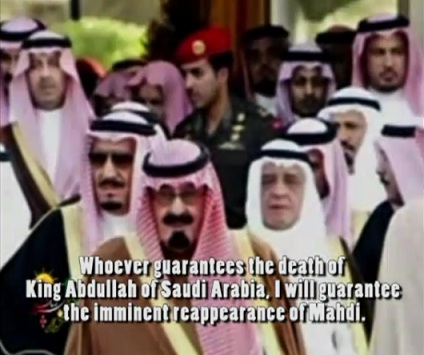
Okay, I’d say things are heating up. Here’s a screen grab from what we are led to believe is a recent video from Iran, made with government backing as described below the fold.

death-of-abdullah-sign-of-mahdi.jpg

This does not bode well…

*

The Christian thriller novelist Joel Rosenberg (author of The Twelfth Imam) has a new blog post up, in which he cites a Christian Broadcasting Network story — which in turn refers to a video posted with some introductory materials on his blog by Reza Kahlili (author of A Time to Betray: The Astonishing Double Life of a CIA Agent Inside the Revolutionary Guards of Iran).

According to Kahlili, who has also posted the full video to YouTube, it is a half-hour long program sponsored by the Basij militia and the Office of the President of Iran, affirming the soon-return of the Mahdi.

And containing “inflammatory language” about King Abdullah of Saudi Arabia (see subtitle above)?  Can I say that?

For what it’s worth, the supposed “hadith” about the death of King Abdullah is discussed in some detail at The Wake-Up Project, so it’s definitely “in the air” — but I don’t recall seeing any references to it in Abbas Amanat, Abdulazziz Sachedina, or any of the lists of Signs of the Coming I’ve read, so my suspicion is that this is an opportunistic addition to the corpus rather than a reliable hadith.

Which brings me to my last point:

I am not posting these materials to encourage panic — that’s what terrorism strives for, and it is the very opposite of what I would wish to see.  If anything, these stirrings of Mahdist sentiment should make us more careful and attentive to the serious scholarly work that has been done in this area.  Jean-Pierre Filiu‘s book Apocalypse in Islam, which I reviewed for Jihadology, would be an excellent place to start.

*

There are plenty of other things going on that I would love to track, blog about or comment on these days, but for the next while I shall try to restrain myself and focus in on this particular issue and its ramifications:

  • Contemporary Shi’ite Mahdist expectation
  • The Iranian nuclear program in the light of Mahdist expectation
  • Iranian attempts to use Mahdism to unite Sunni and Shi’a
  • Mahdism and jihad
  • The role of Khorasan in Mahdist rhetoric
  • Christian apocalyptic responses to Mahdist stirrings
  • Joel Rosenberg‘s book, The Twelfth Imam
  • Joel Richardson‘s book, The Islamic Antichrist
  • Glenn Beck‘s increasing focus on Iranian Mahdism
  • The increasing influence of Islamic and Christian apocalyptic on geopolitics

This is a pretty complex and potent mix of topics, and while I’ll post some individual pieces of the puzzle as I see it, I shall also try to put together a “bigger picture” piece with the whole mosaic laid out.

*

Apart from that, I remain deeply committed to questions of chivalry and peace-making, and will continue to monitor developments and write what I can on those topics as time allows…

Corn’s Caliphates in Wonderland

Saturday, March 26th, 2011


They Just Don’t Make Caliphates Like They Used To….

SWJ Blog featured a lengthy (30 page) essay by Dr. Tony Corn on….well….many things. Corn begins with caliphates and then sort of takes off much like a blown up balloon abruptly released by a child prior to tying a knot in the end.

The Clash of the Caliphates: Understanding the Real War of Ideas by Dr. Tony Corn

….For one thing, within the global umma, there appears to be as many conceptions of the ideal Caliphate as there are Muslims. This grass-roots longing for a symbol of unity should be heard with the proverbial Freudian -third ear,?? and seen for what it really is, i.e., a symptom rather than a disease. For another, by agreeing to establish diplomatic relations with the 57-member Organization of the Islamic Conference (OIC), America and Europe have, in essence, already granted the OIC the status of a Quasi-Caliphate.

More important still, it is time for Western policy-makers to realize that the ideological rivalry between Saudi Arabia and Iran that has been going on since 1979 constitutes nothing less than a Clash of the Caliphates. Through a soft power strategy blurring the distinction between -public diplomacy?? and -political warfare,?? -humanitarian aid?? and -religious propaganda,?? the two states have been the main drivers of the re-Islamization process throughout the Muslim world. The one-upmanship dynamic generated by the rivalry between these two fundamentalist regimes is the main reason why, from the Balkans to Pakistan, the re-Islamization of the global umma has taken a radical, rather than moderate, dimension.

Ok, “caliphates” as a metaphor/analogy for geopolitical rivalry of Muslim states works but it is not really what Islamists or normal Muslims would mean by the term. It is a very odd usage. I’m not overly bothered by that because I tend to like analogies but Corn’s device here is apt to make the heads of area studies and Islamic history scholars explode. The whole essay is in this meandering, idiosyncratic, vein.

Now that is not to suggest that you should not read the piece. Dr. Corn held my attention all the way through and he has a number of excellent observations on many, loosely related, subjects. For example, after discussing the pernicious effects of Saudi donations and Edward Said’s agitprop theory of “Orientalism” on the intellectual objectivity of academia, Corn writes:

…The combined effect of the House of Saud and the House of Said is the first reason why the Ivory Tower has done such a poor job identifying the nature of Muslim Exceptionalism. A more indirect, yet more insidious, reason is that, unlike in the early days of the Cold War, American academics across the board today are trained in social sciences rather than educated in the humanities. For social scientists, Explanation (erklaren) and -theory-building?? take precedence over Understanding (verstehen) and -policy-making. The victory of the -numerates over the -literates in the 1970s has produced a generation of scholars who show a certain virtuosity when it comes to -research design, but display an amazing lack, not just of historical literacy, but of -historical empathy as well. Not to make too fine a point: the Long War is being waged by a generation of policy-makers who, however articulate, never learned anything about history in their college years

Corn is spot on here. Not only is it spot on, it is likely to get much worse. After a brief qualitative “bump” from Iraq-Afghan war  language trained vets, diplos, analysts and spooks peters out, we will have the Gen Y kids with K-12 educations scrubbed free of history, foreign languages and science graduating from college with communication and marketing degrees and entering government service. Hang on to your hat when that happens.

What Corn really requires to vault his essays to the next level are the services of an experienced editor because less would be more. The man is erudite and insightful. He writes forcefully and raises a number of points that are important and with which I agree. Corn, commendably, also makes more of an effort to connect the dots than most. But maybe, if you have an essay that references David Kilcullen, Trotsky, neo-Ottomanism, lawfare, Sam Huntington, neo-COIN, Nasser, Vatican II, the Comintern, the Hapsburgs, Ataturk, public diplomacy, al- Qaradawi, social media, Fascism, Marc Lynch, Youtube, network theory, the UN, hybrid wars and the Protestant Reformation, it might be time to up the Ritalin dosage a notch. Jesus, there’s either a book proposal or four different articles in that kitchen sink of an op-ed!

Read it and take what is useful.


Switch to our mobile site