The Handbook of 5GW
Sunday, October 25th, 2009
Is coming.
Is coming.
My amigo and blogging colleague Lexington Green had an excellent post this week on the anniversary of the invasion of Poland by Nazi Germany, abetted by Joseph Stalin’s Soviet Union, which set off WWII in Europe. Lex laments the state of historical knowlege in public schools and asks readers for their recommendations for books on the Second world War. As of this writing, there are already 47 comments:
World War II started (in Europe) 70 years ago today.
There are two sorts of people in the USA today. A tiny minority who are very interested in military history and know a lot about World War II, and a vast majority who can barely even tell you who was in it (“was that the one with Hitler?”), when it occurred (“the Seventies?”), or what it was about, or even who won (“Japan?”). American children whom I talk to are apparently taught two things and two things only about our participation in World War II: (1) The Japanese Americans were imprisoned, and that was racist and wrong, and (2) we dropped atomic bombs on Japan, and that was racist and wrong. Some know about the Holocaust. College age youth are taught that the war was an exercise in American imperialism, meant to spread expoitative capitalism across the world, and that it is a myth that the GIs went to Europe to liberate the conquered countries or to bring democracy and freedom. Even depictions that are not entirely negative, such as Saving Private Ryan, depict the war solely as a personal tragedy and pointless death and destruction, and not about anything, and certainly not about anything good or admirable. Fed exclusively on this diet for over a generation, we now have a population that sees the war in this way.
This is precisely what Pres. Reagan warned us about:
We’ve got to do a better job of getting across that America is freedom-freedom of speech, freedom of religion, freedom of enterprise. And freedom is special and rare. It’s fragile; it needs [protection]. So, we’ve got to teach history based not on what’s in fashion but what’s important-why the Pilgrims came here, who Jimmy Doolittle was, and what those 30 seconds over Tokyo meant. You know, 4 years ago on the 40th anniversary of D-Day, I read a letter from a young woman writing to her late father, who’d fought on Omaha Beach. Her name was Lisa Zanatta Henn, and she said, “We will always remember, we will never forget what the boys of Normandy did.” Well, let’s help her keep her word. If we forget what we did, we won’t know who we are. I’m warning of an eradication of the American memory that could result, ultimately, in an erosion of the American spirit.
Reagan was right. I have gone beyond being distressed about all this to being fatalistically resigned. With historical memory either non-existent or actively corrupted, those of us who care about these things will have to preserve the record as best we can.
At The Corner (updated here) they are asking people to list their favorite books on World War II. This is a good idea, and I solicit your suggestions in the comments. The Boyz readership always suggests something I have not heard of already. Please list two or three favorites, in the comments. I could spend all day doing this, but I will abide by my own rule, and limit myself to three.
Read the rest here:
You should read the rest, as well as the comments, many of which are informative and a few of which qualify as entertaining. While I am very tempted to discuss books and historiography, I will instead address the teaching of history in our public schools.
The ideological Marxoid craziness of which Lex writes does indeed exist, though it is far more common in university courses than in secondary school classrooms ( Oak Park, though, is a pretty liberal UMC burg) and more common in urban school districts on the coasts than in the Midwest or South. In particular, I have seen firsthand at national conferences, teacher-zealots from California who appear to have been kicked out of Trotskyite Collectives for excessive radicalism and who are more like the mentally unsound homeless than someone entrusted with the education of children. They are largely scary exceptions though. The main problem with the teaching of history in our public schools is that as far as subjects go, history is a tertiary concern of government officials, administrators and school boards; as a result, most of history instructors are hard working and well-meaning people who are by education, totally unqualified for the positions they hold.
This is not to say that these history teachers do not have college degrees, They do, usually they are education or English lit majors with a scattering of PE and business majors whose main career concern is becoming varsity football or basketball coach. A few were punitively reassigned to history departments out of fields they are highly qualified to teach because they are good teachers and administrators saw them as capable of filling a gap in the master schedule, credentials be damned.
Nor would I say that these teachers do not care about children or shirk their responsibilities. By and large they are professionals who are dedicated to and care about the welfare of their students. The problem is that they don’t know much history – and it is very difficult to teach something well that you yourself do not even know enough about to be aware of the parameters of your own ignorance.
In 1997, education scholar Diane Ravitch wrote:
…Of those teachers who describe themselves as social studies teachers, that is, those who teach social studies in middle school or secondary school, only 18.5% have either a major or a minor in history. That is, 81.5% of social studies teachers did not study history in college either as a major or as a minor. In case you thinkyou didn’t hear me correctly, let me say it again: 81.5% of social studies teachers did not study history in college either as a major or a minor. This figure helps to explain why history is no longer the center of the social studies, since so few social studies teachers have ever studied history
What? “Well that was twelve years ago!” you say? My friend, the vast majority of that 81 % of unqualified teachers are still teaching today. And most of that remainder are still as unqualified now as they were in 1997. Imagine the state of our buildings and bridges if 81% of the professors of engineering had majored in, say Art Criticism or Women’s Studies.
Aggravating matters, even if a prospective teacher did major in history in college, fewer of their professors were full-time history instructors than ever before, meaning that even the quality of the small minority of teachers who are history majors is going into decline! NCLB scorns history as a subject, so school districts across the nation will continue to starve it. Poorer districts will fire all the social studies teachers in coming years and parcel out the history sections to unwilling English teachers in order to save the jobs that will preserve reading scores (assuming those are making AYP in the first place). After that, the science teachers will start to get the axe.
Students know a few bare minimum things about WWII, what can be gleaned from dumbed-down, turgidly written, textbooks that are long on glossy pictures and short on engaging prose, plus what they might catch on the History Channel which is seldom short of Nazi-related documentaries. It is unsurprising that most high school students are ignorant of their own nation’s history – given the state state of the field, it would actually be surprising if they knew anything at all.
We are deliberately cultivating a level of societal ignorance that is a deadly longitudinal threat to the continuance of democratic governance and individual liberties in this country. Maybe that was always part of the plan.
Hat tip to Critt Jarvis, social entrepreneur, conversational catalyst.
I am pleased to have as a guest-blogger, Charles Cameron, who is the former Senior Analyst with The Arlington Institute and Principal Researcher with the Center for Millennial Studies at Boston University. He specializes in forensic theology, with a deep interest in millennial, eschatological and apocalyptic religious sects of all stripes.
MAHDISM IN THE NEWS
by Charles Cameron
I.
What’s this about the Mahdi and a call for Islamic mobilization?
Al-Arabiya carried what seems to me to be a significant article about the Mahdi, Islam’s end-times savior on August 17th. The report stated that the personal representative of the Supreme Leader was calling on Iran’s neighboring states “to mobilize their forces in preparation for the coming of the savior of Islam”.
Ayatollah Ali Khamenei’s spokesman, Ali Saeedi, said countries like Turkey, Iraq, Lebanon, Pakistan and Afghanistan should gather together all their forces in order to make drastic changes to prepare for the coming of al-Mahdi al-Montazar, Arabic for “the awaited guided one.”
“We still have a long way to go in order to achieve this. We have to train honest forces that can stop the obstacles that may hinder the coming of the Mahdi like the United States and Israel,” Saeedi said in statement posted by the Iranian Labor News Agency (ILNA).
Muslims must unite for Islam’s Savior: Iran, Al-Arabiya, Monday, 17 August 2009
Except that bin Laden seems to share the apocalyptic expectation, if not the exclusively Shi’ite details — the view that the Mahdi has already been born once, into a Shi’ite family, and is presently in occultation prior to his soon return.
So I am not arguing that we should worry too much about Turkey, Iraq, Lebanon, Pakistan and Afghanistan all deciding to join forces with the Iranian Republican Guard any time soon. But I am arguing that we should be alert to Mahdism — and more generally, Messianism — as a contemporary driver.
II.
It so happens that Steve Coll was on the radio again this week, in a rebroadcast of a talk he gave in April, and here’s some of what he had to say on the subject of Osama bin Laden:
It’s a mistake to see him entirely as a political, or even to some extent mostly, as a political leader. He has a purchase on these grievances and he understands them and I’m sure he feels them — but he’s also a millenarian: he believes that he’s been called by God to wage a war that will only conclude at the end of time. He hasn’t built a political movement, he doesn’t offer any social services, he doesn’t build a hospital — he thinks he’s fighting until the end of time, that he’s carrying out a narrative that’s pre-ordained, and that his role is to awaken God’s followers to their righteous role so that they can pass to the next phase. And so there is this interaction of millenarian, apocalyptic thinking on the one hand — which justifies all violence — and this sort of terrestrial political critique on the other. And what happens when you read his statements in the west is that, well, everyone can understand the political critique, so that gets all the attention — and people’s eyes glaze over at the rest because it’s a little bit hard to digest. But when you read it in full it’s a very, very important aspect of why he’s doing what he’s doing and who he thinks he is.
Steve Coll, talking about his book The Bin Ladens for the World Affairs Council.
Should that surprise us?
Not if we noted Bin Laden’s quotation of the “Gharqad tree hadith” — which specifies the nature of the end times conflict:
Doomsday shall not come until Muslims fight Jews. A Jew would be hiding behind a tree or a stone. The tree or the stone would say, O Muslim, O subject of God, there is a Jew behind me come and kill him. The only exception is [Gharqad] tree is a tree that belongs to Jews.
and his comment:
Whoever claims that there is lasting peace with the Jews is a disbeliever of what the prophet, may the peace and blessings of God upon him, said. Our conflict with the enemies of Islam will continue until Doomsday.
No definite timeline is given, and bin Laden also remarks that his father waited forty years for the Mahdi — and indeed set aside $12 million to support him on his arrival — but the appeal is to end-times expectation,
FWIW, this isn’t the only time bin Laden has
III.
Why is eschatological or apocalyptic rhetoric significant?
It is an accelerant. Simply put, it is a force-multiplier, acting on morale via the sphere of religion, by providing divine sanction for violence — zeal with a deadline.
.
Apocalyptic expectation is in part the expectation that “all the injustices of the old world will be put right” very soon, as Damian Thompson noted, and it creates “an especially potent form of charismatic authority, one that rubs off on ordinary believers as well as the prophet.” This extraordinary empowerment of the individual believer comes about because “foreknowledge about one of the most important subjects imaginable — the fate of the planet — creates a special, even intimate, bond between those who share it”:
In every case, the most striking feature of the millennial theodicy is the contrast between present misery and the glory to come: the latter justifies and makes tolerable the formed.
It may also justify and make tolerable the use of violence in the lead-up to apocalypse, as it clearly does in both the Shi’ite call to arms and the Sunni hadith quoted above. And furthermore, in all these cases the misery is the fruit of sin, whereas the glory is the glory of God.
The nature of millennial expectation is conditioned by culture, yet cross-cultural in its basic patterns, and transcendent in its authority. Thompson goes on to note that “the anticipation of violence does not constitute a cost of millenarianism, since the blood being shed will be that of the unsaved” — and Kerry Noble put the point quite succinctly in his retrospective account of a Christian millenarian movement he later left:
I was not looking forward to the coming war, but I was looking forward to the Kingdom of God that was to follow. That’s how many of us rationalized being soldiers of God. We wanted peace, but if purging had to precede peace, then let the purging begin.
Ahmadinejad or bin Laden might say much the same.
IV.
Who is awake to this pervasive strand of eschatological thinking, among the Shi’a, among the Sunni, and among ourselves?
I cannot speak for the intelligence community, except to say that a rational, secular analyst monitoring these matters is liable to note the “blips” of open source intel but miss the fire that underlies them. Or again, as Steve Coll put it,
people’s eyes glaze over at the rest because it’s a little bit hard to digest.
That’s not a feature — that’s a bug.
Some on the Christian right get it, because they live in the apocalyptic realm themselves. The two Joels, Rosenberg (author of Epicenter) and Richardson (author of The Islamic Antichrist), were among the few to blog Ali Saeedi’s comments, with Joel Rosenberg
But short of actual apocalyptic belief of one’s own — which will generally cause one to disparage if not dismiss the equivalent apocalypses of others — it takes an ear open to the whisperings of myth and dream, a mind open to the logic of music and poetry to understand such thinking, such imaginings.
Michael Vlahos of Johns Hopkins, the author of Fighting Identity: Sacred War and World Change
Ali Allawi knows it, and dedicated his 2007 talk at the Jamestown Foundation to noting the “under the radar” existence and significance of Mahdist millennialism in Iraq.
But who else?
V.
When the overtly millennial year two thousand CE was approaching, Boston University hosted the Center or Millennial Studies, brainchild of Richard Landes of BU and Stephen O’Leary of USC, and for almost a decade scholars gathered for conferences to share the commonalities and differences between millennial movements from before the birth of Christ to the coming century and beyond.
When the roll-over to 2000 passed without major apocalyptic incident, the Center closed — but the millennial season was not over, it has only just begun.
Just this month I saw a “birther” — someone who believes President Obama was born in Kenya, and is thus not eligible to be president of the United States — tying that position in with Joel Richardson’s “middle eastern” antichrist: apocalyptic fervor once again enhancing a political stance. There will be more…
We will keep seeing millennial outpourings of zeal — and perhaps, though not always, violence — at least until 2012, when Mayan calendar enthusiasts (and apparently some readers of the jihadist online magazine, Jihad Recollections, issue 3) expect apocalyptic changes. And if the world staggers through to 2013 then at least to 2033, when many Christians will no doubt wish to celebrate the 2000th anniversary of the crucifixion and resurrection of their Savior. And should that not suffice for an ending of an age, at least till the turn of the next Islamic century in 1500 AH or 2076 CE and arrival of that century’s mujaddid or “reformer”. Or indeed the climactic battle between Islam (represented by the Mahdi) and Buddhism, predicted, curiously enough, in one of the Dalai Lama’s preferred texts — the Kalachakra or Wheel of Time Tantra — to take place in 2424 CE..
VI.
Perhaps we should take a hint from the Kalachakra, which in addition to positing an end times war, suggests that this is no more than a “a metaphor for the inner battle of deep blissful awareness … against unawareness and destructive behavior”. Gandhi said much the same about the battle of Kurukshetra in the Bhagavad Gita.
One might wish that all apocalyptic believers felt that way: they don’t.

Emergence: The Connected Lives of Ants, Brains, Cities, and Software
This classic popular text from 2001 still holds up well as an introduction into the phenomena of emergence and the nature of self-organizing systems. Johnsaon uses a rich array of analogies and historical anecdotes to bring  the reader to an understanding how bottom-up, “blind”, systems work and the principles behind them. Highly readable and next to no jargon. Probably due soon for an updated edition though, given the scientific advances in research in network and complexity studies.
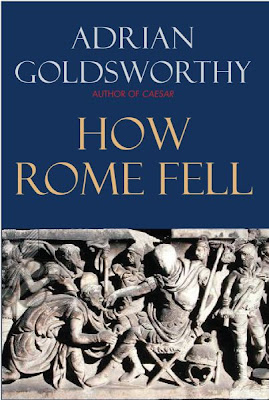
How Rome Fell: Death of a Superpower
Superb overview of the decline and fall of Rome with a rejection of the traditional assertions of causations for the end of the Roman empire ( Barbarians, Christianity etc.). Goldsworthy also sharply criticizes the popular idea among postmodern classicists today that the Roman Empire was “really” as strong during the fourth and fifth  centuries as it was during the golden age of philosopher-warrior-emperor Marcus Aurelius. Or that there was no fall of the empire at all, just a gentle “transformation” into something new. Goldsworthy discusses the likelihood of Late antquity “paper legions” of Roman armies which, in any event, scarcely resembled in elan, tactics or fighting strength the ones that Julius Caesar wielded in Gaul. A tour de force marred only by a weird epilogue that ranges from pedestrian to ( in it’s last sentences) truly awful – was it it tacked on as an afterthought? Did the editor of the rest of the book die before it was completed? Regardless, How Rome Fell is a worthy addition to an collection of popular ancient histories.
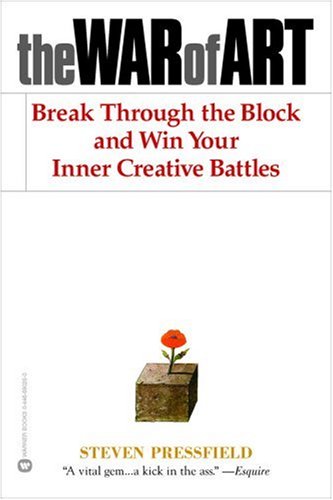
The War of Art: Break Through the Blocks and Win Your Inner Creative Battles
A rare, nonfiction book by novelist and blogger Steven Pressfield. The War of Art is a book that I strongly recommend to aspiring writers ( which includes most bloggers) and other people pursuing dreams, not because it  is brilliant but because it is profound. Utilizing select personal vignettes and other anecdotes, Pressfield distills in everyday language the essence of what creative people need to understand if they are to succeed – concepts of “resistance”, which seductively undermine your efforts, and being a “professional”, which is the mindset that will get you there.
Most of the readers of this blog are interested in military affairs to some extent so I will use this reference to explain why I read The War of Art from cover to cover. Pressfield captures the difference in what Col. John Boyd called the question of “To be or to do. Which way will you go?”. By Boyd’s definition, Pressfield is a doer.
Steven Pressfield blogs on The War of Art of writing every Wednesday.

Zenpundit is a blog dedicated to exploring the intersections of foreign policy, history, military theory, national security,strategic thinking, futurism, cognition and a number of other esoteric pursuits.
Customized Web Site & Blog Design

