zenpundit.com » Charles Cameron

Archive for the ‘Charles Cameron’ Category

Metaphors, more iv, featuring Oliver Roeder & Chris Cillizza

Wednesday, August 1st, 2018

[ by Charles Cameron — others besides david ronfeldt who find game & sports metaphors valuable — or should that be invaluable? ]
.

I’m making this post a “special” because Ron Hale-Evans pointed me to a trove of articles variously about or touching on game metaphors for politics, geo or otherwise.

**

This was the start:

What game is President Trump playing? By that I mean what actual game is he playing?

Trump’s political performance, in seriousness and in jest, has often been likened to chess. Even to three-, four-, eight-, 10- and 12-dimensional chess. His proponents argue he’s a grandmaster,1 and his detractors argue he’s a patzer. CNN’s Chris Cillizza has written two different articles accusing Trump of playing “zero-dimensional chess,” whatever that means. Even Garry Kasparov, probably the greatest actual chess player of all time, has weighed in, inveighing against the use of this gaming cliche via Politico.

In my job here at FiveThirtyEight, I spend a lot of time thinking about games — board games, video games, chess tournaments, math puzzles, the game theory of international affairs. So I understand that “playing chess” is easy shorthand for “doing strategy” or “being smart” or whatever. But I think we can do better. I humbly propose to you that Trump is not playing chess (of any dimension), but rather something called “ultimate tic-tac-toe.” It’s time to update your tropes.

It’s a good day when I find an entire article dedicated to game or sports metaphors for politics, but this one had some great links..

Instances:

**

The second thing this Corker episode makes clear is that, strategically speaking, Trump is playing zero-dimensional chess. As in, the only strategy is that there is no strategy.

In the wake of Trump’s absolutely stunning 2016 victory, the conventional wisdom — in political circles — was that Trump was a strategic genius, always seeing five moves ahead. He was playing three-dimensional chess while the media was still trying to figure out which way pawns could move. The reason no one thought Trump could win was because “we” didn’t see the whole board the way he did. No one else saw it that way. Trump was a genius. An unconventional genius but a genius nonetheless.
There, incidentally, is the definition of zero-dimensional chess:

Trump is playing zero-dimensional chess. As in, the only strategy is that there is no strategy.

And:

**

The key part is when he concludes Flake will be a “no” on the tax reform package in the Senate because, well, his political career is “toast” — or something.

I submit this as yet another piece of evidence that Trump is playing zero-dimensional chess.

What do I mean? Simply this: When Trump won the White House — against all odds — the working assumption was that he had executed a plan so brilliant and so complex that only he (and the few advisers he let in on the plan) could see it. He was playing three-dimensional chess while the media, the Clinton campaign and virtually everyone else was still playing checkers.

But as his first year in the White House has progressed, there’s mounting evidence that Trump may not be playing three-dimensional chess. In fact, he might just be playing zero-dimensional chess. As in, the only strategy Trump is pursuing is no strategy at all.

From a game-policy metaphor angle, this doesn’t take us much further, although you can read the whole post for details of the Trump-Flake business..

And..

**

Chess? That’s not what Garry Kasparov sees Donald Trump or Vladimir Putin playing—three-dimensional or any other kind. But if they did sit down for a game, the former grandmaster believes the Russian president would obviously win.

“Both of them despise playing by the rules, so it’s who will cheat first,” Kasparov told me in an interview for POLITICO’s Off Message podcast. “But in any game of wits, I would bet on Putin, unfortunately.”

Kasparov gets into some interesting details, not entirely uncritical of Obama, and even GW Bush, but flicking Trump off the board with a flick of his cultivated fingernail..

I think I’vetheis referenced the Kasparov article once before, but hey, this is a rich harvest..

Next:

**

Shall we play a game?

Imagine that a crisp $100 bill lies on a table between us. We both want it, of course, but there’s no chance of splitting it — our wallets are empty. So we vie for it according to a few simple rules. We’ll each write down a secret number — between 0 and 100 — and stick that number in an envelope. When we’re both done, we’ll open the envelopes. Whichever of us wrote down the higher number pockets the $100. But here’s the catch: There’s a percentage chance that we’ll each have to burn $10,000 of our own money, and that chance is equal to the lower of the two numbers.

So, for example, if you wrote down 10 and I wrote down 20, I’d win the $100 … but then we’d both run a 10 percent risk of losing $10,000. This is a competition in which, no matter what, we both end up paying a price — the risk of disaster.

What number would you write down?

In the 538 post, the game’s available for interactive play.. And later in the same piece, too..

Now imagine that you’re playing the same game, but for much more than $100. You’re a head of state facing off against another, and the risk you run is a small chance of nuclear war

That was instructive, I think, though my mind is artificially dimmed at present..

And finally:

**

This one revolved around a tweet in which Trump had said

:When a country (USA) is losing many billions of dollars on trade with virtually every country it does business with, trade wars are good, and easy to win. Example, when we are down $100 billion with a certain country and they get cute, don’t trade anymore-we win big. It’s easy!

How easy? was this post’s response:

But how easy? And how exactly do you win them? (Also, what’s a trade war?)

Let’s find out. You (Yes, you!) have just been elected president of your very own country. Congratulations! Now it’s time to get to work. There is another country out there that has goods you can buy, and you have goods it may want to buy. Your job is to choose your foreign economic policy — which you’ll do in the little game we’ve prepared for you below.

The rules go like this: You can cooperate with the other country, allowing the free flow of its goods into your country. Or you can defect, imposing tariffs on the foreign goods. And because you will trade with the same country over and over again, you have to decide whether to stick with a single strategy no matter what or whether to change course in response to your opponent. The other country faces the same choice, but you can’t know in advance what plan they’ve chosen. Free trade helps both countries, generating big windfalls for both sides. But it’s possible for a single country to improve its own situation at the other’s expense — you both have a selfish incentive to defect, taxing the imports from the other country and helping only yourself. However, if you both defect, you both wind up isolated, cutting yourselves off from the market and reducing earnings on both sides.

Again, the game is available for interactive play.

We’ve simplified trade dramatically: You’re engaging in 100 rounds of trade with a randomly chosen FiveThirtyEight reader. In each round, you and your trade partner can either cooperate (allow free trade) or defect (impose a tariff). Your goal is to pick a strategy that earns you as much as possible.

The game mechanics here were interesting (and “gave the game away” where the game is game theory a la Prisoners Dilemma):

Well..

Was there a trade war? Was it good? Did you win it?

Tariffs are the weapons of a trade war

The game you just played took a little game theory — the formal, mathematical study of strategy — and retrofitted it to the world of international relations. (Of course, our simulation is extremely simplified, and it runs in a very controlled little world that ignores alliances, trade deals, political histories, other countries, and hundreds of other factors.)

**

Memory slippage — lest we forget, there was one last game ref today:
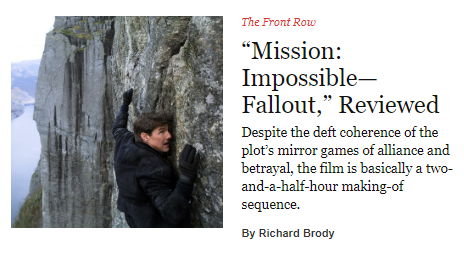
It’s the NYorker‘s film criticism of the latest impossible Mission, and the game sentence in the piece itself reads:

Despite the deft coherence of the plot’s mirror games of alliance and betrayal, which provide the illusion of a developed drama, the movie almost totally deprives its characters of inner life or complex motives.

Mirroring’s one of the patterns I love to collect, and game thinking here might note the Kierkegaardian note:

In his 1846 essay “The Present Age,” Søren Kierkegaard decried the widespread tendency of the time -— which he summed up as an age “without passion” —- to “transform daring and enthusiasm into a feat of skill.”

The continuum from “daring and enthusiasm to “feat of skill” is an interesting one for game designers to place their games on — before and after design, and when player feedback is in.

A rich day indeed.

**

Sources:

  • FiveThirtyEight, Trump Isn’t Playing 3D Chess
  • CNN Politics, Donald Trump is playing zero-dimensional chess
  • CNN POlitics, Donald Trump is playing zero-dimensional chess (again)
  • Politico, Garry Kasparov Would Like You to Stop Saying ‘Trump Is Playing 4-D Chess’
  • FiveThirtyEight, How To Win A Nuclear Standoff
  • FiveThirtyEight, How To Win A Trade War
  • Trump on Twitter, trade wars are good, and easy to win
  • New Yorker, Mission: Impossible -— Fallout
  • **

    Some other posts in this series

    And I emphasize Some, previous posts in the game & sports metaphor series, as somewhat randomly collected, and Likelky not in sequential order:

  • ZP post, http://zenpundit.com/?p=57435
  • ZP post, http://zenpundit.com/?p=59988
  • ZP post, http://zenpundit.com/?p=59082
  • ZP post, http://zenpundit.com/?p=58644
  • ZP post, http://zenpundit.com/?p=57908
  • ZP post, http://zenpundit.com/?p=59678
  • ZP post, http://zenpundit.com/?p=57493
  • ZP post, http://zenpundit.com/?p=59496
  • ZP post, http://zenpundit.com/?p=60193
  • With any luck, some of these will have links to yet others in the series..

    **

    And dammit, pwned by another one before my head hit the pillow..

    Pawn, yes. Pwn?

    For the lore, lure, and love of language

    Tuesday, July 31st, 2018

    [ by Charles Cameron — this is / was all written on 29th (“today”), but has been tidied up before posting late today, really a rich day! ]
    .

    Today has been a rich day for me for language, and I’d like to share some of what I’ve found. I’ll use a series of my own tweets for this purpose, since the tweets include both the particular phrases or sentences that caught my eye, and links and images I’d otherwise have to fish for, giving you an idea of the articles themselves in which I found the items of interest..

    This one’s pretty fabulous, with plants living inside animals — I suppose we are fauna with flora inside us too, though, but the coral instance really hit home:

    That was the first one that really delighted me, this one cinched (clenched?) the deal:

    The bird snaking (its neck), which caught my eye as a companion to the coral (animal) planting (inside its cells), I noted in the tweet, making these two taken together a DoubleTweet. What I didn’t mention was the positively Homeric echo in “reshuffles her storm-cloud-gray wings”..

    **

    which leads me inevitably to my other Homeric finds today, with both the Odyssey:

    and Zeus..

    And that’s enough for now!

    Beach umbrellas impaling East Coast women

    Monday, July 23rd, 2018

    [ by Charles Cameron — the writer is an indoors man, both literally and in GM Hopkins’ metaphorical sense ]
    .

    The first event took place in Seaside Heights, NJ, and the second in Ocean City, MD:

    **

    One instance, I have always argued, is a poor indicator of anything — but two instances could be early indicators of a trend.

    Two beach umbrella impalings in about a week seems less than plausible by coincidence — it looks like there’s a master plan at work, and while the first umbrella pierced an ankle, the second reached the chest. It is time to take notice, and prepare appropriate defenses..

    Instance #1:

    A pleasant day at the Jersey shore turned into a bloody nightmare for a British sunbather when a gust of wind blew an umbrella straight through her ankle, officials said.

    Margaret Reynolds, 67, of London was impaled by one of the tips of the aluminum umbrella, which turned into a projectile about 4:30 p.m. Monday in Seaside Heights, police Detective Steve Korman told The Post.

    Instance #2:

    OCEAN CITY, Md. — A spokeswoman for a Maryland beach town says a woman has been accidentally impaled in the chest by a beach umbrella.

    Ocean City spokeswoman Jessica Waters said it happened Sunday afternoon on the beach. She says the 54-year-old woman was conscious, but that her condition is not known at this time.

    A bolt-cutter was used to help withdraw the projectile from the British tourist in Instance #1, whiln a helicopter airlift to a nearby hospital was required in instance #2.

    **

    Sources:

  • New York Post, Tourist impaled by beach umbrella on Jersey Shore
  • New York Post, Woman impaled in chest by beach umbrella
  • **

    I am happy to re-report of the woman in instance #2, the more grievously attacked of the two:

    She was flown to an area hospital for treatment of non-life threatening injuries.

    We wish her a speedy recovery.

    Of the woman in instance #1, I take pleasure in re-noting:

    Reynolds was taken to Jersey Shore University Medical Center for treatment and has been discharged.

    A satisfactory conclusion to a difficult affair.

    **

    The perpetrator in each case would appear to be the wind:

    Instance #1:

    A pleasant day at the Jersey shore turned into a bloody nightmare for a British sunbather when a gust of wind blew an umbrella straight through her ankle, officials said.

    Instance #2:

    Witnesses said one gust lifted the umbrella

    No winds have been apprehended at this time. John 3.8:

    The wind bloweth where it listeth, and thou hearest the sound thereof, but canst not tell whence it cometh, and whither it goeth:

    Greed can do it as easily as Religion — or Time Itself

    Sunday, July 22nd, 2018

    [ by Charles Cameron — the passing of time is theft is the passing of all things ]
    .

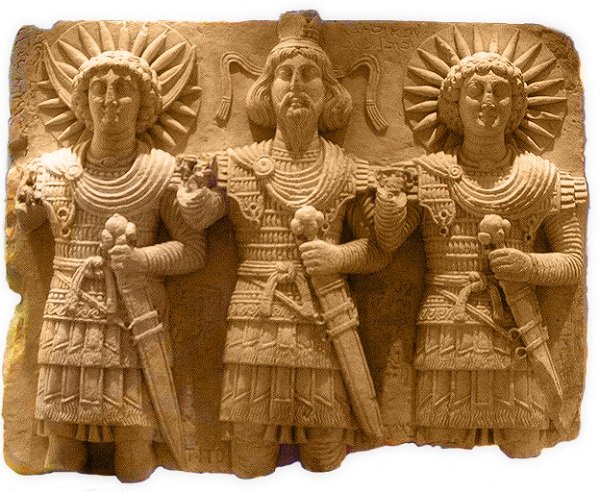
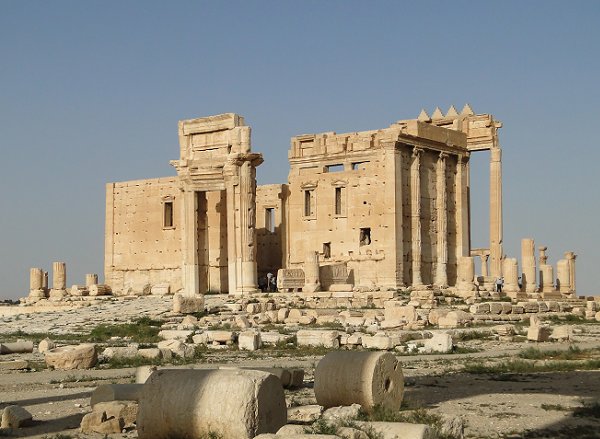
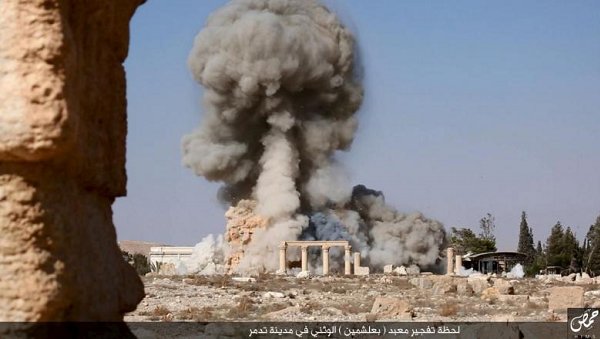
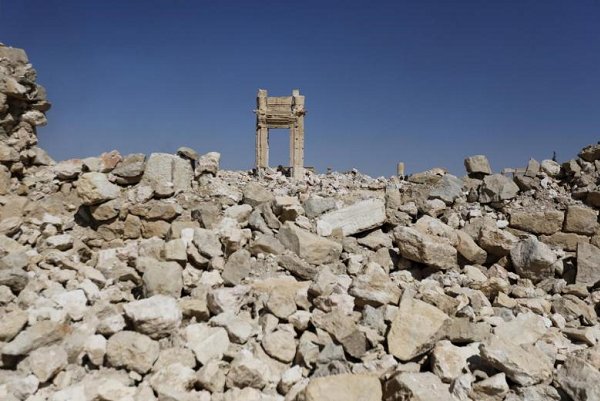
    Here’s a quick stop-motion movie of the Temple of Bel, Palmyra, in four powerful frames.

    The Temple was originally gloriously decorated..

    null

    That’s Palmyra’s divine triad: Baalshamin, with the Moon god Aglibol on his right and the Sun-god Yarhibol at left, discovered at Bir Wereb, near Palmyra, 60 cm high (Louvre, Paris) (photo: Emmanuel PIERRE, CC BY-SA 3.0)

    The Temple was, in fact, until recently, an impressive ruin..

    null

    That’s the Temple of Bel, Palmyra, Syria, in a photo by Bernard Gagnon, GNU license.

    But then ISIS used explosives for a sacred demolition..

    null

    Credit for this and the final image goes to Reuters

    …and now there’s not much remaining of the glory..

    null

    End of film, end of story — setup for the point I want to make.

    **

    Stuff gets made or born, stuff lives or exists.. stuff dies, fades, crumbles, evaporates.. sometimes stuff is reboorn, salvaged, gets a second life..

    Consider the great temple of Angkor Wat, buit by Khmer artists, partly destroyed by centuries of weather and overgrowth, pock-marked by the bullets of insurgents & army.. now given a second life as a tourist destination.. Consider Tibetan mandalas, chalked out in detail, painstakingly painted in sand, then swept away, proof of impermancence..

    Well?

    **

    The establishment of monotheism in Egypt was accompanied by royal command with the destruction of what we might now call religious and cultural works —

    In rebellion against the old religion and the powerful priests of Amun, Akhenaten ordered the eradication of all of Egypt’s traditional gods. He sent royal officials to chisel out and destroy every reference to Amun and the names of other deities on tombs, temple walls, and cartouches to instill in the people that the Aten was the one true god.

    — in a manner that calls to mind some of ISIS excesses, their destruction of the Temple of Bel, for a recent and striking instance.

    **

    Indeed, places of worship have not infrequently been torn down:

    Lord what work was here! What clattering of glasses! What beating down of walls! What tearing up of monuments! What pulling down of seats! What wresting out of irons and brass from the windows! What defacing of arms! What demolishing of curious stonework! What tooting and piping upon organ pipes! And what a hideous triumph in the market-place before all the country, when all the mangled organ pipes, vestments, both copes and surplices, together with the leaden cross which had newly been sawn down from the Green-yard pulpit and the service-books and singing books that could be carried to the fire in the public market-place were heaped together.

    That’s from England — which suffered under Cranmer (Reformation) and Cromwell (Civil War), both of them politically influential Puritans.. who between them made ruins of many British abbeys — think Glastonbury, Fountains, Walsingham..

    Well, all that’s background, simply to establish that time’s river allows for the buildup by a wide variety of means and sweeping away of all manner of things animate and ootherwise, in a continual flux, a continual emergence, a continual impermanence..

    **

    But my point, remember?


    Photo credit: via Trib Live

    My point is that the thief of Pittsburg’s unique and valuable book antiquities deprives us of treasures of the mind in much the same way that ISIS does with its explosives in Palmyra. In the latter case: impassioned religion; in the former: simple greed.

    Appraisers discovered missing items and books that had been “cannibalized,” with entire portions removed, according to the affidavit.

    and the alleged thief:

    is charged with theft, receiving stolen property, dealing in proceeds of illegal activity, conspiracy, retail theft, theft by deception, forgery and deceptive business practices.

    Items of high value and greed, idolatry and iconoclasm — the cutting up of books from the Carnegie Library of Pittsburgh including a copy of Newton’s Principia is nend ot in the too different from what ISIS’ Kata’ib Taswiyya batallion did to Palmyra.

    Not too different, either, from the activities of Tibetan monks.. or, I suppose, wind, rain, and a thousand years..

    **

    Percy Bysshe Shelley:

    I met a traveller from an antique land,
    Who said—“Two vast and trunkless legs of stone
    Stand in the desert. . . . Near them, on the sand,
    Half sunk a shattered visage lies, whose frown,
    And wrinkled lip, and sneer of cold command,
    Tell that its sculptor well those passions read
    Which yet survive, stamped on these lifeless things,
    The hand that mocked them, and the heart that fed;
    And on the pedestal, these words appear:
    My name is Ozymandias, King of Kings;
    Look on my Works, ye Mighty, and despair!
    Nothing beside remains. Round the decay
    Of that colossal Wreck, boundless and bare
    The lone and level sands stretch far away.”

    Sermo I: Sanctity of the unsavory

    Wednesday, July 18th, 2018

    [ by Charles Cameron — my most original contribution to theology? — saints of negative virtue ]
    .

    Anthony Bourdain, RIP.

    Friend Callum Flack drew my attention to Don’t Eat Before Reading This: A New York chef spills some trade secrets in the New Yorker yessterday. It’s a piece Anthony Bourdain, chef raconteur extraordinaire, wrote in the waning months of th twentieth century, and in Callum’s note it is “The article that kicked off Anthony Bourdain’s writing career. Everything is there already: curiosity, no-bullshit, brotherhood, secrets. Hell of a rollick.”

    I’ve occasionally dipped into one of Bourdain’s exotic foods shows on TV, but was frankly surprised and impressed by the outbreak of love and high respect that attended his recent passing. Naturally, I read the piece, and this sentence jumped out at me:

    In fact, it was the unsavory side of professional cooking that attracted me to it in the first place.

    Those words crystallized for me something i’ve been feeling my way into for years — the sense that there is a second sanctity, just as laudable as the well-recognized first. Bourdain, I saw very clearly in that moment, is a saint of the second category — no insult or diminishment in any way intended — and that remark of his offers exactly the right term to begin my consideration of the hitherto intuited, but to my knowledge seldom theologically recognized category of the sacred to which Bourdain belonged.

    Anthony Bourdain was a saint of thee unsavory.

    **

    Bourdain’s piece opens with a paean to unsavories to be savored and tasty cruelties of various forms:

    Good food, good eating, is all about blood and organs, cruelty and decay. It’s about sodium-loaded pork fat, stinky triple-cream cheeses, the tender thymus glands and distended livers of young animals. It’s about danger—risking the dark, bacterial forces of beef, chicken, cheese, and shellfish. Your first two hundred and seven Wellfleet oysters may transport you to a state of rapture, but your two hundred and eighth may send you to bed with the sweats, chills, and vomits.

    Shocking. Distinctly unsaintly.

    Sanctity of the first category is liable to sound more like this account of the diet of FF Baptiste Vianney, the Curé d’Ars:

    There was no housekeeper at the presbytery. Until 1827 the staple of his food was potatoes, an occasional boiled egg and a kind of tough, indigestible, flat cake made of flour, salt, and water which the people called .[2] Subsequent to the foundation of the orphan girls’ school, to which he gave the beautiful name of ” Providence,” he used to take his meals there. At one time he tried to live on grass, but he had to confess that such a diet proved impossible. He himself reveals his mind, as regards all this, in the words he addressed to a young priest: “The devil,” he said, “is not much afraid of the discipline and hair-shirts what he really fears is the curtailing of food, drink and sleep.”

    This too is shocking — but Shakespeare would have recognized and, may we even say, delighted, in both. Indeed, in responding to Callum, I wrote:

    Shakespeare knew all about this type of sanctity, theology misses, the blues know it.

    **

    We frequently view the creator, religiously speaking, as “all good” — in which cae the category of the sacred will tend to be open to those whose lives demonstrate extreme “goodness ” — purity, love, self-sacrifice, call it what you will. But if we view the creator, religiously or in terms of evolutionarily biology and psychology, as an artist, then tension becomes a positive, the brilliant extreme of “evil” as significant as that of “good” — and Hannibal Lecter a paragon of negative virtue. Shakespeare must have relished writing Lady Macbeth.

    Shakespeare, the great dramatist of our humanity, speaks to the unsavory as well as the savory virtues, while the blues, among the most piercing of our expressions of grief, fury, jealousy, and yes, sin, is also a fount of joy and exultation. In a later sermon in this series, I shall explore Eric Clapton‘s two songs, Have You Ever Loved a Woman, and Wonderful Tonight — one of which is an exploration of “a shame and a sin” — the other of the wonder of an evening in love..

    **

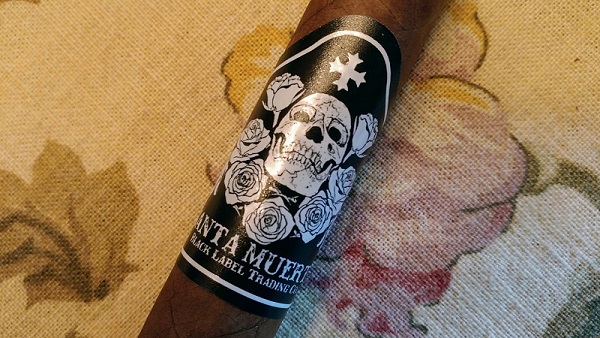
    Let me note briefly here that Santa Muerte is an example of a folk outcropping from traditional Catholic piety in a morbid direction not sanctioned by the Church — an unsavory saint, and what is perhaps worse, visually an inversion of the Blessed Virgin Mary. Her typical offerings include whiskey and cigars.

    **

    Getting back to our culinary theme, I ran across a fascinating account of JS Bach‘s eating habits recently, headed:

    J.S. Bach’s wife recorded an epic meal that he enjoyed after dedicating the new organ in Halle on May 3, 1716. The meal had almost as many courses as he had children

    That was quite a few. The courses:

    Beef bourguignon, followed by sardines and pike, then smoked ham, a side plate of peas and a side plate of potatoes, spinach (that apparentttly counts as one course), belgian endive, and let’s get hearty, roast mutton, veal, squash, a head of lettuce, ooh, sweet, glazed donuts (plural), white radishes, sweet again and a touch sour, candied lemon peel, fresh butter, and cherry preserves

    — surely those last two go with a large tranche of bread, no? — Mrs Bach didn’t tell us. In any case, stout JS Bach was obviously quite a trencherman.

    And yet his name crops up in an Episcopalian church calendar as that of a saint, with his feast day on July 28:

    Johann Sebastian Bach, 1750, George Frederick Handel, 1759, and Henry Purcell, 1695, Composers

    followed a short while later on August 5th by:

    Albrecht Dürer, 1528, Matthias Grünewald, 1529, and Lucas Cranach the Elder, 1553, Artists

    — while the Orthodox Church in DC celebrates the life of “St. Andrei Rublev, iconographer” on July 4/17.. while Kenneth Randolph Taylor, an Episcopalian in Georgia, is compiling his own “ecumenical calendar of saints”, and includes “the poet and Jesuit priest Gerard Manley Hopkinsas a saint, and surely John Donne and perhaps even Jonathan Swift will soon follow..

    My point being that artists seem to occupy a space that has plenty of room for culinary delight, wives and childen, asceticism, monasticism, Lutheranism, Catholicism, Anglicanism, you name it. My own birthday, November 27, occurs in older Catholic calendars as the feast of Sts Baarlam and Ioasaph, whose story is recounted by St. John Damascene and can be traced back to a tale of the Buddha (Ioasaph = Iodasaph = Bodasaph = Bodhisattva if I recall the various names as they can be traced back to their various sources) — so I have a truly ecumenical saint’s day for a birthday in Catholic tradition — and the Buddha as a patron saint!

    **

    Anyway, how long till the church recognizes the uncanny lack of hypocrisy in Hannibal Lecter, ambling down a street in the Bahamas, intent on having “an old friend for dinner”…?

    IMO, that’s the over-the-top case that brings my whole suggestion here into the status of an Open Question.


    Switch to our mobile site