zenpundit.com » ideas

Archive for the ‘ideas’ Category

PRISM: Col. Bob Killebrew on Criminal Insurgency

Tuesday, June 14th, 2011

Criminal Insurgency” is becoming a preferred term of art to describe entities like the Narco-cartels of Mexico that have evolved from transnational criminal organizations into groups with paramilitary and intelligence capabilities or Colombia’s FARC which formerly was a model Marxist insurgency but devolved downward into a drug trafficking army. The term is used partly to placate doctrinaire purists among defense intellectuals who see insurgency definitively as armed political movements following Mao’s three stages or bust. After all, they have only had since the late 80’s and early 90’s, when Bill Lind and Martin van Creveld warned them this was coming, to get used to the idea.

Colonel Robert Killebrew, a smart fellow at CNAS, has an article in NDU‘s PRISM that puts the problem of criminal insurgency into a hemispheric context:

Criminal Insurgency in the Americas and Beyond

….Essentially, the United States faces external and internal challenges in reorienting to more effectively fight the cartels and their allies. Refocusing U.S. policy from a “war on drugs” to a more comprehensive fight against the cartels and gangs is essential if the United States and its allies are to prevail. Since the basis of the cartels’ survival lies in the control of regions where governmental control is nonexistent and populations may be impoverished and alienated, successful counter-cartel strategies are fundamentally counterinsurgency strategies developed by the concerned states themselves and supported by the United States. Counter-cartel strategies must first be political strategies, integrating military and police activity into a broader political approach that emphasizes the rule of law as an alternative to the rule of force. Four aspects of a Western Hemisphere counter-cartel strategy follow.

First, step up the direct attacks on the cartels. Over the past decades, U.S. law enforcement professionals have developed successful operational techniques that cartel leaders fear: partnerships with effective local police (often with U.S. training), expertise with judicially approved wiretaps and electronic surveillance, rewards programs that make criminal bosses vulnerable to betrayal, and, above all, when local laws permit, extradition to U.S. courts and prisons. The United States and its allies should increase the capability for multiagency field operations in all these dimensions, as well as the professionalization of host country military forces for operations requiring holding ground while the rule of law is reinstituted by other national agencies. DEA already operates throughout the region and has solid relationships with counterpart agencies; additionally, the agency has worked closely with U.S. combatant commands, notably U.S. Southern Command, where its powerful extraterritorial jurisdiction authority supplemented the military’s own programs to help U.S. allies in the region. DEA should continue to advise and assist host country police and counternarcotics forces, but the size of the agency must be greatly increased. With 5,500 agents spread over the hemisphere-including the United States-the agency that plays such a key role in the ongoing war with the cartels is spread too thin.

Second, the U.S. and its allies must continue to attack the cartels’ financial networks and money-laundering capabilities-a key strategy that requires more resourcing at Treasury. Cartel leaders fear U.S. indictments and extradition to American courts; extradition, exposure, and seizure of “dirty” money from criminal operations are all effective strategies that identify kingpins and threaten them with trials in U.S. courts and long terms in U.S. prisons. The United States has learned to use financial analysis and indictments as weapons against the cartels, even when they are beyond the immediate reach of U.S. law. Their use should be expanded.

Third, help our neighbors build more functional state institutions, particularly courts, and stimulate economic growth. In terms of the U.S. role and our assistance to allies, our understanding of security assistance must be broadened to include effective assistance to police and courts. For example, as part of Plan Colombia-a Colombian-developed counter-cartel strategy-the United States provided the Colombian National Police (CNP) with telecommunications-intercept equipment and, working through the Department of Justice, helped the CNP build a judicial process to support wiretap investigations. The result was a powerful tool that assisted indictments against cartel leadership and extraditions to the United States for prosecution. Likewise, assisting host nations to build strong, noncorrupt judicial systems is critical to assisting or restoring stable governments in areas threatened by cartel or other insurgent violence; courts, appellate courts, and efficient prisons are key pieces. Other U.S. agencies and contractors can provide other materiel assistance, training, partnership, and, when authorized, direct help in specified areas such as the collection of certain kinds of strategic intelligence. The U.S. Department of Defense can provide advisors and trainers on the Colombia model to supplement local military and law enforcement efforts, and occasionally direct aid in the form of helicopter transportation and naval support.61
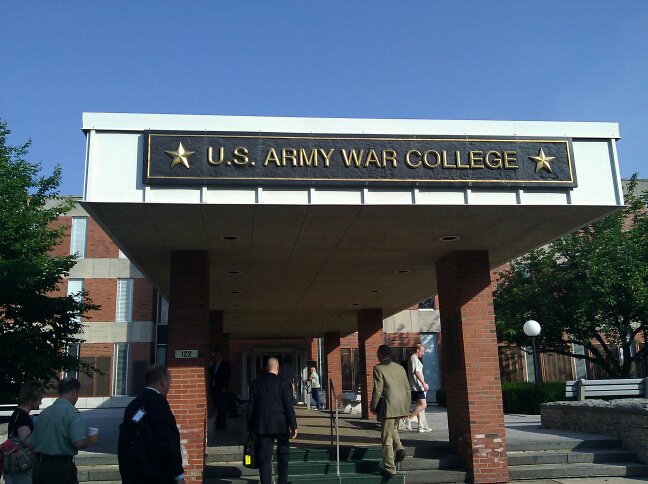
The US Army War College National Security Seminar 2011

Sunday, June 12th, 2011

warcollege.jpg

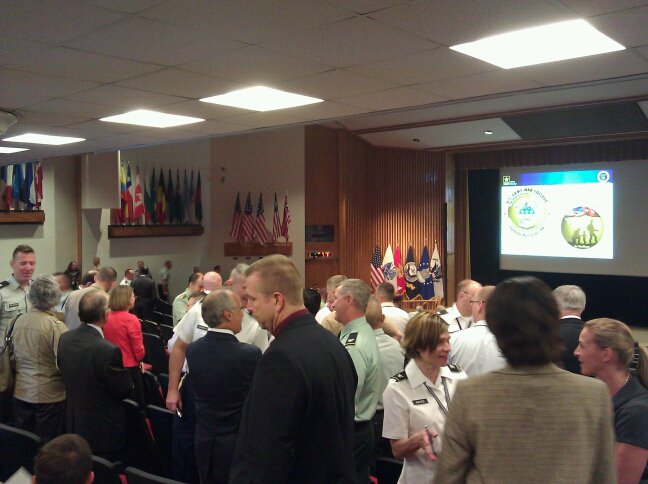
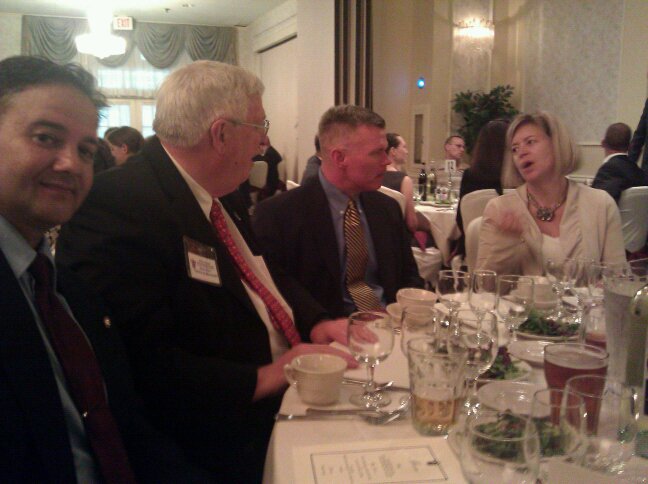
As noted previously, I was fortunate to attend the National Security Seminar at the the US Army War College this year and wanted to relay my impressions while they were still fresh.

First, in terms of reception and cordiality, I have rarely experienced such an extensive and personal outreach as was demonstrated by the War College staff, faculty, administration and students. Every new member had a “sponsor” – a student, usually a colonel or Navy captain, who acted as a liason and personal guide from the time their plane touched down until the moment they returned to the airport. My sponsor, the former commander of the WolfhoundsColonel Richard “Flip” Wilson, whom I consider a friend, really extended himself on my behalf, making me feel welcome and a full member of Seminar Group 20. Most of the students have multiple tours of duty in Iraq and Afghanistan under their belt and many can report the same for the first Gulf War, Panama, Bosnia or Kosovo.

The War College, the Commandant and the Seminar Group all hosted receptions and dinners designed to get students and civilian new members to mix and further discuss issues raised in the seminar sessions or lectures. At these events I had the opportunity to meet and talk to the leadership of the Army War College including the Commandant Major General Gregg Martin, the Deputy Commandant for International Affairs, Ambassador Carol Van Voorst, the Executive Director of the Army Heritage Foundation, Mike Perry, the Director of SSI, Dr. Douglas Lovelace,  the Chief of Staff and numerous faculty and seminar members. The New Members such as myself were exceedingly well fed at these events as I suspect the Army was attempting to prove that it really does march on it’s stomach.


warparty.jpg

warparty2.jpg

The serious business of the National Security Seminar was divided into two segments, the talks given by distinguished speakers to the entire class of 2011 and the New Members and the Seminar Group sessions of approximately twenty students, New Members, academics and foreign visitors. We received a brief on the war in Afghanistan from the ISAF Chief of Staff, who was standing in last minute for General Petraeus who was called to meet with senior adminstration officials; and a very interesting concluding talk by Foreign Affairs Editor Gideon Rose, author of How Wars End, which covered issues of strategy, grand strategy and the disconnect with policy.

warseminar.jpg

  The National Security Seminar is run strictly on a non-attribution basis, in order to encourage candor and frank exchange of views, which handicaps my ability to discuss specifics here. I can say that my views on Pakistan ( which I compared to “North Vietnam” ) riled more than a few people – Pakistan is the only country in the world given 2 exchange student slots at the Army War College at the request of the most senior leadership of the US Army – and several students and faculty members took the time, outside of seminar sessions, to make certain I heard countervailing POV regarding Pakistan’s value as an ally. Other topics included, but were not limited to:

Defense budget cuts and force structure
Narco-cartels in Mexico: Insurgency or No?
Civil-Military Relations
Repeal of DADT
AfPak War
al Qaida and GWOT/US Strategy
COIN
Critical thinking and Leadership
Logistics
Libya and NATO
AWC Strategy Curriculum/Program
What the US public expects from their military
China as a peer competitor
Effects of ten years of war on officer corps/military
Illegal combatants and international law
PTSD
Battle of Gettysburg and Grand Strategy
Cyberwar
Differences in Armed Services strategy, command climate, discipline, leadership
The Arab Spring
US Global leadership and Economics
Interagency Operational jointness

Most of the discussion took place in the seminar groups, with Q&A periods in the mass sessions with featured speakers. I came away deeply impressed with the seriousness and insights as practitioners that AWC students brought to the table. The AWC strategic studies program seeks to broaden students who are assumed to arrive with tactical expertise and prepare them for higher command that carries operational, strategic and even policy responsibilities (at least in terms of interpreting and executing within policy guidelines). Many students were articulating ideas associated with Thomas P.M. Barnett, the “mission order” and “commander’s intent” style of leadership or Clausewitzian strategic premises during debates and discussion.

The National Security Seminar Week was for me, an enlightening and exceptionally enjoyable experience, one I would highly recommend to readers who may have such opportunities in future years.

Patterns, Language, and Knowledge

Monday, June 6th, 2011

[by J. Scott Shipman]

John Boyd’s work led me to zenpundit a few years ago, and I am flattered and grateful to be small part of such an intellectually stimulating community.

One Boydian theme that has driven my reading is the “observe” node of his OODA (observe, orient, decide, act). While “orientation” gets most of the attention in Boydian circles, I have come to consider “observe” to be the foundation of knowledge, thus action.  “What” we see, or as my friend Dr. Terry Barnhart points out, what we “sense” directs orientations, decisions, and actions.

This short post is something of a preview (and an opportunity to try-out WordPress which does not like Safari—I’m using an old laptop that is slower than slow). I’d like to share four books that have influenced my thinking and I plan to review the first two of them here in the coming weeks.

patterns.jpg

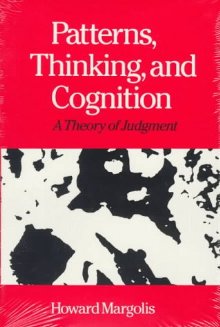
Patterns, Thinking, and Cognition, A Theory of Judgment, by Howard Margolis

Margolis’ thesis is “thinking and judgment…everything is reduced to pattern recognition.” Accordingly, he offers what he calls a P’ Cognition spiral, where the “spirals” represent a cognitive cycle and at the tops of the cycles represent a pattern recognition process. A review is in the works.

language.jpg

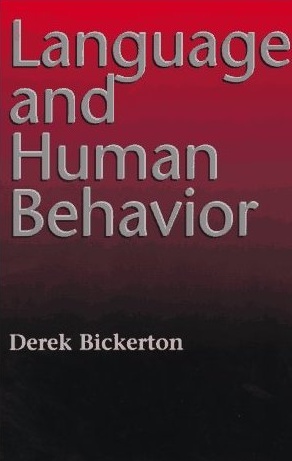
Language and Human Behavior, by Derek Bickerton Bickerton’s thesis is that “human cognition came out of language.” In this work, he defines language, explains the connection of language and evolution, and how language is integral to intelligence and consciousness. A review is in the works.

The final two books are  Personal Knowledge: Towards a Post-Critical Philosophy, and Meaning, by Michael Polanyi

“We know more than we can tell.” Michael Polanyi

There are several points of intersection between Polanyi’s work and that of Margolis and Bickerton, but what I found interesting were Polanyi’s treatment of what he refers to as two types of awareness; subsidiary and focal awareness. In Personal Knowledge, he offers an example of driving a nail, “I have a subsidiary awareness [also called from awareness in Meaning] of the feeling in the palm of my hand which is merged into my focal awareness of my driving the nail.” Subsidiary and focal awareness, according to Polanyi, are mutually exclusive where if one diverts one’s attention to the “feeling in the palm” one is likely to miss the nail. Musicians will recognize the distinction of “looking” at one’s hands will almost always divert from the music on the sheet.In Meaning, Polanyi goes further and assembles what he calls “three centers of tacit knowledge: first, the subsidiary particulars; second, the focal target; and third the knower who links the first to the second. We can place these three things in the three corners of a triangle. Or we can think of them as forming a triad, controlled by a person, the knower, who causes the subsidiaries to bear on the focus of his attention.”

Synthesis: I believe these ideas connect. For if Margolis is correct, then the “awareness” expressed by Polanyi would be apprehended using pattern recognition; recognition of patterns using Bickerton’s ideas with respect to language. Language is pattern-based, and we use language patterns in sense-making/creation of meaning.

More to come.

Guest Post: David Ronfeldt on Dignity and Democracy

Thursday, May 26th, 2011

 ronfeldt_david.jpg

Blog-friend David Ronfeldt, until recently Senior Social Scientist with the RAND International Policy Dept., is author / co-author of such seminal works as Networks and Netwars; In Athena’s Camp; In Search of How Societies Work: Tribes — the First and Forever Form; and The Zapatista “Social Netwar” in Mexico. Today he offered a detailed comment on Zen‘s post, Skulls & Human Sacrifice — the central portion of which we felt deserved to stand as a post of its own, and attract its own body of discussion. We are accordingly delighted and honored to offer it here as David’s first guest-post on Zenpundit. –CC

______________________________________________________________________________________________

For months, many arab commentators have observed that the uprisings are mainly about “dignity”: e.g., identity and dignity, or dignity and freedom, or some other combination — but always dignity.

In contrast, American observers keep saying the uprisings are mainly about “democracy” — freedom and democracy in particular. some Arabs include a call for democracy with their call for dignity; but Americans only occasionally acknowledge their parallel pursuit of dignity. in fact, Americans rarely think about dignity; we’re raised to assume it. Language about dignity slides right through our modernized minds.

Yet, in many cultures, dignity is a more crucial concept than democracy. Dignity (along with its customary companions: respect, honor, pride) goes to the core of how people want to be treated. it’s an ancient tribal as well as personal principle. indeed, it’s central to the tribal form. tribal and clannish peoples think and talk about dignity far more than do americans and other westerners in advanced liberal democratic societies.

In the Arab spring, what many arabs seem concerned about is thus more primal than democracy. They’re fed up with the indignities inflicted by corrupt, rigged patronage systems, by rulers and functionaries who act in predatory contemptuous ways, by the endless abuse of personal rights and freedoms — in other words, by all the insults to their daily sense of dignity. Of course, many Arabs seek democracy too; and dignity and democracy (not to mention justice, equality, and other values) overlap and can reinforce each other. But dignity and democracy are not identical impulses, nor based on identical grievances. in some situations, the desire for dignity trumps the desire for democracy.

This interplay between “dignity” and “democracy” may have implications for US policy and strategy. I’m not exactly sure what they are, but it seems to me that we ought to be analyzing and operating as much in terms of dignity as democracy. I bring this up not only because americans tend to overlook the significance of the dignity principle, but also because I detect a dignity-democracy fault-line among the Arab-spring’s protagonists — a fault-line that may relate to whether the Arab spring ends up having democratic or re-authoritarian consequences.

My sense is that the younger modernizing protagonists of the Arab spring may well be pursuing democracy (along with dignity) as their strategic goal, but the older, more traditionalist elements operating alongside them are more interested in pursuing dignity, without necessarily favoring democracy. and the latter may be stronger than we have observed. if so, the quest for dignity may be satisfied by outcomes that have little to do with democracy: say, for example, a shift in tribal and clan balances, an enhanced appeal for islamic law (shariah), or a charismatic call for strong government devoid of foreign influence. It may be easier, and more popular, to gratify a quest for dignity than a quest for democracy.

*

I’m led to these observations via the TIMN framework about the four major forms of organization that lie behind social evolution: tribes + hierarchical institutions + markets + info-age networks. the young modernizing protagonists of the arab spring express the nascent +N part of TIMN, while the older traditionalist elements remain steeped in the ancient pro-T part — and therein lies the fault-line I mentioned earlier.

_______________________________________________________________________________________________

For further details of Dr. Ronfeldt’s published work, see his RAND portfolio.His current interests include in particular:

  • Development of a framework (TIMN) about the long-range evolution of societies, based on their capacity to use and combine four major forms of organization: tribes, hierarchical institutions, markets, and networks
  • Development of a framework (STA) for analyzing people’s mind-sets and cultural cosmologies in terms of basic beliefs about the nature of social space, social time, and social action

He blogs recent thinking on both frameworks at Visions from Two Theories.

Book Review: The Shaping of Grand Strategy

Tuesday, May 24th, 2011

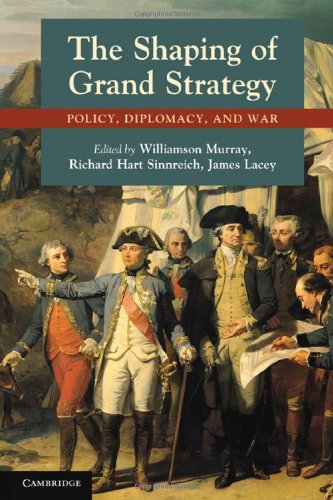
The Shaping of Grand Strategy: Policy, Diplomacy, and War by Williamson Murray, Richard Hart Sinnreich and James Lacey (Ed.)


As readers of this blog know, grand strategy is an important and timely subject that speaks directly to the difficulty American leaders have had in navigating the ship of state in the waters of the international arena. The Shaping of Grand Strategy: Policy, Diplomacy, and War by Williamson Murray, Richard Hart Sinnreich and James Lacey (Ed.) and contributing authors Colin S. Gray, Marcus Jones, Jeremy Black and John A. Lynn III postulates what grand strategy is and explain from historical case studies how statesmen struggled to fashion one in peace and war.

The Shaping of Grand Strategy has a number of strengths to recommend it to the serious student of history or strategic practitioner:

Focus: The case studies are all anchored in the Westphalian state system starting with the early modern period of European absolutism and apex of “national” monarchies and transitions through a Bismarckian 19th century to finish with the West’s cataclysmic 20th century battle with totalitarianism. This gives the chapters by different scholars a sense of cohesion and chronological succession.

Balance: The Shaping of Grand Strategy gives scholarly treatment from both the theoretical, strategic studies perspective as well as the historical case study. I learned some things about Louis XIV’s Europe and the Great Britain of the Pitts and the Hanoverian dynasty of which I was unaware. Theory bookends history in this tome.

Nuance: Each scholar gives his subject an adult treatment. Controversial points are interesting rather than shrill and each author engages an impressive synthesis of historiographic material as they cover a broad ground in investigating grand strategy. Each chapter is sound and engaging.

Limitations, such as they are, to be considered:

Absent: Powerful non-Western case studies. The ancient world.  Revolutionary war (French, Soviet or Islamist insurgent) as a grand strategy. Geoeconomics asnd political economy as a foundation for grand strategy. 

Weak: Insufficient treatment of the impact of nuclear weapons and deterrence on grand strategy, which frankly deserved a chapter of it’s own.

If you are composing a syllabus for a class on grand strategy or strategy, The Shaping of Grand Strategy would serve as an excellent generalist core for the course, supplemented by cognate, specialist or subtopical readings.

Some things that struck me while reading The Shaping of Grand Strategy:

  • Colin Gray’s distillation of the strategic dilemmas faced by Truman and an almost Boydian implicit explanation of what grand strategy is and why it needs a compelling moral power:

High policy does not emerge in a vacuum, though it can be invented in a hurry without much forethought when necessity presses. Policy requires a North Star for guidance that can inspire, yielding to would-be leaders the fuel they require to recruit and satisfy their followers

  • James Lacey’s realistic and granular treatment of the relationship between military strategy and grand strategy in the WWII Anglo-American Alliance and his generally admiring assessment of FDR as a strategist vs. a critical treatment of George Marshall.
  • Marcus Jones’ emphasis of the importance of the strategist himself and the uncertainty of decision making in his chapter on Otto von Bismarck.
  • The drawing of historical parallels with today  by John Lynn and Richard Sinnreich as well as the investigation of the reasons for grand strategic failure of British appeasement by Williamson Murray.

The Shaping of Grand Strategy is a tight, concise and focused academic book that furthers the discussion of grand strategy by providing coherent and detailed examples as well as a readable an interesting analysis from which both the professional or the the student can profit.

Strongly recommended.


Switch to our mobile site