zenpundit.com » law enforcement

Archive for the ‘law enforcement’ Category

Arresting Citizens, part I: the Law

Saturday, March 23rd, 2013

[ by Charles Cameron — on various instances of citizens “taking the law into their own hands” in attempts to arrest the Queen, two Popes, Harper of Canada and Tony Blair ]
.

I am not really up on the sovereign citizen movement here in the US, perhaps because it is not overly religious — we’ll talk about that in part II. What interests me in this first part is the sense that the sovereignty of nations is being questioned by citizens.

**

It sees to me that what we’re witnessing in these two “leading indicators” is an unraveling of trust in the state itself.

My first instance comes from the Arrest Blair movement, which is basically a blog site with a bank account…

This site offers a reward to people attempting a peaceful citizen’s arrest of the former British prime minister, Tony Blair, for crimes against peace. Anyone attempting an arrest which meets the rules laid down here will be entitled to one quarter of the money collected at the time of his or her application.

Money donated to this site will be used for no other purpose than to pay bounties for attempts to arrest Tony Blair. All the costs of administering this site will be paid by the site’s founder.

The site is not without supporters, and there are at least a few people willing to attempt the arrest. The site’s Attempts made so far page records four payments thus far totaling £10,971.56, or roughly $16,700 US. Notably, it appears that at least three out of the four claimants have paid all or a major part of the funds they received to charities.

I would note as an aside that the suggestion that Tony Blair should be tried for war crimes has a number of supporters who are not AFAIK connected in any way with the “citizen arrest” attempts described here.

**

My second instance is that of the International Tribunal into Crimes of Church and State, which appears to be largely the brainchild of one Rev Kevin D Annett MA, MDiv, a one-time minister of the United Church of Canada.

I’d suggest that anyone who takes Kevin Annett at all seriously should consider that he purports to be involved with an international legal entity with competence to try the Pope — and yet gives his signature to paragraphs like these:

When the Bloody Emperor stands naked, only our illusions keeps him protected and immune from the final accounting that is coming.

The tornado that followed my first exorcism outside the Vatican in 2009, and the lightning that struck it on the day of Benedict’s resignation, were not accidental. Joe Ratzinger should know from the history of his own former SS buddies that criminal institutions can run, but they can’t hide – even behind all the wealth and pomp in the world.

Prepare for Easter! Flush the Rat from the Vat!

With such strident rhetoric and with exorcism a feature of his own activities, it’s hard to take him altogether seriously.

The court’s view of its own status, independent of other jurisdictions, is expressed thus:

It is understood by our Court that its decisions, based as they are on Natural and Common Law, supersede and invalidate all statutes and statutory laws which conflict with the decisions of the Court, particularly when those statues uphold crimes or their concealment, or the protection of the guilty. Similarly, our Court does not recognize the jurisdiction or authority of any contending legal systems, such as the so-called “Canon Law”, or any form of personal, diplomatic or legal immunity governing any person or institution, including heads of states, churches and corporations.

Here, FWIW, is the opening of a recent posting on their site of a Public Banning Order to be issued by the Common Law Court of Justice against Pope, Cardinals, and Archbishop Wilfrid Napier for aiding and encouraging child rape in the case of some First Nations children:

After evading arrest by lawful Common Law Court officers, over thirty officials of church and state now face permanent banishment from their communities during Easter Week for being wanted criminals who are a danger to children everywhere.

These officers include Pope Francis I and former Pope Joseph Ratzinger, Canadian Prime Minister Stephen Harper and Queen Elizabeth Windsor of England, all of whom were ordered detained by Citizen Arrest Warrants issued by the International Common Law Court of Justice on March 5 and 15, 2013.

“They have defied the law and lawful arrest, so therefore they are declared to be public enemies who are no longer welcome or allowed in our communities” explained Rev. Kevin Annett, who presented the evidence to the Court that convicted the guilty.

Here I would note for the record that I am entirely uninformed and take no sides in those issues which form the basis of Annett’s acute disgust with various churches, churchmen and politicians.

**

By way of context, but without suggesting any direct connection between the two instances above and the widely-documented Sovereign Citizens, here’s a brief overview of that movement.

From a WECT special report:

Hundreds of thousands of sovereign citizens currently live throughout the United States.

The FBI calls them “domestic terrorists.” They’re also known as extremists, radicals and defenders of freedom.

According to experts, sovereign citizens are Americans who think the laws don’t apply to them.

Most of them have their own constitution, bill of rights and government officials.

Sovereign citizens can be dangerous and violent. There have been a number of cases where sovereigns took matters into their own hands by killing members of law enforcement.

From the Montgomery Advertiser, today:

Self-proclaimed president of sovereign citizen nation convicted

After a five-day trail, a federal jury in Montgomery has convicted Tim Turner, the self-proclaimed president of the Sovereign Citizen Nation, on a variety of charges relating to defrauding the government.

The jury convicted the 57-year-old Skipperville resident on conspiracy to defraud the U.S. government, attempting to pay taxes with fictitious financial instruments, attempting to obstruct and impede the Internal Revenue Service, failing to file a 2009 federal income tax return and falsely testifying under oath in a bankruptcy proceeding, according to the U.S. Attorney’s office.

The FBI began an investigation after Turner and three other individuals sent demands to all 50 governors in the United States ordering each governor to resign within three days or be “removed,” according to a news release from Sandra J. Stewart, acting U.S. attorney for the Middle District of Alabama.

The investigation found that Turner was the self-proclaimed president of the so-called sovereign citizen group “Republic for the united States of America (RuSA).” As president, Turner traveled the country in 2008 and 2009 teaching others how to defraud the IRS by preparing and submitting fictitious “bonds” to the U.S. government in payment of federal taxes.

An estimate of the group’s size was posted in the SPLC’s Intelligence Report a few years back:

Not all tax protesters are sovereign citizens, and many newer recruits to the sovereign life did not start out as tax protesters. But based on the available evidence, a reasonable estimate of hard-core sovereign believers today would be 100,000, with another 200,000 just starting out by testing sovereign techniques for resisting everything from speeding tickets to drug charges, for a total of 300,000. As sovereign theories go viral throughout the nation’s prison systems and among people who are unemployed and desperate in a punishing recession, this number is likely to grow.

**

Finally, it’s worth comparing the attempts to make citizen’s arrests of sundry heads of state, present and former, monarchic, papal and democratic, with the methods employed by the International Criminal Court at the Hague — which has a question in its FAQ:

Who has to execute the warrants of arrest?

The responsibility to enforce warrants of arrest in all cases remains with States. In establishing the ICC, the States set up a system based on two pillars. The Court itself is the judicial pillar. The operational pillar belongs to States, including the enforcement of Court’s orders.

**

As I say, I’m not “up” on the theory or history of loss of faith in government and it’s corollary, taking the law into one’s own hands” — but it presumably ties into such notions as hollow states, prerevolutionary states, and vigilantism.

I’d appreciate a little history, a little context… not just in terms of the US sovereign citizen movement, but in broad enough scope to include vigilantism, non-violence, and the current attempts to arrest the Queen, the Popes (Francis regnant and Benedict emeritus) and Tony Blair.

Your comments and insights?

The White Paper and its Critics

Monday, February 11th, 2013

Someone for reasons unknown last week leaked the classified Department of JusticeWhite Paper” on targeting with drone attacks the numerically tiny number of US citizens overseas who have joined al Qaida or affiliated groups. The leak set off an outburst of public debate, much of it ill-informed by people who did not bother to read the white paper and some of it intentionally misleading by those who had and, frankly, know better.

Generally, I’m a harsh critic of the Holder DOJ, but their white paper, though not without some minor flaws of reasoning and one point of policy, is – unlike some of the critics – solidly in compliance with the laws of war, broader questions of international law and the major SCOTUS decisions on war powers. It was a political error to classify this document in the first place rather than properly share it with the relevant Congressional committees conducting oversight

Here it is and I encourage you to read it for yourself:

Lawfulness of Lethal Operation Directed Against a US Citizen Who is a Senior Operational Leader of al-Qa’ida

Much of this white paper debate has been over a legitimate policy dispute (“Is it a good idea if we use drones to kill AQ terrorists, including American ones?”) intentionally being mischaracterized by opponents of the policy (or the war) as a legal or constitutional question. It is not. The law is fairly settled as is the question if the conflict with AQ rises to a state of armed conflict, which SCOTUS dealt with as recently as Hamdi and for which there are ample precedents from previous wars and prior SCOTUS decisions to build upon. At best, framed as a legal dispute, the opponents of the drone policy would have a very long uphill climb with the Supreme Court. So why do it?

The reason, as I discern it, is substituting a legalistic argument and judicial process (“FISA court to decide drone killings”) to conceal what is really a debate over American war policy   and the President’s war powers in order to accrue domestic political advantage or at least avoid paying the costs of advocating a potentially unpopular position. Otherwise, opponents have to argue on the merits that the US should not as a matter of policy kill al Qaida terrorists sheltered by Pakistan or beyond the reach of government control in Yemen. Or that we are not “really” at war or that Federal judges are better suited for picking bombing targets than Air Force and CIA analysts and that “due process” should apply to enemy combatants on the battlefield. Many of these arguments are valid ones to raise and debate but are unlikely to be persuasive to the public or Congress; if they were, they would have prevailed in 2010 (drones) or 2001 (“are we at war?).

A straightforward legal analysis begins and stops with ascertaining whether or not we are in a state of armed conflict with al Qaida. The white paper used a “kitchen sink” approach to try and cover all legal bases, perhaps to create a basis for a later freewheeling peacetime use of armed drones – which incidentally, I am not in favor of – but it is not required here and actually distracts from the strongest legal argument – the administration is lawfully fighting an enemy in an armed conflict declared by Congress.
.
If we are in an armed conflict under international law with al Qaida – and the evidence appears here in fact, legislative action, context, historical and legal precedent to be overwhelming – renders most of the other justifications cited in the white paper for the policy regarding due process as well as nearly all of the criticisms of it moot, at least in terms of legality. Wartime enemy combatants are in a qualitatively different legal status vis-a-vis the United States government acting as a belligerent than are non-combatants or are civilians in peacetime (even civilians who commit criminal acts). No American citizen has a right to pick up arms and join an enemy army or armed group during a war, period. Or a subsequent right to be treated as anything but a combatant if they do. Combatant status is not determined by nationality under international law but by behavior and adherence to a belligerent party’s military forces and their physical disposition ( hors d’ combat, in the act of surrender etc.).
.
American citizens fought in enemy armies, notably the Wehrmacht and Waffen-SS, against the United States in WWII and a handful defected to the enemy in the Korean and Vietnam Wars. While some of these men were tried for treason after these wars ended, others were treated as enemy POWs or simply allowed to come home at a later date, but none were accorded judicial due process *during* the conflict as potential targets of an American military attack. Only after capture, as with the saboteurs in the Ex Parte Quirin case, did judicial review and due process come in to play.. We see a similar phenomena with the Civil War where, even under the Lincolnian theory that the Confederacy merely represented “Combinations too powerful to be suppressed” (i.e. a private insurrectionist conspiracy and not the states themselves as corporate, legal, sovereign entities in rebellion), we do not see SCOTUS insisting on normal, civilian, judicial due process in Ex Parte Milligan except where “civil courts are in operation” (i.e. away from the battlefield). This was to prevent the application of martial law in civilian areas in the North, not to stop martial law in theater or occupational zones.
.
Had this issue of due process for active enemy combatants been raised during WWII or even Vietnam, it would have been likely (and properly) regarded by US officials as ludicrous; if true, the logic would imply that enemy units could immunize themselves from attack (or substantially delay them)  by recruiting American citizens into their ranks. It would also beg the question why the US could lawfully bomb enemy targets and risk killing American POWs via collateral damage, but not directly target enemy fighters who happened to be American citizens. It would further beg the question why it would be lawful to indirectly target an American citizen in a group of enemy fighters with, say, artillery or gravity bombs from 52,000 feet but be an unlawful violation of due process to aim at him directly with a drone missile or a sniper rifle. Is a Marine rifleman who happens upon Adam Gadahn in Afghanistan and kills him therefore an “assassin” (to use Glenn Greenwald’s description of targeted killings) to be charged with murder?
.
Even as a matter of “due process” (!) – never mind fighting a war – how could this legal argument possibly make any sense? What precedent under military law or international law from prior conflicts supports it?
.
How would inserting judicial review – even SCOTUS – over operational planning and target selection as a step in the President’s exercise of his Constitutional authority as Commander-in-Chief likely to affect the Separation of Powers? This is not a trivial question – in military terms it is analogous to the judiciary usurping the position of the Rules Committee in the House of Representatives over legislative matters. How would this innovation impact our ability to fight our next war or wars?
.
Much like the white paper’s lengthy, but entirely irrelevant discourse into the nature of threat “imminence” and “breadth”, this argument is sheer invention if a state of armed conflict with al Qaida exists. Most criticisms and not a few of the white paper’s own legal justifications consist of novel restraints alien to the historical practice of states prosecuting an armed conflict that we would be extremely unwise to adopt and sanctify as precedents for waging future wars.
.
Let us take one of the more intellectually serious and responsible expert critics as an example, Steve Vladeck of American University. Not everything he has to say in his lengthy post is wrong and I even agree with some of his points, but things like this strike me as specious, or at least a very weak reed upon which to rest an argument that alters the constitutional balance:
.

….First, many of us who argue for at least some judicial review in this context specifically don’t argue for ex ante review for the precise reasons the white paper suggests. Instead, we argue for ex postreview–in the form of damages actions after the fact, in which liability would only attach if the government both (1) exceeded its authority; and (2) did so in a way that violated clearly established law. Whatever else might be said about such damages suits, they simply don’t raise the interference concerns articulated in the white paper, and so one would have expected some distinct explanation for why that kind of judicial review shouldn’t be available in this context. All the white paper offers, though, is its more general allusion to the political question doctrine. Which brings me to…

.

Second, and in any event, the suggestion that lawsuits arising out of targeted killing operations against U.S. citizens raise a nonjusticiable political question is almost laughable–and is the one part of this white paper that really does hearken back to the good ole’ days of the Bush Administration (I’m less sold on any analogy based upon the rest of the paper). Even before last Term’s Zivotofsky decision, in which the Supreme Court went out of its way to remind everyone (especially the D.C. Circuit) of just how limited the political question doctrine really should be, it should’ve followed that uses of military force against U.S. citizens neither “turn on standards that defy the judicial application,” nor “involve the exercise of a discretion demonstrably committed to the executive or legislature.” Indeed, in the context of the Guantánamo habeas litigation, courts routinely inquire into the very questions that might well arise in such a damages suit, e.g., whether there is sufficient evidence to support the government’s conclusion that the target is/was a senior operational leader of al Qaeda or one of its affiliates…

My first criticism would be that Vladeck’s premise that the question of a targeting decision of an American citizen who is a senior leader of al Qaida during a state of armed conflict who is active outside the territory of the United States is a matter for adjudication by US courts is incorrect. He is essentially arguing that the political question doctrine does not cover the exercise of the Constitutionally specified war-making powers of the executive and legislative branches during a war. I am highly skeptical this is an argument any Supreme Court would entertain lightly, much less the Roberts Court.
.
My second criticism is more practical – that Vladeck in seeking judicial review of the decision process by which an American citizen is determined to be senior or not senior leader in al Qaida leadership is a distinction without a difference from a court having a priori judicial review of the larger military operation in wartime but with the added detriment of exposing the intelligence process, to discovery. Targeting decisions involve assessment of intel about the target from a variety of perspectives – confidence, effect, probability of success/costs and the “fusion” of (usually) USAF and IC in a targeteering shop. Why  judicial scrutiny should apply only to drone strikes targeting a specific US citizen among other al Qaida operatives in wartime vice simply bombing an al Qaida safe house in which a US citizen might be employs a legal reasoning that is obscure to me. If a US citizen being a potential casualty is the critical constitutional variable here, then not also judicial review of a bayonet charge?
.
The proposal for judicial review of potential attacks during an armed conflict (not peacetime) is rife with a host of counterproductive second and third order constitutional and military effects. It represents a sweeping change in our political order by a technical legal fiat. It would also be an exceedingly dumb way to run a war. It might test our powers of imagination, but somehow, we faced down Hitler and the Imperial Japanese without Federal judges running our strategic bombing campaigns.
.
This preference for legalistic arguments is partly a product of over representation of lawyers among the American political elite. Highly competent attorneys are very skilled at framing arguments on behalf of clients so that they begin litigation not only from a favorable explicitly stated position but, where possible, with several layers of one-sided implicit premises built in that you accept uncritically only at your peril. When a lawyer comes into a public policy debate saying that a political question is a legal question, he is making a political argument to remove a political dispute in a democratic polity to the courts where the matter will be decided under very different procedures and will remain as a legal question thereafter.
.
Sometimes, this is the constitutionally correct thing to do; more often, it is simply an expedient thing to do that diminishes democratic accountability while rendering policy and process needlessly more complex and adversarial than even open public debate. It is also a self-aggrandizing feedback loop for lawyers as a class – when all political questions are legal questions, then should we not all defer to their superior expertise and training? It is the road to technocracy and the rule of law becoming “rule by lawyers”.
.
Does that mean the critics have no point whatsoever regarding the use of drones in “targeted killings”? No. The idea that targeting American citizens is bad *policy* because it might, for example, be poorly employed against innocent people by mistake or, in slippery slope fashion, lead to a normalization and extension of the practice of targeted killing outside of an officially recognized armed conflict is a completely valid *political* argument. It is even, in my view, a very wise caution. It just does not hold water as a legal argument on behalf American citizens who go overseas and pick up arms and wage war against the US by joining al Qaida.
.
More importantly, there are better, simpler remedies to a “slippery slope” with drone attacks that can be employed legislatively and through vigorous oversight that can be enacted that will strengthen rather than undermine and confuse our constitutional system of governance. First, the Obama administration, for it’s part, should allay critics fears by removing “targeted killings” from the arbitrary hands of unnamed “senior officials” (code for the President? The National Security Adviser? A random White House lawyer?) and either return to a more traditional Pentagon target assessment procedure or use the NSC process with a PDD/NSDD and a properly and timely “finding” being presented to Congress.
.
Secondly, the proper body to review the judgement of the administration in tactics, operations, and strategy is not the judicial branch, but the legislative, which has done so in prior conflicts and holds the power of the purse to control the extent of campaigns and the raising of armies. The Joint Committee on the Conduct of the War was the oversight mechanism the Congress employed during the Civil War to review and influence the actions of the Lincoln administration. I would argue that the US Congress is more than sufficient to do the same task today with a far less existential conflict, if it chose to do so. Congress could, if it wished, forbid these operations or cease funding them. Quite pointedly, they have done neither.
.
If Congress does not engage in rigorous oversight, it does not follow that a Federal Court is the appropriate constitutional substitute for Congress abdicating it’s wartime responsibilities. Targeted killings of enemy combatants during a declared armed conflict is a question of war policy, not due process, and is the purview of the political branches, not the judiciary
.
Thirdly, the “slippery slope” danger is genuine and should be interdicted with legislation prohibiting or severely restricting the use of armed drones at home or forbidding their use against civilians resident in the territory of the United States entirely. A definition from Congress of under which circumstances that terrorism is a matter for law enforcement or military action is something that is likewise years overdue.
.
Congress should be taking up it’s weighty responsibilities in war policy and not punting them to the executive or the judiciary, so that the actions of the US government in a matter of extreme gravity like a war are constitutionally clothed in democratic consent.

Concerning the enforcement of morals

Wednesday, January 30th, 2013

[ by Charles Cameron — enforcement of moral codes in the UK, US, Israel and KSA, unofficial and official, worsening, continuing and improving, quite the smörgåsbord ]
.


.

Moral vigilantism appears to be on the rise in parts of London, according to this first-person piece by Jane Kelly, consulting editor of the Salisbury Review, which identifies itself as “seriously right” — ‘I feel like a stranger where I live’ [Telegraph, 29 January 2013]:

“When you go swimming, it’s much healthier to keep your whole body completely covered, you know.” The Muslim lady behind the counter in my local pharmacy has recently started giving me advice like this. It’s kindly meant and I’m always glad to hear her views because she is one of the few people in west London where I live who talks to me.

[ … ]

More worryingly, I feel that public spaces are becoming contested. One food store has recently installed a sign banning alcohol on the premises. Fair enough. But it also says: “No alcohol allowed on the streets near this shop.” I am no fan of street drinking, and rowdy behaviour and loutish individuals are an aspect of modern British ”culture’’ I hate. But I feel uneasy that this shopkeeper wants to control the streets outside his shop. I asked him what he meant by his notice but he just smiled at me wistfully.

Perhaps he and his fellow Muslims want to turn the area into another Tower Hamlets, the east London borough where ”suggestive’’ advertising is banned and last year a woman was refused a job in a pharmacy because she wasn’t veiled.

On the other hand, maybe I should be grateful. At least in Acton there is just a sign in a shop. Since the start of the year there have been several reports from around London of a more aggressive approach. Television news footage last week showed incidents filmed on a mobile phone on a Saturday night, in the borough of Waltham Forest, of men shouting “This is a Muslim area” at white Britons.

The video commentary stated: “From women walking the street dressed like complete naked animals with no self-respect, to drunk people carrying alcohol, we try our best to capture and forbid it all.”

**

It also appears to be present in parts of Brooklyn, according to Modesty in Ultra-Orthodox Brooklyn Is Enforced by Secret Squads, [New York Times, January 29, 2013]:

In the close-knit world of ultra-Orthodox Judaism, community members know the modesty rules as well as Wall Street bankers who show up for work in a Brooks Brothers suit. Women wear long skirts and long-sleeved, high-necked blouses on the street; men do not wear Bermuda shorts in summer. Schools prescribe the color and thickness of girls’ stockings.

The rules are spoken and unspoken, enforced by social pressure but also, in ways that some find increasingly disturbing, by the modesty committees. Their power is evident in the fact that of the half dozen women’s clothing stores along Lee Avenue, only one features mannequins, and those are relatively shapeless, fully clothed torsos.

The groups have long been a part of daily life in the ultra-Orthodox communities that dot Brooklyn and other corners of the Jewish world. But they sprang into public view with the trial of Nechemya Weberman, a prominent member of the Satmar Hasidim in Brooklyn, who last week was sentenced to 103 years in prison after being convicted of sexually abusing a young girl sent to him for counseling.

[… ]

The details were startling: a witness for Mr. Weberman’s defense, Baila Gluck, testified that masked men representing a modesty committee in the Hasidic village of Kiryas Joel, N.Y ., 50 miles northwest of New Y ork City, broke into her bedroom about seven years ago and confiscated her cellphone.

The Brooklyn district attorney, Charles J. Hynes, who prosecuted the Weberman case, has now received allegations that members of a modesty committee forced their way into a home in the borough, confiscating an iPad and computer equipment deemed inappropriate for Orthodox children, officials say.

[ … ]

“They operate like the Mafia,” said Rabbi Allan Nadler, director of the Jewish studies program at Drew University in Madison, N.J.

**

And in Israel — from the same report, although perhaps more widely known? I’ve certainly seen mentions…

In Israel, there have been similar concerns. Though no modesty committee was overtly involved, there has been anger over ultra-Orthodox zealots who spit on and insulted an 8-year-old girl for walking to school through their neighborhood in a dress they considered immodest.

**

Meanwhile, the Saudis seem to be decreasing the scope of their official equivalent, according to Saudi limits powers of the notorious religious police [Al Arabiya, 30 January 2013]:

Saudi Arabia has set new limitations on the powers of its notorious religious police, charged with ensuring compliance with Islamic morality but often accused of abuses, its chief said on Tuesday.

The Commission for the Promotion of Virtue and Prevention of Vice “once had much expanded powers, but with the new system… some of these powers, such as interrogating suspects and pressing charges,” will be restricted to the police and public prosecution, Shaikh Abdul Latif Abdel Aziz Al Shaikh told AFP.

The religious police may still arrest those carrying out “flagrant offences such as harassing women, consuming alcohol and drugs, blackmail and the practice of witchcraft,” Shaikh said of the new law approved by the cabinet.

and:

Relatively moderate Al Shaikh, appointed last year, has raised hopes that a more lenient force will ease draconian social constraints in deeply conservative Islamic country.

Two weeks into his post, Al Shaikh banned volunteers from serving in the commission, which enforces the kingdom’s strict Islamic rules.

H/t John Burgess at Crossroads Arabia.

**

All these articles are worth reading in full, and you’ll be enriched by reading them together, comparatively — food for thought!

The Controversial CTC Report

Friday, January 25th, 2013

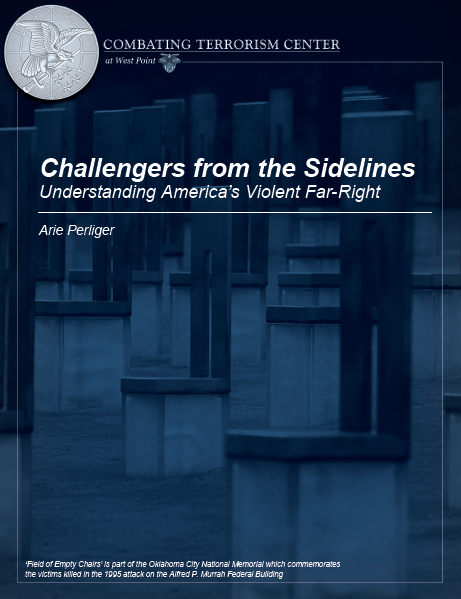
The Center for Combating Terrorism at West Point released a report on domestic terrorism that raised hackles for a number of reasons. Despite the dismissals of liberal political pundits, the reasons for objections to the CTC report are legitimate but they did not need to arise in the first place and might have been avoided with a slightly different editorial approach or appropriate caveats (I just finished reading the report, which is primarily focused on the usual suspects). Here’s why I think the normally well-regarded CTC stumbled into a hornet’s nest:

First, in this foray into domestic terrorism analysis, the center chose to concentrate only on the threat of violence of the Far Right while ignoring other threats coming from the Far Left, infiltration by criminal insurgent networks from Mexico, notably the ultraviolent Zetas whose reach has stirred gang violence in Chicago and Islamist terrorism, either homegrown “lone wolves” or from foreign infiltration or subversion. In itself, this is understandable if the CTC plans a series of reports with a separate focus on different domestic threats; but without that context, it is a myopic analytic perspective, particularly given the demonstrated capabilities of various AQ affiliates or just south of the border, the criminalinsurgency of  the narco-cartels. Had all of these been addressed in one omnibus report, any complaints from conservatives were likely to have been muted or nonexistent. This is not to say that the radical American Far Right does not have a violent threat potential of it’s own worth studying; it does and it is real. But available evidence indicates it to be the least organized, least operationally active and least professionally competent in terms of terrorist “tradecraft” of the three.

The second and most problematic aspect of the report is an intellectually sloppy definition of a dangerous “antifederalist movement”  where noxious concepts like “white supremacy” and wacko conspiracy theories are casually associated with very mainstream conservative (or even traditionally bipartisan !) political ideas – coincidentally, some of the same ideas that contemporary “big government” liberal elites tend to find irritating, objectionable or critical of their preferred policies. Part of the equation here is that American politics are evolvng into a very bitterly partisan, “low trust” environment, but even on the merits of critical analysis,  these two passages are ill-considered and are largely responsible for most of the recent public criticism of the CTC:

….The antifederalist rationale is multifaceted, and includes the beliefs that the American political system and its proxies were hijacked by external forces interested in promoting a “New World Order” (NWO) in which the United States will be absorbed into the United Nations or another version of global government.  They also espouse strong convictions regarding the federal government, believing it to be corrupt and tyrannical, with a natural tendency to intrude on individuals’ civil and constitutional rights.  Finally, they support civil activism, individual freedoms, and self government

….In contrast to the relatively long tradition of the white supremacy racist movement, the anti-federalist movement appeared in full force only in the early to mid-1990s, with the emergence of groups such as the  Militia of Montana and the Michigan Militia. Antifederalism is normally identified in the literature as the “Militia” or “Patriot” movement. Anti-federalist and anti-government sentiments were present in American society before the 1990s in diverse movements and ideological associations promoting anti-taxation, gun rights, survivalist  practices,and libertarian ideas 

This is taxonomic incoherence, or at least could have used some bright-line specifics ( like “Posse Commitatus” qualifying what was meant by “anti-taxation” activists) though in some cases, such as “libertarian ideas” and “civil activism”, I’m at a loss to know who or what violent actors they were implying, despite being fairly well informed on such matters.

By the standard used in the first paragraph, Glenn Greenwald, Ralph Nader and the ACLU would also be considered “far right antifederalists”. By the standards of the second, we might be in physical danger from Grover Norquist,  Congressman John Dingell and Penn Jillette. No one who opposed the recent increases in income tax rates, dislikes gun-control or thought the DOJ may have abused it’s power in the prosecution of Aaron Swartz or in their stubborn refusal to prosecute Bankster racketeering is likely to welcome a report under the auspices of West Point that juxtaposes such normal and perfectly valid American political beliefs with neo-Nazism. A move that is simply going to – and quite frankly, did – gratuitously irritate a large number of people, including many in the defense and national security communities who are a natural “customer base” for CTC reports.

As I said previously, this could easily have been completely avoided with more careful use of language, given that 99% the report has nothing to do with mainstream politics and is concerned with actors and orgs with often extensive track records of violence. As the CTC, despite it’s independence, is associated so strongly with an official U.S. Army institution, it needs to go the extra mile in explaining it’s analysis when examining domestic terrorism subjects that are or, appear to be, connected to perfectly legitimate participation in the political process. This is the case whether the subject is on the Left or Right – few activists on the Left, for example, have forgotten the days of COINTELPRO and are currently aggrieved by the activities of Project Vigilant.

I might make a few other criticisms of the report, such as the need for a better informed historical perspective, but that is hardly what the recent uproar was about.

Steady breathing

Tuesday, January 8th, 2013

[ by Charles Cameron — something as simple as spirit, important to special ops & law enforcement — an open question ]
.


.

Let’s begin with a quote from Buddhist monk Thich Nhat Hanh, The Miracle of Mindfulness: An Introduction to the Practice of Meditation:

Breath is the bridge which connects life to consciousness, which unites your body to your thoughts. Whenever your mind becomes scattered, use your breath as the means to take hold of your mind again.

That’s about as basic as you can get. Breath begins with your first gasp (in-spiration) and runs like a silk thread through your life till your last sigh (ex-spiration) and it’s all spirit — which turns out to be beyond the mind-body dichotomy, and a balancing factor for both.

**

Fast forward.

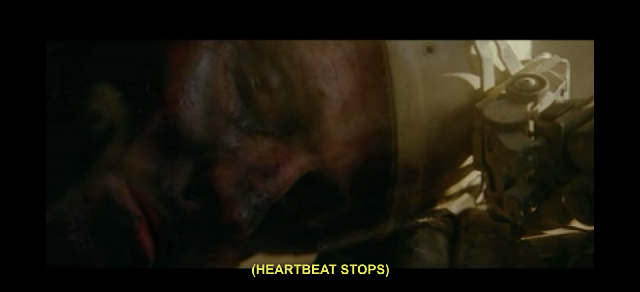
Let’s turn from breath — spiritus in Latin, as in spiritus ubi vult spirat, “breath blows where it wants to”, John 3.8 — to its specific application in “combat breathing” as illustrated by the still from the National Geographic movie Seal Team Six: the Raid on Osama bin Laden at the head of this post.

In “Fear Factor”, his review of Amanda Ripley’s fascinating-sounding The Unthinkable: Who Survives When Disaster Strikes, published in City Journal 21 June 2008, blog-friend John Robb writes:

… in complex disasters, the biological-fear response can slow thinking so severely that it can kill you.

We can counter fear, however. The best method, FBI trainers say, is to get control of your breathing. “Combat breathing” is a simple variant on Lamaze or yoga training — breathe in four counts, hold four counts, exhale four counts, and repeat. It works because breathing is a combination of the somatic (which we control) and the autonomic (which we can’t easily control) nervous systems. Regulation of the autonomic system deescalates the biological-fear response and returns our higher-level brain functions to full capacity. So one of the best ways you can prepare yourself to overcome fear in a crisis is as simple as a meditation, Lamaze, or yoga class.

I find it fascinating and also sensible that yogic / meditative techniques are now taught by members of the special ops and law enforcement communities:

Training under stress also will help officers learn to control their arousal level. As their physiological agitation escalates, so might their susceptibility to perceptual and memory distortions. Thus, learning to control arousal level can help reduce distortions. Therefore, officers should receive training in and regularly practice ways to control arousal levels in high-stress situations. One process, the combat breathing technique, has proven highly effective in this area.

Alexis Artwohl, “Perceptual and memory distortion during officer-involved shootings”, FBI Law Enforcement Bulletin, Oct, 2002

This reminds me of Richard Strozzi Heckler’s In Search of the Warrior Spirit: Teaching Awareness Disciplines to the Green Berets, now in its fourth edition.

**

Breath, spirit, breathing — it’s …

… “right under our noses”, all too easily overlooked, and heart-stoppingly, mind-blowingly important.

Let’s talk a bit about it…


Switch to our mobile site