zenpundit.com » 2016

Archive for 2016

On the felicities of graph-based game-board design: six

Thursday, May 19th, 2016

[ by Charles Cameron — on the rich visual similarities between two diagrams from widely separated topic areas ]
.

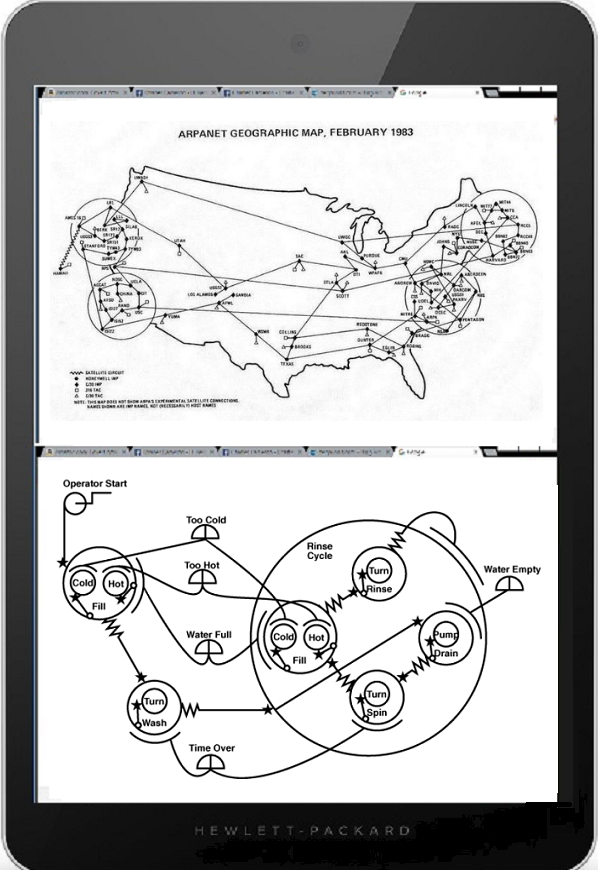
I don’t think we always appreciate just how similar graph-based mappings are to one another — or why the HipBone-Sembl Games are therefore so closely analogous to so many other graph-based mappings of the world around us:

ARPANET Washingmachine DQ tablet

This particular pairing of images struck me today when Mike Walker tweeted it the Arpanet map in quoting a World Economic Forum post — and the memory it called up was another image I found, who knows where, quite a few years ago, of the workings of a washing machine.

We really have two tips of the iceberg of a hugely pervasive language of node-and-edge-based graphs here.

**

Previous posts in this series:

  • On the felicities of graph-based game-board design: preliminaries
  • On the felicities of graph-based game-board design: two dazzlers
  • On the felicities of graph-based game-board design: three
  • On the felicities of graph-based game-board design: four
  • On the felicities of graph-based game-board design: five
  • Related posts, overlapping with those above:

  • Graph-types 1: sample graphs and boards
  • Graph-types 2: towards a universal graphical mapping language
  • I expect there’s more but that’s what a quick scan brought up.

    Philanthropic? I guess the bombs were sent pro bono?

    Tuesday, May 17th, 2016

    [ by Charles Cameron — the horror! the incongruity! ]
    .

    Tablet DQ Philanthropic

    **

    To be fair, the Chronicle of Philanthropy carried this report because what happens to a MSF hospital in wartime is of appropriate interest to philanthropists.

    The juxtaposition of journal title and topic, however, remains jarring — click on the link below and take a look at their page as it originally appeared, to see what I mean.

    Sources:

  • Chronicle of Philanthropy, Report Examines Afghan Forces’ Role in Hospital Bombing
  • New York Times Magazine, Doctors With Enemies: Did AfghanForces Target the M.S.F. Hospital?
  • Why I suspect I’d make a lousy Tibetan Buddhist meditator

    Tuesday, May 17th, 2016

    [ by Charles Cameron — where the blind spot of aphantasia meets the beauty of Avalokiteshvara ]
    .

    Tablet DQ 600 Avalokiteshvara & the aphantasic

    **

    Perhaps sadly, perhaps not, I suffer from aphantasia.

    It’s a great relief, actually, to have found someone who doesn’t laugh at me when I say I can’t visualize — a researcher, no less, Prof. Adam Zeman, with a paper on the topic in Cortex.

    I have tried on occasion to find metaphors for my condition. The best way to explain what does happen when someone asks me to visualize something is to say I can see it “as if painted in water on glass” — or “as if it’s behind me, out of sight, but I can remember roughly what it was like when I last looked.”

    Sources:

  • Lion’s Roar, Developing Pure Perception Through Visualization
  • BBC Science news, Aphantasia: A life without mental images
  • University of Exeter, Can’t count sheep? You could have aphantasia
  • Adam Zeman, Lives without imagery – Congenital aphantasia
  • Mancala games in culture & nature

    Tuesday, May 17th, 2016

    [ by Charles Cameron — I would rather play with the woodpeckers than with the humans ]
    .

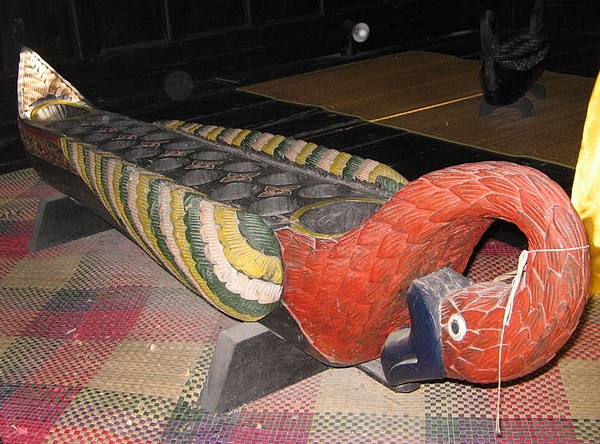
    Mancala games are games in which “seeds” are places in a series of “holes” in a board, often a carved wooden board, according to mathematical principles of play and capture. Wikipedia:

    Most mancala games share a common general game play. Players begin by placing a certain number of seeds, prescribed for the particular game, in each of the pits on the game board. A player may count their stones to plot the game. A turn consists of removing all seeds from a pit, “sowing” the seeds (placing one in each of the following pits in sequence) and capturing based on the state of board. This leads to the English phrase “count and capture” sometimes used to describe the gameplay. Although the details differ greatly, this general sequence applies to all games.

    ¶¶

    Equipment is typically a board, constructed of various materials, with a series of holes arranged in rows, usually two or four. The materials include clay and other shape-able materials. Some games are more often played with holes dug in the earth, or carved in stone. The holes may be referred to as “depressions”, “pits”, or “houses”. Sometimes, large holes on the ends of the board, called stores, are used for holding the pieces.

    Playing pieces are seeds, beans, stones, cowry shells, half-marbles or other small undifferentiated counters that are placed in and transferred about the holes during play.

    ¶¶

    Among the earliest evidence of the game are fragments of a pottery board and several rock cuts found in Aksumite areas in Matara (in Eritrea) and Yeha (in Ethiopia), which are dated by archaeologists to between the 6th and 7th century AD; the game may have been mentioned by Giyorgis of Segla in his 14th century Ge’ez text Mysteries of Heaven and Earth, where he refers to a game called qarqis, a term used in Ge’ez to refer to both Gebet’a (mancala) and Sant’araz (modern sent’erazh, Ethiopian chess).

    Nota Bene:

    Even when played with glass beads, mancala games are not even close to the Glass Bead Game as Hermann Hesse describes it, since their moves have nothing to do with cultural citation or meanings, let along their contrapuntal connections and correspondences, but are indifferent markers, inherently fungible.

    **

    It was 3 Quarks Daily that introduced me to the avian version of mancala games in a post that read:

    Acorn woodpeckers drill into trees not in order to find acorns, but in order to make holes in which they can store acorns for later use, especially during the winter.

    As the acorn dries out, it decreases in size, and the woodpecker moves it to a smaller hole. The birds spend an awful lot of time tending to their granaries in this way, transferring acorns from hole to hole as if engaged in some complicated game of solitaire.

    Multiple acorn woodpeckers work together to maintain a single granary, which may be located in a man-made structure – a fence or a wooden building – as well as in a tree trunk. And whereas most woodpecker species are monogamous, acorn woodpeckers take a communal approach to family life. In the bird world, this is called cooperative breeding. Acorn woodpeckers live in groups of up to seven breeding males and three breeding females, plus as many as ten non-breeding helpers. Helpers are young birds who stick around to help their parents raise future broods; only about five per cent of bird species operate in this way.

    **

    Conclusion:

    For myself, I would rather play with the woodpeckers than with the humans.

    Even so, a humanly-wrought board can be very lovely:
    swan mancala board

    Turner on Cultural Understanding and Influence In The Arena

    Tuesday, May 17th, 2016

    [by Mark Safranski / “zen“]


    Pete Turner (Right)                                                       Anthony Iannarino

    “Alcohol and hand grenades” is always the mark of a great interview.

    Some ZP readers are familiar with business strategist and sales expert S. Anthony Iannarino due to his highly regarded and widely read The Sales BlogAnthony also has a podcast, In the Arena and in this week’s episode he interviews another friend of ZP, Pete Turner of The Break it Down Show.

    Pete and Anthony discuss HUMINT, cultural understanding, John Boyd, Afghanistan, 4GW, trust building, relationships, organizational cultures and making connections through respect, analogs to the business world, institutional “tribes”, cross-cultural interactions, books and much more.

    Give it a listen here. Strongest recommendation.


    Switch to our mobile site