zenpundit.com » diplomacy

Archive for the ‘diplomacy’ Category

Strategic Communication, Science, Technology

Wednesday, July 8th, 2009

Blogfriend Matt Armstrong had an important post regarding The Strategic Communication Science and Technology Plan, April 2009. An excerpt:

The plan describes current efforts within the Department of Defense, the military services, the combatant commands and other agencies on SC. In total, these efforts could be linked together to form the foundation of an S&T thrust area for strategic communication. The report also includes a macro-analysis of capability gaps not being addressed by ongoing initiatives and lays out potential areas for future S&T investment.

While the request for the plan itself represents recognition from Congress that SC plays a critical role in the public and private response to current and emerging threats, it also highlights that there is much research and development already underway and many tools available to increase the government’s effectiveness in global engagement. The rub today is the need for strong leadership and coordination to ensure: 1) awareness of the long list of capabilities; 2) incorporating these capabilities into plans; and 3) participation by stakeholders across the US government, NGO’s, industry, and private citizens.

The S&T plan sorts current efforts into the following categories:

  • Infrastructure: Enabling and facilitating access to information from news to markets to vocational
  • Social Media: Knowledge Management, Social Media, and Virtual Worlds
  • Discourse: Analysis of radical and counter-radical messages and ideas
  • Modeling and Forecasting: Gaming and anticipating adversarial messages and ideas as well as our counters and pre-emptive measures
  • Collaboration: Increasing collaboration and training across and beyond Government
  • First Three Feet: Empowering, Equipping, Educating, and Encouraging media and others to exist and freely report on events for what they really are
  • Understanding: Develop country, culture, and regional expertise, including polling
  • Psychological Defense: Planning and capacity building for dealing with critical strains on society in peacetime and wartime

The interesting thing here for me is that “strong leadership” is lacking because the people spread across and outside government who have the shared awareness of technology, social media and national security at a level of sophistication where they could actually craft a strategic communication policy, are usually many levels removed from the appointee policy deciders for whom these variables are (usually) fuzzily understood.

To use an analogy, the chefs are valet parking cars outside while trying to get the manager of the restaurant to acknowledge their recipes. Or, maybe that there should be cooking going on in the kitchen if they want to have any customers. Or that the business is, in fact, a restaurant and not a nicely organized room full of tables.

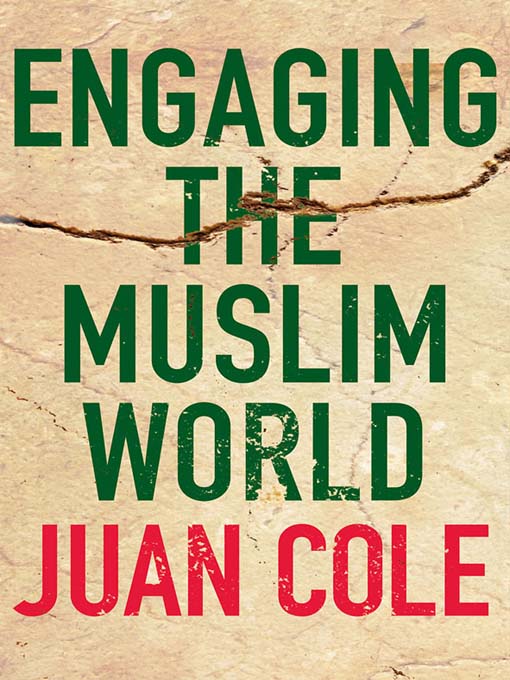
Book Review: Engaging the Muslim World by Juan Cole

Wednesday, July 8th, 2009

Engaging the Muslim World by Juan Cole

I recently finished reading Engaging the Muslim World by Juan Cole, the influential academic, well known liberal-left blogger of Informed Comment, past president of the Middle East Studies Association and occasional media talking head. Cole has written an intriguing book on contemporary foreign policy that is of special interest to those readers concerned with public diplomacy, the Muslim world, terrorism and the domestic politics of American foreign policy, particularly the war in Iraq. I will state straight off that there are arguments in this book presented by Cole that I profoundly disagree with, or, national security related assertions that I consider questionable; but in other instances, when Cole is concentrating on the nuances of the Arab-Muslim world’s political-cultural lens, he is an illuminating and insightful analyst from whom I have learned new things. 

Engaging the Muslim World is…well….engaging. I found Cole’s prose flowed smoothly, as if the author was talking to the reader across a table, and I had a hard time putting the book down, albeit I was frequently scribbling furiously in the margins. This is a polemical -policy book written by an academic for a lay audience and the reader’s reaction to Engaging the Muslim World will depend in part on their own worldview. Liberals will cheer more than they disagree with Cole, while conservatives and supporters of Israel are likely to reject many of the book’s normative assumptions long before they read the conclusions – but Cole also offers some prescriptive advice that center-right COIN and public diplomacy advocates will warmly embrace.

The book  is divided into six chapters. The first, “The Struggle for Islamic Oil:The Truth About Energy Independence” which deals with energy markets, the Cold War history of the Mideast, global warming, environmental policy, alternative fuel technologies and globalization, is a necessary effort to concisely account for the geoeconomic importance of Muslim oil producing states and the future of fossil fuel economies.  Cole argues – correctly, I suspect – that there will be no short or medium term substitutes for oil and gas until solar power technology is cost-efficient enough (and efficient in a physics sense) to compete with fossil fuels in the marketplace. Not being a scientist or an expert in energy market issues, I am poorly placed by professional background to evaluate Cole’s claims in these areas and will leave those to others.

That said, chapter one remains the odd man out. It smacks of having been  compacted by an editor out of two or more chapters and consequently has disparate issues jumbled together with insufficient explanation; as a whole, chapter one fits uncomfortably with the subsequent chapters which flow together naturally and thematically. On the other hand, the topic of oil can hardly be dispensed with either in a geopolitical discussion of the Mideast, so Cole was right to tackle it and the primary problem is really one of sequence, not subject matter.

Chapters two through six are the heart of Engaging the Muslim World, where Juan Cole articulates a theme of “Islam anxiety” permeating Western, particularly American, media and public opinion. Poorly informed about even the most basic information regarding the Muslim world, such as the differences between Shia and Sunnis, secular Baathist nationalists and Islamist radicals, quietists and the politically militant, Arabs and non-Arabs, Cole asserts that Westerners tend to lump Muslims of all shades of political belief, religiousity and nationality into a homogenous, vaguely mysterious but ever dangerous entity. Cole cites as one example, Egypt’s Sunni Muslim Brotherhood, which has foresworn violence and has members who sit in Egypt’s legislature, being lumped uncritically by American commentators with al Qaida and Hezbollah (which is a radical Shiite group).

A better way to understand violent Islamist extremists in relation to normal Muslims, in Cole’s view, would be to see them as analogous to our homegrown, violent, far-Right, white racist underground that produced Timothy McVeigh, who carried out the Oklahoma City bombing or as cult-like movements. While smaller in size than Islamist radicalism, the racist Right shares with violent Islamists the trappings of a fringe, ostracized, quasi-religious, political cult with a conspiratorial worldview that diverges sharply from the nation’s mainstream religious life. Violent Islamists often make themeslves as unpopular with their co-religioinists as do neo-Nazi extremists here, through actions that horrify society, such as the bloody massacre of Western tourists and Egyptian workers at  Luxor, Egypt.

Cole’s analogy with cults and racial extremists I think is a useful one. Radical Islamists are difficult to classify on a traditional political spectrum as their political behavior has definite similarities with those of the fascist and communist totalitarians of the 20th century, but will not fit smoothly with either, given Islamist religious extremism and the fanatical atheism or at least radically secular nature of the Bolsheviks and Nazis. The psychological overlap however is certain, something akin to the 19th century Anarchist-terrorists or what Eric Hoffer captured in his classic work, The True Believer.

On Israel and Iran, Cole bends over backwards, like a circus sideshow contortionist, to try and explain the lunacy (and Cole admits it is, at best, a crackpot worldview) of Ahmadinejad’s violently antisemitic statements about the Holocaust and Iran’s generally defiant behavior toward the international community while giving Israel no similar benefit of the doubt.  Cole argues that Ahmadinejad’s oft-stated “wipe Israel off of the map” is a deliberate mistranslation by the Western media. Ok, possibly so. I do not speak Farsi, so I’ll take Cole’s word here. If it is the case though, Ahmadinejad is well aware of how his repeated statement is being mistranslated by Reuters and AP, yet he keeps using it. Again and again. That is an ominous statement in itself.

This uneveness regarding Iran and Israel will no doubt enrage conservatives and delight progressives, but in fairness to Juan, I must say that despite his partiality toward Iran in his book, as a blogger he was very quick to denounce the obvious stealing of the recent election by Khameini-Ahmadinejad-IRGC and my perception is that Cole views the apocalyptic Mahdist tendency in Twelver Shiism that Ahmadinejad embraces as a kooky deviation from mainstream Shiism. That not just Ahmadinejad holds this belief dear, but also many influential figures in the Iranian security apparatus as well, is in my view, a cause for alarm.

Despite his politics, Cole concludes Engaging the Muslim World with a very pragmatic prescription for American public diplomacy for engaging Arabs and Muslims in a more effective manner than in the past eight or eighteen or eighty years. If I do not agree with every aspect, it is a good deal better than what the State Department and the rest of the USG is doing now:

Once I saw an Iraqi tribal leader interviewed on al-Jazeera. He said. “There is good and bad in America”. I was struck by how pragmatic and realistic his response was, and how different it was from so much of the fundamentalist vigilantee propaganda about the United States posted on radical internet bulletin boards. If Washington could reach out to all Muslims and bring them around to a more nuanced -and clear-view, in which America was not simply demonized, it would be a major accomplishment. The point is not that they should see the West through rose colored glasses, but that they should be willing to see the good and bad.

That would represent a step up by an order of magnitude.

Obama’s Foreign Policy Trifecta of Foolishness

Wednesday, March 4th, 2009

The Obama administration has been strikingly inept in the last few days in foreign policy, making a series of gaffes and counterproductive gestures that, had George W. Bush made them, would be igniting howls of anger and ridicule from the New York Times and the Left blogosphere. Now the crickets are chirping.

In a short span of time, the White House has managed to 1) embarrass visiting British Prime Minister Gordon Brown; 2) enrage Jerusalem by offering Gaza almost  $ 1 billion ( in return for….?) while HAMAS is still firing rockets at Israelis ;and 3) pull the rug out from under our NATO allies Poland and the Czech Republic with of a give-away-the-store offer to Moscow on missile defense, while pleading for help with Iran. A clumsy and premature gesture that President Medvedev treated with contempt and left Prague and Warsaw, which stuck their necks out in agreeing to host the missile systems, scrambling for diplomatic fig leaves. I wonder to what degree the Czechs and Poles had been consulted beforehand?  None of these actions appear to have been properly vetted and they left the new administration looking very green, slightly impulsive, indifferent toward America’s allies and fairly arrogant.

In fairness, almost every new administration makes first and second year blunders in foreign policy, most of which are completely forgettable in the long run. For example, as a student, an old professor of mine who was an eminent authority in Southeast Asian studies, once recounted to me LBJ giving ” the Johnson Treatment” to the King of Thailand, whose person is considered sacred to Thais and was, probably, in any event, unprepared for being put into a giant Texas bear hug.  Ronald Reagan did not give Prime Minister Margaret Thatcher prior notice of the invasion of Grenada and had initially waffled in the early days of the Falklands War. At other times, the early mistakes prove decisive, such as John F. Kennedy’s failure of nerve during the Bay of Pigs ( or alternatively, approving a cocked-up covert-op plan in the first place) which helped precipitate the later Cuban Missile Crisis.

The one bright spot in foreign policy was the unveiling of the Obama administration’s new National Security Council structure which seems to have been judiciciously considered with an eye toward improving interagency DIME integration in policy formation and enforcing real discipline in execution. On paper, it’s a very good plan with some important changes for improving the national security community’s performance.

Now they need to put it into practice.

A White Oak for Public Diplomacy

Saturday, February 21st, 2009

The chronically poor state of American public diplomacy has been a topic of discussion in the foreign policy-mil-national security blogosphere for years. As with COIN on the military side of things, pressure has built from conversation to a greater public awareness of the inadequacy of American public diplomacy toward strategic planning and lobbying for reform. Few people have been more active on this important issue than my blogfriend Matt Armstrong, who recently participated in formulating the….

White Oak Recommendations: Rethinking Public Diplomacy (Updated)

Over the weekend of January 30 through February 1, the Howard Gilman Foundation, Meridian International Center, and The Public Diplomacy Council brought together seventy people – public and private sector stakeholders frustrated with this demise and determined to restore public diplomacy as a viable tool of foreign policy – to discuss the structure of America’s global engagement at the White Oak Conference Center in Florida.

The product of the conference is a short, easily read document of common sense recommendations that would otherwise be in larger reports. All but three of the conference participants endorsed the report. Those who abstained did so because their employers do not permit even personal endorsements. The report is simple and straight forward, so much so that the endorsements run longer than the report.

Download the Recommendations here (26kb PDF).

Download the Endorsements here (84kb PDF).

Matt also organized a blogger’s roundtable with members of the White Oak Conference ( he was kind enough to invite me but unfortunately, I had a schedule conflict that day):

On February 19, I moderated a sixty minute roundtable discussion between Doug Wilson of the Howard Gilman Foundation and Bob Coonrod of The Public Diplomacy Council. Tara Sonenshine was originally scheduled to attend but had a scheduling conflict at the last minute. The participants were Pat Kushlis of WhirledView, Shawn Powers of Intermap.org, John Brown of PDPBR (and now Notes and Essays), Kim Andrew Elliot of http://www.kimandrewelliott.com/, Steve Corman of COMOPS, Jennifer Bryson of Public Discourse, Chris Tomlinson of the AP, and Danielle Kelton from PD 101.

White Oak-Related posts:

Read the rest here.

American public diplomacy is beyond broken – it borders on non-existent. There’s a great deal of building that needs to be done and the White Oak Conference was an important step forward.

Why the NSC Structure Matters – and When it Does Not

Tuesday, February 10th, 2009

J. at Armchair Generalist gets a big hat tip for his post Reforming the National Security Council that pointed to this WaPo article on the interview of National Security Adviser, Gen. James Jones.  The new APNSA opines on the coming of a “strong” NSC process for the Obama administration:

….The result will be a “dramatically different” NSC from that of the Bush administration or any of its predecessors since the forum was established after World War II to advise the president on diplomatic and military matters, according to national security adviser James L. Jones, who described the changes in an interview. “The world that we live in has changed so dramatically in this decade that organizations that were created to meet a certain set of criteria no longer are terribly useful,” he said.

….”The whole concept of what constitutes the membership of the national security community — which, historically has been, let’s face it, the Defense Department, the NSC itself and a little bit of the State Department, to the exclusion perhaps of the Energy Department, Commerce Department and Treasury, all the law enforcement agencies, the Drug Enforcement Administration, all of those things — especially in the moment we’re currently in, has got to embrace a broader membership,” he said

New NSC directorates will deal with such department-spanning 21st-century issues as cybersecurity, energy, climate change, nation-building and infrastructure. Many of the functions of the Homeland Security Council, established as a separate White House entity by President Bush after the terrorist attacks of Sept. 11, 2001, may be subsumed into the expanded NSC, although it is still undetermined whether elements of the HSC will remain as a separate body within the White House.

Presidents rarely get the national security process they want but they usually get what they deserve by default of their own unwillingness to  police their subordinates when they stray from the blueprint laid out in their first NSC-drafted executive order – usually titled PDD-1 or NSDD-1 ( “Presidential Decision Directive”, “National Security Decision Directive”). When a Henry Kissinger, or a Zbigniew Brzezinski or a Dick Cheney “grab power” from whomever is supposed to have it, you can be certain that these coups have implicit presidential approval.

 It is unusual that such a directive has not already been issued by the Obama administration, if the WaPo article is correct. Normally, this is a new president’s first (or one of the first) executive order that the transition team prepares in case the administration begins with a national security crisis. If that has not happened yet it’s a troublesome sign but I will give the Obama administration credit for attempting to create a new structure outside conventional Cold War and statutory arrangements for the NSC. That is long overdue, as is some hard thinking about what role the NSC should play in crafting national strategy and policy.

Presidents need an NSC Adviser and staff to do three things, not all of which are compatible:

1. Be an “honest broker” and coordinator between State, Defense and the IC on behalf of the POTUS ( Scowcroft Model).

2. Critically evaluate the policy options provided to the POTUS by Cabinet bureaucracies and offer creative alternatives (Kissinger Model).

3. Act as the “enforcer” and monitor to make certain presidential policy is being implemented and identify those who are obstacles, free-lancers and bureaucratic sabotuers for reprimand or removal (Sherman Adams/H.R. Haldeman* Model).

* Adams and Haldeman were WH Chiefs of Staff who were the designated and much feared “enforcers” of their administrations. One of Reagan’s numerous APNSAs, Judge Clark, was concerned with enforcing Reagan’s ideological line in foreign policy but he is too obscure a figure and his tenure too short to serve as an effective example.


One is easy. Two are difficult but common enough. Success at three is virtually unknown.

A president who is himself a product of the establishment consensus – a George Bush, Sr. or a Dwight Eisenhower– is looking for a National Security Adviser who is an honest broker and staffs his NSC with military and foreign service officers, with a sprinkling of CIA and DIA veterans. They will expect obedience from State and the Pentagon but as their policy choices coincide with Beltway conventional wisdom, they get it most of the time anyway.

A president who comes to Washington as an “outsider” in some fashion or as a “change agent” – a Richard Nixon, Jimmy Carter, Ronald Reagan or Bill Clinton– will pick a National Security Adviser who will build a staff of what one national security scholar has called a “team of academic superstars” who will aid the president in taking control of American foreign policy. Clashes between the White House and the career bureaucracy will be frequent and increasingly vicious, particularly with State, though in the Bush II administration that role was played by the senior managers of the CIA.

Some presidents have a dysfunctional NSC process – a category that includes John F. KennedyRonald Reagan, Bill Clinton and George W. Bush – where the inmates take over the asylum and free-lancing by deputy assistant secretaries reigns supreme. Both Kennedy and Clinton strongly resisted a formal NSC decision making structure for their administration that would inhibit their ability to “pop in” to offices, chat up whomever and issue snap decisions. While this stance flowed from their desire to keep their options open and remain free of “handling” by their own staffers, it ultimately led to chaos and dangerously amateurish improvising during crisis moments.  Reagan and Bush II by contrast had formal structures in place but undermined them overtly ( Reagan in NSDD-2) or covertly ( Bush in letting his Vice-President operate a shadow mini-me NSC of his own). In Reagan’s case, this was aggravated by an unwillingness to fire anyone, no matter how much the rat-bastard deserved it, and a general distaste for confrontation.

Unless a president supports his NSC adviser down the line, the bureaucracies will do as they please to the point of making his administration’s top officials into laughingstocks. While you might not know it from the State Department’s current broken down condition, it was historically amongst the very worst offenders in this regard ( though both the Pentagon and Langley could rise to the occasion), regularly abusing the interagency process and blatantly defying presidential instructions. Give Foggy Bottom strategic planning, USAID or Public Diplomacy and they will let these nascent “competitors” wither on the vine.

The problem largely is that the State Department is filled with bright and talented but fairly insular individuals who imagine themselves more capable and informed and ultimately deserving of authority than the guy actually sitting in the Oval Office who was elected by the American people or any of his appointees. They need a strong hand at SecState and consistent follow-up by the NSC; and if given these conditions, State can perform amazing feats of diplomacy for a president. Absent that, State can create great friction for an administration.

The Obama administration is setting itself up for a very “strong” NSC process. Jones and Chief of Staff Emanuel are a potent combination and Defense, State and the CIA all have been given major political heavyweights as principals. Moreover, Jones appears to be in sync with Robert Gates as to the need for imaginative “new thinking” in national security affairs ( maybe we should send him this). However all the potential on paper in the world, at this stage of the game, means nothing.

It ultimately comes down to the President of the United States. What does he want ?


Switch to our mobile site

