zenpundit.com » swj blog

Archive for the ‘swj blog’ Category

Query: COIN Manual Conference Feedback

Wednesday, May 16th, 2012


Was the COIN  Manual conference at Fort Leavenworth last week a success or a failure?

I have heard backchannel that the focus of the rewrite of FM 3-24 was going to be on “tactics” and but that a “light footprint option” had to be included to appease policy makers. Some good suggestions were made at SWJ by Colonel Robert C. Jones, but not much has been said yet online that I have seen. USACAC bloseriously could use some updating on a more frequent basis.

I’m curious where they went with this. Opinions and comments solicited.

Before Disruption….Thinking

Monday, April 23rd, 2012

“What you think, you become”

    – Buddha

“We are what we frequently do”

    – Aristotle

There has been a lively and still evolving debate in the milblogosphere regarding “disruptive thinkers”, starting with Benjamin Kohlman’s post at SWJ whose editor Peter J. Munson has done a fine job steering, collecting and commenting upon. A selection:

The Military Needs More Disruptive Thinkers by Benjamin Kohlman

Disruptive Thinking, Innovation, Whatever You Want to Call It is Needed for a Military in Crisis by Peter J. Munson 

The focus on disruptive thinkers coincided with a different but relevant debate over professional military education (PME) when a scathing blast was recently  leveled at the US Army War College by Major General Robert Scales (ret.) , himself the former commandant and a strong advocate of rigorous PME.  A few of the criticisms made by General Scales at a gathering at FPRI were mentioned in a post by Thomas Ricks who believes in shutting down the service academies and war colleges and maybe just sending everyone to Yale, Princeton and Harvard for MBAs. Or something.
.
What was interesting to me is that many authors and their points had less to do with a close examination of cultivating cognitive skills than related topics of changing organizational culture, the perils of groupthink, rehashing ideas from Frans Johanssen’s The Medici Effect and John Kao’s Innovation Nation, the superiority of entrepreneurshiphidebound military bureaucracy and other tangents to indirectly create an environment in which insightful or innovative behavior might happen.  Only Mike Mazarr zeroed in to the heart of the matter, writing:
….We need to improve, for example, in the detail and specificity of critical and creative thinking methodologies that we integrate into the curriculum.
Bingo!
.
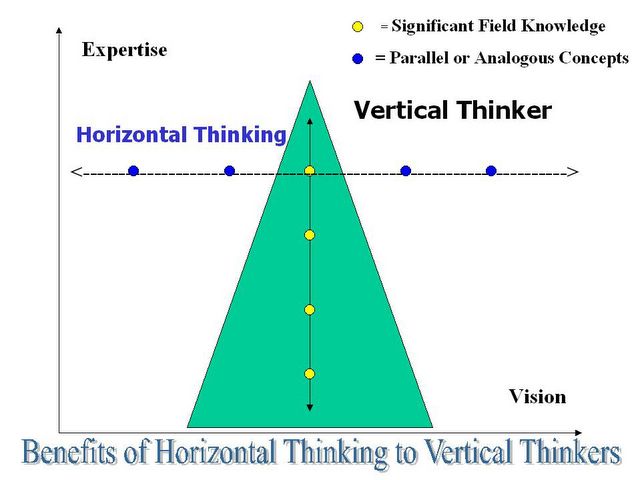
There’s nothing wrong -in fact, much to the good – with the call of Kohlman and others like Joan Johnson-Freese to deliberately combine students and faculty of radically different professional backgrounds. Such a personnel mix is a good base for horizontal thinking to take place, where discussions can range across fields generating insights and analogies and accelerating learning.
However, just assembling a broad mix of talent and putting them together in a building is not enough because it is not any more goal oriented than a MENSA social. Good things might happen, sure, but just as easily not. This is why DARPA is a lot more productive of an organization on an annual basis than the Institute for Advanced Study. There needs to be a mixture of problem-solving and play, free inquiry or experimentation and unifying goals. Communities of interest have to first have a sense of community for the vibrantly sharing and inspiring “minds on fire” effect to take place.
.
If the military or more broadly, American society, wants a larger number of creative, innovative, “disruptive”, strategic or whatever kind of thinker, then the answer is to actively and purposefully teach students creative, critical, insight-generating and strategic thinking skills and to value intellectual curiosity, skepticism, imagination and empiricism over ideology and conformity. The other indirect, “better environment”, stuff certainly improves your chance of success, but systemic improvement will only come about by making such objectives the focus of instruction and learning rather than a haphazard byproduct.
UPDATE:
At Best Defense, Ricks has provided a copy of his prepared remarks on PME as well as a link to the audiofile that I could not pull up the other day. Check out what he has to say.

Iran is a classic wicked problem

Saturday, March 10th, 2012

[ by Charles Cameron — Iran, unknown unknowns, Madhyamika philosophy and a blessed unknowing ]
.


.
image from Jackson Pollock / AustinKids
an artist’s representation of a wicked problem to be untangled?

1.

Dr. TX Hammes, who will need no introduction to most ZP readers, wrote a few days back in On Bombing Iran, A False Choice:

While there has been some discussion of Iran closing the Straits of Hormuz, there has been no consideration of other Iranian actions – mining harbors overseas (using merchant ships), major attacks on oil production chokepoints globally or major terror attacks using the nuclear equivalent explosive power inherent in many industrial practices. In short, bombing proponents assume Iran will be an essentially supine enemy and not attempt to expand the conflict geographically or chronographically.

Iran is a classic wicked problem. Any “solution” brings a new set of problems. Lacking a solution, the strategist’s job is to think through how to manage such a problem.

My train of thought now departing the National Defense University on Dr Hammes’ platform will make its way with stops at Hans Morgenthau, Jeff Conklin and Richard Feynman to a final destination deep in the heartland of Buddhist Madhyamika philosophy with Elizabeth Mattis-Namgyel.

2.

Drs. Francis J. Gavin and James B. Steinberg‘s recent Foreign Policy piece The Unknown Unknowns carried the subtitle:

If the past half-century of American political history has taught us anything, it’s that we can’t possibly know the consequences of bombing — or not bombing — Iran

and opined:

Based on our experiences — one of us a former senior policymaker, the other a historian of U.S. foreign policy — we are convinced that the “right” answer, but the one you will never read on blogs or hear on any cable news network, is that we simply cannot know ahead of time, with any degree of certainty, what the optimal policy will turn out to be. Why? Even if forecasters could provide probabilities about the likelihood of a narrow, specific event, it is simply beyond the capacity of human foresight to make confident predictions about the short- and long-term global consequences of a military strike against Iran.

3.

It appears that this sense of unknowing has application beyond the specific question of whether or not to bomb Iran. Blog-friend Peter J Munson just the other day quoted Hans Morgenthau in a short SWJ piece titled Gentile: Realities of a Syrian Intervention — using a Morgenthau quote that he also features as an epigraph to his book, Iraq in Transition: The Legacy of Dictatorship and the Prospects for Democracy.

So that’s Iran, Iraq and Syria — but the Morgenthau quote itself, from his Politics among Nations, is even more general in application:

The first lesson the student of international politics must learn and never forget is that the complexities of international affairs make simple solutions and trustworthy prophecies impossible.

Okay?

4.

And it goes further. Love that quote from Laurence J Peters that Jeff Conklin uses as the epigraph to his seminal paper on Wicked Problems:

Some problems are so complex that you have to be highly intelligent and well informed just to be undecided about them

Next up, here’s the Nobel physicist Richard Feynman speaking in The Pleasure of Finding Things Out, a Horizon / Nova interview, illustrating the approach Morgenthau takes to international relations as applicable to the grand issues of philosophy, religion and science:

I can live with doubt and uncertainty and not knowing. I think it’s much more interesting to live not knowing than to have answers which might be wrong. I have approximate answers and possible beliefs and different degrees of certainty about different things, but I’m not absolutely sure of anything and there are many things I don’t know anything about, such as whether it means anything to ask why we’re here, and what the question might mean.

5.

And how far is that from Elizabeth Mattis-Namgyel, student and wife of the lama Dzigar Kongtrul Rinpoche, writing in her book on Madhyamika, The Power of an Open Question (p. 58):

Maybe experiencing complexity brings us closer to reality than does thinking we’ve actually figured things out. False certainty doesn’t finalize anything. Things keep moving and changing. They are influenced by countless variables, twists and turns … never for a moment settling into thingness. So maybe we should question the accuracy or limitations of this kind of false certainty. Conflicting information confuses us only when we’re trying to reach a definite conclusion. But if we’re not trying to reach a conclusion in the first place — if we just observe and pay attention — we may actually have a fuller, more accurate reading of whatever we encounter.

6.

Zen, too, welcomes this “open ended” approach in its working with koans, those mysterious and / or paradoxical riddles and / or poetic statements and / or legal cases for which such teachers as Dogen Zenji had such affection. In the words of Shozan Jack Haubner:

The searching, open-ended nature of koan work yields the kind of answer, however, that frustrates easy analysis, not to mention that most exquisite of all human pleasures: being “right.” For, ultimately, koan practice teaches that as long as a question is alive in the world around us, it should not — indeed, cannot — be settled once and for all within us. Koan practice does not put life’s deepest issues “to bed.” It wakes these issues up within us, waking us up in the process.

or consider this, from Lin Jensen, An Ear to the Ground: Uncovering the living source of Zen ethics:

Judgments on right and wrong are a nearly irresistible enticement to pick sides. And that’s exactly why the old Zen masters warned against becoming a person of right and wrong. It isn’t that the masters were indifferent to questions of ethics, but for them ethical conduct went beyond simply taking the prescribed right side. For these masters, the source of ethical conduct is found in the way things are, circumstance itself: unfiltered immediate reality reveals what is needed.

Policy-makers, of course, can’t suspend judgment indefinitely — but maybe a contemplative approach in general would make them better prepared for snap judgments and sound intuitions when such are called for. Clausewitz [grinning, with an h/t to Zen here]:

When all is said and done, it really is the commander’s coup d’œil, his ability to see things simply, to identify the whole business of war completely with himself, that is the essence of good generalship. Only if the mind works in this comprehensive fashion can it achieve the freedom it needs to dominate events and not be dominated by them.

7.

And let’s go the distance…

Here’s Elizabeth Mattis-Namgyel again, from an online retreat she gave last year for subscribers to Tricycle magazine:

We need to ask, what is love or beauty or pain before we objectify it? what happens when we can abide without conclusions? you know, these are questions for the practitioner, practitioners questions… and I wanted to use one word in Tibetan that I’ve found very useful for myself… and this is the word zöpa.. this translates usually as patience or endurance or tolerance, but there’s this very subtle translation of zöpa, which is the ability to tolerate emptiness basically, which is another ways of saying the ability to tolerate that things don’t exist in one way, that things are so full and infinite and leave you so speechless, and so undefinably grand – and these are just descriptive words, but you have to use some words to communicate, I guess — the ability to bear that, that fullness, like we’ve been talking about, not turning away, not turning away.

On scoring complexity

Thursday, February 2nd, 2012

[ by Charles Cameron — mapping, modeling — no, scoring complexity ]
.
.

.
.
I was interested to see David Bohm‘s On Dialogue (Pegasus Communications, 1990) listed in the bibliography of Nancy Roberts‘ paper, Wicked problems and Network Approaches to Resolution, which Mike Few quoted extensively in his recent post Failing into Collaboration? on the SWJ blog. Dr. Bohm’s book On Creativity was the topic of Zen’s recent post.

Wicked problems, multiple stakeholders, multiple voices, polyphony, counterpoint – there’s a whole nexus here that needs exploring.

My post on The speeds of thought, complexities of problems addresses the “thought-speed” that best addresses this kind of issue. There are ways to educate that particular style of thinking, and I hope to address them in a future post – but the other issue that’s of importance here is how to notate such problems, how to map them, or …

model them? No.

*

The question we should be asking is not how to code a machine (via stocks and flows, agent based models) to model them, but how to sketch them in such a way that the human mind, working at that slowest and most profound of speeds, can model them using its own natural complexity and capacity for emergent (“aha!”) insights.

That’s a topic I have discussed here before (e.g.: i, ii, iii) and shall take up again, and my preferred term for the activity is the one used in music: scoring.

The other issue that’s of importance here, then, is how to notate such problems, how to map them, how to score them — so that the tortoise mind can read them the way a musician reads a score…

*

Above: Score by Cornelius Cardew, “Treatise” (1963-1967), p.183
Below: Score of JS Bach, “Kyrie” from Mass in B Minor

*

Metz on the Psychology of Insurgency

Saturday, January 28th, 2012

Dr. Steve Metz, a friend of ZP blog and Chairman of the Regional Strategy and Planning Department and Research Professor of National Security Affairs at the Strategic Studies Institute, has new and heavily footnoted article up at SWJ:

Psychology of Participation in Insurgency 

 It’s common sense: to make insurgents quit the fight or to deter other people from joining them, to understand their appeal, we must know what makes them tick.   This is easier said than done as we Americans face a mental barrier of our own creation–we insist on approaching insurgency (and counterinsurgency) as a political activity.  This entails a major dose of mirror imaging.  We are a quintessentially political people, but it is politics of a peculiar type, born of the European Enlightenment.  We assume that the purpose of a political system is to reconcile competing interests, priorities, and objectives.  From this vantage point, we see insurgency as a form of collective, goal-focused activity that comes about when nefarious people exploit the weaknesses of a political system.  It occurs when “grievances are sufficiently acute that people want to engage in violent protest.”[1]  The state cannot or will not address the grievances.  And since insurgency is political, so too are its solutions: strengthen the state so it can address grievances and assert control over all of the national territory.  The improved state can then return to its mission of reconciling competing interests, priorities, and objectives.

            Much of the world–including the parts prone to insurgency–sees things different.  Most often the political system is used by an elite to solidify its hold on power and defend the status quo.  Most insurgents do not seek a better political system but rather one that empowers them or, at least, leaves them alone.  People become insurgents because the status quo does not fulfill their needs.  This is a simple observation with profound implications.  It means that the true essence of insurgency is not political objectives, but unmet psychological needs (although political objectives may serve as a proxy for psychological needs as insurgent leaders seek to legitimize and popularize their efforts).

This coincides with the observation of David Kilcullen that many insurgents are purely localized “accidental guerrillas“, motivated by other drivers than political calculation – such as opportunity for excitement, the dictates of an honor culture, fear of being considered a coward, prospects for glory or booty or the aggressive territoriality of young men.  Looking at historical examples of warlords as diverse as “General Butt Naked“, the Mad Baron Ungern von Sternberg and General Abdul RashidHeavy D”  Dostum, it is evident that some men fight and kill because they revel in slaughter for it’s own sake, are skilled at combat and find purpose in war.

Indeed, as Metz writes:

….Boredom also contributes to a sense of being lost.  In rural areas and urban slums, insurgency seems to provide excitement for those whose lives are devoid of it.[21] This theme appears over and over when former insurgents explain their motives.  Ribetti, for instance, heard it from Colombians, particularly from the female insurgents she interviewed who sought to escape the tedium of a woman’s life in rural areas.[22]  Louise Shelley observed that youth violence and association with terrorism is often linked to “the glamour of living dangerously and the adrenalin flow that is associated with living precariously.”[23]  States not susceptible to insurgency have proxies for youth boredom and the need for excitement which drains these impulses into less destructive channels, whether video games, violent movies, sports, or fast cars.  Societies without alternatives–particularly ones where the educational system has collapsed like Sierra Leone, Afghanistan, and he tribal areas of Pakistan can see boredom be channeled into political violence.[24]

            The Thugs:  There are people in every society–usually young males–with a propensity for aggression and violence.  Insurgency attracts them since it is more prestigious and legitimate than crime, and has a better chance of gaining internal or external support.  It offers them a chance to justify imposing their will on others.  This is amplified when a nation has a long history of violence or major military demobilization which increases the number of thugs and puts many of them out of work.  In many parts of the world, whole generations have never known a time without brutality and bloodshed.  Sierra Leone is a perfect example of this.  The RUF emerged from a group of young people from the slums of Freetown known for their antisocial behavior.[25]  While this group sometimes provided violent muscle for politicians, it also served up the raw material for the RUF, leading Ibrahim Abdullah and Patrick Muana to label it the “revolt of the lumpenproletariat” (a word coined by Karl Marx to describe society’s lowest strata).[26]  Thugs seldom create or lead insurgencies, but they do provide many of its foot soldiers.


Switch to our mobile site