zenpundit.com » geopolitics

Archive for the ‘geopolitics’ Category

Burning scriptures and human lives

Tuesday, April 5th, 2011

[ by Charles Cameron ]

*

Which is more sacred? You own life? Or an ideal you would be willing to die for?

I ask this, because we often think, act and speak as though one human life, any human life, is automatically more sacred, more to be preserved, than any idea – or book.

We make allowances, to be sure, and “thou shalt not murder” is no doubt closer to the Hebrew than “thou shalt not kill” – but we tend to think of human life as a paramount value, and in this we have the support both of our legal code (“murder one”) and of many scriptures, including the Qur’an, which declares, “whoso saveth the life of one, it shall be as if he had saved the life of all mankind” (for details, see below).

And I also ask this because Martin Luther King said, “If a man hasn’t discovered something that he will die for, he isn’t fit to live” — and even if I find MLK’s exact phrasing a little strange, I think I know what he’s getting at.

Somehow, then, I think we can agree that there may at times be good reasons to value something that’s not a human life but an ideal of some sort more than one’s own life itself, but that in general, a human life, any human life, is of comparable worth to one’s own.

.

One:

Which brings me to this thought experiment – a list of rhetorical questions designed to elicit thought, not to be answered like a questionnaire…

how-sacred-is.gif

.

Two:

These are rhetorical questions, and I’m asking them for specific reasons.

Under Islamic theology, for instance, the Qur’an cannot be destroyed, since it says of itself (Sura 82, al-Buruj, 21-22:

Surely this is a Glorious Qur’an, inscribed on an Imperishable Tablet.

It is physically possible to burn a physical “copy” [mushaf] of the Qur’an in book form— one particularly obnoxious pastor in Florida has recently done so, although he had been warned in advance by GEN Petraeus:

the safety of our soldiers and civilians would be put in jeopardy and accomplishment of the mission would be made more difficult.

— and the Muslims who recently bombed a Sufi shrine in the Punjab no doubt burned more than one such copy / mushaf, hence my final question in the list above.

.

Three:

I could add many other questions to the list — for instance:

  • For Protestants: How precious is the Saving Blood?
  • For Catholics: If someone bombs a church in which the Mass is being celebrated, does that destroy the Marriage Feast of the Lamb of which every Eucharist is a foretaste?
  • And if someone assassinates the priest while he is “in persona Christi” (in the person of Christ) celebrating Mass, does that kill Christ (again)?

That last, I should add, did in fact happen, not only more recently to Archbishop Romero in El Salvador, but also, several centuries ago, in the little parish church of the village of Brightwell-cum-Sotwell near Oxford where I was raised — and is commemorated there by a brass which reads:

Here lyeth the body of Master John Scoeffyld who died on the 15th day of the month of May in the year of our Lord 1507, on whose soul may God have mercy, Amen

So you see, I have a personal interest in these things…

.

Four:

As to the value of a human life, opinions vary…

Some humans feel the need to hold ethical discussions before wantonly taking other human lives:

For weeks, they had weighed the ethics of bagging “savages” and debated the probability of getting caught. Some of them agonized over the idea; others were gung-ho from the start. But not long after the New Year, as winter descended on the arid plains of Kandahar Province, they agreed to stop talking and actually pull the trigger.

Mark Boal, The Kill Team, Rolling Stone, March 27, 2011

Around two percent of the human race is psychopathic, I’ve read, and most of us can be strongly tugged and swayed by peer-pressure, this was wartime — the pressure-cooker of souls — and whatever got into those men could very likely get inside me, too.

Who’s to say I wouldn’t buckle under pressure like that?

.

Five:

But I’m at peace, here, philosophizing.

One could perhaps be forgiven for thinking the US values the loss of “two sons, two daughters and one grandchild” to an Afghan villager in Gardez at two sheep, because that’s all the payment that’s mentioned in a 2-page ABC News article about VADM William McRaven‘s visit to the village, in which he offered to sacrifice one of the sheep at the door by way of asking for forgiveness, as is customary among the Pashtun. That ABC report, however, was based on and cited a first-hand report in the London Times, which mentions also that the Afghan generals present “gave the family a wad of cash wrapped in a handkerchief. Relatives said there was almost $30,000 (£19,000).” The ABC version omitted that part… That’s a bit better than a couple of sheep – but even so, two sons, two daughters and a grandchild?

Look, that’s better than what the German Bundeswehr is willing to pay for the victims of an admitted bombing error in Afghanistan that killed a hundred or so people, perhaps five of whom were Taliban. From another ABC News report, worth reading in its entirety:

Now the Bundeswehr will be paying $5,000 — not for each life that was lost, but to each family of a victim or multiple victims. In other words, all families will receive the same compensation, no matter how many of their members were killed in the Kunduz bombing.

.

Six:

But, you know – no mention there of the sacred, except perhaps in VADM McRaven’s exemplary gesture.

So let’s go back to some religious authorities…

There is the Mishnah (Sanhedrin 4) teaching:

Therefore man was created alone to teach you that whoever destroys a single life from Israel, is considered by Scripture as though he destroyed an entire world; and whoever preserves a single life from Israel, is considered by Scripture as though he had preserved an entire world.

Some would argue that the qualification, “from Israel” renders this passage less than universal in its implications — yet the same passage goes on to say, without making any distinction between Jew and Gentile:

the Supreme King of kings, the Holy One, Blessed is He, fashioned each man in the mold of the first man, yet not one of them resembles another. Therefore, every single person is obliged to say: The world was created for my sake.

That would appear to cover every created human being… and that is clearly the sense of the Qur’an, in Sura 5, al-Maeda, 32:

We decreed for the Children of Israel that whosoever killeth a human being for other than manslaughter or corruption in the earth, it shall be as if he had killed all mankind, and whoso saveth the life of one, it shall be as if he had saved the life of all mankind.

Less generous and more specific, alas, is the Shafi’i jurist Ahmad ibn Naqib al-Misri, who writes in his Reliance of the Traveler:

The indemnity for the death or injury of a woman is one-half the indemnity paid for a man. The indemnity paid for a Jew or Christian is one-third of the indemnity paid for a Muslim. The indemnity paid of a Zoroastrian is one-fifteenth of that a Muslim

.

Seven:

I’ve already admitted that if the pressure were sufficient I might buckle – what about inspiration, how strong could I be if need be, how high do I reach?

So.

I ask myself: how much suffering am I ready to take on myself, to save the life of a child dying of leukemia in some country far from my home? And if my actions to date are anything to go by, my answer must be: not much.

That’s my walk.  Here’s the talk I talk.

Life is infinitely complex and rich in nuance — dappled, as Hopkins says, with swift, slow; sweet, sour; adazzle, dim

The value of one human life is the value of the world. The Qur’an is indestructible. It is deeply inadvisable to threaten, attempt or facilitate the destruction of man, world, or book:

He fathers-forth whose beauty is past change: Praise him.

More Books and Reviews to Come

Wednesday, March 30th, 2011

Going to try to catch up this week on the backlog of book reviews I need to do, particularly those books sent to me by publishers. I may have to break down and do a set of mini-reviews, so far behind I have gotten myself.

So, naturally, that was a suitable pretext to order more books 🙂

Here’s what arrived the other day….


STRATEGY: The Logic of War and Peace by Edward Luttwak

War Before Civilization by Lawrence H. Keeley

WAR: In Human Civilization by Azar Gat

The World of Yesterday by Stefan Zweig

Why the West Rules – For Now by Ian Morris

Luttwak’s book is a strategy classic and I recently enjoyed his Grand Strategy of the Byzantine Empire. I first heard of Stefan Zweig from Lexington Green but nearly everyone who has read The World of Yesterday that I have encountered has raved about it, so I am looking forward to that one. Why the West Rules- For Now is another rec from the Chicago Boyz crowd but I do not think that anyone has reviewed it there as of yet. Finally, I am pairing War Before Civilization with Azar Gat’s War in Human Civilization – have a sense that Gat’s ideas may be somewhat in tune with Martin van Creveld.

Have you read any of these?

Announcements!

Tuesday, March 29th, 2011

A busy day for blogfriends and associates….want to draw your attention to a few highlights:

First, congratulations to Matt Armstrong of MountainRunner on his new appointment as Executive Director of the US Advisory Commission on Public Diplomacy. It’s hard to think of anyone better qualified than Matt!

There is a new Executive Director of the US Advisory Commission on Public Diplomacy

The U.S. Advisory Commission on Public Diplomacy is charged with appraising U.S. Government activities intended to understand, inform, and influence foreign publics. The Commission formulates and recommends to the President, the Secretary of State, and Members of Congress policies and programs to carry out the public diplomacy functions vested in the State Department, Broadcasting Board of Governors, and other government agencies, as well as appraising the effectiveness of the public diplomacy policies and programs carried out by government agencies.
There are seven members on the Commission, with “not more than four members may be from one political party.” In February, the White House sent to the Senate four nominations for the Commission.

Today, Matt Armstrong, author and publisher of MountainRunner.us, was sworn in as the Executive Director of the Advisory Commission. The immediate impact is the suspension of blogging, including the publishing of guest posts, at MountainRunner.us.

Secondly, Steven Pressfield has a new book out, titled Do The Work, in Kindle format and, for a limited time, it is free! One of the great things about Steve is that as an author, he gives back to his readership in myriad ways and isn’t afraid to break new ground:

A Publishing First: General Electric sponsorship for a Best Selling Author’s latest book

Never before done in the history of the publishing industry has this been done before (as far as we know, and we’ve checked) and we are so proud to be offering this phenomenal opportunity to our readership and the world.

General Electric has become our “Launch a Book” sponsor for  Do the Work, our latest release from The Domino Project.

What this means for you, the reader, is that you have access to the digital edition of this book for FREE. It won’t be free forever, so you should act now to grab your free copy. Order it here and it will be automatically delivered on pub date. You can read it on a Kindle, an iPad, an iPhone a PC and more. (If you already ordered your copy, your payment will be credited back to you…

Dr. Thomas P.M. Barnett threw some props my way for the Wikistrat futurist simulation on Turkey and managed to find a few sentences from my section that were non-abstruse and jargon-free 🙂 . The nice thing about the analytical process at Wikistrat is that people can grasp the part of the scenario where their strengths are emphasized ( I looked at possible external strategic options and impacts and left Turkish internals to those who could better drill-down):

Turkey – Re-Rise of the Ottoman Empire?

One of the most interesting things we do in Wikistrat is Scenario Planning. Through the use of live collaborative simulations, our analysts and subscribers alike engage in the mapping of scenarios, country interests and policy options on a given issue. We ran such drills on Egypt (The Egypt War Room) and on the “Sudden death of Kim Jong Il“.

Our current Simulation is on Turkey, and deals with its political and economic rise in the Middle East, its implications and potential pathways. So far several interesting scenarios were mapped, as well as interests and policy objectives for major regional and global powers affected by Turkey’s Rise.

Essentially we ask – Will Turkey’s rise continue? Will its relations with the West deteriorate given its “Shift eastward”? And- How should the US, the EU, Israel, Iran and the KSA react? [….]

Join Wikistrat

Soon soon coming of the Mahdi?

Monday, March 28th, 2011

[ by Charles Cameron ]

*

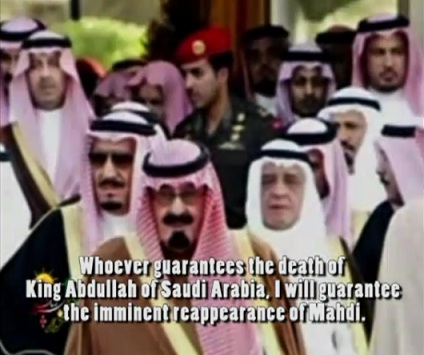
Okay, I’d say things are heating up. Here’s a screen grab from what we are led to believe is a recent video from Iran, made with government backing as described below the fold.

death-of-abdullah-sign-of-mahdi.jpg

This does not bode well…

*

The Christian thriller novelist Joel Rosenberg (author of The Twelfth Imam) has a new blog post up, in which he cites a Christian Broadcasting Network story — which in turn refers to a video posted with some introductory materials on his blog by Reza Kahlili (author of A Time to Betray: The Astonishing Double Life of a CIA Agent Inside the Revolutionary Guards of Iran).

According to Kahlili, who has also posted the full video to YouTube, it is a half-hour long program sponsored by the Basij militia and the Office of the President of Iran, affirming the soon-return of the Mahdi.

And containing “inflammatory language” about King Abdullah of Saudi Arabia (see subtitle above)?  Can I say that?

For what it’s worth, the supposed “hadith” about the death of King Abdullah is discussed in some detail at The Wake-Up Project, so it’s definitely “in the air” — but I don’t recall seeing any references to it in Abbas Amanat, Abdulazziz Sachedina, or any of the lists of Signs of the Coming I’ve read, so my suspicion is that this is an opportunistic addition to the corpus rather than a reliable hadith.

Which brings me to my last point:

I am not posting these materials to encourage panic — that’s what terrorism strives for, and it is the very opposite of what I would wish to see.  If anything, these stirrings of Mahdist sentiment should make us more careful and attentive to the serious scholarly work that has been done in this area.  Jean-Pierre Filiu‘s book Apocalypse in Islam, which I reviewed for Jihadology, would be an excellent place to start.

*

There are plenty of other things going on that I would love to track, blog about or comment on these days, but for the next while I shall try to restrain myself and focus in on this particular issue and its ramifications:

  • Contemporary Shi’ite Mahdist expectation
  • The Iranian nuclear program in the light of Mahdist expectation
  • Iranian attempts to use Mahdism to unite Sunni and Shi’a
  • Mahdism and jihad
  • The role of Khorasan in Mahdist rhetoric
  • Christian apocalyptic responses to Mahdist stirrings
  • Joel Rosenberg‘s book, The Twelfth Imam
  • Joel Richardson‘s book, The Islamic Antichrist
  • Glenn Beck‘s increasing focus on Iranian Mahdism
  • The increasing influence of Islamic and Christian apocalyptic on geopolitics

This is a pretty complex and potent mix of topics, and while I’ll post some individual pieces of the puzzle as I see it, I shall also try to put together a “bigger picture” piece with the whole mosaic laid out.

*

Apart from that, I remain deeply committed to questions of chivalry and peace-making, and will continue to monitor developments and write what I can on those topics as time allows…

Corn’s Caliphates in Wonderland

Saturday, March 26th, 2011


They Just Don’t Make Caliphates Like They Used To….

SWJ Blog featured a lengthy (30 page) essay by Dr. Tony Corn on….well….many things. Corn begins with caliphates and then sort of takes off much like a blown up balloon abruptly released by a child prior to tying a knot in the end.

The Clash of the Caliphates: Understanding the Real War of Ideas by Dr. Tony Corn

….For one thing, within the global umma, there appears to be as many conceptions of the ideal Caliphate as there are Muslims. This grass-roots longing for a symbol of unity should be heard with the proverbial Freudian -third ear,?? and seen for what it really is, i.e., a symptom rather than a disease. For another, by agreeing to establish diplomatic relations with the 57-member Organization of the Islamic Conference (OIC), America and Europe have, in essence, already granted the OIC the status of a Quasi-Caliphate.

More important still, it is time for Western policy-makers to realize that the ideological rivalry between Saudi Arabia and Iran that has been going on since 1979 constitutes nothing less than a Clash of the Caliphates. Through a soft power strategy blurring the distinction between -public diplomacy?? and -political warfare,?? -humanitarian aid?? and -religious propaganda,?? the two states have been the main drivers of the re-Islamization process throughout the Muslim world. The one-upmanship dynamic generated by the rivalry between these two fundamentalist regimes is the main reason why, from the Balkans to Pakistan, the re-Islamization of the global umma has taken a radical, rather than moderate, dimension.

Ok, “caliphates” as a metaphor/analogy for geopolitical rivalry of Muslim states works but it is not really what Islamists or normal Muslims would mean by the term. It is a very odd usage. I’m not overly bothered by that because I tend to like analogies but Corn’s device here is apt to make the heads of area studies and Islamic history scholars explode. The whole essay is in this meandering, idiosyncratic, vein.

Now that is not to suggest that you should not read the piece. Dr. Corn held my attention all the way through and he has a number of excellent observations on many, loosely related, subjects. For example, after discussing the pernicious effects of Saudi donations and Edward Said’s agitprop theory of “Orientalism” on the intellectual objectivity of academia, Corn writes:

…The combined effect of the House of Saud and the House of Said is the first reason why the Ivory Tower has done such a poor job identifying the nature of Muslim Exceptionalism. A more indirect, yet more insidious, reason is that, unlike in the early days of the Cold War, American academics across the board today are trained in social sciences rather than educated in the humanities. For social scientists, Explanation (erklaren) and -theory-building?? take precedence over Understanding (verstehen) and -policy-making. The victory of the -numerates over the -literates in the 1970s has produced a generation of scholars who show a certain virtuosity when it comes to -research design, but display an amazing lack, not just of historical literacy, but of -historical empathy as well. Not to make too fine a point: the Long War is being waged by a generation of policy-makers who, however articulate, never learned anything about history in their college years

Corn is spot on here. Not only is it spot on, it is likely to get much worse. After a brief qualitative “bump” from Iraq-Afghan war  language trained vets, diplos, analysts and spooks peters out, we will have the Gen Y kids with K-12 educations scrubbed free of history, foreign languages and science graduating from college with communication and marketing degrees and entering government service. Hang on to your hat when that happens.

What Corn really requires to vault his essays to the next level are the services of an experienced editor because less would be more. The man is erudite and insightful. He writes forcefully and raises a number of points that are important and with which I agree. Corn, commendably, also makes more of an effort to connect the dots than most. But maybe, if you have an essay that references David Kilcullen, Trotsky, neo-Ottomanism, lawfare, Sam Huntington, neo-COIN, Nasser, Vatican II, the Comintern, the Hapsburgs, Ataturk, public diplomacy, al- Qaradawi, social media, Fascism, Marc Lynch, Youtube, network theory, the UN, hybrid wars and the Protestant Reformation, it might be time to up the Ritalin dosage a notch. Jesus, there’s either a book proposal or four different articles in that kitchen sink of an op-ed!

Read it and take what is useful.


Switch to our mobile site