zenpundit.com » geopolitics

Archive for the ‘geopolitics’ Category

At the round earths imagin’d corners

Friday, July 20th, 2012

[ by Charles Cameron — mapping, holding two worldviews in mind at one time, a conductor’s score, complexity thinking ]
.

.

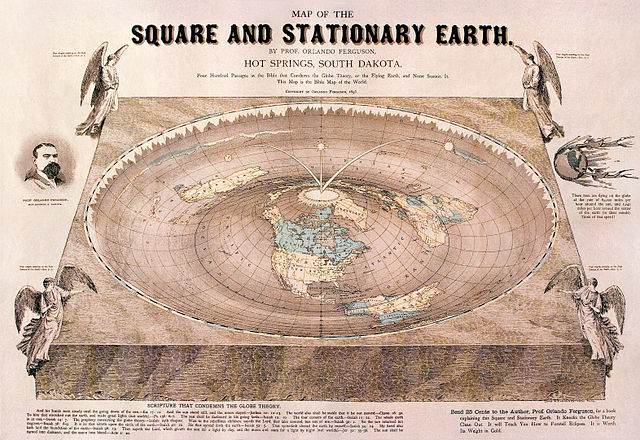
About a year ago, the Atlantic reported that the Library of Congress had been given a map of the flat earth, designed according to Biblical principles — yet showing knowledge of the border between the United States and Canada…

Thanks to a post from Jason Wells, I saw it today.

The view that the earth is flat is one worldview, of course, and no longer the prevailing one. As Nicholas Jackson noted at the Atlantic:

The interesting thing about the map is that it was created about 120 years ago by Orlando Ferguson, then a practicing physician in Hot Springs [South Dakota]. This is more than 500 years after most educated people gave up on the idea of the Earth as flat and accepted the spherical viewpoint first expressed by the Ancient Greeks.

**

It is, however, possible to hold two worldviews in mind at the same time. John Donne manages it in the first line of his extraordinary poem, written at a time when the two views were clashing:

At the round earths imagin’d corners, blow

AT the round earths imagin’d corners, blow
Your trumpets, Angells, and arise, arise
From death, you numberlesse infinities
Of soules, and to your scattred bodies goe,
All whom the flood did, and fire shall o’erthrow,
All whom warre, dearth, age, agues, tyrannies,
Despaire, law, chance, hath slaine, and you whose eyes,
Shall behold God, and never tast deaths woe.
But let them sleepe, Lord, and mee mourne a space,
For, if above all these, my sinnes abound,
‘Tis late to aske abundance of thy grace,
When wee are there; here on this lowly ground,
Teach mee how to repent; for that’s as good
As if thou’hadst seal’d my pardon, with thy blood.

Donne accomplishes the task of holding two worldviews in mind at one time with four simple words: “round earths imagin’d corners”.

**

I don’t know how many melodic “lines of thought” the mind can hold in counterpoint at once. I do know it’s an important cognitive skill for us to cultivate. A classical conductor must surely be able to hold as many lines as there are in this page of Olivier Messaien‘s Oiseaux:

As I pointed out in a recent comment here, “somewhere above three and before eleven there’s a point — Miller’s ‘magical number seven, plus or minus two‘ where the human mind can’t hold any more detail, so that’s a cut-off of sorts.”

Well, Messaien clearly imagines the conductor’s mind can follow more than eleven paths…

**

And then there’s Bob Milne.

I’ll let the Philosophy Compass take it from here:

Bob is predominantly known for his piano concerts of Ragtime and Bogie-Woogie music – and was given the moniker of ‘National Treasure’ by the United States Library of Congress. It was at one of these concerts that drew the attention of Penn State neuroscientist Kerstin Bettermann. At his concerts, Bob often carries on conversations, telling stories and jokes, while simultaneously modulating key signatures over the polyrhythmic Ragtime music. In their broadcast, Radiolab discusses with Dr. Bettermann why this is so surprising.

Language use and musical competency often use the same neural resources: the prototypical language areas in the left hemisphere of the brain, and the working memory circuit that keeps information available and rapidly accessible for a short-period of time. Our ability to use language and engage with music should, on most models of the brain, be competing for these neural resources and interfere with one another. Not so with Bob – he appears to be able to tackle both tasks with ease. Further, while most people can approach this kind of competency in multi-tasking, it usually involves many learning trials, a process of sedimenting the learning into what psychologists call procedural memory, which may have its roots in a different brain region, the cerebellum. But Bob can hear a tune just once, and play it back with commentary.

But that’s not all Bob can do.

In their interview, Dr. Bettermann heard Bob claim something extraordinary. He claims not only to be able to hear a symphony in his head, but that he normally does this with two symphonies simultaneously. Where most individuals would only hear a cacophonous mess – Bob claimed he could dial the relative volume of either symphony up or down, and could zoom in or out of individual instrumentations. To return to the considerations above, Bob further states on the Radiolab website that he does this while driving – another procedural memory task and presumable source of interference. But when Dr. Bettermann challenged him, Bob reluctantly claimed that he could probably do the same (not while driving, mind you) with four simultaneous symphonies.

The claim is something like this: Bob states that he can hold and listen to four symphonies with different keys, instrumentation, tempo and style in his working memory at the same time. And what is stunning is that when they put Bob into an fMRI machine, they verified his claim. Bob could be stopped at any time during his imaginative trip through the four simultaneous symphonies, and hum out the exact phrase that the original recording would be on. Remarkable.

**

This in turn takes us back to that point Edward Said made, which gave me the basic concept for my Said Sympohony (must get back to that soon):

When you think about it, when you think about Jew and Palestinian not separately, but as part of a symphony, there is something magnificently imposing about it. A very rich, also very tragic, also in many ways desperate history of extremes — opposites in the Hegelian sense — that is yet to receive its due. So what you are faced with is a kind of sublime grandeur of a series of tragedies, of losses, of sacrifices, of pain that would take the brain of a Bach to figure out. It would require the imagination of someone like Edmund Burke to fathom.

Edward W. Said, Power, Politics, and Culture, p. 447 — from the section titled “My Right of Return,” consisting of an interview with Ari Shavit from Ha’aretz Magazine, August 18, 2000.

I asked in a post yesterday how good we now are at modeling or simulating ideas in the “war of ideas” — just for a moment, suppose we could think through all complex geopolitical issues in this polyphonic, contrapuntal way…

**

Okay, you deserve a reward for faithful reading if you’ve come this far with me. Here’s the incomparable Richard Burton reading Donne’s poem — the text is up above, if you want to follow along:
Putin and Syria: Siloviki Realism in Geopolitical Strategy

Thursday, July 12th, 2012


Russian President Vladimir Putin made a foreign policy speech to Russia’s ambassadors and Foreign Ministry officials that is very much worth reading in context of his dispatch to Syria of a fleet of warships, including a battleship, to the modest Russian naval base in Tartus. Under Putin’s hand, Russian support for the bloody regime of Bashar Assad has consistently been more about safeguarding and expanding Russia’s strategic place in world than about Syria:

….We are forced to admit that no reliable solution for overcoming the global economic crisis has been found yet. Indeed, the prospects are looking more and more worrying. The debt problems in the Eurozone and its slide towards recession are just the tip of the iceberg as far as the global economy’s unresolved structural problems go. The traditional powerhouses of global development – the USA, the EU, and Japan – are seeing their leadership erode, but the absence of new development models is putting a brake on global growth. There is increasing competition for access to resources, and this provokes abnormal fluctuations on the raw materials and energy markets. The traditional Western economic powers are being weakened by the crisis, which has exacerbated social and economic problems in the developed economies, and by the multi-vector nature of global development today. We can already see this for a fact now. 

Colleagues, this is no cause for joy. We should not take delight in this turn of events, and much less feel malicious glee. On the contrary, we cannot but worry over these developments, because the consequences of these tectonic shifts in the global economy are not yet clear, nor are the inevitable shifts in the international balance of power and in global policy that will follow. 

We are all the more worried when we see attempts by some actors in international relations to maintain their traditional influence, often by resorting to unilateral action that runs counter to the principles of international law. We see evidence of this in so-called ‘humanitarian operations’, the export of bomb and missile diplomacy, and intervention in internal conflicts.

We see how contradictory and unbalanced the reform process is in North Africa and the Middle East, and I am sure that many of you still have the tragic events in Libya before your eyes. We cannot allow a repeat of such scenarios in other countries, in Syria, for example. I believe that we must do everything possible to press the parties in this conflict into negotiating a peaceful political solution to all issues of dispute. We must do all we can to facilitate such a dialogue. Of course this is a more complex and subtle undertaking than intervention using brute force from outside, but only this process can guarantee a lasting settlement and future stable development in the region, and in Syria’s case, in the country itself….

It would be harder for Putin to have been more clear about what his priorities were, or that for Russia, R2P as a doctrine has no standing whatsoever in international law [ incidentally, he’s correct on that point] and Syria is not going to be allowed to go the way of Libya, if the Kremlin can prevent it.

Generally, the media reported this speech, highly misleadingly, as Putin’s prediction of “Western decline” when the message was Russia’s opposition to Western military intervention in Syria to remove Assad from power. Putin neither overestimates the means at Russia’s disposal to accomplish his limited objective (blocking intervention) nor inflates his objective to an unrealizable, vaguely defined, abstraction.

Contrast, with the speech on Syria made recently by SECSTATE Hillary Clinton. Here is a snippet that gives the tenor of her remarks:

….What was accomplished in Geneva by the action group was, for the very first time, to enlist not only all five permanent members of the Security Council including Russia and China, but also important leaders in the region and in the Arab League in support of such a transition. The issue now is to determine how best to put into action what was accomplished there and is continuing here. And I really hope everyone reads the communique from Geneva, because for example, one of the earlier speakers from Syria expressed concern there was nothing about political prisoners. Well, indeed there is. And a call for the release from detention. So it would be very helpful to get everybody on the same page if we’re going to work together about what we have already done and what we need to be doing as we move forward.

Under the Geneva communique, the opposition is for the first time put on an even basis with the government. They are given equal power in constituting the transition governing entity that will have, as we just heard, full executive authority. That could not have been imagined three months ago, let alone a year ago.

So although none of us here is satisfied or comfortable with what is still going on inside of Syria, because it is against every norm of international law and human decency for a government to be murdering its own people, there has been in the last several months, starting in Tunisia, a steady, inexorable march toward ending this regime. What we need to do is to follow through on what each of us can contribute to the end of the Assad regime and the beginning of a new day for Syria. 

….Now what can every nation and group represented here do? I ask you to reach out to Russia and China and to not only urge, but demand that they get off the sidelines and begin to support the legitimate aspirations of the Syrian people. It is frankly not enough just to come to the Friends of the Syrian People, because I will tell you very frankly, I don’t think Russia and China believe they are paying any price at all – nothing at all – for standing up on behalf of the Assad regime. The only way that will change is if every nation represented here directly and urgently makes it clear that Russia and China will pay a price, because they are holding up progress – blockading it – that is no longer tolerable. 

First of all, the Secretary of State needs a more effective speechwriter. Period.

Secondly, there is a substantive problem here with an obsession with the minutia of process, possibly because the legal principle behind American policy on Syria is a novelty of intellectuals and is not accepted by two veto-wielding great powers that sit on the UN Security Council. Moreover this focus on minutia of process obstructs clear thinking in regard to the larger geopolitical picture and the ways to get to the end in mind – the removal of Assad’s regime – or the consequences for opposing American policy. Russia and China are told their continued support for the Assad regime, which they see as being in their own interests, is “intolerable” – an outburst of unseemly frustration as we have no stick and strangely offer no carrots for these states to change their positions. Instead we choose to moralize  in public, a diplomatic technique with a long pedigree of failure.

The comparison of statecraft between Russia and the United States is unflattering. Russia has vastly fewer cards to play, but because  Putin has grounded his policy in a siloviki assessment the realities of power, has limited his objectives to those within Russia’s means and related those to the larger diplomatic context that would appeal to other powers, he has played those cards well. Moreover, Putin has positioned Russia to be an indispensable party in a peaceful resolution of the conflict in Syria at very little cost, as Secretary Clinton herself has admitted and capped it off with a naval show of force in the eastern Mediterranean.

We, who have a wealth of resources to employ, have squandered them ineffectively and navigate the ship of state with our heads in the clouds. We forced a vote in the UNSC on Syria, ignoring all signals that the end result would be failure. Syria shoots down a Turkish warplane intruding in it’s airspace (likely at our request) and we had no plan to capitalize on the incident. We gratuitously leak information or disinformation about covert operations that serves more to make us look amateurish than to intimidate our opponents. We do not even appear to be well-informed about the Syrian opposition we are aiding inside Syria, as opposed to expatriate organizations. Some of the fighters in the opposition are as morally objectionable as Assad’s militia thugs and secret police killers.

We play at tactical geopolitics while the Russians do strategy.

Byzantium, Constantinople, Istanbul

Sunday, July 8th, 2012

[ by Charles Cameron — different styles of online communication, main topic: Istanbul in three Islamic videos ]
.

There’s passionate and visceral communication, and there’s communication that’s more scholarly, dispassionate and calm. Let’s begin and end with calm.

**

Visceral communication is essential for getting people out of a theater on fire, but a 30% application of scholarly distance and calm may be prerequisite for avoiding panic — and scholarly communication may be important for conveying in detail the high-dimensionality of a complex topic, but a drop of visceral may ease the salient points into more general circulation.

In an earlier, text heavy post — Damascus, Dearborn, Rome, Vienna? — I belabored you with details as to just how much ambiguity and fog surrounds the use of place names in scriptural and prophetic contexts. Here I’d like to give you a visceral sense of what some prophetic voices are doing with those place names.

One of the easiest ways to move from scholarly to visceral is to switch from text quotation to video clip, so that’s what I’ll do here — but my first video clip will be relatively calm and scholarly as video clips go, the next one more visceral and exhortatory, while the third and final clip will use all the tricks of the feature movie trade to provide a Tolkien-heroic account of the Muslim siege and taking of then-Christian Constantinople in 1453.

**

First, a very short clip from Adnan Oktar, aka Harun Yahya, widely known in the Islamic world for his lavishly illustrated books, CDs and DVDs presenting an Islamic version of creationism, the Mahdist end times — which he sees as entirely peaceable — and more besides.

In this clip, he’s talking about Istanbul, and he means that very city, even if it has sometimes been called Byzantium or Constantinople — or even on occasion, Rome.
.

**

My second clip is far longer, and presents an interview with Sheikh Imran Nazar Hosein, Islamic scholar, sometime Trinidadian diplomat and sometimes fiery YouTube preacher, whom I have quoted previously in Al-Awlaki and the former and latter rains and elsewhere.

Hosein discusses the prophecies of the conquest of Constantinople by Muslim forces as part of the background for a grand sweep overview of what he terms the first and second Arab Springs — which he locates a century apart and views as both engineered by an Anglo-American alliance to advance a Zionist agenda — and contemporary events in Bahrain, Saudi, Syria, Iran, Israel, and Russia:
.

.

It’s an hour-long interview, perhaps you didn’t watch the whole way through. Hosein concludes this interview, centered in Islamic prophecy about Constantinople, with a Saudi-American alliance facing off against an Iranian-Russian alliance in service to very long term Zionist interests, making the video a window not only on the Sheikh’s own worldview but also on how widely perceptions of the world situation can diverge:

I want the viewing audience to know that a situation is evolving in the world before our eyes, and we must understand it, that the two major powers in the world are now moving in a collision course, that collision course between these two major powers, the American-led alliance and the Russian-led alliance, is going to lead to nuclear warfare of such a magnitude that there is only one word that we can look for in the vocabulary to fit it, and that’s called Armageddon, that is, millions and millions and millions are going to die, most of them probably in North America and Europe, Europe of the East and Europe of the West — and what is left of the world after that, the Zionists hope that they can cope with it, and they can somehow survive and come out on top and Israel will rule the world, the rump that is left after the two giants engage in a war of mutual destruction, That is what we are facing now…

Is that what you thought scholarly Islamists were thinking? By what paths did a highly educated and world traveled man come to that conclusion?

**

My third clip speaks for itself. It is a trailer for an upcoming motion picture about the siege of Constantinople, presented as heroic spectacle with improbable but striking feats of arms, beautiful but not excessively modestly dressed women, obligatory mass choruses of Allahu Akbar, and at least one reference to the Antichrist.
.

.

I can’t wait to see it — but I expect to do so with mixed emotions. Perhaps they will stir up a decent blog post or two.

What emotions will they stir in those who identify with the heroic Mehmet II, and how much of an echo will those emotions find in the world around us? Long shot — any Turkey-NATO impact?

**

To return to a calmer clime:


.

Byzantium, Constantinople, Istanbul. I have prayed in the Sultan Ahmed — click image above to glimpse its beauty — I have relaxed deliciously at a nearby hammam.

The history of Istanbul could be the rich study of many lifetimes, its promise — for better or worse or a little of both — may have been variously prophesied or predicted, but remains to be seen.

The Russians are Not Coming….Nor are they Going Away

Monday, June 25th, 2012

Now that Vladimir Putin has resumed the Presidency of Russia, it merits looking at the defense discussion that appeared under his name in Rossiiskaya Gazeta. Virtually everyone agrees that the condition of the Russian Army is parlous and that Putin’s program of difficult military reform to transform the Russian military from a conscripted army to a modernized professional force has not borne fruit. Therefore it is interesting to look at how Putin’s regime articulates it’s defense challenges with a mixture of bravado and brutal strategic realism we would never hear from an American politician.

Excerpts of the article are in bold while my commentary is in normal text.

 Being Strong 

…..The world is changing, and the transformations underway could hide various risks, often unpredictable risks. In a world of economic and other upheaval, there is always the temptation to resolve one’s problems at another’s expense, through pressure and force. It is no surprise that some are calling for resources of global significance to be freed from the exclusive sovereignty of a single nation, and that this issue will soon be raised as a “matter-of-course.”

There will be no possibility of this, even a hypothetical one, with respect to Russia. In other words, we should not tempt anyone by allowing ourselves to be weak. 

While some of this is boilerplate, it does demonstrate Putin’s astute view of Western elite noises about “global governance” as an effort to erode historic Westphalian legal norms of sovereignty for a self-aggrandizing reasons.

I am including paragraphs here from different parts of the paper where President Putin deals with nuclear weapons, though the first one continues from where the last excerpt left off.:

It is for this reason that we will under no circumstances surrender our strategic deterrent capability, and indeed, will in fact strengthen it. It was this strength that enabled us to maintain our national sovereignty during the extremely difficult 1990s, when, lets’ be frank, we did not have anything else to argue with.

….I remember in 2002 when the Chief of the General Staff proposed liquidating a base for strategic ballistic missile submarines on the Kamchatka Peninsula. Understandably, this proposal was motivated by dire circumstances. This would have deprived Russia of its naval presence in the Pacific Ocean. I decided against this. Due to the lack of the required budgetary funding, we had to ask private companies for help. I would like to thank them for that. Both Surgutneftegaz and TNK stepped up to provide the required funding for the base’s initial reconstruction. Budgetary allocations were later disbursed. Today, we have a modern base in Vilyuchinsk where next-generation Borei class submarines will soon be deployed.

….We have greatly increased the capabilities of our early missile warning system. Tracking stations have been launched in the Leningrad and Kaliningrad Regions and in Armavir, and a similar facility is undergoing tests in Irkutsk. All aerospace defence brigades have been equipped with the Universal-1S automation systems, and the Glonass satellite group has been deployed.

The land, sea and air components of our Strategic Nuclear Forces are reliable and sufficient. The proportion of modern land-based missile systems has grown from 13% to 25% over the past four years. The rearmament of 10 missile regiments with the Topol-M and Yars strategic missile systems will be continued.  Long-range aviation will maintain the fleet of strategic Tu-160 and Tu-95MS bombers; work is underway to modernise them. They will be equipped with a new long-range cruise missile system. Russia’s strategic aviation resumed combat patrols in their zone of responsibility in 2007. A new aircraft is being designed for strategic long-range aviation.

New-generation Borei class strategic submarines are being put on combat duty. These include the Yury Dolgoruky and Alexander Nevsky which are undergoing state trials.

….In the coming decade, Russian armed forces will be provided with over 400 modern land and sea-based inter-continental ballistic missiles, 8 strategic ballistic missile submarines…. 

This does not sound  like Putin puts much stock in his predecessor’s endorsement of Global Zero or President Obama’s goal of eliminating nuclear weapons. Or that a drastic unilateral American cut in nuclear weapons proposed by Global Zero to “break the triad” contemplated by the Obama administration would be reciprocated by Russia. Or any other nuclear power state.

Given that Pakistan, India, North Korea, Israel and China are reportedly increasing and improving their nuclear arsenals, it begs the question of whether the Obama or the Putin administrations have the most realistic view about nuclear weapons and their currency in international relations. Or what the Obama administration would use as bargaining chips to negotiate reductions in foreign nuclear arsenals after making gratuitously slashing unilateral cuts. And if the paper was not clear enough, Putin was more blunt about the strategic situation two days ago:

“With regard to further steps in the sphere of nuclear weapons, these further steps should be of a complex character, and this time all the nuclear powers should be involved in this process. We cannot disarm indefinitely while some other nuclear powers are building up their arsenal. It is out of the question!” 

On the subject of Russia’s land forces:

….There are no undermanned units in the Russian armed forces any more. The Army has over 100 combined and special brigades. These are full-scale military units with the requisite personnel and equipment. Their alert reaction time is one hour and they can be deployed to a potential theatre of war within 24 hours.

In the past, it took up to five days to prepare for combat readiness. The deployment and equipment of all the armed forces to wartime conditions could take nearly a year, even though most armed conflicts now last from a few hours to several days.

Why have we chosen the brigade as the main tactical unit? First of all, we have relied on our own experience in the Afghan and other wars, where mobile combat and assault groups reinforced with air and other support units have proved  more efficient than regiments and divisions.

The new brigades are smaller than divisions in the number of personnel but have a bigger strike capability, better firepower and support, including artillery, air defence, reconnaissance, communications, and so on. Brigades can operate both autonomously and jointly with other units. I admit that the quality is not perfect in all instances. We need to achieve the required standards in the near future. 

A Russian Army brigade numbers slightly over 4000 soldiers (vs. 3000-5000 in American and NATO militaries) and moving to a brigade structure is intended to make the Russian Army more versatile, flexible, deployable and mobile. The US essentially did the same thing with the “modularity” reforms for a brigade team force structure. However, I find it dubious that the Russian version is anything other than an aspirational work in progress or that Russia today could muster a force remotely approaching 100 combat brigades on short notice or keep them in the field for more than thirty days.

The old Soviet Red Army in the 80’s at the peak of it’s power was a military long on officers and critically deficient in NCOs  and the 90’s cratered the main force quality of what remained of the Soviet armies. Russia will not have a deployable fighting army for anything other than brief Georgia type raids and SPETSNAZ operations until it builds a proportionate NCO corps and modernized logistical support system.

On future war and it’s strategic context:

….The probability of a global war between nuclear powers is not high, because that would mean the end of civilisation. As long as the “powder” of our strategic nuclear forces created by the tremendous efforts of our fathers and grandfathers remains dry, nobody will dare launch a large-scale aggression against us.

However, it should be borne in mind that technological progress in many varied areas, from new models of weaponry and military hardware to information and communications technology, has dramatically changed the nature of armed conflicts. Thus, as high-precision long-range conventional weapons become increasingly common, they will tend to become the means of achieving a decisive victory over an opponent, including in a global conflict.

The military capability of a country in space or information countermeasures, especially in cyberspace, will play a great, if not decisive, role in determining the nature of an armed conflict. In the more distant future, weapons systems based on new principles (beam, geophysical, wave, genetic, psychophysical and other technology) will be developed. All this will, in addition to nuclear weapons, provide entirely new instruments for achieving political and strategic goals. Such hi-tech weapons systems will be comparable in effect to nuclear weapons but will be more “acceptable” in terms of political and military ideology. In this sense, the strategic balance of nuclear forces will play a gradually diminishing role in deterring aggression and chaos.

We see ever new regional and local wars breaking out in the world. We continue to see new areas of instability and deliberately managed chaos. There also are purposeful attempts to provoke such conflicts even within the direct proximity of Russia’s and its allies’ borders.

The basic principles of international law are being degraded and eroded, especially in terms of international security. 

Here we see much of the same keen interest Western military experts have had in RMA/”transformation” but more as new domains in which to fight or weapons to fight with, but Putin’s assumptions about the roots of international conflict remain exceedingly traditional in Clausewitzian and Machiavellian realpolitik senses. There’s no idea here that war’s political nature is being transformed by technological advances or even that breakdowns in order in other nations flow primarily from indigenous social forces  than from strategic conspiracies and manipulations of foreign powers hell-bent on humiliating Russia.

This is a worldview of cynical realism salted with nationalism and a paranoia induced by the lessons of centuries of Russian history. International relations, it follows, hinge primarily on power in all it’s manifestations, a few rules that separate the law of nations from the law of the jungle and that states exert power to accomplish rational strategic objectives. Furthermore, in an echo of Tsarist Russia’s last modernizer, Petr Stolypin, what Putin has put forth as a political program for his domestic audience (sincere or not) is “a great Russia”.

The good news is that President Putin is, unlike his Soviet predecessors, is uninterested in grand ideological crusades that would destabilize the world order and that Russia currently would be incapable of carrying any out. The bad news is that Putin is a shrewd strategic thinker, one who views the US as a long-term adversary of Russia and one who is likely to be highly antagonized and partially misread (and thus miscalculate)  the tactical geopolitics of intervention pursued by America’s R2P moralizers.

From Putin’s perspective, we are currently crusaders rather than deal-cutters grounded in reality. America does not need to appease other power,s but we’d further our own interests faster if we spent a little time looking at the world through the eyes of others

Hat tip to Lexington Green

One bead for a rosary

Friday, June 22nd, 2012

[ by Charles Cameron — one bead from NASA for the glass bead game as rosary ]
.


photo credit: Norman Kuring, NASA’s Goddard Space Flight Center
.

Consider her sacred, treat her with care.


Switch to our mobile site

