The colors of hope
Thursday, February 10th, 2011[ by Charles Cameron — cross-posted from Brainstormers on the Web ]

You know, we talk a lot about Facebook and Twitter as technologies for change, but how about painted fingers?
[ by Charles Cameron — cross-posted from Brainstormers on the Web ]
You know, we talk a lot about Facebook and Twitter as technologies for change, but how about painted fingers?
[ by Charles Cameron — cross-posted from Brainstormers on the Web ]

There are so many possible lessons to take here:
That a single image speaks louder than dozens of words. That we are more easily persuaded by images than by words. That FB and Twitter are clearly important to Egyptian youth. That dozens of words can convey nuances that a single image misses. That FB and Twitter were at best among the vehicles, rather than the drivers, of the events of January 25th.
That we’d do well to bear the Aristotelian distinction between material, formal, efficient and final causes in mind when talking about what “caused” or “becaused” those events – and elsewhere.
That the simple juxtaposition of two closely similar ideas can illuminate both, and perhaps create a spectral “third thing” which possesses the full detail of both with greater depth than either one in a single understanding, by a sort of stereo process not too different from stereoscopic vision or stereophonic sound.
That we live in exciting times…
[ by Charles Cameron ]
Okay, the Reagan Roundtable is happening, and I hope to contribute to it later. In the meantime, I don’t want to disrupt the flow at ChicagoBoyz, so I’ll continue posting my non-Reagan material here — since here at ZP we’re excerpting and hollering and supporting but not actually hosting the Roundtable, and since Egypt, after all, is not waiting for the Roundtable to be over before continuing on its path of discovery…
Having said which:
*
I’m not the only one who’s eye is caught by DoubleQuotes, I see.
I ran across this one at the top of a piece by Esam al-Amin on CounterPunch entitled Mubarak’s Last Gasps, where al-Amin had made it his double epigraph — and even though I’m almost totally ignorant of the writings of Vladimir Ilyich and hope to keep things that way, I do think Quote #1 is quite a fine aphorism.
And having recently posted One for Zen and the Boydz here (remember that?), I really couldn’t resist this follow-up!
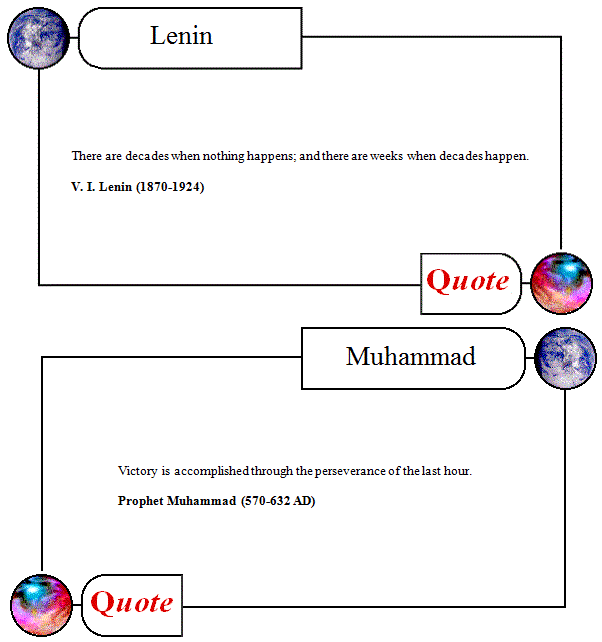
Very apt for the last few weeks.
Mind you, I think there’s an apocalyptic hint to Quote #2, which bears an interesting resemblance to Matthew 24:13:
But he that shall endure unto the end, the same shall be saved.
[ by Charles Cameron [hoping Zen’s ISP will be back up shortly] — cross-posted from ChicagoBoyz ]
Someone posted an excerpt from an interview with Khaled Hamza, the webmaster of the Muslim Brotherhood, as a comment on an earlier post of mine on ChicagoBoyz, where I also blog, and I was interested enough to track the original interview down, and have presented the key points of the excerpt here in Quote #1.
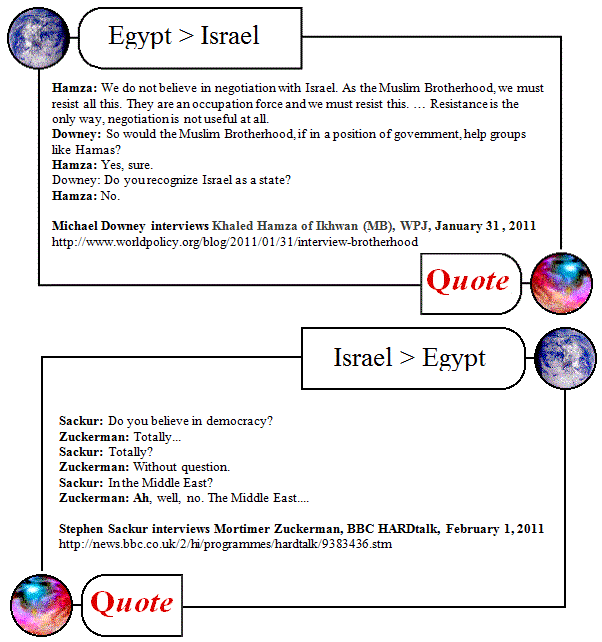
I am pairing it, in Quote #2, with an excerpt from an interview the BBC recently conducted with Mortimer Zuckerman – because I find the two quotes taken together suggest something of the complexity of the breaking situation in the Middle East.
*
I’d like to float a trial balloon / try a though experiment, if I might. And since I’m more “tail” than “left” or “right wing”, I’ll be posting this in more than one place, and hope to get comments from all sides…
On the face of it, Zuckeman is applying what’s arguably a racist double-standard. He advocates democracy, “totally” and “without question” – but not for the Egyptians, or at least not today or tomorrow.
On the face of it, the Egyptian public seems distinctly unenthused by Mubarak’s regime and will, in a democratic election, presumably vote in a fair number of Muslim Brotherhood representatives – though it’s by no means clear that they would be in the majority, and their present ideology in any case is closer to the processes of electoral politics than those of violent jihad.
So there is reason for Israel to be concerned, and reason for those who support democracy to see some hope for democracy, in the ongoing events in Egypt.
Let me put it this way: Quote #1 illustrates why Zuckerman might make the remarks quoted in Quote #2, while Quote #2 illuminates why Hamza might make the remarks quoted in Quote #1.
*
And here’s the thought experiment — I’d like to come at this from a Maslovian angle.
Maslow’s Hierarchy of Needs
I’d like to suggest that “democracy” is an ideal, or to get away from that word with its somewhat ambiguous political connotations, an activity of the “the better angels of our nature” – and thus, from a Maslovian perspective, an aspect of a group or nation’s “self-actualization” level of interest, whereas “stability” would fall under “safety” or even “physiological”.
If that’s right, Zuckerman is at least arguably articulating a “stability first, eventual democracy would be ideal” position.
Does that “Maslovian” formulation throw any additional light on the situation?
*
The problem with the position I just described is nicely articulated by Mohammad Fadel at the very end of a Foreign Policy post, Can Black Swans lead to a sustainable Arab-Israeli peace? — and it’s only his conclusion I’m quoting here:
Tunisia and Egypt have demonstrated categorically that any peace which relies on the stability of police states is doomed from the outset.
If a butterfly flapping its wings in Brazil can in theory cause a tornado in Texas – heaven alone knows what someone blinking in Cairo or Jerusalem or Washington can do.
Myself, I pray for empathy, which seems a reasonable request, I hope for wisdom, which seems a great deal more chancy — and I long for peace.
In the current environment of hatred and mistrust, that seems entirely beyond the capacity of anyone’s present thinking to achieve.
[ by Charles Cameron — cross-posted from the DIME/PMESII boards at LinkedIn ]
I’ve been hammering away at the importance of a nuanced understanding of religious drivers in successful modeling of our world, and today I ran across some paragraphs from a book by Gary Sick that explain, forcefully and briefly, just why this seems like a big deal to me.
1
Sick, who was the National Security Council’s point man on Iran at the time of the Ayatollah Khomeini‘s Iranian Revolution, recounts how totally unprepared we were for the sudden emergence of a theocracy in his book, All Fall Down:
Vision is influenced by expectations, and perceptions — especially in politics — are colored by the models and analogies all of us carry in our heads. Unfortunately, there were no relevant models in Western political tradition to explain what we were seeing in Iran during the revolution. This contradiction between expectation and reality was so profound and so persistent that it interfered fundamentally with the normal processes of observation and analysis on which all of us instinctively rely.
On one level, it helps to explain why the early-warning functions of all existing intelligence systems — from SAVAK to Mossad to the CIA — failed so utterly in the Iranian case. Certainly, US intelligence capability to track the shah’s domestic opposition had been allowed to deteriorate almost to the vanishing point. But even if it had not, it would probably have looked in the wrong place. Only in retrospect is it obvious that a good intelligence organization should have focused its attention on the religious schools, the mosques and the recorded sermons of an aged religious leader who had been living in exile for fourteen years. As one State Department official remarked in some exasperation after the revolution, “Whoever took religion seriously?”
Even after it became clear that the revolution was gaining momentum and that the movement was being organized through the mosques in the name of Khomeini, observers of all stripes assumed that the purely religious forces were merely a means to the end of ousting the shah and that their political role would be severely limited in the political environment following the shah’s departure, The mosque, it was believed, would serve as the transmission belt of the revolution, but its political importance would quickly wane once its initial objectives had been achieved.
2
The blissful ignorance didn’t end back there in 1979. Right at the end of 2006, reporter Jeff Stein asked Rep. Silvestre Reyes (Dem, TX), the incoming head of the House Intelligence Committee (which has oversight of the entire US Intelligence Community) whether Al-Qaida was Sunni or Shiite – noting in two asides, “Members of the Intelligence Committee, mind you, are paid $165,200 a year to know more than basic facts about our foes in the Middle East” and “To me, it’s like asking about Catholics and Protestants in Northern Ireland: Who’s on what side?”
Reyes guessed wrong – not good – and so did a lot of other senior people in the FBI, Congress and so forth. Understandable perhaps, but still, not good.
The popular media keep many of the rest of us confused, too. Glenn Beck has been misinformed by the Christian thriller writer Joel Rosenberg, and refers to the “Twelvers” when he means the “Anjoman-e Hojjatieh” -which, to extend Stein’s point, is the equivalent of saying “Catholic Church” when you mean “Legionnaires of Christ”.
3
Okay, we know that religion has something to do with all this Iran – and Afghanistan and Pakistan and Iraq, and Yemen, and Somalia, and Nigeria — and maybe even homegrown — mess. And I agree, other people’s religions really aren’t our business normally, and it’s not surprising if we don’t know much about them.
Except, I’d say, when religions take up the sword, or have significant power to influence decisions about the use of nuclear weapons — at which point it’s appropriate to get up to speed…

Zenpundit is a blog dedicated to exploring the intersections of foreign policy, history, military theory, national security,strategic thinking, futurism, cognition and a number of other esoteric pursuits.
Customized Web Site & Blog Design


