zenpundit.com » war

Archive for the ‘war’ Category

Adding to the Bookpile

Sunday, February 9th, 2014

[by Mark Safranski, a.k.a. “zen“]
  

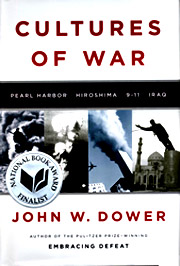
Cultures of War: Pearl Harbor / Hiroshima / 9-11 / Iraq by John Dower 

Berlin Diary: The Journal of a Foreign Correspondent, 1934-1941 by William Shirer

Moral Combat: Good and Evil in World War II by Michael Burleigh 

Picked up a few more books for the antilibrary.

Dower is best known for his prizewinning Embracing Defeat: Japan in the Wake of World War II, which unfortunately, I have never read.  Berlin Diaries I have previously skimmed through for research purposes but I did not own a copy. Shirer’s The Rise and Fall of the Third Reich: A History of Nazi Germany was an immensely bestselling book which nearly everyone interested in WWII reads at some point in time. I would put in a good word for Shirer’s lesser known The Collapse of the Third Republic: An Inquiry into the Fall of France in 1940 . It was a very readable introduction to the deep political schisms of France during the interwar and Vichy years which ( as I am not focused on French history) later made reading Ian Ousby’s Occupation: The Ordeal of France 1940-1944 more profitable.

I am a fan of the vigorous prose of British historian Michael Burleigh, having previously reviewed  Blood and Rage: A Cultural History of Terrorism here and can give a strong recommendation for his The Third Reich: A New History.  Burleigh here is tackling moral choices in war and also conflict at what Colonel John Boyd termed “the moral level of war” in a scenario containing the greatest moral extremes in human history, the Second World War.

The more I try to read, the further behind I fall!

R2P Debate Rising ( Part I.)

Friday, February 7th, 2014

I thought I would call the attention of the readership to a debate that has been ricocheting around different social media platforms on R2P (Responsibility to Protect“). I have dealt with the topic several times in the past, related to the ideas of Anne-Marie Slaughter, but not much recently until Victor Allen, over at The Bridge, put up an enthusiastic post:

Strong State, Weak State: The New Sovereignty and the Responsibility to Protect

The Responsibility to Protect doctrine represents a leap forward in accountability for states and does not infringe upon their sovereignty, as states are no longer held to be completely self-contained entities with absolute power over their populations. Rather, there is a strictly defined corpus of actions that begin the R2P process?—?a process that has different levels of corrective action undertaken by the international community in order to persuade, cajole and finally coerce states into actively taking steps to prevent atrocities from occurring within their boundaries. That R2P does not violate sovereignty stems from the evolution of sovereignty from its Westphalian form in the mid 17th century to the “sovereignty as responsibility” concept advanced by Deng, et al. Modern sovereignty can no longer be held to give states carte blanche in their internal affairs regardless of the level of suffering going on within their borders. This does not diminish state agency for internal affairs, but rather holds them responsible and accountable for their action and inaction regarding the welfare of their populations…

Victor’s post deserves to be read in full.

I did not agree with Victor’s framing of the legal character of state sovereignty, to put it mildly, nor his normative assessment of R2P.  Mr. Allen also described R2P somewhat differently than I have seen from other advocates, but I was less concerned by that as the concept does not seem to be presented with consistency by the community of  R2P advocates and theorists. Having seen similar theoretical debates over the years about angels dancing on pins over 4GW, constructivism, EBO, Network-centric Warfare, OODA,  Clausewitz’s remarkable trinity,  nuclear deterrence, preemptive war, COIN,  neoconservatism, free market economics, the agrarian origin of capitalism in England, Marxist theory etc. I am not too worried if Victor’s interpretation in its specifics is not ideologically perfect. It is representative enough.

I responded to Allen’s post somewhat crankily and with too much brevity:

R2P: Asserting Theory is not = Law 

….As far as premises go, the first point is highly debatable; the second is formally disputed by *many* states, including Russia and China, great powers which are permanent members of the UN Security Council; and the third bears no relation to whether a military intervention is a violation of sovereignty or not. I am not a self-contained entity either, that does not mean you get to forcibly enter my house.

That R2P does not violate sovereignty stems from the evolution of sovereignty from its Westphalian form in the mid 17th century to the “sovereignty as responsibility” concept advanced by Deng, et al. Modern sovereignty can no longer be held to give states carte blanche in their internal affairs regardless of the level of suffering going on within their borders.

Academic theorists do not have the authority to override sovereign powers (!) constituted as legitimized, recognized, states and write their theories into international law – as if an international covenant like the Geneva Convention had just been contracted. Even persuading red haired activist cronies of the American president and State Department bureaucrats to recite your arguments at White House press conferences does not make them “international law” either – it makes them “policy” – and that only of a particular administration. 

This riff  set off something of a reaction on Facebook in private groups and on Twitter as Mr. Allen, who I am sure is a fine gent, has a large set of common colleagues with me, some of whom are Boydians and all of whom are sharp strategic thinkers. Consequently,  Victor’s post(s) as well as mine and a later follow up by a “Leonidas Musashi” ( great nom de guerre)  made it into a high caliber defense forum as well as other sites online. My spleen-venting provoked the following rebuttal at The Bridge:

R2P: A Spectrum of Responses 

….Safranski’s final point about sovereignty as carte blanche seems to be a stealth argument for the principles of R2P:

States always could and did take military action in self-defense when disorders in neighboring states threatened their security or spilled over their border outright.R2P seeks to minimize harm caused by disorder through early action taken prior to conflicts spilling over borders that can potentially cause larger conflagrations, but more importantly, it recognizes that atrocities can happen entirely within the confines of a state, and that the international community will not allow them to continue unchecked. This recognition is easily seen in the rhetoric and discussions regarding rebels in both Libya and Syria. Libya is admittedly a flawed example of the use of R2P, with second-order effects seen in the Russian and Chinese opposition to UN-sanctioned stabilization operations in Syria, but that concern for the population first and the state second were common facets to both bear mentioning in the debate and illustrate the shifting nature of intervention and sovereignty. This shift is exemplified in the contrast between discussions in the UN General Assembly regarding Kosovo/East Timor and Syria: “most of the 118 states that mentioned Syria at the UN General Assembly in 2012 expressed concern about the population, up from less than a third who invoked Kosovo and East Timor in 1999… It is clear that a fundamental shift has taken place regarding humanitarian intervention and that more and more states embrace the broad values expressed by R2P.” (“Democracy, Human Rights, and the Emerging Global Order: Workshop Summary,” Brookings Institution, 2012)

Again, I caution about reading posts in full.

Here in this rebuttal Victor doubled down, which I admire because that is interesting, but with which I agree with even less because he seems to be far removed from how the world really works in terms of international relations, not merely in practice, but also in theory as well.  That said, his response deserves a much more serious reply than my first post evinced. I have been fiddling with one ( I seem to be moving slowly these days) but another voice – “Leonidas Musashi” – has entered the debate at The Bridge with a sharp retort against Allen’s conception of R2P:

Responsibility to Protect: Rhetoric and Reality 

….My main observation, however, is that the discussion thus far has been focused more on a “right” to protect than a “responsibility” to do so. The arguments indicate that a state has a responsibility to protect its people but takes for granted that third parties somehow inherit this responsibility when the state cannot fulfill it. There is a missing explanation here. The need to justify such efforts may seem callous, but a nation’s highest moral order is to serve its own citizens first. Such an explanation would certainly be a legitimate demand for a mother that loses a son who volunteered to defend his nation, or for a government entrusted by its people to use their resources to their own benefit. While it is often stated that the international community “should” intervene, explanation of where this imperative comes from is not addressed other than by vague references to modern states being interconnected. But this implies, as previously stated, a right based on the self-interest of states, firmly grounded in realistic security concerns, rather than any inherent humanitarian responsibility to intervene. Instability and potential spillover may very well make it within a nation’s vital interests to intervene in another country and pursuing humanitarian and human rights goals within the borders of another state may well be in a nation’s secondary interests. But if this is the case, the calculus of the political leadership will determine if pursuing this goal is worth the cost/potential costs – as has been done in such cases as North Korea, Iran, Zimbabwe, Tibet and Syria. In either case, the decision is determined by what is in the nation’s interests, a reality that makes R2P not a mandate, but a merely a post hoc justification for interventions that do occur.

Leonidas makes many good points, in my view, but the intellectual fungibility of R2P as a concept, its elastic and ever evolving capacity to serve as a pretext for any situation at hand is the most important, because it is potentially most destabilizing and threatening to other great powers with which the United States has to share the globe. In short, with great responsibilities come greater costs.

In part II. I will lay out a more methodical case on the intellectual phantom that is R2P.
Heraclitus at the Vatican

Sunday, February 2nd, 2014

[  by Charles Cameron — within the Vatican, feathers fly — a second post posted at our zenpuditry site during our recent downtime ]

.

Children, at the side of Pope Francis, release doves in a symbolic prayer for peace in the Ukraine:

Image

What happens next is seen in the lower panel — an almost heraldic battle of the birds, black crow against white dove. Consider, then, war and peace, as they are embodied here.

Heraclitus it was who observed,

What opposes unites, and the finest attunement stems from things bearing in opposite directions, and all things come about by strife.

Thoughts on CNAS “Preparing for War in the Robotic Age”

Friday, January 24th, 2014

[by Mark Safranski, a.k.a. “zen“]

My reading at CNAS, which had once been frequent, declined with the waning of the Abu Muqawama blog. While formerly I usually scanned through CNAS reports on a regular basis after reading what Exum and his commenters had to say, toward the end I only visited when Adam and Dan had new posts up.

At the gentle nudging of Frank Hoffman, I decided to read the latest CNAS product;  I’m pleased to say with the release of ” 20YY:Preparing for War in the Robotic Age by Robert Work ( CNAS CEO and former Undersecretary of the Navy) and Shawn Brimley (CNAS Executive V.P. and former NSC Strategic Planning Director) CNAS has rolled out an intellectually provocative analysis on an important emerging aspect of modern warfare.

Work and Brimley have done a number of things well and did them concisely (only 36 pages) in “20YY”:

  • A readable summary of the technological evolution of modern warfare in the past half century while distinguishing between military revolutions,  military-technical revolution and the the 80’s-90’s  American “revolution in military affairs“.
  • .
  • A more specific drill-down on the history of guided munitions and their game-changing importance on the relationship between offense and defense that flourished after the Gulf War. 
  • .
  • An argument that the proliferation of technology and information power into the hands unfriendly states and non-state actors is altering the strategic environment for the United States, writing:
  • .
  • “Meanwhile in the 13 years since the last 20XX game, foreign nation-state C41, surveillance and reconaissance systems, and guided munitions-battle network capabilities have become increasingly capable.  Indeed, these systems now form the very robust and advanced “anti-access and area denial”  (A2/AD) capabilities envisioned in the 20XX game series. The effect has been that the dominance enjoyed by the United States in the late 1990’s/2000’s in the area of high end sensors, guided weaponry, space and cyberspace systems and stealth technology has started to erode. Moreover the erosion is now occurring at an accelerated rate.”
  • .
  • Positing the near-future global proliferation of unmanned, autonomous, networked and swarmed robotic systems replacing( and leveraged by diminishing numbers of) expensive manpower and piloted platforms on the battlefield and altering the age-old relationship between a nation’s population base and the traditional calculation of its potential military power.
  • .
  • An argument that “warfare in the robotic age” will mean substantial to fundamental shifts in strategic calculation of deterrence, coercion, the use of force, operational doctrines and the evolution of military technology and that the United States must prepare for this eventuality.

This report is well worth reading.  In my view there are some areas that require further exploration and debate than can be found in “20YY”. For example:

  • While the power of economics as a driver of unmanned, autonomous weapons is present, the implications are vastly understated. Every nation will face strategic investment choices between opting for simple and cheaper robotic platforms in mass and “pricing out” potential rivals by opting for “class” – fewer but more powerful, sophisticated and versatile robotic systems.
  • .
  • The scale of robot swarms are limited primarily by computing power and cost of manufactureand could be composed of robots from the size of a fly to that of a zeppelin. As John Robb has noted, this could mean billions of drones.
  • .
  • The US defense acquisition system and the armed services are ill-suited for fast and inexpensive introduction of robotic warfare technology – particularly if they threaten to displace profitable legacy platforms – as was demonstrated by the CIA rather than the USAF taking the lead on building a drone fleet.  Once foreign states reach parity, they may soon exceed us technologically in this area. A future presidential candidate may someday warn of  a growing ” robot gap” with China.
  • .
  • Reliance on robotic systems as the center of gravity of your military power carries a terrific risk if effective countermeasures suddenly render them useless at the worst possible time (“Our…our drone swarm….they’ve turned around…they are attacking our own troops….Aaaaahhhh!”)
  • .
  • The use of robotic systems to indiscriminately and autonomously kill is virtually inevitable much like terrorism is inevitable. As with WMD, the weaker the enemy, the less moral scruple they are likely to have in employing lethal robotic technology.
  • .
  • For that matter, the use of robotic systems by an authoritarian state against its own citizens to suppress insurgency, peaceful protest or engage in genocide against minority groups is also highly probable. Is there much doubt how the Kim Family regime in north Korea or Assad in Syria would make use of an army of “killer robots” if they feel their hold on power was threatened?
  • .
  • International Law is not currently configured for genuinely autonomous weapons with Ai operating systems. Most of the theorists and certainly the activists on the subject of  “killer robots” are more interested in waging lawfare exclusively against American possession and use of such weapons than in stopping their proliferation to authoritarian regimes or contracting realistic covenants as to their use.

All in all “20YY:Preparing for War in the Robotic Age provides much food for thought.

Christian cannibal: first the horror, then the meditation

Friday, January 17th, 2014

[ by Charles Cameron — you may not want to watch the video – read the text first, okay? ]
.

Here’s what the BBC-wallah said:

The Christians were victims; now they’re on top. It’s a dangerous time to be Muslim. A charred and dismembered body is dragged through the streets. Christians have just killed a Muslim passerby. Ouandja “Mad Dog” Magloire was at the head of the mob. He was in a blind fury that day. Muslims killed his pregnant wife, his sister in law, her baby, he tells me. They broke down the door and cut the baby in half. I promised I’d get my revenge. Revenge was an act of cannibalism. First, he stabbed j\his victim. You are Muslim, Muslim, Muslim, he said. I poured petrol over him, I burned him, I ate his leg, right down to the white bone. The victim was just passing through on a bus. Most Christians are horrified, but resigned. No-one tried to help him, say these eyewitnesses. Everyone is so angry with these Muslims. No way anyone was going to intervene.

This happened at two o’clock in the afternoon, when the streets were crowded with people, just like you see today. Everyone we’ve spoken to is still at a loss to know what to make of it. Was it the act of a madman, was it somebody who’d been pushed by sectarian hatred, was it explained perhaps, by traditional beliefs in magic and sorcery. These fighters are Christians but they also believe in magic. their amulets contain soil from their ancestors’ graves. Some carry the flesh of enemies they’ve killed. These charms are a delicate subject, not often discussed with outsiders. We are bullet-proof, says the commander. Mad Dog Magloire went further. perhaps his crime resulted from his own demons, but to some Christians he’s a hero. That doesn’t bode well for this country’s future.

If you want to watch him say it, it’s powerful. Here you go:

Okay, now for the meditation: I want to rescue something out of all this horror.

**

The very first thing I want to note is this:

We are bullet-proof, says the commander.

I’ve run across this before, it’s a common motif. Remember the Lakota Ghost Dance shirts? Johnny and Luther Htoo, the cigar-smoking twins who led God’s Army in Myanmar…? Televangelist Wilde Almeda of the Jesus Miracle Crusade in the Philippines?

This is just to say that in my view, religion with spiritual bullet-proofing is different from religion without it, no matter what name you tag the religion with.

**

Next up:

Most Christians are horrified, but resigned. … perhaps his crime resulted from his own demons, but to some Christians he’s a hero.

It could be tribal. It could be magical, maybe. It could be religious, specifically Christian. It could be Mad Dog Magloire‘s “own demons”. It could be, and surely was, that he saw his pregnant wife slaughtered before his own eyes.

But he projected his thirst for vengeance not on the man — a Muslim — who had butchered them, but on a guy in a passing bus who looked like he was Muslim.

**

Some weeks back, Commander Abu Sakkar of the Farouq Brigades in Syria ate what he took to be the heart of one of his enemies. It turned out to be his enemy’s lung.

  • If you think Mad Dog Magloire doesn’t represent Christianity, maybe Abu Sakkar doesn’t represent Islam.
  • If you think Abu Sakkar is representative of Islam, maybe Magloire is representative of Christianity.
  • I think it is fair to say that any religions with in excess of a billion adherents will find the odd cannibal among them in time of war.

    **

    But then consider this, in peacetime:

    In Ireland this week, a man confessed he’d murdered his landlord over a chess game, and eaten his heart. Forensics showed it was a lung that was missing

    **

    We are, after all, human.


    Switch to our mobile site