zenpundit.com » creativity

Archive for the ‘creativity’ Category

The Abbottabad raid: tellings and retellings

Thursday, May 5th, 2011

[ by Charles Cameron ]
*

.
bryanalex.jpg

My friend Bryan Alexander‘s book, The New Digital Storytelling: Creating Narratives with New Media, hit the shelves a short while ago (recommended) — and this month Bryan is exploring the various forms of digital story-telling on his new digital storytelling blog.

I’m interested in narrative, too – even when it isn’t digital – because it’s the prime way in which we humans figure out what’s going on around us…

Here, then, are two “tellings and retellings” of the Abbottabad raid and the death of Osama bin Laden.

.
1. The fog of war

In his first briefing on bin Laden’s death from the White House, John Brennan, Assistant to the President for Homeland Security and Counter-Terrorism, dismissed bin Laden with the words, “I think it really just speaks to just how false his narrative has been over the years.”

Narrative is important, and the narrative John Brennan was proposing as a corrective to bin Laden’s version went as follows:

here is bin Laden, who has been calling for these attacks, living in this million dollar-plus compound, living in an area that is far removed from the front, hiding behind women who were put in front of him as a shield. I think it really just speaks to just how false his narrative has been over the years. And so, again, looking at what bin Laden was doing hiding there while he’s putting other people out there to carry out attacks again just speaks to I think the nature of the individual he was.

A writer in the Atlantic commented today:

And that’s the message our counterterrorism officials would, I expect, like the world — and especially any potential followers of al-Qaeda’s anti-American ideology — to get about our newly vanquished enemy, responsible to the single deadliest attack on American soil. The leader of the terrorist group was soft, a coward in the end who hid behind a woman’s skirts like a little girl, having grown accustomed to living in luxury in a mansion. Almost everything about this narrative seemed calculated to diminish any possible perception of strength or masculinity in bin Laden’s reaction to the raid by an elite team of U.S. Navy Seals — men who are in contrast among the most mythic and valorized in our armed forces, known for slogans like “pain is just weakness leaving the body.”

But just a day after Brennan’s briefing, the President’s Press Secretary, Jay Carney, gave a second briefing, in which he revised the official narrative, saying:

Well, what is true is that we provided a great deal of information with great haste in order to inform you and, through you, the American public about the operation and how it transpired and the events that took place there in Pakistan. And obviously some of the information was — came in piece by piece and is being reviewed and updated and elaborated on.
.
So what I can tell you, I have a narrative that I can provide to you on the raid itself, on the bin Laden compound in Pakistan.

I have a narrative…

The revised narrative featured an unarmed bin Laden in a far from palatial house with no visible air-conditioning, who didn’t in fact use a woman as a human shield… all of which “really just speaks to just how false” Brennan’s own original narrative was.

But then – you don’t believe everything you read in the press, do you? And besides, the first news reports of almost any big story are almost invariably inaccurate, it takes time for clarity to emerge… which adds up to the idea that it’s not so easy to distinguish between how the world actually spins — and how the world is spun.

So that’s a telling and retelling of the Abbottabad raid in “real life” as transmitted to us by various media and recorded on the web…
.

2: The twitter-stream and the analyst

A little earlier a more “purely” digital version of the story – no less confused by the “fog” that inevitably surrounds the reporting of highly volatile situations – had emerged quite spontaneously via Twitter, when the delightfully-named ReallyVirtual (an IT specialist who had moved to Abbottabad for some peace and quiet) was kept awake by the noise of helicopters overhead and sounds of explosions, and tweeted a couple of late-night friends… and a stream of tweets began which quickly led to an almost thousandfold spike in Yahoo searches on bin Laden, and bin Laden related searches occupying all top twenty spots on Google trends

You might call that spontaneous, distributed story-telling – but it’s also the raw material for a collated and curated twitter narrative, using Chirpstory, a tool for curating and presenting stories from the twitter-stream:
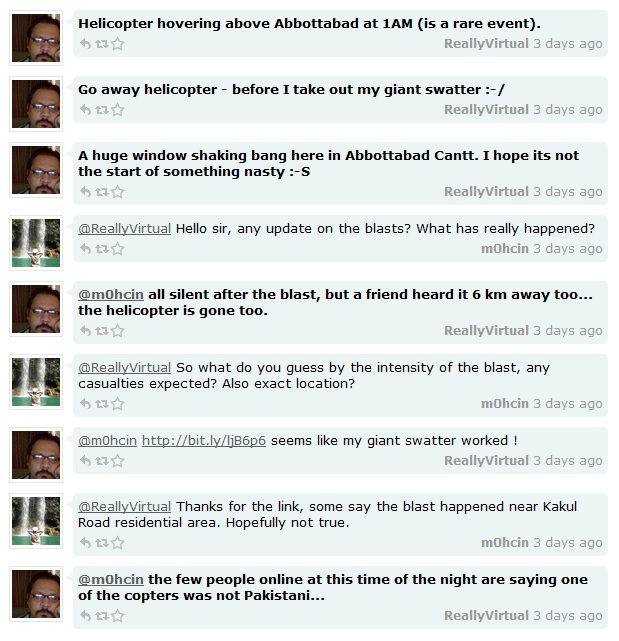
chirpstory.jpg

We’re not done yet…

That in turn provides grist for the analytic mill of B Raman, a highly-regarded Indian analyst, blogger, and former chief of counter-terrorism with India’s R&AW intelligence agency – who winnowed out the chaff and added in his own commentary to create a denser, tighter analytic narrative of his own:
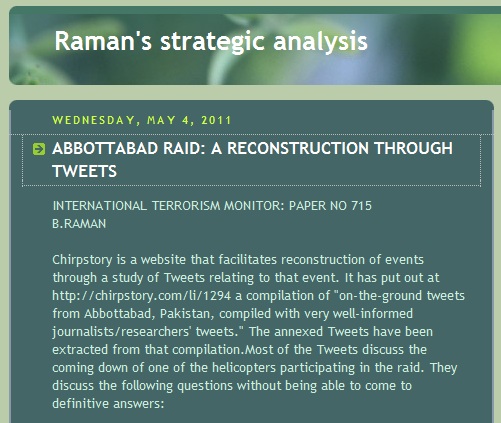
raman.jpg

To my way of thinking, the spontaneous twitter-stream version, the Chirpstory adaptation and B. Raman’s midrash on it are at least as interesting as the successive White House narratives…

.

3. Further reading:

Also relevant to our narrative here, and your own readings on the topic of our tale:

How the Bin Laden Announcement Leaked Out
Bin Laden Reading Guide: How to Cut Through the Coverage

More on Where Good Ideas Come From

Tuesday, April 19th, 2011

Dr. Von weighed in on Steven Johnson’s Where Good Ideas Come From with an extensive book review last December( I posted on Johnson here. On a related note, read Charles Cameron’s comment about the limitations of linear thinking here):

Where do New Ideas come from?

….But what exactly are innovation and creativity? The dictionary definition of innovation is ‘the introduction of new things or methods,’ while creativity is ‘the ability to create meaningful new ideas, forms or methods’ that are original and imaginative. So the key notion is the development of new ideas in whatever field one is working. A question naturally develops, which is where do new ideas come from? How do we begin preparing children now to be creative and innovative in the future? In the past, many would have first thought about the arts as being the training ground for creativity. Now, we realize that the development of the abilities and mindsets and skills necessary to be creative in every field of study is necessary.Steven Johnson’s new book, Where Good Ideas Come From: The Natural History of Innovation, provides the argument that there are seven common themes that have led to the vast majority of great ideas throughout history. He gives numerous examples of such ideas, ranging from Darwin’s development of the theory of evolution to the of the GPS system, from Google to the creation of the first mechanical computing devices centuries ago, and so on. It is an interesting read.Here is a summary of the seven themes that lead to good ideas. Keep in mind there is certainly some degree of overlap and relationships between the themes, but overall they can be thought of as distinct concepts.1. The Adjacent Possible: Even if you have an interest in some topic or problem, if there is not a good environment conducive to presenting the necessary pieces to solve the problem, good ideas will almost certainly not develop. You may be brilliant with some of the information (i.e. pieces of a puzzle) in your mind that is necessary to solve a problem, but if your surroundings are not able to provide the remaining pieces of information or experiences, you will endlessly search for them to no avail. If you are isolated from others who know something about your problem or issue, or if there is no means of gathering further information (which is becoming less of a problem with the advent of the Internet), or if your environment does not provide the physical infrastructure or supplies to finish building a new physical device, you will be unable to develop the Idea or solution to your problem.

2. Liquid Networks: Great ideas can develop when information is allowed to flow through a larger network. One possible network is a social network, or often and more specifically, a professional network. The focus of this is the ability to collaborate to solve problems. It turns out that there are almost no great ideas throughout history that have been developed in isolation or by an individual who did not need any help in the development of that great idea. One may think Newton or Einstein did their work in isolation, but this is not entirely true. Those two individuals come about as close as you can get to not needing a network to develop the laws of motion or relativity, but they relied on some level of feedback, reading others’ work, and ultimately talking and discussing issues with close colleagues and friends.
An interesting study was done that looked at how research groups reach the coveted ‘Eureka!’ moment, where a new discovery is made. It turns out that these rare moments of discovery or problem solving almost never happen in the lab! Instead, the ‘Aha!’ are yelled out at the conference table, where members of the group are throwing ideas around and sharing results of their latest work over the past week. The person who figures it out needs to have input they have not thought about from the larger group or network, before the grand idea is formed….

Read the rest here.

A HipBone approach to analysis VII: world wide spiders & the web

Tuesday, April 19th, 2011

[ by Charles Cameron ]

*

I thought I’d back-track a little, and drag in two blog posts that I made elsewhere back in March of 2008, which may help to explain my basic outlook on the sorts of issues that analysts face.

.

I. The version of the idea as poetry:

I am Charles

.

My concern is the human mind in service
to an open heart, and my problem
is that the heart picks issues rich in ambiguity
and multiplicity of voices, tensions
and torsions tugging not one way but
in many directions, even dimensions, as does
a spider’s web weighed down with dew –
to clarify which a mind’s abacus is required
.
equal in subtlety to subtlety itself, while
in all our thinking and talking, one
effect follows one cause from question
to conclusion down one sentence or white
paper — whereas in counterpoint,
Bach’s fugal voices contain their dissonance.

.

II. The same idea presented in prose — as I say, a few years back — with graphical illustration:

Spiders and dewdrops

Spiders and dewdrops do a pretty convincing job of portraying a certain level of complexity in this node-and-edge diagram of the global situation.

spider_web.jpg

When, say, Castro hands over power to his brother, or Musharraf has to give up control of the Pakistani army, it’s like snipping a couple of threads in that spiders web — and the droplets fall this way and that, carom into one another, the fine threads they’re on swing down and around until a new equilibrium is reached…

But try thinking that through in terms of Cuba and Pakistan before breakfast one morning if you’re Secretary of State, with a linear Cold War mind, Russia going through its own changes, and al-Qaida and associates training and recruiting in the background…

Well, those two instances have been and gone, and the new configurations are now the tired old same old configurations we believe we’ve figured out — until another dewdrop slips, and a thread breaks, and all things are once again new…

.

Funnily enough, I think this spider’s web of mine ties in with the Hokusai quote I posted in response to Zen‘s quote from Steven Pressfield yesterday, and with a piece I read today about intelligence analysts — Martin Petersen, What I Learned in 40 Years of Doing Intelligence.

It’s the web of tensions that constitutes the “complexity” that must somehow be grasped by the analyst, the writer, the historian…

And Hokusai, watching across the years how grasses bend in the winds, reach for sunlight, bow under the weight of dew — and spring back when released — may finally have a mind that’s attuned to that kind of complexity — to a degree that linear thinking will never reach…

Book Review: Do The Work by Steven Pressfield

Monday, April 18th, 2011

Do the Work by Steven Pressfield

Steven Pressfield has gone Zen on us with this little tome dedicated to the triumph of the creative spirit over the self-defeating power of “Resistance”. Do the Work is both a distillation and a complementary addition to his previous and longer non-fiction examination of becoming “a professional” in a creative field, The War of Art, which I recommend highly.

Here’s my favorite passage in Do the Work:

I was thirty years old before I had an actual thought. Everything up till then was either what the Buddhists call “monkey mind” chatter or reflexive regurgitation of whatever my parents or teachers said, or whatever I saw on the news or read in a book, or heard somebody rap about, hanging around the street corner.

In this book, when I say “Don’t Think”, what I mean is: don’t listen to the chatter. Pay no attention to the rambling, disjointed images and notions that drift across the movie screen of your mind.

                                                           Those are not your thoughts.

                                                                        They are chatter.

                                                                    They are Resistance.

Something I try to impart in my students is the practice of metacognition. Not that I expect them to execute a precision analysis of their thought process the first time through, or even the fiftieth. Instead, I am trying to break them of habitually moving on mental autopilot, running “tapes” in their head recorded by cultural  osmosis, to stop and ask themselves, what do I really think here? With skepticism and active, focused, attention. For more than a few, it is the first time in their lives experiencing what it is like to be intellectually awake and in control of their own thinking.


Reading Do the Work is a little like reading the Mao’s Little Red Book or Marcus Aurelius’ Meditations of writing. The sections are short vignettes of certitude that add up to a philosophical whole, in the case of Pressfield, a prescription for a personal creativity jihad based on in the moment creative action followed by reflection and refinement. It is meant for the person who can but doesn’t and doesn’t know why. Pressfield explains why and then, essentially, tells the reader to get off of the dime….NOW!

For the creative procrastinator ( like yours truly) or aspiring writer, Do the Work is a book that reads like an ass-kicking.

Social and Individual Components of Creativity

Thursday, April 14th, 2011

This is very good. And it is fast.

I have enjoyed several of Steven Johnson’s previous books, Emergence and Mind Wide Open and his latest one, Where Good Ideas Come From looks to be a must read, though I think those of you who have read Wikinomics or works like Flow by Mihaly Csikszentmihalyi will find some of Johnson’s points in the video to be familiar as will those long time readers who have seen my views on horizontal thinking   and  insight.

My students watched this and reacted by defining themselves as those who were creative mostly through social collaboration but a decided minority required solitude and an environmental filter to think clearly and creatively – not a catalyst of a series of  social-intellectual stimuli. For them, the cognitive load generated by the environment amounted to an overload, a distracting white noise that short-circuited the emergence of good ideas.

This suggests to me that there are multiple and very different neuronal pathways to creativity in the brain and a person’s predisposition in their executive function, say for example the classic “ADHD” kid at the back of the class, may have different requirements to be creative than a peer without that characteristic. It also means that creativity may be subject to improvement if we can cultivate proficiency in several “styles” of creative thinking.


Switch to our mobile site