Here’s a meme worth noting when it crops up in the advocacy of religious violence:
You don’t need permission from a religious authority…
1
This particular idea came up in the video of Anwar al-Awlaki that was released yesterday, Nov. 8th.
Flashpoint Partners translated the comment in question, “do not consult anyone in killing the Americans. Fighting Satan does not require a jurisprudence. It does not require consulting. It does not need a prayer for the cause. They are the party of Satan … It is the battle between truth and falsehood.”
My interest was piqued because of the correspondence between this comment from al-Awlaki, and the case of Phineas in the biblical Book of Numbers, chapter 25.
Phineas is “the son of Eleazar, the son of Aaron the priest” – but when he recognizes that the Lord would be infuriated by the interracial and interreligious copulation of Zimri, “a prince of a chief house” in Israel, with Cozbi, the daughter of the “head over a people, and of a chief house in Midian”, he does not go to the priest his grandfather seeking permission to kill them – he knows it is his Lord’s wish that they should die, and so he takes the responsibility for his action entirely upon himself, and kills them.
3
As I shall recount in greater detail in two future posts on the topic of Phineas, it is the fact that Phineas acts without first requesting permission that pleases his Lord so much that He grants to Phineas and his seed “the covenant of an everlasting priesthood”.
It is precisely this acting without requesting permission that is emphasized in modern Christian Identity writings on the topic of “Phineas Priests”:
So a Phinehas priest is a MAN who acts on personal initiative to execute Yah’s judgment on violations of Yah’s laws which are adversely affecting His people.
And according to Ehud Sprinzak, the eminent scholar of modern Jewish terrorism, it was reading the “Balak portion” of the book of Numbers, in which the story of Phineas is recounted, that convinced Yigal Amir that he could legitimately assassinate Yitzhak Rabin without first obtaining rabbinic approval (which would have put the rabbi who granted him permission at risk).
4
So. We have one more piece of the puzzle by which a mind with its own interpretation of God’s will can come to the conclusion that some specific act or acts of violence – accurately termed “terrorism” by others – are not only divinely sanctioned, and indeed mandatory, but can be undertaken without the requirement of prior verification from an appropriate religious authority.
And in this case — the religious authority, such as it is, of Sheikh al-Awlaki proposes this.
Charles Cameron is the regular guest-blogger at Zenpundit, and has also posted at Small Wars Journal, All Things Counterterrorism, for the Chicago Boyz Afghanistan 2050 roundtable and elsewhere. Charles read Theology at Christ Church, Oxford, under AE Harvey, and was at one time a Principal Researcher with Boston University’s Center for Millennial Studies and the Senior Analyst with theArlington Institute:
Zen here – I think Charles has hit upon a primal psychological mechanism that comes into full flower as societies break down and war begins to shade into warlordism. We have seen this repeatedly in history from Tamerlane’s mounds of skulls to Khmer Rouge killing fields. Mad Barons, Dogmeat Generals, Friekorps kapteins and butchers long since forgotten by history- there’s a gravitational pull toward atavistic, symbolic, destruction as social norms erode under the corrosive effects of escalating violence.
Mexico, Africa, Zarqawi?
by Charles Cameron
I’ve been struck by a couple of passages I’ve run across in my reading recently that remind me of what I can only call “brutality with religious overtones”. 1. Mexico
There have been a fair number of articles about the various Mexican cartels, but the excerpt from Ed Vulliamy’s book, Amexica: War Along the Borderline that’s now online at Vanity Fair is the one that caught my eye yesterday.
Here’s Vulliamy’s account of a conversation with Dr. Hiram Muñoz of Tijuana:
He explained his work to me during the first of several visits I have made to his mortuary. “Each different mutilation leaves a message,” he said. “The mutilations have become a kind of folk tradition. If the tongue is cut out, it means the person talked too much—a snitch, or chupro. A man who has informed on the clan has his finger cut off and maybe put in his mouth.” This makes sense: a traitor to a narco-cartel is known as a dedo — a finger. “If you are castrated,” Muñoz continued, “you may have slept with or looked at the woman of another man in the business. Severed arms could mean that you stole from your consignment, severed legs that you tried to walk away from the cartel.”<¶>Earlier this year, 36-year-old Hugo Hernandez was abducted in Sonora; his body turned up a week later in Los Mochis, Sinaloa, but not in a single piece. His torso was in one location, his severed arms and legs (boxed) in another. The face had been cut off. It was found near city hall, sewn to a soccer ball.
That’s the brutality — I haven’t see the book itself yet, but I gather it also gets into the narco-corrida music and the “quasi-Catholic cult of Santíssima Muerte” — which brings me to the second part of my interest – the religious aspect.
As Vulliamy mentions, there’s the cult of Holy Death, to be sure, a sort of shadow or inverse of the Blessed Virgin — a Dark Mother for dark times, or perhaps a revival of the ancient Mictlancihuatl, lady of the Dead? — with her own liturgy, too:
Almighty God: in the name of the Father and of the Son and of the Holy Spirit, we ask for your permission to summon Saint Death. Welcome, White Sister: we find ourselves gathered here at this altar of the Romero Romero family and of each one of us, to offer you a Mass that we hope you will like…
Which brings us to the Robin-Hood-like bandit and folk-saint, Jesus Malverde, to whom prayers such as the following [FBI .pdf, see p. 20] are offered:
Lord Malverde, give your voluntary help to my people in the name of God. Defend me from justice and the jails of those powerful ones. Listen to my prayer and fill my heart with happiness. For you shall make me fortunate.
Oh Malverde! The Vatican did not believe you to be holy and would not canonize you, but when they brought the Caterpillars to tear down your hood, you broke one machine and nobody could move you away, you broke another, leaving those who disrespect you speechless — and when the third one broke, they said, “Let Malverde’s chapel alone.”
Right beside the syncretistic quasi-Catholicism, there’s also a Protestant angle: La Familia is the group that, in Vulliamy’s words, “made its ‘coming out’ known in a famous episode: bowling five severed heads across the floor of a discotheque.” Time magazine reported on what it termed Mexico’s Evangelical Narcos:
Federal agents seized one copy of La Familia’s Bible in a raid last year. Quoted in local newspapers, the scripture paints an ideology that mixes Evangelical-style self-help with insurgent peasant slogans reminiscent of the Mexican Revolution. “I ask God for strength and he gives me challenges that make me strong; I ask him for wisdom and he gives me problems to resolve; I ask him for prosperity and he gives me brain and muscles to work,” Moreno writes, using terms that could be found in many Christian sermons preached from Mississippi to Brazil. But on the next page, there’s a switch to phrases strikingly similar to those coined by revolutionary Emiliano Zapata. “It is better to be a master of one peso than a slave of two; it is better to die fighting head on than on your knees and humiliated; it is better to be a living dog than a dead lion.”
What’s troubling here is that there is only one undoubtedly “evangelical” phrase in all those that Time quotes, and it is one of then ones said to resemble the aphorisms of Emilio Zapata. “It is better to be a living dog than a dead lion” is a pretty direct borrowing from Ecclesiastes 9.4 in the King James Version: “To him that is joined to all the living, there is hope: for a living dog is better than a dead lion.”
But that’s not actually all. I didn’t mention it at the time, but “I ask God for strength and he gives me challenges that make me strong; I ask him for wisdom and he gives me problems to resolve; I ask him for prosperity and he gives me brain and muscles to work” is almost word-for-word the same as a poem attributed to Islam — or Judaism for that matter. Indeed, it can be hard to tell who is borrowing from whom – but one final source for the La Familia bibleis known – it’s the book Wild at Heart by John Eldredge, the pastor of a ministry in Colorado Springs, who must have been surprised at the uses to which his writings were being put.
In any case, as I said on Zenpundit: These people have a theology, and we should be studying it. 2. Africa
I have stood in a blood-splattered house in Tanzania where an old woman had just been beaten to death for being a “witch” who cast spells on her neighbors. I have stood in battlefields in the Congo where the troops insist with absolute certainty they cannot be killed because they have carried out a magical spell that guarantees, if they are shot, they will turn briefly into a tree, then charge on unharmed. I have been cursed in Ethiopia by a witch-doctor with “impotence, obesity, and then leprosy” for asking insistently why he charged so much to “cure” his patients. (I’m still waiting for the leprosy.) Where do these beliefs come from? What do so many Africans get out of them? Can they be changed? These are questions that are asked in Africa all the time, but we are deaf to the conversation.
That sent me in search of some early military anthropology related to guerrilla warfare I’d come across in earlier readings.
I’m quoting here from the chapter on “The Mau Mau Religion” in Maj. Hughes paper:
Leakey’s original hypothesis in Mau Mau and the Kikuyu: “Mau Mau was nothing more than a new expression of the old KCA … a political body that was banned … because it had become wholly subversive.” Furthermore, “Mau Mau was synomomous with the new body called the in school, Kenya African Union…” However, Leakey admits to a reversal of his original hypothesis in Defeating Mau Mau, and goes on to say, “Mau Mau, while to some extent synonymous with these political organizations, was in fact a religion and owed its success to this fact more than to anything else at all.”<¶>He then proceeds to attribute the origin of Mau Mau to an “ideology transfer,” wherein the religious beliefs of the Kikuyu transitioned from their ancient tribal religion to Euro-Christianity to Mau Mau. The first transition took place artificially, as the missionaries stripped away the traditional beliefs and supplanted them with “20th Century Europe’s concept of Christianity.” The second transition was more natural and evolutionary than the first. A reactionary hybrid of the old and the new developed, because the supplanted concepts would not hold up in their society. There were too many contradictions between the old and the new, mainly due to the 20th Century European “add-ons.”
Most of us have a pretty fixed view of what religion is, should be, or isn’t. Some of my readers no doubt hold to a evangelical Christian position, some are Catholic, some perhaps Buddhist, agnostic or atheist, and some perhaps Muslim. Each of us tends to take our own view of a particular religion as normative, but the reality is that the history of each of the great world religions contains sanctions for both peace-making and warfare — and human nature itself encompasses a range of behaviors that run from the kind of atavistic violence described above to the forgiving and compassionate impulse behind the Beatitudes…
And while economic pressures and political frustrations may be enough to power great struggles, when religious rituals, beliefs and feelings are added into the mix, it can quickly become even more lethal. 3. And Zarqawi?
All of which leaves me wondering how close the parallels are between the Mau Mau in LSB Leakey’s account, La Familia and the other Mexican cartels — and the brutalities of jihadists such as Abu Musab al-Zarqawi.
Charles Cameron is the regular guest-blogger at Zenpundit, and has also posted at Small Wars Journal, All Things Counterterrorism, for the Chicago Boyz Afghanistan 2050 roundtable and elsewhere. Charles read Theology at Christ Church, Oxford, under AE Harvey, and was at one time a Principal Researcher with Boston University’s Center for Millennial Studies and the Senior Analyst with theArlington Institute:
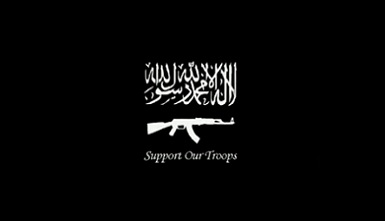
As it happens, I’d just been viewing a pro-jihadist United States of Islam video and made the following screen-capture as an illustration of my continuing concern about the “black flags of Khorasan” and the issue of whether AQ and or its franchises and or portions of the Taliban consider themselves to be fighting the apocalyptic war of the end of time.
Note also that the filmmaker’s ironic borrowing of the phrase “Support Our Troops” to urge support of the troops of the Mahdi will not be lost on some viewers.
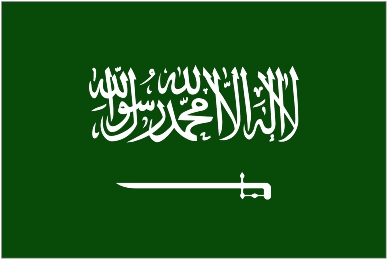
This screen-capture, from the United States of Islam video, in turn reminded reminded me of the Saudi flag, which likewise carries the shahada or Muslim profession of faith and a weapon – a sword.
The script in the centre of the flag is the Islamic creed, “There is no God but Allah, and Mohammed is the Prophet of Allah”. The flag is therefore considered sacred and special protocol rules apply: the flag does not dip in salute, nor is it ever flown at half-mast. Note that the creed always reads properly from right to left, with the sword hilt to the right, so the reverse of the flag is not a mirror image of the obverse. When making the flag, the creed must be reproduced precisely, including the accent marks. The use of the flag on any commercial item (especially clothing) is not recommended as it might be considered inappropriate, or even insulting.
The Shahada is the central testament of faith of Islam, as is the Shema Yisroel of Judaism and the Credo of Christianity, and I respect it as such – and likewise the Saudi flag., on which it is displayed.
*
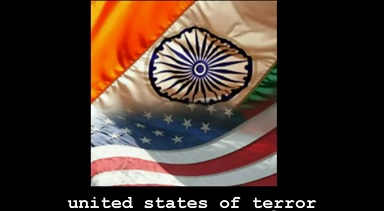
Flags, however, are potent symbols, and the graphical power of the “black flags of Khorasan” motif should not, in my view, be underestimated. The particular video that I took that screen-capture from makes use of “mix” flags of its own devising:
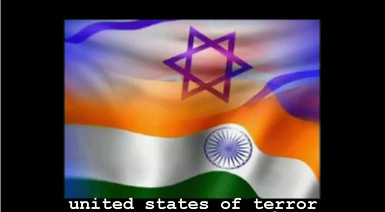
– merging the American and Indian flags – or the flags of India and Israel –
to create an imagery of the “United States of Terror” to juxtapose against their own black flags as the “United States of Islam” – giving us Huntington’s “Clash of Civilizations” in visceral graphic form.
And that conjunction of India with Israel bears thinking about, too… not only in terms of military aid between the two nations, but also of the symbolic juxtaposition of the Al-Aqsa Mosque and Jerusalem with the Babri Masjid and Ayodhya…
Indeed, the Indian flag itself also deserves consideration in our context.
Originally, Mahatma Gandhi had hoped that it would feature the charka or spinning wheel which he had made famous. As an informative article on the subject from The Hindu puts it:
For Gandhiji, the charka represented not a mere hand-spinning device that could provide employment and income to the poor, but much more. “The message of the spinning-wheel is much wider than its circumference. Its message is one of simplicity, service of mankind, living so as not to hurt others, creating an indissoluble bond between the rich and the poor, capital and labour, the prince and the peasant.” (Young India, September 17, 1925). “Above all, charka is a symbol of non-violence” (Collected Works of Mahatma Gandhi, Vol. 71, first edition, p.234).Gandhiji was, therefore, all the more sad when a correspondent from Hyderabad brought to his notice, on the eve of Independence, K. M. Munshi’s indictment in his broadcast speech that the wheel in the new flag represented the Sudarshana Chakra (discus of Lord Vishnu), a symbol of violence! But Gandhiji consoled himself that “under no circumstances, can the Asoka Chakra become a symbol of violence as Emperor Asoka was a Buddhist and a votary of non-violence” (Harijan Sevak, August 17, 1947).
So there’s another weapon-flag connection – albeit one where non-violence seems to triumph over violence.
*
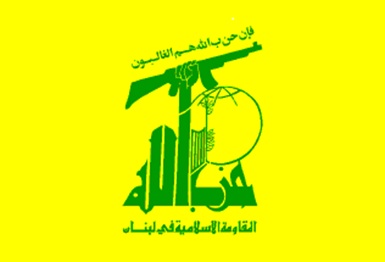
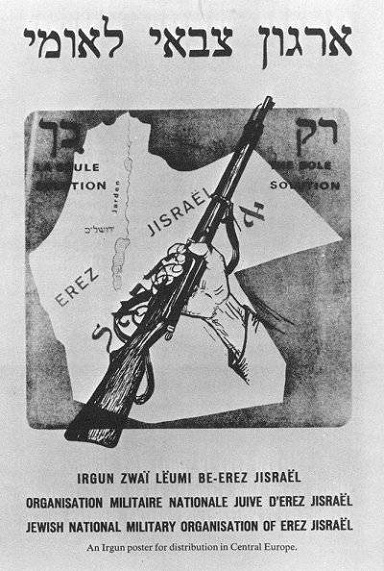
But let me get back to the yellow Hizbollah flag with which we started, and quickly note the resemblance (which I don’t claim to be the first to note, but cannot presently find my source for) between its portrayal of a rifle raised in a victorious fist, and this poster from the Irgun:
And that’s enough about weaponry and flags for now, I think.
I hope to follow this post up shortly with a more detailed account of the United States of Islam video mentioned above, and its many and curious references and resonances.
….What the USG desperately needs is a national security equivalent to DARPA that can both engage in deep thinking and have the freedom to run pilot programs to enhance America’s strategic influence that can later be expanded by our traditional power bureaucracies. This would be far more than a just a federally funded think tank – RAND, Brookings, Hoover , Heritage, AEI, CATO, CFR, Carnegie, CSIS and others all do a fine job of policy analysis. They also give statesmen a productive place to hang their hat as an alternative to whoring themselves out as corporate or ideological lobbyists. Another one of those is not what the times require.
What I’m proposing is a lot closer to a cross between a soft-power version of the Institute for Advanced Studies and a clandestine service – one with the objective of developing innovative programs to maximize the influence of American values and promote “Connectivity ” in nations mired in the endemic, isolated, misery of the “Gap”. This is not what the USG normally does. The bias of State and Defense, State in particular, when dealing with foreign policy questions tend to be orientated toward day to day, tactical, crisis management….
Google appears to be trodding down that very path:
Jared Cohen joined Google last week as the director of its newly created Google Ideas “think/do tank”-an entity whose objective is to dream up and try out ideas that address the challenges of counterterrorism, counterradicalism, and nonproliferation, as well as innovations for development and citizen empowerment. He has also landed a side gig as an adjunct fellow at the Council on Foreign Relations, focusing on innovation, technology, and statecraft.
Google has now hired Cohen to set up Google Ideas, which will look for innovative approaches to some of the stickiest international issues of the day. Out of his New York office, Cohen will, he told Foreign Policy, seek to “[build] teams of stakeholders with different resources and perspectives to troubleshoot challenges.” As for why he decided to give this a shot in the private sector, rather than in the public sphere, to which these issues have traditionally belonged, Cohen says there are “things the private sector can do that the U.S. government can’t do.”
The big thing is the resources and the capabilities. There are not a couple hundred [computer] engineers in the State Department that can build things; that’s just not what government does. You don’t necessarily have some of the financial resources to put behind these things. It’s really hard to bring talented young people in; there are not a lot mechanisms to do it. [And] on some topics, it’s very sensitive for government to be the one doing this.
During the Cold War, DARPA was a great success, as government bureaucracies go, partly because secrecy freed it from the normal political and bean counting constraints. The other reason was that DARPA’s focus was primarily upon engineering types of problems. Technically difficult, innovative and exploratory problems to be certain, but generally not the sort of socially constructed or influenced “wicked problems“. Or “intractable ones” ( DARPA delved into technical problems that were, due to the technological level of that earlier era, also intractable, but that is still a different kettle of fish from socioeconomic, perceptually intractable, problems). It would seem that Google Ideas will be tackling the harder set of problems to solve.
Google Ideas is an entity to watch but all the observation will be detrimental to the accomplishment of it’s mission, as the nature of social wicked problems carry with them vested interests determined to defend the dysfunctional status quo from which they derive benefits. In some scenarios, with extreme violence. In others, with political pressure. There’s a reason these problems in the human realm go unsolved – sweet reason and pilot program rational incentives might not appeal to leaders of La Familiaor Palestinian Islamic Jihad.
Charles Cameron is the regular guest-blogger at Zenpundit, and has also posted at Small Wars Journal, All Things Counterterrorism, for the Chicago Boyz Afghanistan 2050 roundtable and elsewhere. Charles read Theology at Christ Church, Oxford, under AE Harvey, and was at one time a Principal Researcher with Boston University’s Center for Millennial Studies and the Senior Analyst with theArlington Institute:
Regarding the popular intel phrase “connect the dots”, this is the first, brief ‘blip’ in a series of short posts that Charles will be feeding in here along with more substantial pieces, to capture the sort of stray thoughts, while they are flying by, that may add up to more of a mosaic later.
Bin Laden the Avatar
by Charles Cameron
Just a quick question:
Is bin Laden portrayed as an “Avatar” in the James Cameron sense in this
video in which he also talks about climate change — a significant
ecological theme in his recent discourses?
h/t Ibn Siqilli, frame taken from the video “Help Your Brothers in Pakistan”. People have joked about it – see Here for instance… But is AQ picking up on the meme and exploiting it, as they’ve exploited Tolkien on occasion?
Zenpundit is a blog dedicated to exploring the intersections of foreign policy, history, military theory, national security,strategic thinking, futurism, cognition and a number of other esoteric pursuits.