zenpundit.com » culture

Archive for the ‘culture’ Category

Head to Head: Colin Gray and Joseph Nye on Soft and Hard Power

Friday, April 15th, 2011

Colin Gray is one of the four or five go-to strategic thinkers around today. Joseph Nye, the father of the soft power concept, is a seminal figure in Political Science and International Relations.

Colin S. Gray  Hard Power and Soft Power: The Utility of Military Force as an Instrument of Policy in the 21st Century

….Unfortunately, although the concept of American soft power is true gold in theory, in practice it is not so valuable. Ironically, the empirical truth behind the attractive concept is just sufficient to mislead policymakers and grand strategists. Not only do Americans want to believe that the soft power of their civilization and culture is truly potent, we are all but programmed by our enculturation to assume that the American story and its values do and should have what amounts to missionary merit that ought to be universal. American culture is so powerful a programmer that it can be difficult for Americans to empathize with, or even understand, the somewhat different values and their implications held deeply abroad. The idea is popular, even possibly authoritative, among Americans that ours is not just an “ordinary country,” but instead is a country both exceptionally blessed (by divine intent) and, as a consequence, exceptionally obliged to lead Mankind. When national exceptionalism is not merely a proposition, but is more akin to an iconic item of faith, it is difficult for usually balanced American minds to consider the potential of their soft power without rose-tinted spectacles. And the problem is that they are somewhat correct. American values, broadly speaking “the American way,” to hazard a large project in reductionism, are indeed attractive beyond America’s frontiers and have some utility for U.S. policy. But there are serious limitations to the worth of the concept of soft power, especially as it might be thought of as an instrument of policy. To date, the idea of soft power has not been subjected to a sufficiently critical forensic examination. In particular, the relation of the soft power of attraction and persuasion to the hard power of coercion urgently requires more rigorous examination than it has received thus far.

Joseph Nye –The War on Soft Power

….In 2007, Richard Armitage and I co-chaired a bipartisan Smart Power Commission of members of Congress, former ambassadors, retired military officers, and heads of non-profit organizations at the Center for Strategic and International Studies in Washington. We concluded that America’s image and influence had declined in recent years and that the United States had to move from exporting fear to inspiring optimism and hope.

The Smart Power Commission was not alone in this conclusion. Even when he was in the George W. Bush administration, Defense Secretary Robert Gates called on Congress to commit more money and effort to soft-power tools including diplomacy, economic assistance, and communications because the military alone cannot defend America’s interests around the world. He pointed out that military spending then totaled nearly half a trillion dollars annually, compared with a State Department budget of just $36 billion. In his words, “I am here to make the case for strengthening our capacity to use soft power and for better integrating it with hard power.” He acknowledged that for the secretary of defense to plead for more resources for the State Department was as odd as a man biting a dog, but these are not normal times. Since then, the ratio of the budgets has become even more unbalanced.

One of the ironies here, is that the United States, through the private sector production of goods, services and intellectual property, has since WWII been overwhelming successful in exporting our “soft power” into foreign cultures to an extent seldom matched in history. However, the ability of the USG to capitalize on this latent-passive global acculturation through public diplomacy has ranged from minimal to excruciatingly counterproductive when our words, deeds and image are in serious disharmony.

Social and Individual Components of Creativity

Thursday, April 14th, 2011

This is very good. And it is fast.

I have enjoyed several of Steven Johnson’s previous books, Emergence and Mind Wide Open and his latest one, Where Good Ideas Come From looks to be a must read, though I think those of you who have read Wikinomics or works like Flow by Mihaly Csikszentmihalyi will find some of Johnson’s points in the video to be familiar as will those long time readers who have seen my views on horizontal thinking   and  insight.

My students watched this and reacted by defining themselves as those who were creative mostly through social collaboration but a decided minority required solitude and an environmental filter to think clearly and creatively – not a catalyst of a series of  social-intellectual stimuli. For them, the cognitive load generated by the environment amounted to an overload, a distracting white noise that short-circuited the emergence of good ideas.

This suggests to me that there are multiple and very different neuronal pathways to creativity in the brain and a person’s predisposition in their executive function, say for example the classic “ADHD” kid at the back of the class, may have different requirements to be creative than a peer without that characteristic. It also means that creativity may be subject to improvement if we can cultivate proficiency in several “styles” of creative thinking.

The etiquette of inflight prayer

Saturday, April 2nd, 2011

[ by Charles Cameron ]

*

The other day, three Orthodox Jews prayed aloud with “something that appeared to the flight attendants to be strapped under their clothing” on Alaska Airlines Flight 241 from Mexico to Los Angeles, and were greeted by the FBI on landing…

Just for the record, this is not the first time that a Jew wearing tefillin and praying in Hebrew on an airliner has been suspected of being a terrorist – just the most recent. AS CBS News reported on January 21st of last year:

A religious Jew wearing a series of black boxes and leather straps called tefillin or phylacteries inadvertently set off a bomb scare on a US Airways flight to Kentucky.

And apparently it doesn’t matter too much what language you pray in, or which of the Abrahamic faiths you belong to…

quo-inflight-prayers.gif

Islam, Judaism, Hebrew, Arabic… even the Christian Lord’s Prayer in English can do the trick if you shout it loud enough:

Maria Busuttil, 60, said a burly Caribbean man in his early 30s put all the passengers on edge on Tuesday when just before take-off from London Heathrow he left his seat, knelt down in the aisle and started bellowing the Our Father in English. [ … ] The man, who had dark skin and dreadlocks, was holding an orange Sainsbury’s plastic bag, which some passengers feared could have contained some sort of explosive. “He didn’t want to take his seat. He was on his knees, shouting ‘Our Father who art in heaven’, as if he were a preacher… It was like he was saying his last prayer before he dies… it was very scary.”

Jesus recommends praying in private rather than standing up and doing it publicly in synagogues – “pray to thy Father which is in secret; and thy Father which seeth in secret shall reward thee openly” – or, by implication, surely, jetliners… And any agnostic passengers can breathe a sigh of relief…

Of the Mahdi and the Matrix

Saturday, April 2nd, 2011

[ by Charles Cameron ]

*

There’s a book by Douglas Harding that I very much doubt Samir Khan has read, which may still be relevant to the ad in Inspire #4 that Jarret Brachman pointed to in this piece on Cronus Global — in which he notes the parallel between Inspire‘s ad featuring the choice between paradise and hell, and the choice featured in The Matrix between the blue and red pills…

jarret.jpg

That image, with its headless figure, put me in mind of another image that greatly interests me — a portrayal of the Imam Mahdi by Mahmud Farshchian — so I rescued it from my files to see if it was a good enough match with the ad for me to suggest a possible second graphic influence to Jarret:

16_imam-zaman2.jpg

Not surprisingly perhaps — considering that Samir Khan’s work is, putting it crudely, an advertising graphic, whereas Farshchian’s is a work of devotional art, and that furthermore Inspire is a Salafi-jihadist journal while Farshchian is a pious Shi’ite — the match isn’t close enough for me to argue influence…

But it did set me thinking.

*

The title of the Harding book to which I referred above is On Having no Head, and although it now carries the subtitle Zen and the Rediscovery of the Obvious it actually draws on Islamic traditions quite a bit, quoting Rumi:

Behead yourself! … Dissolve your whole body into Vision: become seeing, seeing, seeing!

and Attar:

Cover your breast with nothingness, and draw over your head the robe of non-existence.

and proposing — I’m putting this into my own words, now — the notion that the physical form of a human face is in some sense no more than a mask, veil or hijab over that light “which lighteth every man that cometh into the world” (John 1.9) — a light too profound for the conventional gaze.

And it is this profundity, attributed in Islam to the prophets in general and superlatively to Muhammad, which makes their literal portrayal a matter of some controversy…

*

Farshchian’s Imam Mahdi, like Khan’s Islamist Morpheus, is headless, I’m suggesting, because, to speak figuratively, radiance has taken the place of the face.

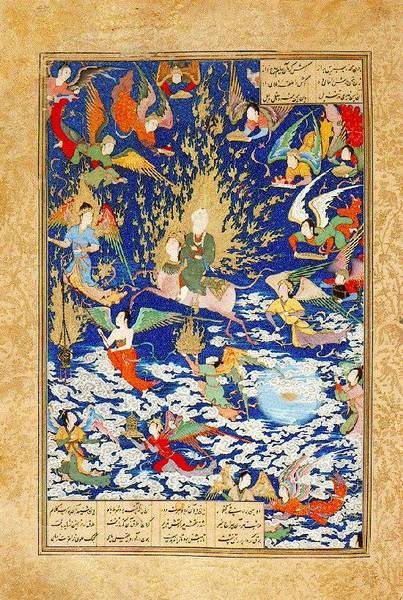
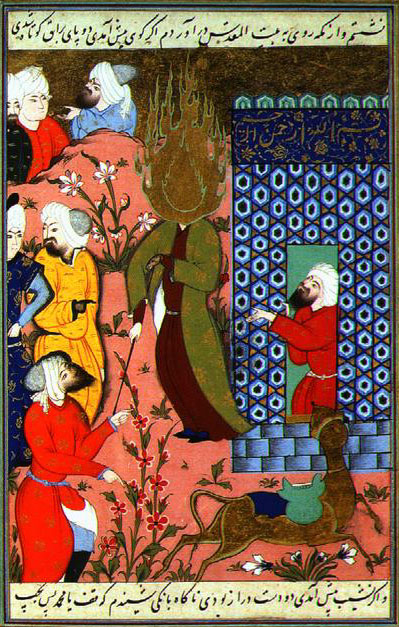
Which is also why, in this image of what must be for Muslims one of the holiest nights in the history of the world, the Night of the Mi’raj, the Prophet is portrayed without a face — or veiled — in this Persian miniature:

miraj_by_sultan_muhammad.jpg

and transfigured by his own fiery “halo” of illumination in this one:

muhammad_miraj1.jpeg

More Books and Reviews to Come

Wednesday, March 30th, 2011

Going to try to catch up this week on the backlog of book reviews I need to do, particularly those books sent to me by publishers. I may have to break down and do a set of mini-reviews, so far behind I have gotten myself.

So, naturally, that was a suitable pretext to order more books 🙂

Here’s what arrived the other day….


STRATEGY: The Logic of War and Peace by Edward Luttwak

War Before Civilization by Lawrence H. Keeley

WAR: In Human Civilization by Azar Gat

The World of Yesterday by Stefan Zweig

Why the West Rules – For Now by Ian Morris

Luttwak’s book is a strategy classic and I recently enjoyed his Grand Strategy of the Byzantine Empire. I first heard of Stefan Zweig from Lexington Green but nearly everyone who has read The World of Yesterday that I have encountered has raved about it, so I am looking forward to that one. Why the West Rules- For Now is another rec from the Chicago Boyz crowd but I do not think that anyone has reviewed it there as of yet. Finally, I am pairing War Before Civilization with Azar Gat’s War in Human Civilization – have a sense that Gat’s ideas may be somewhat in tune with Martin van Creveld.

Have you read any of these?


Switch to our mobile site