by Charles Cameron
[ cross-posted from ChicagoBoyz ]
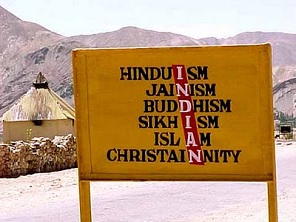
A great many people will have seen (or designed) some variant of the “coexist” bumper-sticker / tee-shirt design:
— the first of which can be found on acsapple‘s photobucket — and hey, the “aum” sign for “oe” is a brilliant bit of graphic substitution! – while I nabbed the second here.
What with a thousand flowers blooming, the importance of preserving memetic variations, peaceful coexistence and all, it’s only natural that some will have different takes on the matter —
Here’s a meme worth noting when it crops up in the advocacy of religious violence:
You don’t need permission from a religious authority…
1
This particular idea came up in the video of Anwar al-Awlaki that was released yesterday, Nov. 8th.
Flashpoint Partners translated the comment in question, “do not consult anyone in killing the Americans. Fighting Satan does not require a jurisprudence. It does not require consulting. It does not need a prayer for the cause. They are the party of Satan … It is the battle between truth and falsehood.”
My interest was piqued because of the correspondence between this comment from al-Awlaki, and the case of Phineas in the biblical Book of Numbers, chapter 25.
Phineas is “the son of Eleazar, the son of Aaron the priest” – but when he recognizes that the Lord would be infuriated by the interracial and interreligious copulation of Zimri, “a prince of a chief house” in Israel, with Cozbi, the daughter of the “head over a people, and of a chief house in Midian”, he does not go to the priest his grandfather seeking permission to kill them – he knows it is his Lord’s wish that they should die, and so he takes the responsibility for his action entirely upon himself, and kills them.
3
As I shall recount in greater detail in two future posts on the topic of Phineas, it is the fact that Phineas acts without first requesting permission that pleases his Lord so much that He grants to Phineas and his seed “the covenant of an everlasting priesthood”.
It is precisely this acting without requesting permission that is emphasized in modern Christian Identity writings on the topic of “Phineas Priests”:
So a Phinehas priest is a MAN who acts on personal initiative to execute Yah’s judgment on violations of Yah’s laws which are adversely affecting His people.
And according to Ehud Sprinzak, the eminent scholar of modern Jewish terrorism, it was reading the “Balak portion” of the book of Numbers, in which the story of Phineas is recounted, that convinced Yigal Amir that he could legitimately assassinate Yitzhak Rabin without first obtaining rabbinic approval (which would have put the rabbi who granted him permission at risk).
4
So. We have one more piece of the puzzle by which a mind with its own interpretation of God’s will can come to the conclusion that some specific act or acts of violence – accurately termed “terrorism” by others – are not only divinely sanctioned, and indeed mandatory, but can be undertaken without the requirement of prior verification from an appropriate religious authority.
And in this case — the religious authority, such as it is, of Sheikh al-Awlaki proposes this.
Charles Cameron is the regular guest-blogger at Zenpundit, and has also posted at Small Wars Journal, All Things Counterterrorism, for the Chicago Boyz Afghanistan 2050 roundtable and elsewhere. Charles read Theology at Christ Church, Oxford, under AE Harvey, and was at one time a Principal Researcher with Boston University’s Center for Millennial Studies and the Senior Analyst with theArlington Institute:
The fine jihadist-media-monitor Aaron Zelin has a Halloween special by that title today – featuring a piece by Omar Bakri Muhammad, founder of the UK group “Al Muhajiroun”, regarding the holiday of the season:
Realising this reality of Halloween, the true believer in the One and Only true God (Allah) we must ask what is the Islamic ruling on: Belief in false gods, pretending to be a false god, offering sacrifice to a false god and praying for the dead from the non-Muslims? What is the Islamic ruling on celebrating Halloween i.e. Dressing up in costumes, asking for treats, offering treats, decorating houses, displaying pumpkins? [ … ] As Muslims we are responsible for purifying the lands from any corruption hence we are duty bound to eradicate all evil and the worst is Shirk (giving the right of Allah to another). Dear Muslims we must realise and understand that any practices, celebrations that do not come from Islam are evil, because if it was good then Allah (SWT) would have included it in our Deen. Halloween is an evil celebration which promotes worship and sacrifice to false gods, an evil that pollutes one’s belief and worship to Allah. Halloween is a form of Shirk and disobedience introduced by Shaytaan in the form of a trick, enjoyment and celebration.
That set me off on a bit of a holiday spree…
According to other Muslims, Valentine’s day is just as bad…
Conservative Muslims opposing St. Valentine’s Day took to the streets of Lahore on Feb. 14 demanding an end to what they call an un-Islamic tradition. About 100 protestors gathered in front of the Lahore Press Club to condemn the “un-Islamic, unethical day.” The Jamiat Ulema-e-Pakistan (JUP), a religio-political party and Lahore Cultural and Heritage Society jointly staged the protest. The participants, most of them women clad in black burqas (a head-to-toe garment worn by Muslim women) waved banners which said “It is a conspiracy to corrupt Muslim children” and “it is treachery to culture.”
India’s Hindu hard-liners are showing no love for Valentine’s Day. A few dozen protesters briefly blocked a road in downtown New Delhi on Wednesday, burning Valentine’s Day cards and chanting “Down with Valentine.” In the nearby city of Lucknow, extremists threatened to beat up couples found celebrating their love. “We are deadly against Valentine’s Day,” said Sapan Dutta, a regional leader of the hard-line Shiv Sena group. “We are for civilized love and affection.” The protests by groups like Shiv Sena, who say they are defending traditional Indian values from Western-style promiscuity, have become an annual media event.
A unique Hindu temple of Sri Krishna dedicated to the concept of Valentine’s Day will be consecrated in April 2010 at Sholingur in Vellore District in Tamil Nadu (140 km from Chennai). The unique temple which tries to amalgamate the ideas of Saint Valentine and Hindu God Krishna – both synonymous with love – is being built by R. Jaganaath, a former food and beverages manager and the author of a book on cocktails.
A group of self-styled “underground feminists” calling themselves the ‘Rehendhi’ movement claim to have bombarded Sheikh Ibrahim Fareed with women’s underwear on Valentine’s Day, in protest “against misogyny in Maldivian society.”
Thing is, St Valentine, whose day February 14th supposedly is, wasn’t a lover in the romantic sense – he was a lover of God who died for his faith — a martyr:
A group of parents in Texas’s Katy Independent School District got a judge to issue a restraining order today to make sure that children can pass out Valentine’s Day cards with religious themes. The school district, however, says it doesn’t understand what the parents’ lawsuit is all about, and was never contacted by the parents about the issue. [ … ] In any case, kids in the district get to give out religious cards today. But did you ever consider what historically accurate religious Valentine’s Day cards might look like? Here are some ideas: “I Love Your Martyr Complex.” “Baby, I’d Rather Die Than Renounce Our God.” “If Love Is Blind, Maybe I Can Cure It.” “I May Not Exist, But My Love Is Real.”
Maybe we should just forget about Valentines. What about Christmas? It seems even Christmas isn’t exempt from suspicion…
What ought to be a time of meditative joy and happy celebration has become a time for combat. December, say scores of the faithful, is a time for war—the Christmas wars. Happy holidays is denounced as a godless substitute for Merry Christmas. The Christmas wars are now as much a part of the season as mistletoe and reindeer. Which brings us to one of the principal battlegrounds of this annual Christmas debate: Santa Claus. Millions of Christians accept Santa uncritically, but some denounce the attention given to him as idol worship. Many pastors crusade against images of the jolly old man’s presence in churches.
While our modern tradition of Halloween has no substantial ties to any paganism or occultism, there remains a strong cultural association and perception of Halloween as occultism and anti-Christian. Christians should be cognizant of the negative cultural implications of partaking in cultural festivals and willingly refrain when appropriate. This is true also of “Christian” holidays, such as Christmas and Easter, as well as holidays that are currently understood in more secular terms, such as Valentine’s Day and Independence Day. The practice of the Days of the Dead is a Mexican tradition that is associated with Mexican culture, so for us from another culture to borrow that practice with new meanings and interpretations was, in my opinion, culturally insensitive and inappropriate.
Independence Day? Independence Day?
I think that pretty much covers everything. Happy All Hallows all, and Feliz Dia de los Muertos.
Charles Cameron is the regular guest-blogger at Zenpundit, and has also posted at Small Wars Journal, All Things Counterterrorism, for the Chicago Boyz Afghanistan 2050 roundtable and elsewhere. Charles read Theology at Christ Church, Oxford, under AE Harvey, and was at one time a Principal Researcher with Boston University’s Center for Millennial Studies and the Senior Analyst with theArlington Institute:
Zen here – I think Charles has hit upon a primal psychological mechanism that comes into full flower as societies break down and war begins to shade into warlordism. We have seen this repeatedly in history from Tamerlane’s mounds of skulls to Khmer Rouge killing fields. Mad Barons, Dogmeat Generals, Friekorps kapteins and butchers long since forgotten by history- there’s a gravitational pull toward atavistic, symbolic, destruction as social norms erode under the corrosive effects of escalating violence.
Mexico, Africa, Zarqawi?
by Charles Cameron
I’ve been struck by a couple of passages I’ve run across in my reading recently that remind me of what I can only call “brutality with religious overtones”. 1. Mexico
There have been a fair number of articles about the various Mexican cartels, but the excerpt from Ed Vulliamy’s book, Amexica: War Along the Borderline that’s now online at Vanity Fair is the one that caught my eye yesterday.
Here’s Vulliamy’s account of a conversation with Dr. Hiram Muñoz of Tijuana:
He explained his work to me during the first of several visits I have made to his mortuary. “Each different mutilation leaves a message,” he said. “The mutilations have become a kind of folk tradition. If the tongue is cut out, it means the person talked too much—a snitch, or chupro. A man who has informed on the clan has his finger cut off and maybe put in his mouth.” This makes sense: a traitor to a narco-cartel is known as a dedo — a finger. “If you are castrated,” Muñoz continued, “you may have slept with or looked at the woman of another man in the business. Severed arms could mean that you stole from your consignment, severed legs that you tried to walk away from the cartel.”<¶>Earlier this year, 36-year-old Hugo Hernandez was abducted in Sonora; his body turned up a week later in Los Mochis, Sinaloa, but not in a single piece. His torso was in one location, his severed arms and legs (boxed) in another. The face had been cut off. It was found near city hall, sewn to a soccer ball.
That’s the brutality — I haven’t see the book itself yet, but I gather it also gets into the narco-corrida music and the “quasi-Catholic cult of Santíssima Muerte” — which brings me to the second part of my interest – the religious aspect.
As Vulliamy mentions, there’s the cult of Holy Death, to be sure, a sort of shadow or inverse of the Blessed Virgin — a Dark Mother for dark times, or perhaps a revival of the ancient Mictlancihuatl, lady of the Dead? — with her own liturgy, too:
Almighty God: in the name of the Father and of the Son and of the Holy Spirit, we ask for your permission to summon Saint Death. Welcome, White Sister: we find ourselves gathered here at this altar of the Romero Romero family and of each one of us, to offer you a Mass that we hope you will like…
Which brings us to the Robin-Hood-like bandit and folk-saint, Jesus Malverde, to whom prayers such as the following [FBI .pdf, see p. 20] are offered:
Lord Malverde, give your voluntary help to my people in the name of God. Defend me from justice and the jails of those powerful ones. Listen to my prayer and fill my heart with happiness. For you shall make me fortunate.
Oh Malverde! The Vatican did not believe you to be holy and would not canonize you, but when they brought the Caterpillars to tear down your hood, you broke one machine and nobody could move you away, you broke another, leaving those who disrespect you speechless — and when the third one broke, they said, “Let Malverde’s chapel alone.”
Right beside the syncretistic quasi-Catholicism, there’s also a Protestant angle: La Familia is the group that, in Vulliamy’s words, “made its ‘coming out’ known in a famous episode: bowling five severed heads across the floor of a discotheque.” Time magazine reported on what it termed Mexico’s Evangelical Narcos:
Federal agents seized one copy of La Familia’s Bible in a raid last year. Quoted in local newspapers, the scripture paints an ideology that mixes Evangelical-style self-help with insurgent peasant slogans reminiscent of the Mexican Revolution. “I ask God for strength and he gives me challenges that make me strong; I ask him for wisdom and he gives me problems to resolve; I ask him for prosperity and he gives me brain and muscles to work,” Moreno writes, using terms that could be found in many Christian sermons preached from Mississippi to Brazil. But on the next page, there’s a switch to phrases strikingly similar to those coined by revolutionary Emiliano Zapata. “It is better to be a master of one peso than a slave of two; it is better to die fighting head on than on your knees and humiliated; it is better to be a living dog than a dead lion.”
What’s troubling here is that there is only one undoubtedly “evangelical” phrase in all those that Time quotes, and it is one of then ones said to resemble the aphorisms of Emilio Zapata. “It is better to be a living dog than a dead lion” is a pretty direct borrowing from Ecclesiastes 9.4 in the King James Version: “To him that is joined to all the living, there is hope: for a living dog is better than a dead lion.”
But that’s not actually all. I didn’t mention it at the time, but “I ask God for strength and he gives me challenges that make me strong; I ask him for wisdom and he gives me problems to resolve; I ask him for prosperity and he gives me brain and muscles to work” is almost word-for-word the same as a poem attributed to Islam — or Judaism for that matter. Indeed, it can be hard to tell who is borrowing from whom – but one final source for the La Familia bibleis known – it’s the book Wild at Heart by John Eldredge, the pastor of a ministry in Colorado Springs, who must have been surprised at the uses to which his writings were being put.
In any case, as I said on Zenpundit: These people have a theology, and we should be studying it. 2. Africa
I have stood in a blood-splattered house in Tanzania where an old woman had just been beaten to death for being a “witch” who cast spells on her neighbors. I have stood in battlefields in the Congo where the troops insist with absolute certainty they cannot be killed because they have carried out a magical spell that guarantees, if they are shot, they will turn briefly into a tree, then charge on unharmed. I have been cursed in Ethiopia by a witch-doctor with “impotence, obesity, and then leprosy” for asking insistently why he charged so much to “cure” his patients. (I’m still waiting for the leprosy.) Where do these beliefs come from? What do so many Africans get out of them? Can they be changed? These are questions that are asked in Africa all the time, but we are deaf to the conversation.
That sent me in search of some early military anthropology related to guerrilla warfare I’d come across in earlier readings.
I’m quoting here from the chapter on “The Mau Mau Religion” in Maj. Hughes paper:
Leakey’s original hypothesis in Mau Mau and the Kikuyu: “Mau Mau was nothing more than a new expression of the old KCA … a political body that was banned … because it had become wholly subversive.” Furthermore, “Mau Mau was synomomous with the new body called the in school, Kenya African Union…” However, Leakey admits to a reversal of his original hypothesis in Defeating Mau Mau, and goes on to say, “Mau Mau, while to some extent synonymous with these political organizations, was in fact a religion and owed its success to this fact more than to anything else at all.”<¶>He then proceeds to attribute the origin of Mau Mau to an “ideology transfer,” wherein the religious beliefs of the Kikuyu transitioned from their ancient tribal religion to Euro-Christianity to Mau Mau. The first transition took place artificially, as the missionaries stripped away the traditional beliefs and supplanted them with “20th Century Europe’s concept of Christianity.” The second transition was more natural and evolutionary than the first. A reactionary hybrid of the old and the new developed, because the supplanted concepts would not hold up in their society. There were too many contradictions between the old and the new, mainly due to the 20th Century European “add-ons.”
Most of us have a pretty fixed view of what religion is, should be, or isn’t. Some of my readers no doubt hold to a evangelical Christian position, some are Catholic, some perhaps Buddhist, agnostic or atheist, and some perhaps Muslim. Each of us tends to take our own view of a particular religion as normative, but the reality is that the history of each of the great world religions contains sanctions for both peace-making and warfare — and human nature itself encompasses a range of behaviors that run from the kind of atavistic violence described above to the forgiving and compassionate impulse behind the Beatitudes…
And while economic pressures and political frustrations may be enough to power great struggles, when religious rituals, beliefs and feelings are added into the mix, it can quickly become even more lethal. 3. And Zarqawi?
All of which leaves me wondering how close the parallels are between the Mau Mau in LSB Leakey’s account, La Familia and the other Mexican cartels — and the brutalities of jihadists such as Abu Musab al-Zarqawi.
Zenpundit is a blog dedicated to exploring the intersections of foreign policy, history, military theory, national security,strategic thinking, futurism, cognition and a number of other esoteric pursuits.