zenpundit.com » culture

Archive for the ‘culture’ Category

Thought Experiment

Thursday, April 22nd, 2010


Oligarchy is not good.

 ….But as soon as the people got leaders, they cooperated with them against the dynasty for the reasons I have mentioned; and then kingship and despotism were alike entirely abolished, and aristocracy once more began to revive and start afresh. For in their immediate gratitude to those who had deposed the despots, the people employed them as leaders, and entrusted their interests to them; who, looking upon this charge at first as a great privilege, made the public advantage their chief concern, and conducted all kinds of business, public or private, with diligence and caution.

16    But when the sons of these men received the same position of authority from their fathers-having had no experience of misfortunes, and none at all of civil equality and freedom of speech, but having been bred up from the first under the shadow of their fathers’ authority and lofty position-some of them gave themselves up with passion to avarice and unscrupulous love of money, others to drinking and the boundless debaucheries which accompanies it, and others to the violation of women or the forcible appropriation of boys; and so they turned an aristocracy into an oligarchy. But it was not long before they roused in the minds of the people the same feelings as before; and their fall therefore was very like the disaster which befell the tyrants.

                                                       – Polybius

I have made, from time to time, the observation that the elite in American society is trending in its favored policies toward conscious promotion of oligarchy. Over at The Committee of Public Safety, Joseph Fouche quoted a theorist, retired CIA analyst Patrick E. Kennon, who is a delighted advocate of a coming technocratic oligarchy:

“Now, as we enter the twenty-first century, the future of the nation-state is much in doubt…Indeed, tribalism has revived with a brutal savagery from Rwanda and Cambodia to the newly dissolved USSR and the newly unified Germany…At the same time, a kind of shadow empire…is being embraced by elites around the globe. UN bureaucrats and Greenpeace activists, Carlos the Jackal and Mother Theresa, Toyota and Amnesty International, the Cali drug cartel and the World Bank, people who worry about the dollar-yen ratio and people who worry about the ozone layer, all of these consciously or unconsciously look to empire for their profit or salvation. All of these have largely given up on the nation.”

Oligarchs elevate self-interest and class interest over national interest, it’s the signature of oligarchy, be it the Thirty Tyrants or the Soviet nomenklatura. Milovan Djilas knew what the hell he was writing about as much as did Thucydides.

What to do?

The proto-oligarchical class in America, the elite who are the product of “the good schools”, tend to embrace and celebrate progressive taxation and diversity as high moral principles. What if we applied them?

The gateway to membership in the elite and opportunities for fabulous wealth and power runs through the admissions offices of our best universities, the Ivy League and a few other select intitutions and a handful of old, highly exclusive, liberal arts colleges. What if we put a special surtax on the purchase of tuition on a sliding scale that correlated with how many generations that members of a family have matriculated at such schools? Plus a few other tweaks here and there.

For example, a student who is the first in their family to go to college and was accepted by Yale would not be taxed at all, perhaps instead, they would be subsidized with a free ride for four years. But someone like Treasury Secretary Tim Geithner, a Dartmouth grad who was the son of a Dartmouth grad and a Ford Foundation executive, his kids might face a steep penalty, maybe a $ 250,000 per annum fee on top of tuition, then an additional surcharge to their income tax rates if they entered government service or certain professions like, say, hedge fund management, for the next couple of decades. Entering a different field, say becoming a social worker, a bowling alley manager or a policeman would not incur any income tax surcharge.

We can argue about the appropriate level of progressive taxation but the basic idea is that we could make it increasingly expensive for a family to continue to perpetuate itself, generation after generation, at the political and economic heart of American power. Not impossible, that would be un-American, but very, very expensive.

The net result would be far greater “diversity” at our flagship educational institutions – far more white ethnics whose last names end in vowels, Catholics, Jews, Eastern Orthodox, Asian-Americans, Hispanics, Southerners, Midwesterners and Westerners, people hailing from small towns or blue collar socioeconomic backgrounds. Currently favored demographic groups might be markedly reduced under such a system but since most of them come from long established UMC to UC families with great connections, they’ll be ok even going to Big State U. and getting a third tier school degree.  No worries.

Thoughts?

Google as a Dishonest Broker?

Tuesday, April 13th, 2010

This strikes me as an exceedingly bad idea from Google:

From Drudge:

GOOGLE FRANKENSTEIN: MACHINES TO CHOOSE YOUR NEWS
Mon Apr 12 2010 08:15:34 ET

GOOGLE CEO and Obama political activist Eric Schmidt declared this weekend that his machines will help decide what news you receive!

News sites should use technology to PREDICT what a user wants to read by what they have already read, Schmidt told the AMERICAN SOCIETY OF NEWS EDITORS, where a few humans still remained in the audience.

“We’re all in this together.”

MORE

Schmidt said he doesn’t want ‘to be treated as a stranger’ when reading online, POLITICO reports.

He envisions a future where technology for news editing could help tailor advertisements for individual readers.

And he wants to be challenged through technology that ‘directs readers’ to a story with an ‘opposing’ view.

[An odd suggestion from the CEO of a company long accused of offering little to no conservative-leaning links on its news page, while aggressively promoting left-leaning hubs.]

Schmidt said GOOGLE is working on new ways to push adverts and content for consumers, based on what stories they’ve read.

What stories his machines have selected.

Developing…

If this no-choice “opposing view” meme sounds familiar, that’s because a prominent friend and appointee of President Obama, former U. of Chicago law professor Cass Sunstein, has, for several years, articulated a sophisticated  theory on the need for government to regulate speech, “reformulate” the 1st Amendment to ensure greater “diversity” and compel the presentation of “opposing views”. While I share Sunstein’s concern that many people are deliberately corrupting their OODA Loops by only reading sources with which they already agree, forcing legal adults to read something else isn’t the answer. It’s a free country and with liberty comes the right to be left to wallow in ignorance in peace.

Getting the Congress and states to turn the free speech and free press clauses on their head is a task with small chance of political success. Persuading or pressuring a small number of friendly CEO’s of search engine companies to optimize their own systems to produce politically favorable results for the administration and the Democratic Party is a lot easier, far less transparent to the public and more difficult for the GOP and conservatives (or for that matter, dissident progressives and unpopular minorities) to combat.

To put it simply, the long term strategy here is that the information aggregators – Google being the 800lb gorilla – will become the new “gatekeepers” with their finger on the scales that determine the page rank of opposing views on controversial issues.

I feared that Google might be tempted to go down this road when they first became entangled with the Chinese government in a way that compromised the integrity of their search engine. At the time I asked:

” If you have agreed to censor what information can be accessed in China in return for greater market opportunities, have you also agreed to censor what information can be accessed about China by the rest of us ?”

As far as I am aware, that question has never been answered, though I think the answer has bearing on American national security and our domestic tranquility. The temptation to use the enormous informational power of Google to deliberately shape public discourse and cultural evolution to “manufacture consent” for policies favored by the elite without the commoners being aware of the manipulation, appears to be very difficult to resist.

I like Google. The company has provided a truly amazing array of informational services that – and I do not think this is an exaggeration – have added real and significant value to civilization. But part of that value comes from Google being regarded universally as an “honest broker” of information. Their CEO’s proposal jeopardizes that trust and once credibility is lost, it is gone for good.

The odd thing is, that this proposal is a really poor business strategy for Google – unless the objective is to create paranoia and drive a large segment of the population to use rival search engines or create new ones free of elite political gamesmanship.

The Games People Play II

Monday, April 5th, 2010

Gaming as a cultural paradigm ( Hat tip to Jessica Margolin):

ADDENDUM:

The Games People Play

“You are formally charged with War Game Crimes and with Playing Games against Humanity…”

ADDENDUM II:

John has the full presentation, not just the above excerpted clip.


Education, Books and the Digital Age

Wednesday, March 24th, 2010


In one of those “Socrates lamenting how the young folk can’t memorize and recite worth a damn because of all the time they waste reading!” moments, The New York Times hosted a debate of cultural significance. The authors are all thoughtful and reasonable in their contentions:

Do School Libraries Need Books?

Keeping traditional school libraries up to date is costly, with the constant need to acquire new books and to find space to store them. Yet for all that trouble, students roam the stacks less and less because they find it so much more efficient to work online. One school, Cushing Academy, made news last fall when it announced that it would give away most of its 20,000 books and transform its library into a digital center.

Do schools need to maintain traditional libraries? What are the educational consequences of having students read less on the printed page and more on the Web?

I spend a copious amount of time reading online with a PC, Blackberry, netbook and a Kindle but there’s something sad and sterile about the concept of a library without books. It is like calling a room with an iPod plugged into a Bose a “concert hall”.

This isn’t an antiquarian reaction. I am enthusiastic about the potential and the evolving reality of Web 2.0 as a powerful tool for learning, to set “minds on fire“, to facilitate mass collaboration in open-source  communities of practice, to lower costs and increase access to the highest quality educational experiences available and to drastically re-engineer public education. I am all for investing in “digital centers” for the “digital natives” – hell, all students should be carrying netbooks as a standard school supply! The capacity to skillfully navigate, evaluate and manipulate online information is not an esoteric accomplishment but an everyday skill for a globalized economy. Going online ought to be a normal part of a child’s school day, not a once a month or semester event.

I am also sympathetic to the economic questions facing school librarians – and not merely of cost, but of physical space. School library budgets are shrinking or nonexistent even as digital data compression and processing power follows Moore’s Law. Digital investment, especially when most vendors that specialize in k-12 educational markets feature egregiously oligopolistic, rip-off, prices, gives librarians an orders of magnitude larger “bang for the buck”.

But abandoning books entirely is not the way to go. Cognitively, reading online is likely not the same at the neuronal level as reading from a book. For literate adults, that may not matter as much as for children who are still in the complicated process of learning how to read. The key variable here may be visual attention moreso than particular cognitive subsets of reading skills, but we don’t actually know. Science cannot yet explain the wide developmental and methodological preference variation  among students who learn or fail to learn how to read using the ancient dead tree format. To quote neuroscientist, Dr. Maryanne Wolf:

….No one really knows the ultimate effects of an immersion in a digital medium on the young developing brain. We do know a great deal, however, about the formation of what we know as the expert reading brain that most of us possess to this point in history.

In brief, this brain learns to access and integrate within 300 milliseconds a vast array of visual, semantic, sound (or phonological), and conceptual processes, which allows us to decode and begin to comprehend a word. At that point, for most of us our circuit is automatic enough to allocate an additional precious 100 to 200 milliseconds to an even more sophisticated set of comprehension processes that allow us to connect the decoded words to inference, analogical reasoning, critical analysis, contextual knowledge, and finally, the apex of reading: our own thoughts that go beyond the text.

This is what Proust called the heart of reading – when we go beyond the author’s wisdom and enter the beginning of our own.

I have no doubt that the new mediums will accomplish many of the goals we have for the reading brain, particularly the motivation to learn to decode, read and experience the knowledge that is available. As a cognitive neuroscientist, however, I believe we need rigorous research about whether the reading circuit of our youngest members will be short-circuited, figuratively and physiologically.

For my greatest concern is that the young brain will never have the time (in milliseconds or in hours or in years) to learn to go deeper into the text after the first decoding, but rather will be pulled by the medium to ever more distracting information, sidebars, and now,perhaps, videos (in the new vooks).

The child’s imagination and children’s nascent sense of probity and introspection are no match for a medium that creates a sense of urgency to get to the next piece of stimulating information. The attention span of children may be one of the main reasons why an immersion in on-screen reading is so engaging, and it may also be why digital reading may ultimately prove antithetical to the long-in-development, reflective nature of the expert reading brain as we know it.

I could make a cultural argument about the tactile pleasure of book reading. Or the intrinsic role of books as the cornerstone of cultivating a “life of the mind” . Or that book-bound literacy is a two thousand year old element of Western civilization that is worth preserving for its own sake – which it is. However, such cultural arguments are not politically persuasive, because if you understand them already then they do not need to be made. And if you do not understand them from firsthand experience, then you cannot grasp the argument’s merit from a pious secondhand lecture.

Which leaves us with an appeal to utilitarianism; bookless schools might result in students who read poorly, which wastes money, time, opportunities and talent. Online mediums should be a regular part of a student’s diet of literacy but without books as a component of reading, a digital environment may not make for a literate people.

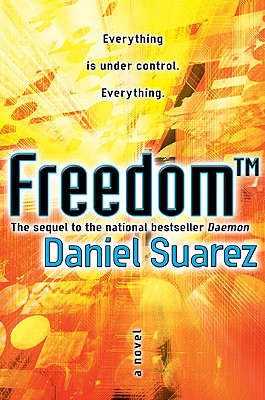
Freedom(TM) by Suarez

Tuesday, March 23rd, 2010


Freedom (TM) by Daniel Suarez

Shlok and John Robb have already endorsed Freedom(TM) by Daniel Suarez, the sequel to his earlier bestselling Daemon and I’d like to briefly join them in praising Freedom(TM) as a must-read work of science fiction. One that meshes well with the societal problems covered on today’s front pages while describing an emergent world of the Darknet being shepherded by the elusive, increasingly powerful, Daemon.

Other Posts on Freedom(TM):

Red Herrings


Switch to our mobile site