In war, and particularly in an Afghanistan counterinsurgency effort, there are always three sides to the coin: the good, the bad and the ugly. This is especially true in President Obama’s new Afghanistan strategy, finally announced to the American public Tuesday from a West Point backdrop.
The prescribed influx of much-needed American warriors onto the battlefield is clearly and rightly the good. And the good can withstand the bad, a Taliban enemy in the absence of reliable partners in the Afghan and Pakistani governments.
But the glimmering light of the good will surely be eclipsed by the ugly, an incoherence of strategy beneath the surface sheen of a surge. The devil is always in the details.
….For a counterinsurgency effort to succeed, the willing partners aren’t in Kabul or Islamabad, no matter the demands made upon each. Rather, they reside in the villages and towns spread through the provinces of Afghanistan. Winning over the local leaders will strengthen our position and ultimately lead to the Afghan people demanding better governance from Kabul.
This requires – in both word and deed – clear demonstration of presence and resolve, not in intellectual arguments for an exit strategy. There are no exits for the Afghans we seek to defend in parallel with our own security and interests.
Arm the tribes. Where there are no tribes, create loyalist paramilitaries from whatever networks are at hand for district and village self-defense. A heavily Tajik and Uzbek Afghan National Army will never fight the Taliban half as eagerly as Pushtun villagers defending their own homes and fields.
Thanks to the kind invitation of S. Anthony Iannarino, I have been on the much vaunted, often coveted, Google Wavebeta app ( I do not have any invites yet, sorry ) which mashes up email, realtime transparent instant messaging, other embedded web 2.0 apps and a wiki-like functionality. The interface looks like this ( from O’Reilly Radar – who can explain Google Wave far better than I can:
What is it like?
First, for me, it’s a small handful of my blogcircle ( most of who are techies) milling about chatting, trying to figure out the functionality. The champ so far isSean Meade, who is Tom Barnett’swebmaster and also the web editor for ARES; Sean assembled a tutorial “wave” for the rest of us that I have just begun to plod through. It is not easy to find other googlewavers which is why people are posting calls on Facebook, Twitter and other social networking sites.
Secondly, this is a very unfinished symphony of a beta – at least compared to prior beta experiences I’ve had. Sliderocket, by comparison was very smooth and probably 95 % ready when I received a beta account while with Google Wave I’d anticipate significant differences before it becomes generally available. As it is going to be open source, the potential creativity for future apps is vast.
Cool, interesting, not entirely sure how I will eventually use it on a regular basis yet.
by Robert Haddick Brigadier General H.R. McMaster has sent to Small Wars Journal the latest draft of Army Capstone Concept version 2.7. McMaster leads a team at TRADOC that is charged with revising the Capstone Concept, which provides fundamental guidance to the Army’s doctrine and training efforts.
By December, McMaster and his team will complete their work on the Capstone Concept. Between now and then, he wants to hear from you. So please open this file, read it, and provide your comments, either here or at the Capstone Concept comment thread at Small Wars Council. McMaster and his team will read these comments and use them to improve this important document.
(You will note that the Capstone Concept draft we received is marked “For Official Use Only.” I assure you that we received this document openly from the Army and for the purposes explained above. McMaster and his colleagues at TRADOC want Small Wars Journal‘s readers to help them improve the Capstone Concept.)
Ok. Mil/intel/strategy/national security/COIN bloggers. We’ve been blogging on the “future of warfare” for five or six or more years. Some of us have also written books and journal articles, spoken at conferences and done op-eds. Along the way, there has been periodic lamentation (i.e. whining) that the powers that be don’t “get it” and no one pays attention anyway. Well HR McMasteris asking for input on shaping official military policy. A “put up or shut up” moment for the bloggers.
This classic popular text from 2001 still holds up well as an introduction into the phenomena of emergence and the nature of self-organizing systems. Johnsaon uses a rich array of analogies and historical anecdotes to bring the reader to an understanding how bottom-up, “blind”, systems work and the principles behind them. Highly readable and next to no jargon. Probably due soon for an updated edition though, given the scientific advances in research in network and complexity studies.
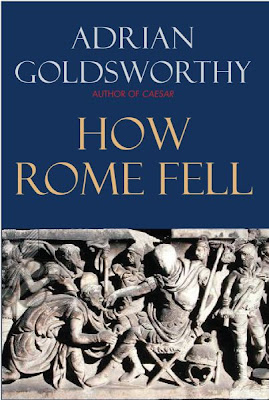
Superb overview of the decline and fall of Rome with a rejection of the traditional assertions of causations for the end of the Roman empire ( Barbarians, Christianity etc.). Goldsworthy also sharply criticizes the popular idea among postmodern classicists today that the Roman Empire was “really” as strong during the fourth and fifth centuries as it was during the golden age of philosopher-warrior-emperor Marcus Aurelius. Or that there was no fall of the empire at all, just a gentle “transformation” into something new. Goldsworthy discusses the likelihood of Late antquity “paper legions” of Roman armies which, in any event, scarcely resembled in elan, tactics or fighting strength the ones that Julius Caesar wielded in Gaul. A tour de force marred only by a weird epilogue that ranges from pedestrian to ( in it’s last sentences) truly awful – was it it tacked on as an afterthought? Did the editor of the rest of the book die before it was completed? Regardless, How Rome Fell is a worthy addition to an collection of popular ancient histories.
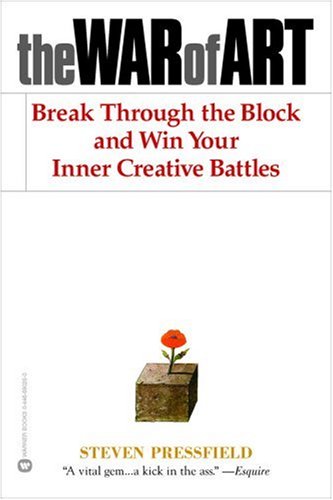
A rare, nonfiction book by novelist and blogger Steven Pressfield. The War of Art is a book that I strongly recommend to aspiring writers ( which includes most bloggers) and other people pursuing dreams, not because it is brilliant but because it is profound. Utilizing select personal vignettes and other anecdotes, Pressfield distills in everyday language the essence of what creative people need to understand if they are to succeed – concepts of “resistance”, which seductively undermine your efforts, and being a “professional”, which is the mindset that will get you there.
Most of the readers of this blog are interested in military affairs to some extent so I will use this reference to explain why I read The War of Art from cover to cover. Pressfield captures the difference in what Col. John Boyd called the question of “To be or to do. Which way will you go?”. By Boyd’s definition, Pressfield is a doer.
Steven Pressfield blogs on The War of Art of writing every Wednesday.
Zenpundit is a blog dedicated to exploring the intersections of foreign policy, history, military theory, national security,strategic thinking, futurism, cognition and a number of other esoteric pursuits.


 wants to hear from you. So please
 by Steven Johnson
 the reader to an understanding how bottom-up, “blind”, systems work and the principles behind them. Highly readable and next to no jargon. Probably due soon for an updated edition though, given the scientific advances in research in network and complexity studies.
 by Adrian Goldsworthy
 centuries as it was during the golden age of philosopher-warrior-emperor Marcus Aurelius. Or that there was no fall of the empire at all, just a gentle “transformation” into something new. Goldsworthy discusses the likelihood of Late antquity “paper legions” of Roman armies which, in any event, scarcely resembled in elan, tactics or fighting strength the ones that Julius Caesar wielded in Gaul. A tour de force marred only by a weird epilogue that ranges from pedestrian to ( in it’s last sentences) truly awful – was it it tacked on as an afterthought? Did the editor of the rest of the book die before it was completed? Regardless, How Rome Fell is a worthy addition to an collection of popular ancient histories.
 by Steven Pressfield
 is brilliant but because it is profound. Utilizing select personal vignettes and other anecdotes, Pressfield distills in everyday language the essence of what creative people need to understand if they are to succeed – concepts of “resistance”, which seductively undermine your efforts, and being a “professional”, which is the mindset that will get you there.

