Monday, March 7th, 2011
[ by Charles Cameron — cross-posted from ChicagoBoyz ]
*
I had occasion today to give myself a quick refresher course on honor killings, one form of which is already present in the Torah as of Leviticus 21.9:
And the daughter of any priest, if she profane herself by playing the whore, she profaneth her father: she shall be burnt with fire.
and found myself once again noting that there is a substantial swathe of regions of the world where honor killings are found, and that where it is found (including in immigrant communities from those parts of the world) the practice is not confined to any one religious group.
Hence this DoubleQuote:
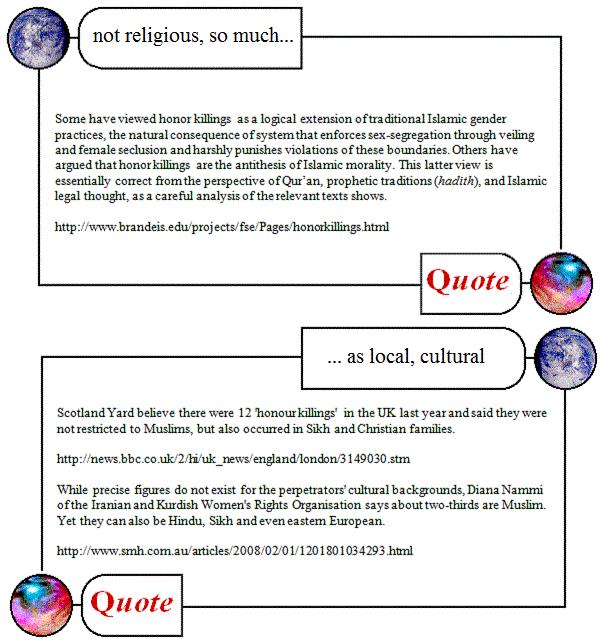
I think it is appropriate to consider honor killing a form of religious violence when the claim is made by those who do the killing that they are acting in the name of their religion — but that it is also important to distinguish such acts committed in a cultural context in which they are practiced across religions from acts that are the exclusive province of one religious tradition.
There are examples of honor killings which are performed in the name of Islam, and/or advocated by Islamic scholars — and the same could no doubt be said of other religious traditions — but honor killing as a genre is fundamentally more cultural than religious.
Sources: Brandeis study — BBC — Sydney Morning Herald
The analytic point:
From my point of view as an analyst, it is important to note and compare both religious and cultural drivers — neither avoiding mention of the one out of “correctness” — nor overlooking the other for lack of comparative data.
Posted in analytic, anthropology, britain, christianity, counterintuitive, cultural intelligence, extremists, framing, freedom, geopolitics, Human Rights, India, islamic world, islamist, kurdistan, Perception, Religion, social science, Theology, tribes, Uncategorized | 1 Comment »
Wednesday, March 2nd, 2011
J. Scott Shipman, the owner of a boutique consulting firm in the Metro DC area that is putting Col. John Boyd’s ideas into action, is a longtime friend of this blog and an occasional guest-poster. Scott has an important report regarding the “war of ideas” against the Islamist-Takfirist enemy in Afghanistan after attending a workshop hosted by DARPA.
DARPA, STORyNet and the Fate of the War
by J. Scott Shipman
I had the opportunity to attend a DARPA workshop yesterday called STORyNet. The purpose was to survey narrative theories, to better understand the role of narrative in security contexts, and to survey the state of the art in narrative analysis and decomposition tools (see below):
This STORyNET workshop has three goals:
1. To survey narrative theories.
These empirically informed theories should tell us something about the nature of stories: what is a story? What are its moving parts? Is there a list of necessary and sufficient conditions it takes for a stimulus to be considered a story instead of something else? Does the structure and function of stories vary considerably across cultural contexts or is there a universal theory of story?
2. To better understand the role of narrative in security contexts.
What role do stories play in influencing political violence and to what extent? What function do narratives serve in the  process of political radicalization and how do theyinfluence a person or group’s choice of means (such as violence) to achieve political ends? How do stories influence bystanders’ response to conflict? Is it possible to measure how attitudes salient to security issues are shaped by stories?
3. To survey the state of the art in narrative analysis and decomposition tools.
How can we take stories and make them quantitatively analyzable in a rigorous, transparent and repeatable fashion? What analytic approaches or tools best establish a framework for the scientific study of the psychological and neurobiological impact of stories on people? Are particular approaches or tools better than others for understanding how stories propagate in a system so as to influence behavior?
I was alerted to the meeting by a member at one of my “groups” at LinkedIn and just barely made the registration cut-off. It was a good meeting, but not reassuring on our situation in Afghanistan—you’ll see why below.
As a “hobby” I’ve been tinkering with the implications of patterns with respect to language and communications. Just about every presumption I have articulated over the last several months is being pursued in one way or another—which is good news for our guys. While the on-going research is good, I do believe there is room for better and more imaginative thinking, although I didn’t say anything during the meeting for once, I kept my mouth shut and just listened.
This is exceptionally brief and decidedly non-techincal. Here are some observations of interest:
- In Afghanistan, stories (those who tell them and those who believe) are central to our geopolitical strategy and policies.
- There is underway, a “battle of the narratives,” where any “counter” narrative developed by the US must have credibility. This seems obvious, but the speaker observed the “story telling” was more important than the story. Given the high illiteracy rate, this makes sense.
- We [DARPA] are reviewing chants (which are wildly popular), video, magazines, poetry, the Internet, and sermons as thematic vehicles for analysis.
- The language of the Taliban is not secular, and not the language of the insurgency—for the Taliban everything hangs on the legacy of jihad and religious struggle.
- The Taliban not willing to negotiate on matters of jihad. They are using a unified vision of Islam giving their struggle a noble foundation against the corruption of outsiders who want to “Christianize” the nation.
- The Taliban uses symbology to portray the struggle as a cosmic conflict against Christian invaders and US puppets (those cooperating with the US). Framing this symbology to communicate clearly the frame of the righteous vs. the infidels.
- The Taliban manipulates the language to connect the current struggle to previous struggles of “warrior poets.” There is hope a “discourse” can be created that will counter this framing [personal note: I’m not optimistic]. The Taliban uses different language to subjugate rural and urban dwellers, and actually have standard operating procedures for dealing with villages that resist.
- The cognitive patterns of rural Afghanistan are “foreign” to most Westerners and they use alien methods of knowledge transfer (chants, often under the influence of hashish).
- We are adding a geospatial element to our analysis of local and personal narratives (which includes subject, verb, object) with respect to identified “master narratives.”
- Internet data is indexed, with an eye toward predictive analysis and situational awareness (and interestingly, “sentiment” analysis). We are finding predictive power from the topology of “networks” used in models.
- From a neuroscience perspective, there was an amazing talk on empathy. It turns out, based on fMRI testing that empathy is quite predictable across subjects. Research indicates people “care more” about an “in-group” to which they belong more than an “out group.” The speaker defined the brain as a “parliament” of competing parties and nuanced spectrums [personal note: this elegant description tracks with everything I’ve read on the topic.].
- One presenter observed that after 10 years of war, we’re finally “getting” the importance of Pashtun culture and language. This presenter also noted US is still in need of people with language skills sufficient to adequately support the effort.
– End
COMMENTARY:
Zen here:
First, I’d like to cordially thank Scott for letting me share his insights gleaned from the workshop here with ZP readers. This is one of those fascinating events largely unavailable to those folks residing outside a reasonable driving distance from the Beltway.
Secondly, I am heartened that the brilliant folks at DARPA are taking the theological-ideological discourse of the enemy seriously in analyzing the power of narrative. Charles Cameron makes that point here with regularity. Michael Scheuer, Gilles Kepel and Olivier Roy did so even before 9/11. Our political appointees and policy makers remain steadfastly allergic to this reality, unable to process or discuss in public with coherence how religious ideas are a root for political extremism. Col. David Kilcullen, who certainly understands political Islam better than most and whose creative and analytical acheivements in structuring a framework for countering insurgency are second to none, eschews dealing with the topic in his theoretical writings on COIN where it can be avoided. That is the cost imposed by the political correctness to which our ruling elite are psychologically welded.
It comes as no surprise to me that only after “10 years of war” are we finally “getting the importance of Pashtun culture”.
Maybe at the dawn of the 22nd century we will be “old hands”.
Posted in Afghanistan, al qaida, analogy, analytic, cognition, cognitive goods, Collaboration, counterinsurgency, creativity, cultural intelligence, culture, emotion, Epistemology, extremists, government, horizontal thinking, ideas, innovation, insight, insurgency, intellectuals, intelligence, IO, islam.insurgency, islamic world, islamist, metacognition, military intelligence, myth, non-state actors, organizations, OSINT, Perception, primary loyalties, priming, propaganda, psychology, public diplomacy, Religion, scenario, social science, synthesis, Tactics, Theology, theory, tribes, war, warriors | 11 Comments »
Tuesday, February 22nd, 2011

“Any Libyan who lifts an arm shall be punished with death….Any Libyan who undermines the sovereign state will be punished with death.” “Those who commit crimes against the army shall be punished with death. Anybody who works for a foreign company that undermines the country will be punished with death.”
Twitter is absolutely amazing on reporting events on Libya the last few days. What they lose in passing on rumors the make up for by being hours or days ahead of MSM and USG reaction.
Col. Gaddafi, who looks these days like a cross between a has-been rock star in Celebrity Rehab and Ethel Merman in her dotage, is desperately trying to cling to power and has unleashed artillery, naval bombardment, warplanes, helicopter gunships and African mercs on his own people. No word if the honorable member of the UN Human Rights Panel has employed poison gas yet, but the Libyans appear to be holding their own in fierce fighting in Libya’s largest cities.
The USG response has been muted on Libya. This sober restraint may reflect the vulnerability of American oil industry workers trapped in the fighting as well as the discomfort of anticipation of the details of recent deals between Western corporations and former government officials and the Libyan regime coming to light if Gaddafi falls. Or alternatively, Gaddafi tearing lucrative agreements up if he remains in power.
Posted in africa, arab world, dictator, diplomacy, extremists, Failed State, foreign policy, geopolitics, government, Human Rights, islamic world, mercenary, mideast, open-source, politics, public diplomacy, revolution, state department, state failure, state terrorism, tribes, twitter | 3 Comments »
Thursday, January 6th, 2011
Onparkstreet, a.k.a. Dr. Madhu has a post I rather liked on Pakistan’s maniacal quest for “strategic depth” in Afghanistan, over at Chicago Boyz:
The Super Sweet Strategery of Strategic Depth
Pakistan’s beliefs in the value of seeking strategic depth in Afghanistan were influenced by two factors. The support it received from the U.S. in waging an armed response against the Soviet occupation triggered the belief. The success of that endeavour with no apparent costs to itself, gave Islamabad the illusion of being able to play a major role in the geo-politics of Central Asia. This more than anything else led to the belief that Afghanistan provided the strategic leverage Pakistan had long been seeking. The energy-rich Muslim states of Central Asia beckoned both Pakistan and the energy-seeking multi-nationals. Iran’s standing up to western pressures was proving an obstacle to long-term plans for energy extraction from the region. Afghanistan offered both shorter energy routing and political control through Pakistan.
V. R. Raghavan (The Hindu, 2001)
Pakistan’s intelligence agency, the ISI, “wants a reliable proxy that has territorial control of the P2K area,” Mr. Dressler adds. This desire is the result of Pakistan’s historic conflict with India. “If India comes across the border, Pakistan can fall back into Afghanistan and drive them out. It’s about strategic depth vis-à-vis India. As long as that continues to be a driving concern, Pakistan’s support for the Haqqani network will continue.”
The Christian Science Monitor (via Small Wars Journal)
A highly plausible future scenario indeed (regarding the second quoted item). In the event that the Indians decide on a massive ground invasion into Pakistan and march sturdily through the landscape of jihadi-networks and scattering Pakistani troops – with nary a nuke in sight and the US sitting idly by – it sounds like a winner of strategy. The supply lines to the Indians will, of course, be Bollywood unicorns pooping ammunition and some sort of MREs.
On the other hand, serious people seem to take Pakistani strategic depth worries seriously. The Indians are forever being told that they must take Pakistani fears of regional encroachment into account so that the United States (ISAF) may have a negotiated settlement in Afghanistan that is stable. Although….
Read the rest here.
The key to understanding Pakistan is that it does not really function like a state in the Westphalian sense, nor do it’s rulers want it to do so, the state merely being a vehicle for their own personal and class aggrandizement. Nor are the official borders of Pakistan the same as the borders that exist in elite Pakistani imaginations. Nor is Pakistan an ally of the United States in any sense that most normal people would use the term “alliance”, as allies are rarely the epicenter of one’s enemies in a shooting war. It is as if in 1944, as we jointly prepared for Operation Overlord, the British were raising volunteer Scottish Waffen SS divisions to kill American troops on the beaches of Normandy.
Strategy works within the confines of reality, strategy does not confine reality. We give Pakistan billions of dollars in military aid annually, and they use some of it to fund and train Taliban who have killed Americans, every year, for the last ten years, and continue to do so while their leadership is safely ensconced in Peshwar, Quetta and Rawalpindi.
Every year.
Think about that as you sign your 1040.
If we our leaders can’t recognize admit in public who America’s enemies really are, how can we win a war?
Our relationship with Pakistan is strategically toxic.
Posted in Afghanistan, America, analytic, economics, extremists, Failed State, foreign policy, geopolitics, ideas, intellectuals, national security, pakistan, slideshare, strategy, terrorism, theory, tribes, war | 3 Comments »
Monday, November 29th, 2010

An important announcement from my colleague, Lexington Green:
Lexington Green – (1) RESTREPO Monday, 11/29/10 at 9PM ET/PT; (2) Maj.Gen. Scales on Small Unit Dominance
This is the television premier of this extraordinarily film. I wrote about seeing this film here.
Restrepo chronicles the deployment of a platoon of U.S. soldiers in Afghanistan’s Korengal Valley. The movie focuses on a remote 15-man outpost, Restrepo, named after a platoon medic who was killed in action. It was considered one of the most dangerous postings in the U.S. military. This is an entirely experiential film: The cameras never leave the valley; there are no interviews with generals or diplomats. The only goal is to make viewers feel as if they have just been through a 94-minute deployment. This is war, full stop. The conclusions are up to you.
I highly recommend this film to all of our readers.
An information page for Restrepo is here, including video.
RESTREPO, an award winning documentary, was based on (or more precisely, closely related to) the book WAR by Sebastian Junger, which told the story of the war against the Taliban in the Korengal Valley, waged by the soldiers of the 2nd Platoon of Battle Company.
I previously reviewed WAR here and the movie RESTREPO here.
Posted in Afghanistan, America, book, COIN, counterinsurgency, cultural intelligence, Failed State, insurgency, islam.insurgency, islamic world, islamist, lexington green, media, military, military history, movies, non-state actors, Perception, Tactics, tribes, war, warriors | Comments Off on RESTREPO on Television this Monday


