zenpundit.com » complex systems

Archive for the ‘complex systems’ Category

Announcement: “Legacies of the Manhattan Project” May 12-13

Tuesday, May 8th, 2012

From blogfriend Cheryl Rofer as well as Molly Cernicek and Susan Voss at Nuclear Diner, – an event for those interested in nuclear weapons, science, Cold War diplomatic history, national security, strategic theory and American strategists:

Nuclear Diner Teams With Santa Fe Institute To Bring You Legacies of the Manhattan Project 

Next weekend, May 12-13, at the Santa Fe Institute, a hand-picked group of physicists, historians, social scientists, systems theorists, and writers will examine the long-term legacies of the Manhattan Project in a timely discussion of an important event in world history that still influences science and society today. Harold Agnew, who was part of the historic effort to develop the first atomic bomb, will participate in the discussion.

SFI is collaborating with the Nuclear Diner to bring the discussion to you live on Twitter. You can participate before, during, and after by searching for the hashtag #bomblegacy or following @nucleardiner. Before the event, you can also leave questions at Nuclear Diner and the Facebook event page. If you “like” the Facebook page, you will get updates throughout the week and continuing information after the workshop.

The group will discuss new information, review original records, and mine the memories of project participants to present a case study in conflict from an important period in scientific history.

More about the Santa Fe Institute working group, including biographies of the participants and discussion topics, here.

Many of SFI’s founders were senior fellows at Los Alamos National Laboratory. As the Institute has emerged as a leader in complexity science, particularly in working toward a theory of conflict in human and animal societies, the Manhattan Project has become an important case study for understanding conflict. The project’s history also illustrates the occasional tension between pure theoretical research and applied science.

Photo: Harold Agnew holding the core of the Nagasaki bomb.

An excellent opportunity for students, grad students, historians and practitioners in various fields to participate here via twitter.

Inventing Grand Strategy and Teaching Command—currently reading

Tuesday, April 24th, 2012

[by J. Scott Shipman]

Inventing Grand Strategy and Teaching Command, by Jon Tetsuro Sumida

This monograph piqued my interest several weeks ago, as I consider whether or not to re-read Alfred Thayer Mahan‘s classic The Influence of Sea Power on History, 1660-1783. I’m about twenty years removed from my original reading, and honestly wasn’t ready for it when I did read it, so much of what I remember remains a blur at best.

Professor Sumida leads with a Preface entitled, Musical Performance, Zen Enlightenment, and Naval Command. Sumida draws parallels between the performance of music and the artistry inherent in sound leadership during war. Boyd’s ideas with respect to harmony came to mind. Sumida also draws parallels between Mahan’s ideas and Zen and offers:

“Mahan’s writing about the art and science of command resembles Zen in three major respects — a pedagogy that attempts to teach that which cannot be directly described in words, the absence of doctrinal ends, and a recognition of the limitations of ratiocination as the basis of action under conditions of rapid and unpredictable change.”

After finishing the first chapter of Professor Sumida’s work, I was struck by how relevant Mahan’s ideas with respect to leadership development seem to be in harmony with ideas advanced of late regarding the need for disruptive thinkers (this links to Mark’s excellent summary). Sumida portrays Mahan as man convinced of the need for naval executive education that goes beyond the scientific and mechanical, and focused rather on the “deep knowledge” and “truths” found only in history (I agree). He writes:

Mahan “was convinced that constant and rapid mechanical innovation had upset planning and education to the detriment of command confidence and authority. He feared the consequences of a navy led by indecisive men, bred by bureaucratic routine—or worse, subservience to corrupt civilian officialdom—to follow rules or act politically.”

At only 116 pages, Sumida’s monograph would normally be a quick read, but I plan to savor every word—and probably read more Mahan.

More to come.

Cross posted at To Be or To Do.

Klimt under the microscope, then on to bigger things

Saturday, March 17th, 2012

[ by Charles Cameron – the “internal” complexity from which we relate to both the simplest and most complex issues and problems in the “external” world ]
.

The painting is by Gustav Klimt: your eye sees it, you know it’s a painting, reproduced here in pixels, you can read the text that accompanies it — a Nobel laureate wrote it — which describes just one chemical level of the complexity in you that responds to the painting, reproduction, pixels, blog post..

Viewing the painting, reading the accompanying text — they’re complex activities. You notice the woman’s head, “detached” for her body by that golden necklace, might see the beheaded head she’s holding almost out of the picture frame, lower right — might or might not know the story of Judith and Holofernes, which gives the painting a cultural intensity of particular interest to Israel under threat — Alexander Kafka sketched the background thus in the Chronicle article that brought all this to my attention today:

In 590 BC, to protect her besieged city of Bethulia, the alluring Jewish widow Judith drank with and seduced the attacking Assyrian general Holofernes. When he fell into a drunken, sated heap, she decapitated him with his own sword and displayed his head as trophy, rallying her fellow citizens to rout the Babylonians.

And if the writer hadn’t forewarned you, you might well have missed that echo effect of the beheaded Holophernes and the necklaced head of his beheader.

All of which touches on meaning, while Nobel laureate (and long-time Klimt collector) Eric Kandel‘s commentary deals in neurotransmitters: dopamine, oxytocin, vasopressin, norepinephrine, serotonin, acetylcholine

*

Gilles Fauconnier and Mark Turner have a fine book out called The Way We Think: Comceptual Blending and the Mind’s Hidden Complexities in which they lay out some fascinating aspects of how the brain builds for us the “blend” of different impulses, correspondences and perceptions that we consider to be “the world we live in”…

They quote Sir Charles Sherrington‘s celebrated description of the mind waking from sleep as an enchanted loom in his Man on his Nature:

The brain is waking and with it the mind is returning. It is as if the Milky Way entered upon some cosmic dance. Swiftly the head mass becomes an enchanted loom where millions of flashing shuttles weave a dissolving pattern, always a meaningful pattern though never an abiding one; a shifting harmony of subpatterns.

And it’s with that “shifting harmony of subpatterns” within us that we meet and attend to the shifting patterns of the world around us — a world that features its own “complex, n-dimensional and constantly shifting” problems, which we seek to understand and resolve via insights and solutions %i(that would also make good tight soundbites) for the TV.

*

Indeed — are those two weaves of complex shifting patterns, within us and around us, distinct — or one and the same?

Eh?

One quick illustrated quote from Secretary Clinton

Wednesday, March 14th, 2012

[ by Charles Cameron — sometimes i post things so obvious they might actually be useful ]
.

One quick annotated quote from Sec. Clinton‘s speech at the U.S. Institute of Peace China Conference, March 7th:

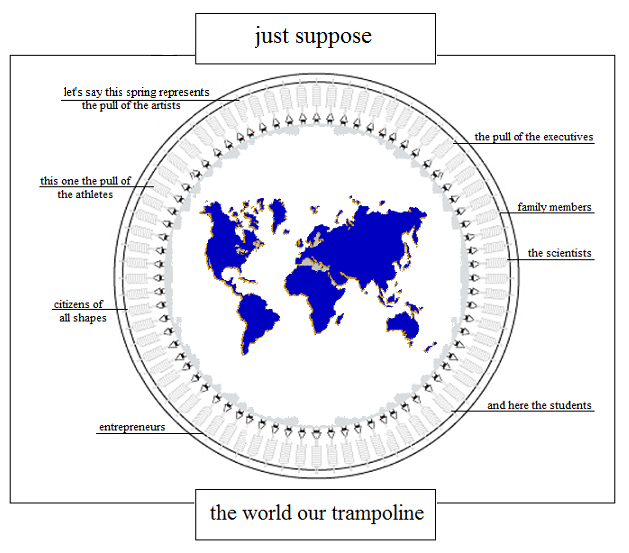
Now when I say “we,” I do not mean only our governments, as important as they are. Every day, across both of our countries, executives and entrepreneurs, scientists and scholars, artists and athletes, students and teachers, family members and citizens of all kinds shape and pull and add to this relationship. Together, they represent a vast range of priorities, concerns, and points of view. And they are all stakeholders in how we build toward a shared future.

It’s really that list I’m after…

There are seven billion individuals bouncing up and down on our trampoline, some of them holding hands, some of them in gangs that want to trip up rival gangs, or make a clearing for themselves and themselves alone, some too weak to bounce much at all…

and each time each one of us lands, we impact the trampoline from a different angle, stretch it a different way – tugging it to the will of the artist, the entrepreneur, the child, the retiree, the curious, the aggressive, the meek…

As we know, the earth is round, which is to say three-dimensional – but the tugs on it, the tensions, are more complicated than that, in fact they’re complex, n-dimensional – and constantly shifting.

Hilary Clinton wants to wake up in the morning, have coffee – and model that! – along with, and in balance with, her counterpart in another huge mass of population, half a globe and at least six philosophies away…

The coffee’s good, but it’s not enough — what we all could use is a new mode of thinking.

*

Maps courtesy of www.theodora.com/maps used with permission

A note about nodes

Monday, March 5th, 2012

[ by Charles Cameron – places, people, neurons, ideas, with Kabul and Khost providing illustrations ]
.


[ illus: Starlight, from PNL ]

I was just reading Matthieu Aikins‘ GQ account of The Siege of September 13 in Kabul, when a couple of sentences caught my eye, not because of the attack itself, but because they reminded me of a point I want to make about the way we think these days about networks, nodes and linkages:

Salangi’s SUV was passing down the main road north of the embassy when the sound of gunshots and his police radio simultaneously erupted. He told his driver to turn around and head toward the sounds.

At Massoud Circle, the next roundabout down from Abdul Haq, they encountered a bottleneck of police vehicles, and so Salangi continued on foot, ducking as he heard the crack and whine of bullets passing close by…

What specifically caught and rerouted my attention was that phrase, “Massoud Circle, the next roundabout down from Abdul Haq” — Abdul Haq Circle, I’d read earlier in the article, “is a wide traffic roundabout named for a deceased mujahideen commander”, as presumably is the circle named for Massoud.

So we have two roundabouts connected by a road… and two deceased mujahideen commanders.

Or to put that another way, we have two nodes and a connection between them, twice over — in once case the nodes are places, and in the other the nodes are people.

*

Further into the article, I found a graphic showing the two places and the road connecting them — and an image of two people in Kabul that day, one extending an arm of care to the other. These two men weren’t Abdul Haq and Massoud, of course, but two people nonetheless. So in each graphic, we have two nodes and a connection:

A great deal of time and treasure goes into the analysis of networks of communication — cellphone to cellphone, person to person — or travel — place to place — (a) because the patterns can be revealing, and (b) because the data (what number called what number, e.g., how often Nidal Hassan emailed al-Awlaki, or what route bought Abu Dujanah from Amman to Khost) is unambiguous when obtained.

*

We’re also fond of neural nets, eh? — whether the “artificial” nets of AI or the “biological” nets of the brain — and again, these are unambiguous, scientists and technicians love them, and software developed with Congress-friendly budgeting implications is required to process them.

But what about ideas?

What about minds, what about the subjective side of persons and travels and communications and contacts and brains — what about thoughts, what about admiration?

That’s the node-link-node mapping that I find most interesting: it utilizes the most complex software (human intelligence), and demands the least complex support system (cappucino, napkin and pencil) — and some of its nodes and their linkages (beliefs, e.g., leading to actions) are among the richest features of the human behavioral landscape.

*

The idea that jihad is an individual obligation, for instance, is a staple of AQ-style theology. It is my contention, indeed, that acceptance of that idea is the religious foundation on which acts of jihadist suicide are based.

And by the same token, these suicide acts are then viewed in terms of martyrdom, since they were enacted in the cause of Allah, giving rise to such eulogies as this one, offered by AQ to Abu Dujanah after the Khost event:

May Allah have mercy on you, our dear Abu Dujanah, and may He raise your ranks in register of the inhabitants of Paradise. By the Lord of the Ka’bah, indeed you have succeeded, our dear Abu Lailah, Allah willing. You were truthful, and you became known. You set an example, and you were truthful in word and deed. You followed the speakers and writers before you. May Allah be pleased with you . Your patience, Jihad, and tolerance of hardships were in Allah’s Cause. Your prayers and insistency was for Allah, and was your solitude and secret conversation. Thus, your reward is with Allah. Allah is your Lord and Protector, and Allah willing, our next meeting will be in Al-Firdaws Al-A’la, our dear beloved brother.

Such logic, such rhetoric, and such devotion are of the essence of what we confront in the jihad…

*

And richest of all for us to come to terms with: the person to person transmission of such ideas…


Switch to our mobile site