zenpundit.com » 21st century

Archive for the ‘21st century’ Category

Congratulations….

Wednesday, January 26th, 2011

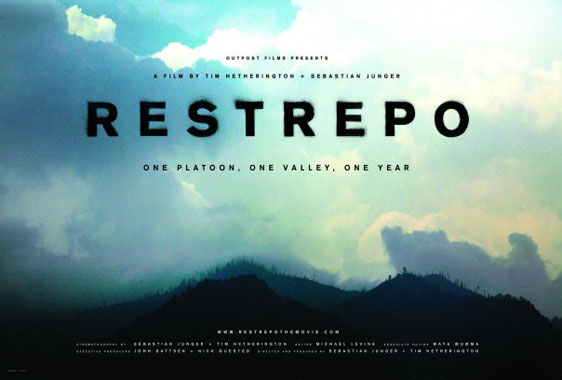
To the men of Battle Company, Sebastian Junger and Tim Hetherington for RESTREPO receiviong a nomination for an Academy Award for Best Documentary.

From blogfriend HistoryGuy99:

Restrepo Earns a Well Deserved Nomination

The filimakers, Sebastian Junger and Tim Hetherington spent 15 months off and on with the soldiers capturing the essence of men under fire and how they reacted to the mundane and the profane. During the filming, an action took place that saw the Medal of Honor won by Sgt Sal Giunta the only live soldier since the Vietnam War to receive the award.No mention of this fine film would be complete without mention of a new blog friend who besides being an Army surgeons wife, writer, and blogger, was the film’s promoter who was instrumental in getting it shown across the country. Kanani Fong deserves praise for her time and devotion to supporting the troops as well as organizing efforts to assist returning veterans and the families of those deployed. This morning after the nomination Kanai posted this about the film.

Making the film was the hard part. Promoting it was easy (at least for me). Because for those of us with loved ones in the war, Restrepo was always personal. I mean, for me… my husband was the surgeon in Asadabad. The Korengal was a hop, step and a jump away.

In the long, dusty corridors of war with its stale smell of punditry, assumptions, and stereotypes along came this film. It helped us put our thoughts about war into some kind of order. Finally, we saw where our loved ones where, it added texture to what we already knew. I was the smallest cog in the PR machine, which if you must know –wasn’t that big. Think of it as a small, efficient machine, with all the parts working to bring this film into the bosom of the American public.

It is well worth a few minutes to visit and read Kanani’s whole post and the heart felt thank you from the filmmakers.

“We heard the news this morning about the Academy Award nominations – and wanted to thank you all for your support for Restrepo. While the nomination is a recognition of the movie, we hope it’s a fitting tribute to those who have fought and died in places like Afghanistan and Iraq. We made this movie because we wanted to bring the war into people’s living rooms back home. We hope the nomination will continue to promote an open and constructive dialogue about the war. Thanks again for all your continued support in making the movie a success.

-Tim and Sebastian

Narcos Over the Border

Friday, January 21st, 2011

Narcos Over the Border: Gangs, Cartels and Mercenaries by Dr. Robert J. Bunker (Ed.)

Just received a review copy courtesy of Dr. Bunker and James Driscoll of Taylor & Francis – could not have arrived at a better time given several research projects in which I am engaged.

The 237 page, heavily footnoted, book is organized into three sections: Organization and Technology Use by the narcos networks, Silver or Lead on their carrot and stick infiltration/intimidation of civil society and the state apparatus, and Response Strategies for the opponents of the cartels. Bunker’s co-authors Matt Begert, Pamela Bunker, Lisa Campbell, Paul Kan, Alberto Melis, Luz Nagle, John Sullivan, Graham Turbiville, Jr., Phil Wiliams and Sarah Womer bring an array of critical perspectives to the table from academia, law enforcement, intelligence, defense and security fields as researchers and practitioners.

Looks good – will get a full review here at a later date, but a work that will definitely of interest to those readers focusing on national security, COIN, 4GW, irregular or Hybrid war, terrorism, transnational organized crime and black globalization.

Quite Cool, But…..

Friday, January 14th, 2011

Commercialization of a step toward singularity.  Impressive!

Now, all those in favor of having corporations record your unique brainwave patterns and share that data with third parties raise your hands.

Dr. Barnett Responds on Sino-American Grand Strategy

Tuesday, January 4th, 2011

In response to my previous post A Short Analysis on The Whyte-Barnett Sino-American Grand Strategy Proposal, Dr. Thomas P.M. Barnett wrote in late this morning and I am giving him the floor:

You’re fundamentally right in your analysis.

What we heard from a senior quasi-official (and I’ll leave the description there) was that we should not present the compromises in the form of annexes but to make it a singular sign-it-or-no agreement.  Why? That path would suffer the deaths of a thousand-edits and ruin the desired dynamic. 

I agreed with the notion for this reason:  The American approach to such a document is to carve it up into pieces and to give the Iran piece to the Iran desk and the Taiwan piece to the Taiwan desk and so on, and everybody comes back saying the same thing: “American could never do this one thing!”  But, of course, the whole point of the process is to encourage the horse-trading mindset.

Do you, America, want a different path with China?

Do you, America, want the money to flow from China back into the US economy in a useful manner for all?  Do you want the trade imbalance balanced?

If you want these things, and see the wisdom of the deepened economic connectivity, then what transparency and strategic trust must be created–minimum list?

Once you see all these “demands” expressed from the Chinese side, do you see a path forward or are these things too much for Beijing to ask for?

Me personally, I want Kim’s regime collapsed–pronto.  But I cannot make that argument stand up right now, given the larger tasks at hand and the relationship to be maintained.  I hear the Chinese on that subject and I think their offer of a slow soft-kill path makes sense.  So I accept the bargain because I see a lot of negative pathways curtailed by it and profoundly positive ones created by it.

But I’m not a China expert who’s incredibly vested in the complexity and opacity of this relationship.  It gets better and I still have plenty of opportunity to pursue.  I’m also not a regional expert well versed in telling you how something is “impossible!”  I approach the issue from the long-range perspective, with more of a businessman’s tendency to look for the deal rather than wait on the perfect architecture or all the policy boxes to get checked.  I want progress, and asked the Chinese what it would cost.

I believe that if you put this package in front of the American people, they will not find the costs high at all.  But that would take seriously visionary leadership on our side (like Brzezinski’s suggestion in the NYT yesterday).  The Chinese have enough of it on their side to move forward.  I fear we do not.  We are now the muddle-through people, looking frighteningly like Brezhnevian Russia.  Nobody is creating any Deng or Gorbachev-like clarity about the path ahead.  Where is our 21st-century Alexander Hamilton?  

We argue amongst ourselves over piddling things, fighting each conversation to the death. And we lower ourselves in the eyes of others.

John Milligan-Whyte is convinced Obama is a transformational figure–a lawyer’s mind who will understand the terms and act on it.  I am less optimistic but felt it was crucial to try.

The Chinese response was–to me–stunning in its openness and flexibility of imagination.  Yes, they have their demands and when you look at it from their perspective, they are fairly reasonable, even as I, in my American mindset, find some of them too slow in unfolding.  But they took this thing with immense seriousness–even an eagerness.  They were like somebody who had long waited to eat a decent meal and were determined to gobble it up with relish, and I found all that sad, because it made me realize what a dead dialogue the SED must be, with its 1-2% improvement goal every year.

But Obama’s crew has no real strategists.  They have handlers and politicos and experts, but no strategists or deal-makers.  They are too satisfied with the “keeping all balls in the air” bit, ecstatic when China does the littlest effort to rein NorKo in for some SouKo artillery ex–like that’s some great victory!  It’s really sad, because the moment is so ripe for imaginative approaches.

We knew the package had to start from the Chinese side and I firmly expected the US side to blow it off, for its lack of proper channels.  But it does not stop there–from the Chinese perspective.  So our work continues.

A Short Analysis on The Whyte-Barnett Sino-American Grand Strategy Proposal

Tuesday, January 4th, 2011


A few comments on the proposed Whyte-Min-Barnett Grand Strategy Executive Agreement for a Sino-American partnership that Dr. Barnett has been deeply engaged with the past few months.

First, a caveat: while Tom has involved me in aa few of his past projects, I was not involved in this one and know only what I have read recently. Secondly, while I know a bit about China in an academic sense, it is not an area of research for me nor am I up to speed on the  current politics of China’s generational transfer of power/power struggle. Those readers who are avid China watchers should chime in with comments.

As an overview, I think the proposal’s specific terms should be viewed less seriously individually than the gesture itself, which represents in my view a very significant trial balloon signal from China’s leadership that they see a need to negotiate a successor to the long outgrown cornerstone of Chinese-American relations, the Shanghai Communique, signed during Nixon’s historic summit with Mao. A new agreement would provide some updated “rules of the road” that would defuse potential and existing tensions and allow the US and China to tackle some urgent problems in the global economy. By using a semi-official independent set of pundits ( Whyte and Min) and a maverick private sector American geostrategist ( Tom) with close ties to the Pentagon, China can advance it’s talking points and interest in negotiating without any loss of face that an official inquiry risks as a result of America’s fractious domestic partisan politics.

Read up on the secret diplomatic minuet that ensued between the US and China 1969-1972.

China’s leadership seems to have invested a sizable heavyweight participation in this proposal, Tom cites:

– Former Minister of Foreign Affairs;
  – Former UN ambassador,
  – Former U.S. ambassador,
  – Former Deputy Chief of the General Staff of the PLA,
  – Former Military Attaché to North Korea and Israel,
  – Former Vice Minister of Commerce,
  – President of Shanghai Institutes of International Studies,
  – China’s Central Party School Institute of International Strategic Studies,
  – Chinese People’s Institute of Foreign Affairs,
  – China Center for International Economic Exchanges,
  – China Institute For International Strategic Studies,
  – China Foundation for International & Strategic Studies,
  – Boao Forum,
  – China Institutes of Contemporary International Relations.

This has resulted in a document that unsurprisingly leans strongly towards China’s interpretation of a good Sino-American partnership but this proposal is not holy writ, it is a red flag ( pun intended) for bargaining to begin. A plea, really by a leadership craving greater certainty, medium term security and “recognition” ( i.e. “face” or “respect” – this is very much like Brezhnev and Kosygin deeply desiring that the USSR be seen as an equal to the US, except unlike the Soviets, China actually has a productive economy) Imagine a US doc shepherded by a comparable set of former and current powerbrokers, the Council of Foreign Relations, CNAS, Carnegie, CNA, SSI, Brookings, AEI, Hoover, the chairmen of the Republican and Democratic Parties and the president of Harvard. Would that catch the attention of foreign observers?

I am not sure if it is being received that way over here. My perception – and I freely admit to having large gaps of knowledge – is that US policy toward China is determined below the NSC level and not in a strategic fashion by a) Treasury b) the Fed c) PACOM in that order , pursuing contradictory policy goals and without proper coordination while State, which should be taking a lead role, is a quiet secondary voice relegated to managing lower level, day to day, routine problems in ad hoc fashion. Some carping and special pleading from Congress is erratically inserted into the mix. If someone in the Obama administration is the China policy “czar” it is obscure to me. It must be obscure to Beijing as well or they would be having their ambassador or foreign minister pushing these proposals to their American counterparts in a normal fashion instead of Tom.

Barnett, Whyte and Min devote a great deal of space to bilateral and global economics relationships. They should. The magnitude of the Sino-American monetary and trade relationship and it’s evolved distortions between two nations that are radically dissimilar, understand one another poorly and are not allied are actually scary. Immense quanties of locked up capital – and we are talking epic figures  that dwarf the interwar period European “dollar gap” or even that of the postwar era remedied by the Marshall Plan – ultimately create money scarcity elsewhere in the global economy until trade breaks down in political reaction or the ebb of a medium of mutual exchange.  That money needs to begin circulating via productive investment and Chinese policies creating this structural imbalance need to be phased out. How exactly this should be done is beyond my ken, but that something needs to be done is obvious.

Dr. Barnett, as I understand his strategic thinking, takes the long view and is willing to concede in the short term what would be impossible to sustain in the long term anyway (“locking in tomorrow’s China at today’s prices” ) and is concerned about defense contractors eager to make China the justification for hyperexpensive weapons mega-platforms ultimately inculcating over time thinking that carelessly slides the United States toward a needless great power war with China. A position mirrored by China’s own ambitious self-dealing military asshats.

Is Tom’s view the last word? No. but it is disturbing to me that a strategic relationship as we have with China is not being handled by American officials with the same attention and degree long term focus we give to Europe.

What do the Sinologists out there say?

Switch to our mobile site