zenpundit.com » America

Archive for the ‘America’ Category

In Defense of Grand Strategy

Tuesday, January 31st, 2012
I have been involved, on and off, with another grand strategy discussion. Several discussions to be exact, one of which was prompted by Adam Elkus’s well-constructed volte-face on the concept of grand strategy. While I can find merit in many of Adam’s points regarding our dysfunctional policy-strategy process, the need to make definitive choices in order to have sound policy and our partisan epistemological crisis, I part company with him on his core argument:

America Needs Sound Policy, Not Grand Strategy

….The idea of grand strategy as both policy and strategy is by definition unachievable, and the source of much confusion.  By infusing normative policy elements into strategy, this fusion turns strategy into a manifestation of ideology rather than a technical device for getting things done.  Think, for example, of how debates about regional strategy and even the tactics and operations of COIN, drones, and counterterrorism have become proxies for domestic ideological political battles. This happens, in larger part, because the policy-strategy distinction in American national security circles is extremely weak, as strategy is taken to be politics and politics becomes strategy.

Adam has further endorsed a more emphatic follow-up post by our mutual blogfriend Joseph Fouche, where, much like his fictional countryman,  Captain Renault, JF in his forcefully argued post is shocked to discover that gambling is going on in here:

Terminology Proliferation is the Escape Hatch of Politics 

….One sure way to detect politics is signs of desperate efforts to call politics something other politics. Though politics is the most elemental of human endeavors, disgust with overt political machinations is one of the most elemental of human emotions:

Who likes a brown noser?

Who likes a squealer?

Who likes the kid who gathers up his toys and goes home when he doesn’t get his way?

Who likes the guy who obviously looks out for number one?

….Policy is portrayed as the objective, virtuous, and expert pursuit of ponies for everyone. Framed this way, policy is politics without the division of power. But politics without the division of power is impossible. “Policy” is a mythical beast. ”Policy making” is mere politicking, trading one favor for another to offset one interest with another, persuading through influence when possible and enforcing compliance with violence when impossible. But this reality reeks of knavery so it must be wrapped in the most virtuous lies imaginable. Hence we see a dramatic proliferation of “policy makers” and “making policy” where we’d normally expect to see politicians and politics. WIth so many policy makers making so much policy, you’d think the good and true would be breaking out all over. But, looking around, we see nobody down here but us dumb humans, horse trading with each other to get incrementally ahead.

“Grand strategy” and “operational art” represent further efforts to divorce politics from politics through politics, leaving behind a vacuum inhabited only by virtuous technocrats. In reality, they’re both attempts by one political group to escape the power of another political group, hopefully gaining more power for themselves in the process. The formulator of “grand strategy” is often an aspiring political actor who lacks the gifts necessary for political success. So they whine from the sidelines, falling back on a passive-aggressive strategy of victimhood where they denounce expertise in politics as squalid while advocating its replacement with their own (implicitly) more virtuous expertise. They attempt to reframe political questions as technical questions best handled by professional specialists. If a political question can be reframed as a technical question, resolving it is a merely an implementation detail. Such technical minutia should be beneath most politicians. Their attention should be devoted to truly important questions, leaving details to the poor peons.

….Policy, grand strategy, and operational art are merely the continuation of politics with the addition of other layers of obscurity.

Now, the insightful Mr. Fouche is not wrong in detecting politics in strategic clothing. In my judgement, he’s very much correct.  His objection, as I infer it, to grubby political decisions within a state being regularly deferred “downward” to be made in the guise of nominally apolitical (in American tradition) operational planning, or “upward” to be masked as “technocratic” grand strategy is reasonable because it is a sign of dysfunction in our political community. He’s right – America has a systemic problem in being unable to overtly make any hard political choices through it’s formal political process.

However, being politically dysfunctional doesn’t mean that grand strategy (or policy, or operational art or whatever) in general is purely fictive or that it is always simply a deceptive substitute for an honest political process. Or that raw politics can replace all these conceptual tools equally well or better. These conceptual tools were developed as a form of intellectual specialization because politics as a general and broad societal activity too often failed to meet the challenges of diplomacy and war. Or worse, politics worked irrationally against the survival of the political community in wartime while to the benefit of a faction within it.

Grand strategy, policy, strategy and even operational art are imbued with a political character, but one that is a step or several more removed from the general politics – the art of strategy is, after all, intended to serve a political community and “Ends” of “Ends-Ways-Means”  is always infused with value-laden assessments of worth and priority. Nor is politics their *only* character; all are, foremost, instrumental, while some may also be specifically cultural and technical.  The recession of politics (ideally as settled choices and not ongoing, sub rosa, competition) in strategy to the background permits greater focus on solving particular problems with diplomacy, coercion and force of arms. If made a substitute for domestic politics, these things are less likely to work for their intended purpose – to the risk of all.

Grand strategy can be useful, and while it is not always needed, at times having a sound grand strategy is vital for survival. As I have previously written on the subject:

….Grand strategy is not, in my view, simply just ”strategy” on a larger scale and with a longer time line. Strategy is an instrumental activity that unifies ends, ways and means. While grand strategy subsumes that aspect, it also provides ordinary strategy with a moral purpose, perhaps even in some instances, an identity.  Grand strategy explains not just “how” and “for what”, but ”why we fight” and imparts to a society the supreme confidence in itself to sustain the will to prevail, even in the face of horrific sacrifice. Grand strategy brings into harmony our complex military and political objectives with the cherished, mythic narrative of a ”good society” we conceive ourselves to be, reducing “friction”, “pumping up” our resolve and demoralizing our enemies. Grand strategy is constructive and energizing.

A simple but profound moral argument is a critical element of a grand strategy, to a great extent, it frames the subsequent political and military objectives for which war is waged.

and furthermore:

….First, to use an analogy from the biological sciences, grand strategy enunciated by a great power is a process of geopolitical co-evolution. There is an effort in grand strategy to impose over time one’s political will upon others to shape the “battlespace”, the sphere of influence, the hegemonic dominion to a state of affairs favorable to the state actor. Often, this is done by military force in times of crisis but over the long term, economic and diplomatic factors, all of DIME really, weigh heavily on the outcome. The process is never a one way street, even for actors who are considered to be largely triumphant. It is coevolutionary. If you gaze into the abyss, the abyss will gaze into you.

….Secondly, sustaining the national or group identity is a critical component of grand strategy that makes it a different, more expressly political/cultural  exercise than crafting strategy as Clausewitzians use the term as being driven by policy. Grand strategy should guide policy formulation because it is not just a set of concrete structural ends, or a laundry list of “vital interests” but a constructive, values-laden, attractive, motivating, civilizational narrative. An ideal or cultural identity for which men and societies are willing to go to war, to stand, fight and die. As Thomas P.M. Barnett once put it, for a “Future worth creating“. Grand strategy is a defiant clarion call of civilizational supremacy, marshalling those who will fight for that which is not, but could be.

Men do not stand, fight and die for mere instrumentalities. You can show a man how to do an unpleasant chore in the most efficient manner but he may remain unmotivated to do it, still less to make terrible sacrifices to do it. Conversely, the passion of faction is strong, but usually rejects the logic of strategy for it’s own self-destructive calculus. It divides the house against itself in the hour of maximum danger.

Not every nation needs or can execute a grand strategy. Having sound policy and competent strategy, as Adam Elkus suggested, is often more than sufficient ( nations frequently prevail despite incoherent policies and poor strategies) and is no small task to get right in itself. A grand strategy, if required, is something that crystallizes into consensus because it emanates from deep cultural roots as well as empirical dangers – without such an anchor to give it legitimacy, it is less likely to amount even to a sound policy than a trite political campaign.


There Will Be Blood…..

Thursday, January 19th, 2012

All In: The Education of General David Petraeus by Paula Broadwell, with Vernon Loeb

The official biography of CIA Director General David Petraeus, by Harvard researcher Paula Broadwell, has long been anticipated in the .mil/COIN/NatSec/Foreign Policy communities and blogosphere.  I can hear pencils scrawling furiously away in the margins even as I type this post. 🙂

Broadwell,  herself a reserve Army officer, West Pointer, Harvard grad, doctoral student at King’s College War Studies Department , and by all accounts, an impressive up and coming individual,  had very extensive access to her subject – allegedly, far more than the official Army historian assigned to General Petraeus’ last command. Given the subject is General Petraeus, the precarious state of American policy in Afghanistan and 2012 as a circus of political excess, All In will be one of the few “must read” books this year.

And, I must commend Miss Mrs. Broadwell highly here, she will be donating 20 % of her net proceeds to help wounded veterans.

That said, in terms of reaction to this book, there will be blood.

Reviews of All In will afford the opportunity to tear the scabs off of the well-worn COINdinista/COINtra debate and rub salt in the exposed wounds – I for one am especially looking forward to reading future back to back reviews by Carl Prine and Thomas Ricks and Abu Muqawama vs. Colonel Gian Gentile. In the mainstream press, the opportunity for newspaper columnists to get in gratuitous potshots against figures like Presidents Bush and Obama, Dick Cheney, Don Rumsfeld, Robert Gates, Joe Biden, Hillary Clinton, Stan McChrystal and numerous others or grind partisan axes will be too tempting to resist, regardless of how relevant these remarks are to Broadwell’s biography of Petraeus. The looming specter of draconian cuts to defense budgets will also add to the rancor of the discussion of the book within the defense community.

Somewhere in that debate will be the book Broadwell actually wrote and within the book, perhaps, we will come to see David Petraeus. Or not.

Get your popcorn ready!

Right now, I am deep into reading the superb George Kennan biography by eminent diplomatic historian John Lewis Gaddis but All In is definitely next on my list.

And it will be reviewed.

SOPA: So Bad, even Hitler is Against It

Thursday, January 19th, 2012

Talking Turkey (and other things)

Tuesday, January 17th, 2012

[ by Charles Cameron — Turkey, Perry, Cheney, also Havel, Dylan and the Stones ]
.

.
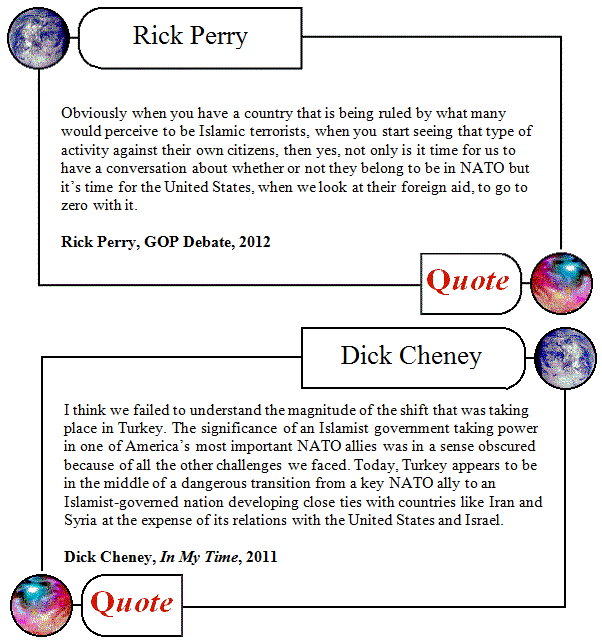
I’m always interested when someone, left or right, uses a juxtaposition of quotes or soundbites to show parallelisms or oppositions between opinions, and today the blogger at Emptywheel did just that with a quote from Rick Perry at last night’s Republican debate and another one from Dick Cheney‘s memoir.

Here’s the result, presented in my own characteristic DoubleQuote format:

I guess my questions here would be about the specific phrasings, “ruled by what many would perceive to be Islamic terrorists” (Perry) and “an Islamist government” (Cheney). Are the two statements virtually identical, somewhat similar – or are there significant nuances separating them?

*

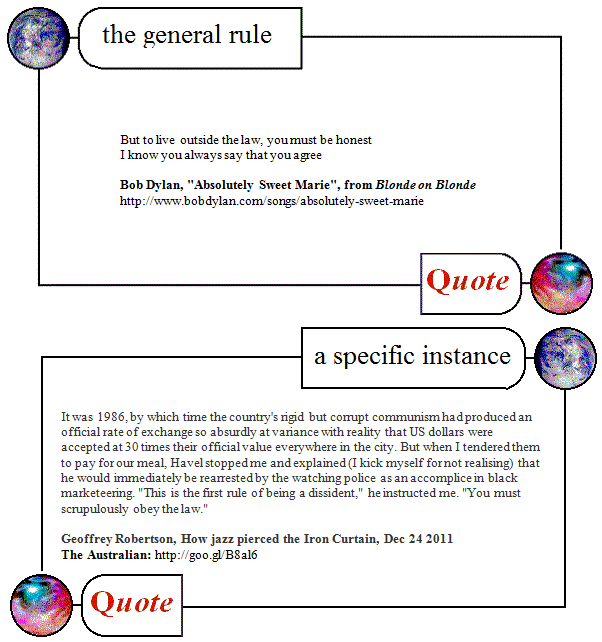
While we’re at it, here’s another DQ — this one struck me while reading a piece about Vaclav Havel today.

Interesting, too, that the Havel piece was fronted by that pic of Havel talking with Mick and Keith

Justice, Coercion, Legitimacy, State-Building and Afghanistan

Tuesday, January 17th, 2012

Discussion has been emerging in the foreign policy blogosphere of   late  regarding sovereignty and the other day, Afghanistan scholar Antonio Giustozzi opined on coercion, a necessary tool of a state seeking to wield a monopoly of force.

Theory is good and the discussion is an important one with implications for US foreign policy, but it helps when debate is informed by empirical examples from practitioners.  Quesopaper, a blog by  someone out in the field  in Afghanistan has been dormant for a while, but sprang alive again with a timely post:

Rule of Law, The Afghan Springer Show 

….Rule of Law is one of the key aspects to “fixing” Afghanistan. When the Taliban dominated the country, they controlled the “courts.” As Taliban influence waned, the US and partner nations have sought to create a more traditional court system. I can’t speak intelligently on why “WE” decided to create a more western form of law in Afghanistan, but I can say, it’s not the correct approach.

I work in a remote district. It’s over an hour to the main provincial (think state) government center. The difference between the two places is about as extreme as possible. The villages, even the district center (think country govt) lack ANY essential services. There are no plumbing systems, no electricity, no garbage service…nothing. Yet, the people here survive; and dare I say? Thrive.

Like most farming folks, the people here like to be left alone. The people appreciate the Govt–Government of the Islamic Republic of Afghanistan aka “GIRoA”–but they only want so much help. Rule of Law doesn’t fit into their needs.

So, how do rural locals settle disputes?

I just recently worked with a local governor as he negotiated the resolution of a 25 year dispute. Dispute doesn’t really describe what happened…feud is more appropriate. Each side had multiple murders, one family had 1300 fig trees destroyed. Decades of money in dispute. The feud was complicated enough that the Taliban failed to resolve the issue in nearly seven years of negotiations. Negotiations require buy-in from many parties…I could go on about this, but I doubt I can make it any clearer…

Land disputes are among the thorniest local civil society issues in Afghanistan, and one where the generally corrupt and inept Karzai regime draws a particularly poor comparison with the Taliban insurgency’s ability to provide “rough justice” where the richer, more influential party to the dispute does not automatically win through bribery. Land claims are blood issues in peasant-agrarian societies in general and all the worse in honor cultures that tolerate vendettas – that the brutal Taliban could not force a settlement in this case, or did not dare to try – speaks volumes.

….Finally, our district (county govt) governor is called upon to start the process of reconciliation. This BTW is MAJOR progress for the legitimacy of GIRoA. It means the people trust this man to handle this dispute. It might become national news (for Afghanistan) though you will never hear this story on any US network or .com site (except quesopaper.com). After weeks of massaging each side, pulling out their story, commitments (commitment to settle is vital in these things) and “evidence.”

An aside about evidence…in a society that is mostly verbal and illiterate, nearly anything written can become something that it is not…WTF are you talking about Pietro? What I mean is, give someone who can’t read a document. That paper is written in a foreign language, with foreign letters. Tell him its a deed to a piece of land…wait 35 years. Now, tell that man’s grandson that the land he’s been farming for 10 years; that his family has worked for generations, isn’t actually his.

Now he has nothing; he can’t provide for his family. Tell him, his paper is a receipt for a Persian rug, not a deed…explain that he owes the real land owner for the use of that property and revenues generated. Let me know how that goes…if you smell cordite it probably didn’t go to well.

For very poor people who live at the margins of subsistence, the stakes could not be higher, which can make rolling the dice on private violence attractive (this is also why land reform programs are only a short term stopgap in economic development and reform. Agrarian population almost always exceeds arable land and as the plots get smaller, they are less productive).  Dying on your feet with a weapon in hand looks a lot more honorable to a hard-pressed farmer than watching your children waste away from starvation as the other villagers gossip about your plight.

A state with legitimate authority can preempt or suppress such private violence, but is also expected to solve the problem.

….Back to our story…The governor calls in Sharia/Islamic law experts and elders from both tribes and other community elders. Mix that group into a bunch of small rooms and start shifting groups from room to room…hours of discussions (which looks like arguing to me). Don’t forget, this thing hasn’t been settled before, it’s serious business, and here serious business is settled with an AK. At anytime the whole ordeal can melt into violence.

Success is fleeting. I have a gun, no fooling…I’m armed….

Go to quesopaper to find out what happened next. 🙂

Part of the problem is, as quesopaper indicates, our Western framework. We began experimenting with rule of law to settle property claims and commons rights starting, oh, in 14th century England with land enclosures and we did not really finish for good until after Reconstruction in the very late 19th century. That’s 500 years for the “Rule of Law” as we understand it to become the standard for 100 % of the population, 100% of the time.

And along the way, there was blood. Rivers of it. From the Highlands of Scotland, to the piney woods upcountry of Appalachia to the Black Hills and the great Western Range Wars. The gavel of the judge had to be preceded by the soldier’s rifle, the settler’s six shooter, the rebel’s musket and knives used in the dead of night.

Are Afghans in far rural villages closer to a Manhattan attorney or an English tenant whose access to the pasture has been closed off by his noble lord against all custom and ancient right? What quesopaer is seeing is “state building” from scratch, from the bottom up. Slow, painful, difficult to be certain, but more likely to be durable than imported abstractions imposed from the top down.

We are leaving Afghanistan, it is clear. Any state that we leave behind that can resist the Taliban must be able to stand behind and enforce a rule of law as Afghans understand and accept it.


Switch to our mobile site