Freedom(TM) by Suarez
Tuesday, March 23rd, 2010
 by
byShlok and John Robb have already endorsed Freedom(TM) by Daniel Suarez, the sequel to his earlier bestselling Daemon
Other Posts on Freedom(TM):
Shlok and John Robb have already endorsed Freedom(TM) by Daniel Suarez, the sequel to his earlier bestselling Daemon
Other Posts on Freedom(TM):
Jamais Cascio explains the cognitive benefits of good futurist methodology:
Foresight exercises that result in a single future story are rarely as useful as they appear, because we can’t predict the future. The goal of futures thinking isn’t to make predictions; the goal is to look for surprising implications. By crafting multiple futures (each focused on your
core dilemma), you can look at your issues from differing perspectives, and try to dig out what happens when critical drivers collide in various ways.
Whatever you come up with, you’ll be wrong. The future that does eventually emerge will almost certainly not look like the scenarios you construct. However, it’s possible to be wrong in useful ways–good scenarios will trigger minor epiphanies (what more traditional consultants usually call “aha!” moments), giving you clues about what to keep an eye out for that you otherwise would have missed.
Yes. I would add that such thought experiments also help to improve pattern recognition in analyzing reality. From teasing out logically sound, if fictional, consequences, we become more discerning about recognizing causation and potential second and third order effects of events or policy choices.
Useful.
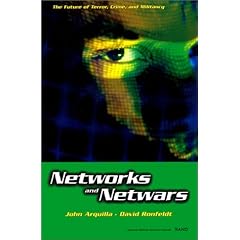
John Arqilla, along with David Ronfeldt, was the pioneering military and security theorist who forseaw the rise of networked non-state adversaries, which they detailed in their now classic book, Networks and Netwars. Below, in a Foreign Policy mag article, Arquilla expounds on the failure of the Pentagon to adapt sufficiently to leverage the power of networks or counter those opponents who have done so.
When militaries don’t keep up with the pace of change, countries suffer. In World War I, the failure to grasp the implications of mass production led not only to senseless slaughter, but also to the end of great empires and the bankruptcy of others. The inability to comprehend the meaning of mechanization at the outset of World War II handed vast tracts of territory to the Axis powers and very nearly gave them victory. The failure to grasp the true meaning of nuclear weapons led to a suicidal arms race and a barely averted apocalypse during the Cuban missile crisis.
Today, the signs of misunderstanding still abound. For example, in an age of supersonic anti-ship missiles, the U.S.Navy has spent countless billions of dollars on “surface warfare ships” whose aluminum superstructures will likely burn to the waterline if hit by a single missile. Yet Navy doctrine calls for them to engage missile-armed enemies at eyeball range in coastal waters.
The U.S. Army, meanwhile, has spent tens of billions of dollars on its “Future Combat Systems,” a grab bag of new weapons, vehicles, and communications gadgets now seen by its own proponents as almost completely unworkable for the kind of military operations that land forces will be undertaking in the years ahead. The oceans of information the systems would generate each day would clog the command circuits so that carrying out even the simplest operation would be a terrible slog.
And the U.S. Air Force, beyond its well-known devotion to massive bombing, remains in love with extremely advanced and extremely expensive fighter aircraft — despite losing only one fighter plane to an enemy fighter in nearly 40 years. Although the hugely costly F-22 turned out to function poorly and is being canceled after enormous investment in its production, the Air Force has by no means given up. Instead, the more advanced F-35 will be produced, at a cost running in the hundreds of billions of dollars. All this in an era in which what the United States already has is far better than anything else in the world and will remain so for many decades.
These developments suggest that the United States is spending huge amounts of money in ways that are actually making Americans less secure, not only against irregular insurgents, but also against smart countries building different sorts of militaries. And the problem goes well beyond weapons and other high-tech items. What’s missing most of all from the U.S. military’s arsenal is a deep understanding of networking, the loose but lively interconnection between people that creates and brings a new kind of collective intelligence, power, and purpose to bear — for good and ill…..”
Read the rest here.
It was nice to see Arquilla give some props to VADM Art Cebrowski, who is underappreciated these days as a strategic thinker and is much critricized by people who seldom bothered to read anything he actually wrote. Or who like to pretend that he had said a highly networked Naval task force is a good way to tackle an insurgency in an arid, mostly landlocked, semi-urban, middle-eastern nation.
It also occurs to me that one of the reasons that the USAF resisted drones tooth and nail is that robotics combined with swarming points to en end ( or serious diminishment) of piloted warplanes. Eliminating the design requirements implicit in human pilots makes for a smaller, faster, more maneuverable, more lethal aircraft that will probably be infinitely cheaper to make, more easily risked in combat and usable for “swarming”. Ditto attack helicopters.
Of course, nuclear bombers will probably stay in human hands. Probably.
ADDENDUM:
Contentious Small Wars Council thread on Arquilla begun by “student of war” and defense consultant Wilf Owen. I have weighed in as has Shlok Vaidya.
To the legacy society of the nation-state and the hierarchical transnational corporation:
….It’s time to up the ante and move onto the next phase: the birth and rapid growth of new societal networks.* This is going to be a fun ride!
* As in, new societal networks that can outcompete (trounce evolutionarily) all existing status quo organizational forms (this should not be confused with the diminutive form of ‘social networking,’ as in Facebook and Twitter).
Long term, I think this is correct and that Robb is, as usual, ahead of the curve on what will become the zeitgeist in the next few decades ( I will add that this evolutionary path appears to be happening much faster than I had considered, by at least 15-20 years). The movement in the 21st century will be toward networked civilizations on one end of the spectrum that will be pretty nice places to be and on the other, a kind of emergent, hypermobile, barbarism where life is hell on Earth.
The proper response for existing institutions is to swing their resources, their mass and their remaining legitimacy behind the triumph of the former and gracefully adapt and acclimate rather than be disintegrated by the latter. I considered this in the essay ” A Grand Strategy for a Networked Civilization” that I wrote for Threats in the Age of Obama (p.208):
….Nation-states in the 21st century will face a complex international ecosystem of players rather than just the society of states envisioned by traditional Realpolitik. If the predictions offered by serious thinkers such as Ray Kurzweill, Fred Ikle or John Robb prove true, then technological breakthroughs will ensure the emergence of “Superempowered Individuals”[1] on a sizable scale in the near future. At that moment, the reliance of the State on its’ punitive powers as a weapon of first resort comes to an end. Superemepowered individuals, separatist groups, insurgents and an “opting-out” citizenry will nibble recalcitrant and unpopular states to death, hollowing them out and transferring their allegiance elsewhere.
While successful states will retain punitive powers, their primary focus will become attracting followers and clients in whom they can generate intense or at least dependable, loyalty and leverage as a networked system to pursue national interests. This represents a shift from worldview of enforcement to one of empowerment, coordination and collaboration. States will be forced to narrow their scope of activity from trying to supervise everything to flexibly providing or facilitating core services, platforms, rule-sets and opportunities – critical public goods – that the private sector or social groups cannot easily replicate or replace. Outside of a vital core of activity, the state becomes an arbiter among the lesser, interdependent, quasi-autonomous, powers to which it is connected.”
In other words, America and our “leaders” need a Boydian strategy and a ruthless commitment to honest clarity and sacrifice in order to weather the transition and retain some relevance. This is what makes the current cultural trend toward a political economy of oligarchy among the elite so worrisome. Their careerist self-interest and class values will push them to make all the wrong choices at critical junctures.
John Hagel is in a small category of thinkers who manage to routinely be thinking ahead of the curve ( he calls his blog, where he features longer but more infrequent posts than is typical, Edge Perspectives). I want to draw attention to the core conclusion of his latest:
Challenging Mindsets: From Reverse Innovation to Innovation Blowback
Innovation blowback
Five years ago, John Seely Brown and I wrote an article for the McKinsey Quarterly entitled “Innovation Blowback: Disruptive Management Practices from Asia.” In that article, we described a series of innovations emerging in Asia that were much more fundamental than isolated product or service innovations. We drew attention to a different form of innovation – institutional innovation. In arenas as diverse as motorcycles, apparel, turbine engines and consumer electronics, we detected a much more disruptive form of innovation.
In these very diverse industries, we saw entrepreneurs re-thinking institutional arrangements across very large
numbers of enterprises, offering all participants an opportunity to learn faster and innovate more effectively by working together. While Western companies were lured into various forms of financial leverage, these entrepreneurs were developing sophisticated approaches to capability leverage in scalable business networks that could generate not just one product innovation, but an accelerating stream of product and service innovations.
…. Institutional innovation is different – it defines new ways of working together, ways that can scale much more effectively across large numbers of very diverse enterprises. It provides ways to flexibly reconfigure capability while at the same time building long-term trust based relationships that help participants to learn faster. That’s a key breakthrough – arrangements that support scalable trust building, flexibility and learning at the same time. Yet this breakthrough is occurring largely under the radar of most Western executives, prisoners of mindsets that prevent them from seeing these radical changes.
Read the whole thing here.
Hagel is describing a mindset that is decentralized and adaptive with a minimum of barriers to entry that block participation or information flow. One that should be very familiar to readers who are aware of John Boyd’s OODA Loop, the stochastic/stigmergic innovation model of John Robb’s Open Source Warfare, Don Vandergriff’s Adaptive Leadership methodology and so on. It’s a vital paradigm to grasp in order to navigate and thrive in the 21st century.
Western executives (think CEO) may be having difficulty grasping the changes that Hagel describes because they run counter to cultural trends emerging among this generation of transnational elites ( not just big business). Increasingly, formerly quasi-meritocratic and democratic Western elites in their late thirties to early sixties are quietly embracing oligarchic social stratification and use political or institutional power to “lock in” the comparative advantages they currently enjoy by crafting double standards through opaque, unaccountable authorities issuing complex and contradictory regulations, special exemptions and insulating ( isolating) themselves socially and physically from the rest of society. It’s a careerism on steroids reminiscient of the corrupt nomenklatura of the late Soviet period.
As the elite cream off resources and access for themselves they are increasingly cutting off the middle-class from the tools of social mobility and legal equality through policies that drive up barriers to entry and participation in the system. Such a worldview is inherently zero-sum and cannot be expected to notice or value non-zero sum innovations.
In all probability, as an emergent class of rentiers, they fear such innovations when they recognize them. If allowed to solidify their position into a permanent, transnational, governing class, they will take Western society in a terminal downward spiral.

Zenpundit is a blog dedicated to exploring the intersections of foreign policy, history, military theory, national security,strategic thinking, futurism, cognition and a number of other esoteric pursuits.
Customized Web Site & Blog Design