zenpundit.com » society

Archive for the ‘society’ Category

When Does Conflict Become “War”?

Tuesday, May 22nd, 2012

When does mere conflict end and war begin?

Great philosophers of strategy and statecraft did not treat all conflict as war but regarded war as a discernably distinct phenomenon, different from both peace and other kinds of conflict. War had a special status and unique character, glorious and terrible:

“Hence to fight and conquer in all your battles is not supreme excellence; supreme excellence consists in breaking the enemy’s resistance without fighting. “

    -Sun Tzu

“When the Corcyraeans heard of their preparations they came to Corinth with envoys from Lacedaemon and Sicyon, whom they persuaded to accompany them, and bade her recall the garrison and settlers, as she had nothing to do with Epidamnus. If, however, she had any claims to make, they were willing to submit the matter to the arbitration of such of the cities in Peloponnese as should be chosen by mutual agreement, and that the colony should remain with the city to whom the arbitrators might assign it. They were also willing to refer the matter to the oracle at Delphi. If, in defiance of their protestations, war was appealed to, they should be themselves compelled by this violence to seek friends in quarters where they had no desire to seek them, and to make even old ties give way to the necessity of assistance. The answer they got from Corinth was that, if they would withdraw their fleet and the barbarians from Epidamnus, negotiation might be possible; but, while the town was still being besieged, going before arbitrators was out of the question. The Corcyraeans retorted that if Corinth would withdraw her troops from Epidamnus they would withdraw theirs, or they were ready to let both parties remain in statu quo, an armistice being concluded till judgment could be given. “

-Thucydides 

“Thus, therefore, the political object, as the original motive of the war, will be the standard for determining both the aim of the military force, and also the amount of effort to be made. This it cannot be in itself; but it is so in relation to both the belligerent states, because we are concerned with realities, not with mere abstractions. One and the same political object may produce totally different effects upon different people, or even upon the same people at different times; we can, therefore, only admit the political object as the measure, by considering it in its effects upon those masses which it is to move, and consequently the nature of those masses also comes into consideration. It is easy to see that thus the result may be very different according as these masses are animated with a spirit which will infuse vigour into the action or otherwise.”

– Carl von Clausewitz 

We see from the above that war was not regarded as the same as either the political conflict which precipitated it or even, in the case of the Corcyraeans, the violence done against their interests in Epidamnus by the Corinthians, which did not yet rise to be considered war in the eyes of either Corcyra or Corinth. Instead the occupation of Epidamnus was something we would recognize today as coercion.  Like war itself, coercion operates by a calculus that is only partially rational; not only is the psychological pressure of coercion subject to passions of the moment, our reactions to the threat of violence -and willingness to engage in it – may be rooted in evolutionary adaptations going back to the dawn of mankind. Coercion, or resistance to it, usually is the midwife of war.

Prehistoric man lived a life that archaeology increasingly indicates, contrary to philosophical myth-making, was endemic in it’s violent brutality. Whether the violence between or within tiny paleolithic hunter-gatherer bands constituted private murder or warfare is a matter of debate, but the existence of the violence itself is not. Earliest firm evidence of a possible large skirmish or massacre dates back to 14,000 BC and definitive evidence for large-scale, organized battle dates to the end of the Neolithic period and dawn of the Bronze Age in 3500 BC.  Lawrence Keeley, in War Before Civilization, describes primitive man as being hyperviolent in comparison with those noted pacifists, the ancient Romans:

….For example, during a five and a half month period, the Dugum Dani tribesmen of New Guinea were observed to participate in seven full battles and nine raids. One Yanomamo village in South America was raided twenty-five times over a fifteen month period…. 

The high frequencies of prestate warfare contrast with those of even the most aggressive ancient and modern civilized states. The early Roman Republic (510-121 BC) initiated war or was attacked only about once every twenty years. During the late Republic and early Empire (118 BC -211 AD), wars started about once every six or seven years, most being civil wars and provincial revolts. Only a few of these later Roman wars involved any general mobilization of resources, and all were fought by the state’s small (relative to the size of the population) long-service, professional forces supported by normal taxation, localized food levies and plunder. In other words, most inhabitants of the Roman Empire were rarely directly involved in warfare and most experienced the Pax Romana unmolested over many generations. [Keeley,33] 

Simple, prestate societies probably waged “war” – a violent and deliberate conflict with rival groups and in alliance with rival groups against more distant interlopers – but the degree to which archaic and prehistoric humans culturally differentiated between this and their everyday, casual, homicidal violence remains unknown. Moreover, many academics would not accept the thesis of neolithic societies being “warlike”, much less, waging “war” as we understand the term until they rose to levels of social and political complexity generally denoted as chiefdoms, kingdoms and empires (“political” societies).

There’s something to that argument; a certain element of cultural identity is required to see the world in distinctly  “us vs. them” terms instead of an atomized Hobbesian “all vs. all” but I suspect it is far more basic a level of communal identification than the level of cultural identity typical of sophisticated chiefdoms like Cahokia or ancient Hawaii. Cultural and communal identity would tend to focus violence toward outsiders while increasingly complex political and social organization could “shape” how violence took place, molding it into recognizable patterns by regulation, ritual, taboo and command of authority. Once there is enough societal complexity for a leadership to organize and direct mass violence with some crude degree of rational choice and control, not only is war possible but strategy is as well.

Once a society is sophisticated enough to employ violence or the threat of violence purposefully for diplomacy or warfare, it is making a political decision to separate mundane and nearly chronic “conflict” and “war” into different categories. This would appear to be a primitive form of economic calculation distinguishing between conflict that generates acceptable costs and manageable risks and those conflicts that pose unacceptable costs or existential risks. This would give the relationship between primitive tribes the character of bargaining, an ongoing negotiation where the common currencies were violence and propitiation, until one party vacated the area or ceased to exist, most wars then having an innate tendency to escalate toward genocide (our current limitations on warfare, such as they are, derive from greater social complexity and political control over the use of violence).

If an economic calculus is indeed the root of the political decision to recognize some conflicts as “war”, that raises some interesting questions about modernity and advanced  states. What happens  when a conflict occurs with a state sufficiently complex that the ruling elite see their class interests as distinct and superceding those of the state? The calculus and what is considered “acceptable” costs or risks in a conflict vice those mandating “war” shift dramatically away from what might be considered “rational” state interest.

In a society at such an end-state, seemingly intolerable conflict might be tolerated indefinitely while full-fledged wars could be waged over what would appear to be mere trivialities to the national interest.

ADDENDUM:

In addition to some already excellent and extensive comments in the thread, I would like to turn your attention to an interview post at The Last Word on Nothing recommended byZack Beauchamp:

Horgan, Hayden, and the Last Word on Warfare 

Ann:  I understand both of you have written authoritative and charming books on war — John’s, just out, is called The End of War; and Tom’s is Sex and War — and that you’vediscussed these matters before.  I also understand you disagree about war.  How could you not agree?   I mean, war is just nasty stuff and we shouldn’t do it, right?

Tom: Ann, you’re poking the hornet’s nest right off the bat! I don’t think John and I disagree about war, but rather about peace. Don’t get me wrong: we both prefer the latter to the former, by a wide margin. And there are many things we do agree on, I think, such as the substantial observed decrease in the frequency and lethality of war over the past several centuries, and the idea that culture is an important part of the balance between war and peace. But I think we do have a difference of opinion about the attainability of peace (John) versus the inevitability of war (me). I think this makes John a better person than me, and certainly a more optimistic one. And I really, really hope he’s right. In my mind it comes down to an argument about human nature, and whether the impulses and behaviors of war are inborn or acquired. Or at least, that’s my take. John, what’s yours? [….]


Query: COIN Manual Conference Feedback

Wednesday, May 16th, 2012


Was the COIN  Manual conference at Fort Leavenworth last week a success or a failure?

I have heard backchannel that the focus of the rewrite of FM 3-24 was going to be on “tactics” and but that a “light footprint option” had to be included to appease policy makers. Some good suggestions were made at SWJ by Colonel Robert C. Jones, but not much has been said yet online that I have seen. USACAC bloseriously could use some updating on a more frequent basis.

I’m curious where they went with this. Opinions and comments solicited.

Ullman’s Strategic Revolution?

Sunday, May 13th, 2012

Strategist Dr. Harlan K. Ullman (best known for the concept of  “Shock and Awe“) had a piece up at Atlantic Council about which I have a mix of opinions, so I am going to break it down with some excerpts and comment:

Needed Now: An Intellectual Revolution in Strategic Thinking 

Toward the end of the Cold War, Soviet military thinkers coined the phrase “Military-Technical Revolution.” Based on a combination of extraordinary advances in precision strike and in information and surveillance technologies, the MTR was successfully transformed by the Pentagon into the “Revolution in Military Affairs.”

Meant to defeat the Red Army, the RMA was a real military revolution proven in the first Iraq War in 1991 when US arms pulverized Saddam Hussein’s army; in Afghanistan quickly routing the Taliban in 2001; and again smashing Iraq two years later.

There’s more than just a semantic difference here.

A “Military Revolution” is a rare thing in history, an epochal event, like the transformation of warfare in early modern Europe , which also dovetails with the Marxist-Leninist  economic deterministic conception of what constituted a world-historical “revolutionary” event in Soviet ideology. A “Military-Technical Revolution” was a terminological effort by Soviet general officers to reduce the ideological scope of the event discussed away from a sphere predominantly governed by the supreme authority of the Party (and in practice then, by politburo ideologist, Mikhail Suslovwho was deeply suspicious of any kind of reform) to one that emphasized that radical changes in warfare originated in or would flow from purely technological innovations and could therefore be safely managed by military professionals without encroaching upon political matters.  Self-interest and institutional interest of the Red Army general staff at work.

American defense intellectuals repackaged the Red Army’s “Military-Technical Revolution” as the  “Revolution in Military Affairs” – a much narrower concept than “Military Revolution” yet broader, more flexible and open-ended than it’s Soviet parent. Eminent strategist and military historian Colin S. Gray described RMA thusly:

Military Revolutions are preceded, implemented, and succeeded by RMAs. RMA refers to a radical change in the character of war. The engines of such change include, but are by no means limited to, technological innovation. Scholars note that most historically plausible RMAs have not obviously been led by new technologies [1].

The American RMA unlike the Soviet version was more closely tied to the force-multiplying effects of the information revolution and Moore’s Law  that was to reshape the global economy, and came to be shorthanded, under Rumsfeld, as “transformation“. However, like the Soviet MTR, RMA suited the growing fascination of American military officers with operational art as the acme of professional identity and a substitute for strategy and troublesome questions of policy and politics. While “transformation” was good for making the military more efficient at applying violence, the focus on technological magic in operations tended to anesthetize senior generals from the need to attend to the vital strategic-policy dimension of war.

Back to Ullman:

….Today, American and certain allied militaries are exhausted by a decade of war. All face large and looming defense cuts meaning far less money for defense. Under these circumstances, readiness and morale become early casualties.

With the exception of North Korea (or to some states in Europe, Russia), few hostile armies are around to fight in a conventional conflict making the case for defense more diaphanous. The wars in Iraq and Afghanistan demonstrated that while military force may have been necessary, it could not make either country more governable, hardly the best argument for defense spending.

The omission of China is simply weird. I am neither a ‘Panda hugger” or a “Panda mugger” and I don’t think China should be shoehorned into the role of near-peer competitor, which it is not yet, except in the fantasies of hypernationalistic Chinese and maybe blogger/salesmen from the Lexington Institute. But how do you ignore a nation like China and the PLA in in a military-geopolitical strategic analysis?

….How can militaries deal with these facts of life? The answer is that a new revolution is desperately needed. Given the bleak funding outlook, this revolution can only be accomplished through intellect and rejuvenating strategic thinking.

British Gen. Rupert Smith’s “The Utility of Force” skillfully interpreted war in the 21st century to be about and over people — to protect and defend them or to defeat or disrupt them rather than as modern armies squaring off against one and other.

Many assumptions to unpack from few words.

I welcome Dr. Ullman’s call for an intellectual renaissance in strategic thinking which, if badly needed among the professional military class, is even more urgently required in our political class who – with some exceptions – were largely AWOL from their responsibilities of senior partnership in fashioning strategy and grand strategy with the uniformed military in the past ten years. Perhaps in a generation or two, the proliferation of grand strategy programs at elite universities that are increasingly feared by anti-American intellectual leftists, will produce a large cadre of statesman with real strategic competence.

Regarding the second paragraph, while I am sympathetic to the assumptions that 4GW environments will increase with the erosion of state sovereignty and legitimacy, the future of warfare may very well be extremely “hybridwith well-financed polities, corporations and networks fielding impressively high tech military capabilities alongside atavistic and disorganized insurgencies wallowing in blood and entrails. The latter will invite intrusion by the former and the former are sometimes going to clash with one another, as well as against postmodern warlords, superempowered individuals, urban guerrillas and networked jihadis.

….Some 15 years earlier, the concept of “shock and awe” was created in which the goal was to affect, influence and ultimately control the will and perception of an adversary (hence Smith’s “people”) with the use or threat of military force. “Shock and awe” was inspired by the Chinese philosopher Sun Tzu eons ago when he wrote that the really brilliant general wins without having to fight a battle.

Shock and awe posited four criteria: control of the environment, rapidity, (near) perfect knowledge and brilliance in execution.

The last two, combined with the realities and uncertainties of today’s international environment, form the foundations for this much needed intellectual revolution in strategic thinking.

If so, then the revolution fizzles out here.

Rapidity and brilliance in execution – or at least excellence – can be trained for, but in control of the environment, the enemy gets a vote (and so, for that matter, does the environment) and “(near) perfect knowledge” is a transient comparative advantage held (if at all) during the initial moments of a complete surprise attack. While it would be nice to have, “(near) perfect knowledge” cannot be a foundation for a strategic revolution as it is a largely unachievable standard in unhurried conditions of perfect peace, much less during the fog and friction of war.

….No one can be certain about the nature of future conflicts as the requirements for defense, once equated in largely military terms, have expanded to cover security with a far broader aperture extending well beyond armies, navies and air forces.

In future conflict, military force may or may not be necessary. But they have not been sufficient to achieve the strategic and political aims of bringing stability and security to Iraq, Afghanistan and so far Libya for example.

Further, given defense cuts, preparations for major conventional operations will be severely curtailed as both weapons and systems for those engagements as well as training will likewise be reduced, possibly dramatically. The strategic question that forms the heart of an intellectual revolution rests on how militaries can prepare for a future so filled with uncertainty while preserving traditional war fighting skills with far less money.

Ullman is correct that public expectations of “security” have expanded beyond military strength to encompass more of the DIME spectrum with, arguably, law enforcement, immigration/assimilation and cyber issues as well.

Disagree that the current political class dominated by aging Boomer fantasists will recognize that sharply curtailed military budgets mean fewer operations.It certainly has not worked that way in Britain where harshly punitive budgetary cuts to the British Army and Royal Navy have scarcely curbed Her Majesty’s government’s appetite for military intervention.  American politicians and Atrocity Boards will simply require the Pentagon eat it’s seed corn to pay for intervention piled upon intervention and when that runs dry, Congress will look at cutting veteran health benefits and pensions and hollow out the force until it breaks.

….First, militaries and strategic thinking must be oriented about obtaining (near) perfect knowledge not merely about traditional operations and employing weapons systems with far greater creativity. There must be far more learning about other, non-military tools and other regions and states round the world of import or interest to assuring national security.

The part  about creativity is spot on, but in a military where majors, colonels and brigadier generals feel they cannot sign off on something as mundane as a platoon, a company or a battalion using ATVs on patrol in Afghanistan without risking their careers, then bureaucratic micromanagement has already reached the state of military rigor mortis. Strategic thinking in the ranks cannot begin until the climate of fear is removed and the incentives for promotion changed to reward risk-taking. Just like the State Department, the Pentagon’s antiquated personnel system is out of alignment with the needs of American national security and  represents a systemic bulwark against positive change.

Pursuit of near perfect knowledge should be dropped. When Admiral Art Cebrowski helped conceive of network-centric warfare,  there was an opportunity present, through real-time sharing of  information across a military “system”, to maximize individual and unit initiative within their understanding of the commander’s intent and accelerate the operational tempo vis-a-vis the enemy. Instead, information technology, as I see it imperfectly from my far remove as a civilian kibbitzer, has empowered micromanagement with three and four star generals playing company commander, colonels playing squad leader and lawyers and powerpoint-inebriated staff officers hundreds  of miles away blocking artillery or air support requested by units under fire.

Perfect knowledge as a doctrinal benchmark encourages organizational paralysis in the face of uncertainty, rather than the fluidity, creativity and adaptiveness that Ullman seeks.

….Second, new means and methods must be created or strengthened that contribute to maintaining fighting skills that enable brilliance in operations. For example, as the British navy and air force lose both carrier and anti-submarine capacities for an interim period, units should be assigned to the US or French navies that will employ these weapons systems. The British army could deploy units to serve in Korea or Pakistan and India where conventional combat is central to those forces to maintain these skills. And new generations of war games and simulators must be invented and fielded so that many scenarios can be played out to keep skills at acceptable levels of readiness.

These are useful ideas, especially the wargames. I don’t think the British will bite though, except for “model” partnerships with the French. There’s really no good reason why there should not be an “Anglospheric” (UK, US, ANZUS, Canada) combined naval warfare planning staff and regular joint exercises.

….Third, to achieve these aims, a further revolution in military education from bottom to top is essential. Officers and troops must be prepared intellectually in order to obtain near perfect knowledge about a future that at best is opaque. And simultaneously, keeping combat skills sharp in an era of austerity when weapons and training will be in shorter supply is best done as Bobby Jones, perhaps the greatest golfer ever observed about that game — it is played in the 6-inch space between the ears!

Militaries will be reluctant to accept new or any revolutions when they are fighting for subsistence. Politicians find governing hard enough. And few are prepared to impose a revolution let alone make tough decisions.

If an intellectual revolution is to be wrought, it must come from within. But who will listen? And who will lead?

As of now, no one is leading and few understand the need to do so.

1. Colin S. Gray. Another Bloody Century. Orion Books Ltd. London. 2005.  117..

Educating Divided Minds for an Illiberal State

Friday, May 4th, 2012

Adam Elkus had well-constructed argument about the Thomas Friedman-Andrew Exum exchange:

Education and Security

Andrew Exum’s has a useful critique of Thomas Friedman’s recent piece. In a nutshell, Friedman makes the old argument that the US could buy friendship and allegiance by giving Middle Easterners more education and scholarship opportunities. To this, Exum has a rather terrific rejoinder:

“I am a proud graduate of the American University of Beirut, but do you know who else counted the AUB as their alma mater? The two most innovative terrorists in modern history, George Habbash and Imad Mughniyeh. U.S. universities and scholarship programs are nice things to do and sometimes forge important ties between peoples and future leaders, but they can also go horribly wrong and do not necessarily serve U.S. interests. There is certainly no guarantee a U.S.-style education leads to greater tolerance or gender and social equality.”

Habbash and Mughniyeh are hardly alone. Diego Gambetta and Steffen Hertog famously observed an distinct overrepresentation of scientists, engineers, and other highly educated professionals in both violent and nonviolent groups with illiberal ideologies. Gambetta and Hertog make an argument that the black-and-white mindset of certain technical groups correlate well with extremist ideologies, but I am unfamiliar with how this has been academically received so I won’t endorse their claims. To be sure, a look at 20th century history would also reveal a significant confluence of intellectuals in the humanities and social sciences being involved in either state or non-state illiberal movements. 

Indeed, the problem here may be the imbalance of educational systems that produce divided minds, where lopsided cultures of thought interact with enough disturbed individuals with a will to power. Stalin demonstrated what Communism looked like when a former Orthodox seminarian presided over a police state run by engineers; Mao one-upped him with Communism as the mystical rule of an all-powerful poet.

One of the more unfortunate trends among many bad ideas currently advertised as “education reform” is the denigration of the humanities and the reduction or elimination of the arts and history in public schools in favor of excessive standardized testing of rote skills and reasoning at the lowest levels of Bloom’s taxonomy, mostly due to Federal coercion. That this has become particularly popular with GOP politicians (though many elitist Democrats echo them) would have appalled erudite conservatives like William F. Buckley and Russell Kirk or old school libertarians who would have seen nationalization of k-12 education policy as worse than the status quo.

In an effort to appear genuinely interested in improving education, some politicians couple this position with advocacy for STEM, as the teaching of science has also been undermined by the NCLB regime and a grassroots jihad by religious rights activists against the teaching of evolution in high school biology classes. While STEM in and of itself is a good thing and better science instruction is badly needed, STEM is no more a substitute for teaching the humanities well than your left hand is a substitute for your right foot.

The modes of thinking produced by quantitative-linear- closed system-analytical reductionist reasoning and qualitative-synthesizing-alinear-imaginative -extrapolative are complementary and synergistic. Students and citizens need both. Mass education that develops one while crippling the other yields a population sharing a deeply entrenched and self-perpetuating lacunae, hostile and suspicious of ideas and concepts that challenge the veracity of their insular mental models. This is an education that tills the soil for intolerance and authoritarianism to take root and grow

Education should be for a whole mind and a free man.

Before Disruption….Thinking

Monday, April 23rd, 2012

“What you think, you become”

    – Buddha

“We are what we frequently do”

    – Aristotle

There has been a lively and still evolving debate in the milblogosphere regarding “disruptive thinkers”, starting with Benjamin Kohlman’s post at SWJ whose editor Peter J. Munson has done a fine job steering, collecting and commenting upon. A selection:

The Military Needs More Disruptive Thinkers by Benjamin Kohlman

Disruptive Thinking, Innovation, Whatever You Want to Call It is Needed for a Military in Crisis by Peter J. Munson 

The focus on disruptive thinkers coincided with a different but relevant debate over professional military education (PME) when a scathing blast was recently  leveled at the US Army War College by Major General Robert Scales (ret.) , himself the former commandant and a strong advocate of rigorous PME.  A few of the criticisms made by General Scales at a gathering at FPRI were mentioned in a post by Thomas Ricks who believes in shutting down the service academies and war colleges and maybe just sending everyone to Yale, Princeton and Harvard for MBAs. Or something.
.
What was interesting to me is that many authors and their points had less to do with a close examination of cultivating cognitive skills than related topics of changing organizational culture, the perils of groupthink, rehashing ideas from Frans Johanssen’s The Medici Effect and John Kao’s Innovation Nation, the superiority of entrepreneurshiphidebound military bureaucracy and other tangents to indirectly create an environment in which insightful or innovative behavior might happen.  Only Mike Mazarr zeroed in to the heart of the matter, writing:
….We need to improve, for example, in the detail and specificity of critical and creative thinking methodologies that we integrate into the curriculum.
Bingo!
.
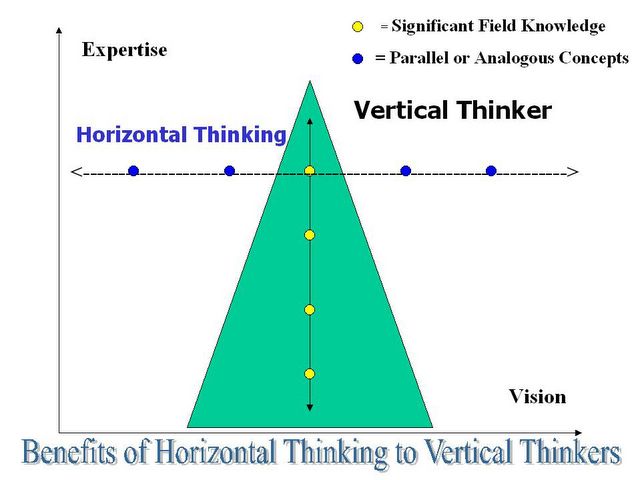
There’s nothing wrong -in fact, much to the good – with the call of Kohlman and others like Joan Johnson-Freese to deliberately combine students and faculty of radically different professional backgrounds. Such a personnel mix is a good base for horizontal thinking to take place, where discussions can range across fields generating insights and analogies and accelerating learning.
However, just assembling a broad mix of talent and putting them together in a building is not enough because it is not any more goal oriented than a MENSA social. Good things might happen, sure, but just as easily not. This is why DARPA is a lot more productive of an organization on an annual basis than the Institute for Advanced Study. There needs to be a mixture of problem-solving and play, free inquiry or experimentation and unifying goals. Communities of interest have to first have a sense of community for the vibrantly sharing and inspiring “minds on fire” effect to take place.
.
If the military or more broadly, American society, wants a larger number of creative, innovative, “disruptive”, strategic or whatever kind of thinker, then the answer is to actively and purposefully teach students creative, critical, insight-generating and strategic thinking skills and to value intellectual curiosity, skepticism, imagination and empiricism over ideology and conformity. The other indirect, “better environment”, stuff certainly improves your chance of success, but systemic improvement will only come about by making such objectives the focus of instruction and learning rather than a haphazard byproduct.
UPDATE:
At Best Defense, Ricks has provided a copy of his prepared remarks on PME as well as a link to the audiofile that I could not pull up the other day. Check out what he has to say.

Switch to our mobile site