zenpundit.com » art

Archive for the ‘art’ Category

It’s snowing metaphoric chyrons, ignore unless interested

Wednesday, February 13th, 2019

[ by Charles Cameron — thug, pit bull, face-off, head-to-head, hardball, hard-charging, trolling, dueling, jabbing, ripping, hammering, gutting, hit job.. ]
.

**

Those are the screen-grabs — here are some of my fallible transcriptions of spoken snippets with metaphoric or other interest:

From the Whitaker hearinn:

Congressman, I’m not a puppet to repeat what you’re saying ..

2/11/2019, Chris Matthews, Hardball:

00 We’ve got an explosive show for you tonight ..
We’re also following the face-off in El Paso, TX, where President Trump and Bedo O’Rourke are holding dueling real-time rallies over the border wall .. ***
11 Mimi Rocah, More, more dominoes, more chips to fall ..
39 This is getting to be quite a cage match between a lot of people and his guy, Trump ..
53 Klobachar: You have to pick your battles with him ..

**

The dismissive / offensive Trump tweet reference to the Trail of Tears:

**

2/11/2019, Ari Melber, The Beat:

Building a case like this .. it’;s sort of like Impressionism.

When you get up close, not sure what you’re seeing, when you step back, aha!

It also raises the question of whether Rudy Giuliani’s style is more Cubist ..

Or Jackson Pollock, just throwing stuff at the wall ..

It’s surreal, it’s surreal. And by the wayu that’s the painting school, I think, Giuliani is in. It’s surrealism, surrealism, pure Dali ..

And so you say, melting clocks all around — that makes good sense to me ..

Great conversation!

Donald Trump ploughing all kinds of time watching television and tweeting at critics, who say he spends too much time watching television and tweetierng at critics. —
Andrew Weissmann is a very, very powerful weapon in the government’s arsenal ..
Trump and Beto O’Rourke holding dueling rallies near the border ..

Hallie Jackson 2/12/2019

27 We never thought we we were going to find a contract between Trump and Vlad saying, Hey, let’s collude ..
President Trump and Beto O’Rourke do their owb kind of Texas Two-step there, split-screen style, in El Paso, Texas .. *****

Nicolle to Brennan:I feel like you just exploded what I call a truth bomb ..

**

I’m closing this post here and taking the remainder of my chyrons &c into a new post, making this look very much like the beginning of a series. We’ll continue with posts on other topics from strategy to imagination, and those not interested in my collection of metaphors, chyrons and headlines can safely ignore this series.

Jackass and catfish, catfish and gourd

Friday, February 1st, 2019

[ by Charles Cameron — an almost-Darwin-Award-worthy foolishness, coupled with a masterpiece of Zen art — just the sort of post I’d love to post, for my own sake, even if no-one else is listening ]
.

Unbelievable!

That’s a serious journal article about a seriously un-serious drunking game.. And if you can’t read the fine print, not to worry — the two top articles below will brief you nicely..

Readings:

  • Atlantic, This Is What Happens When You Drunkenly Swallow a Live Catfish
  • LiveScience, A Drunk Man Swallowed a Live, Venomous, Spiny Catfish.

  • Acta Oto-Laryngologica Case Reports, A Jackass and a Catfish
  • **

    By way of contrast:

    Here’s what the book’s about:

    Zen art poses a conundrum. On the one hand, Zen Buddhism emphasizes the concept of emptiness, which among other things asserts that form is empty, that all phenomena in the world are illusory. On the other hand, a prodigious amount of artwork has been created in association with Zen thought and practice. A wide range of media, genres, expressive modes, and strategies of representation have been embraced to convey the idea of emptiness. Form has been used to express the essence of formlessness, and in Japan, this gave rise to a remarkable, highly diverse array of artworks and a tradition of self-negating art.

    In this volume, Yukio Lippit explores the painting The Gourd and the Catfish (ca. 1413), widely considered one of the most iconic works of Japanese Zen art today. Its subject matter appears straightforward enough: a man standing on a bank holds a gourd in both hands, attempting to capture or pin down the catfish swimming in the stream below. This is an impossible task, a nonsensical act underscored by the awkwardness with which the figure struggles even to hold his gourd. But this impossibility is precisely the point.

    Read or view:

  • Getty Research, Japanese Zen Buddhism and the Impossible Painting
  • Getty YouTube lecture, Japanese Zen Buddhism and the Impossible Painting
  • **

    On the zen of swallowing, or not:

    In Zen work, an existential contradiction, Mumon’s “red hot coal,” sticks in the student’s throat; the inability “to swallow it or spit it out” precipitates a crisis to be resolved through an insight that is simultaneously an existential gesture. “If I am whole and complete as I am, why do I feel ignorant and incomplete?” might be one formulation of the conundrum, though encoded in a ritual question like “What is the sound of one hand?” The greater the contradiction, the greater the tension — ”doubt mass” — and the greater the breakthrough, according to Zen tradition.

    Source:

  • Tricycle, Fruitful Contradictions: The Zen of mathematics
  • On the felicities of graph-based game-board design: fifteen

    Wednesday, January 30th, 2019

    [ by Charles Cameron — surprise, surprise — this isn’t the #15 I expected and predicted ]
    .

    In Two eminently watchable TV series by Hugo Blick I looked at narrative artistry as an approach to understanding complex problems — and I do mean complex, the Israeli-Palestinian and Hutu-Tutsi errh, situations..

    Here, we consider artistry of another sort — polyphonic, graphical, yet still clearly artistic in execution ..

    **

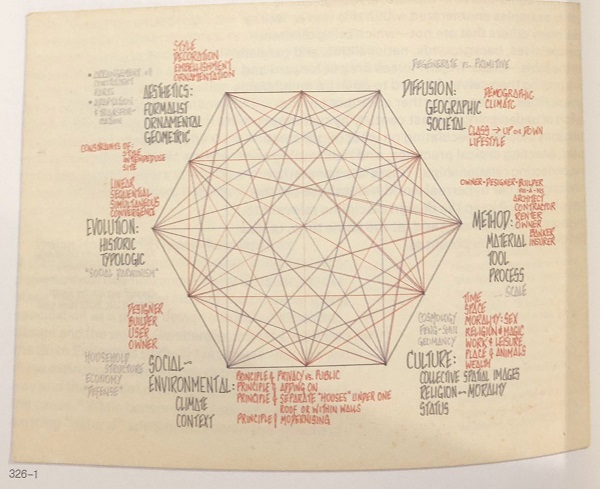
    Here’s a drawing from Victor Papanek‘s Notebook — and very notebook it is — courtesy Roelof Pieters:

    **

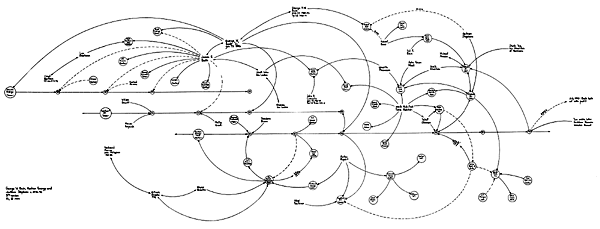
    Compare the above with this example of Mark Lombardi‘s fine art “conspiracy” graphs from his book, Global Networks:

    We’re getting positively calligraphic here, and approaching the scope of one of those Song dynasty scroll paintings that feature (am I right? memory, imagination!) a hermit disappearing into his cave in some obscure not quite corner of the scroll, while thunder wreaks havoc on armies by a river in almost center field..

    Speaking of which..

    Ah, but we’re straggling away from our topic: On the felicities of graph-based game-board design. The point is that the arts have many inventive ways to approach complexity.

    I mean, we could start with Hamlet..

    **

    Earlier in this series:

  • On the felicities of graph-based game-board design: preliminaries
  • On the felicities of graph-based game-board design: two dazzlers
  • On the felicities of graph-based game-board design: three
  • On the felicities of graph-based game-board design: four
  • On the felicities of graph-based game-board design: five
  • On the felicities of graph-based game-board design: six
  • On the felicities of graph-based game-board design: seven
  • On the felicities of graph-based game-board design: eight
  • On the felicities of graph-based game-board design: nine
  • On the felicities of graph-based game-board design: ten
  • On the felicities of graph-based game-board design: eleven
  • On the felicities of graph-based game-board design: twelve
  • On the felicities of graph-based game-board design: thirteen
  • On the felicities of graph-based game-board design: fourteen
  • Today, the anti-Magritte

    Tuesday, January 29th, 2019

    [ by Charles Cameron — curious “sign” sign seen outside today’s Roger Stone hearing ]
    .

    Someone has a sense of humor? of art?

    The statement “This is a Sign” isn’t even paradoxical, unless you remember Magritte‘s un-pipe — but it’s certainly an obvious statement of truth, albeit self-referential, ouroboric.

    In my view, witty, to say the least..

    The remaking of angels, their rank and sweep

    Wednesday, January 16th, 2019

    [ by Charles Cameron — on, i suppose, the uphill slog or seduction of genius — or a very different take on complexity? ]
    .

    Paul Klee‘s Angelus Novus — described by the Verso writer Stuart Jeffries as “this goofy, eternally hovering angel with hair that looks like paper scrolls, aerodynamically hopeless wings and googly if rather melancholy eyes”:

    was admired and bought for a thousand marks by Walter Benjamin, and moved with him from one lodging to the next until her fled Germany and the onrushing Nazis. It is also:

    Benjamin’s most famous image, in the 1940 “Theses on the Philosophy of History”: the “angel of history” who is blown backward into the future by the storm of progress.

    or to quote Benjamin himself:

    A Klee painting named Angelus Novus shows an angel looking as though he is about to move away from something he is fixedly contemplating. His eyes are staring, his mouth is open, his wings are spread. This is how one pictures the angel of history. His face is turned toward the past. Where we perceive a chain of events, he sees one single catastrophe which keeps piling wreckage upon wreckage and hurls it in front of his feet. The angel would like to stay, awaken the dead, and make whole what has been smashed. But a storm is blowing from Paradise; it has got caught in his wings with such violence that the angel can no longer close them. The storm irresistibly propels him into the future to which his back is turned, while the pile of debris before him grows skyward. This storm is what we call progress.

    **

    At a time after Darwin, Marx and Freud have dissolved the basics of fundamentalism, and before the likes of Sam Harris, Richard Dawkins, Daniel Dennett and the brilliant Christopher Hitchens proclaimed “the new atheism” in an easily-won contest with that same low, popular religiosity — all but ignoring the retreat of angels from Renaissance tryptich to Hallmark Card — we might do well to carry the God-NoBoDaddy debate up an octave, and consider the possibility that once angels have been more or less erased from modern western consciousness, they may, as in a palimpsest, reappear in new-old guises..

    **

    Principally, I think here of Rilke‘s angels in the Duino Elegies:

    Who, if I cried out, would hear me among the angels’ hierarchies?
    and even if one of them pressed me suddenly against his heart:
    I would be consumed in that overwhelming existence.
    For beauty is nothing but the beginning of terror, which we are still just able to endure,
    and we are so awed because it serenely disdains to annihilate us.
    Every angel is terrifying.

    Ah!

    Rilke told one of his translators that she should not make the mistake of understanding the angel referred to in the elegies as a Christian angel. To the contrary, this angel was quite distinctly drawn from an Islamic tradition. Rilke writes that in the months before his trip to Duino, he had traveled in Spain and had been consumed with reading the Qu’ran and a book on the life of the Prophet Mohammed. It seems fairly clear that this occurred under the influence of his friend Lou Andreas-Salomé, whose husband, Friedrich Carl Andreas, was a leading scholar of Islamic culture in the Russian Empire, particularly including Naqshibandiyya.

    **

    Let Rilke have traveled next to India or China, the apsarases and gandharvas of Hinduism and Buddhism might have affected him, with their sensuality, their song, their dance..

    **

    But while gandharvas and apsarases capture us by their powers of seduction — in some ways like the houris of Islamic paradise — with Rilke’s angels, drawing no less on the Old Testament than on the Qur’an, our surrender is to elemental force:

    I mean the Angel who appeared
    to the wrestlers of the Old Testament:
    when the wrestlers’ sinews
    grew long like metal strings,
    he felt them under his fingers
    like chords of deep music.

    Whoever was beaten by this Angel
    (who often simply declined the fight)
    went away proud and strengthened
    and great from that harsh hand,
    that kneaded him as if to change his shape.
    Winning does not tempt that man.
    This is how he grows: by being defeated, decisively,
    by constantly greater beings.

    **

    Constantly greater beings, with which we may if we are spiritually fortunate, wrestle — these are Rilke‘s angels, and they fill the gap in the once-dominant Great Chain of Being paradigm, on a rung above human usualness, demanding, promising, skirmishing, delivering…

    To be carried in the arms of an apsara, to be swept by the gale-force storm of an angel, these are human experiences of the transhuman kind, and we need words for them, both forgetful of any surrounding dogma and delighting in their strength as imagery — gandharvas and angels named as such, and constantly revivified by the poetic imagination.

    Klee, Benjamin, Rilke, but also Jacob wrestling with — who? a man, angel, God? — and becoming IsraelGiotto, Fra Angelico, Michelangelo who wrestled form from Carrera marble, Dogen Zenji for whom mountains were the sages into whom, living among them, he blended.. Kalidasa with his yakshas in Cloud Messenger and perhaps supremely in the gandharva marriage in his Shakuntala..

    Isaac becoming Israel, Shakuntala the mother of Bharata.. Of such are sacred nations born.

    **

    Yet this world is wide and deep, the beings above us multitudinous, and the humans touched by them more than a single mind can comprehend. And:

    The problem of god is a problem in ballistics, Icarus discovered this,
    that to shoot for the sun is to fall short of it, those who shoot
    for beauty achieve prettiness, there is a gravity in aesthetics as there is
    in physics, and theology too has its fall, the problem of god being
    that the mind falls short of what is huge enough to conceive it, give
    conception whatever relevant definition you choose, too vast
    to think of, give birth to it — no, no, mind has sheer cliffs of fall, and
    to shoot for a conception of god is full speed ahead to fall, fail ..

    I bow, salute, prostrate, pranam, bow gassho.


    Switch to our mobile site