zenpundit.com » military

Archive for the ‘military’ Category

“Optimizing the Potential of Special Forces”

Sunday, July 14th, 2013

[ by Mark Safranski – a.k.a “zen”]

A remarkably blunt article on SF/SOF (“special forces” is being used as an umbrella term for both) in the context of policy and strategy, from the perspective of an emerging great power by LTG Prakosh Katoch of the Indian Army. The American example of SOCOM in Afghanistan/Iraq/GWOT has obviously had an impact here, as has the negative example of Pakistani use of terrorists as proxy forces and ISI covert operatives for direct action in Indian territory and elsewhere. Quite aside from global conflicts and the bilateral rivalry with Pakistan, India also faces more than a dozen long term irregular conflicts with their own dynamics, such as the NaxaliteMaoist insurgency , which Katoch places in the context of Chinese strategic ambitions against India.

A must read.

Optimizing the Potential of Special Forces

….In India, the lack of strategic culture, more on account of keeping the military out from strategic military decision making, has led the hierarchy to believe that conventional forces coupled with nuclear clout can deter us from irregular threats. Nothing can be farther from the truth. Pakistan, though conventionally inferior, has been successfully playing her ‘thousand cuts policy’ knowing full well that India has failed to develop the required deterrent. It is our inability to find a cure to this Achilles’ heel, that has led China, which was hitherto using Pakistan as proxy to wage irregular war on India, now directly aids and supports insurgent and terrorist outfits inside India.

….Why the US has managed to secure its mainland post 9/11 is not only because of an efficient Homeland Security organisation but because the US Special Forces (USSF) are operating in 200 countries including India. Significantly, USSF have undeclared tasks such as conducting proactive, sustained ‘man-hunts’ and disrupt operations globally; building partner capacity in relevant ground, air and maritime capabilities in scores of countries on a steady – state basis; helping generate persistent ground, air and maritime surveillance and strike coverage over ‘under-governed’ areas and littoral zones and employing unconventional warfare against state-sponsored terrorism and trans-national terrorist groups globally. Before 26/11, Al-Qaeda had planned similar operations against New York but could not because the USSF had infiltrated Al-Qaeda. One cannot guard the house by simply barricading it. You must patrol the streets and the area outside.

Growing inter-dependence and interlinking of terrorist groups regionally and internationally should be a matter of serious concern. It is not the US alone that has deployed its Special Forces abroad. This is the case with most advanced countries including UK, Russia, Israel, China and even Pakistan. Pakistan’s SSG was operating with the Taliban in Afghanistan and has been active in Jammu and Kashmir, Nepal and Bangladesh, primarily training anti-India forces. There is a strong possibility of their presence in the Maldives and Sri Lanka as well, aside from presence within India. The Chinese have been smarter. For all the development projects throughout the globe, including in Myanmar, Nepal, Pakistan-POK, Sri Lanka, Bangladesh and Seychelles, contracts underway by PLA-owned/affiliated companies employ serving and veteran PLA soldiers and disguised Special Forces with assigned tasks, including evacuation of Chinese citizens from that country in case of emergencies. 

Read the rest here.

On Time and timeframes

Monday, July 1st, 2013

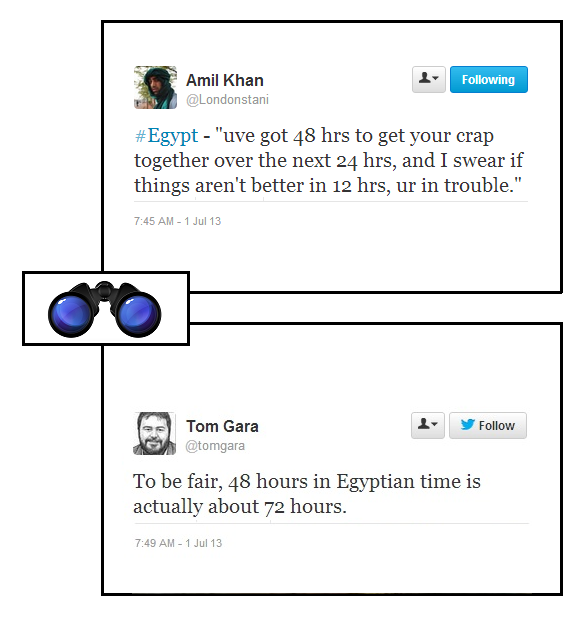
[ by Charles Cameron — 48 hours, Egyptian time, can mean many things, also DoD foresight, next 48 hrs ]
.

We seem to have at least four “times” here, ranking from 12 to 72 hours — or zero to 72 if you take the Army’s announcement itself as a sort of starting pistol — and they’re operating, obviously enough, under different frames. The army likes nicely rounded numbers like “48 hrs”, PERT chart thinking gives you the least time available in which to take the first step towards a desired aim, here “12 hours” — and “24 hours” is the latest target time for serious, visible progress to avert “worst case” response preparations. Or something along those lines.

And “72 hours”? That may be Egyptian elastic time, and thus roughly comparable to Lakota time

The Lakota view of time was simple. “Time was never a specific minute, but rather spaces of time,like early morning, just afternoon or just before midnight. The real meaning of time could be summed up by the phrase “nake nula waunyelo” loosely translated it means:

“I am ready for whatever, any place, any time, always prepared”.

When work needed to be done, people were prepared to work late inthe fields or stay up until 3 am to finish goods to be sold at market.When no work needed to be done, they didn’t work.

The irony is in the next comment:

Policy makers saw an opportunity to improve things by installing awestern time ethic and a respect for the clock.

I don’t know Egypt — but I have spent time “on Lakota time” and don’t wear a watch or carry a phone these days… The piece I drew those quotes from, Lessons from the Lakota: Time lessons for today’s managers, may or may not be useful advice for managers, but its overview-with-graphic of different time systems is worth a quick look. Anthropologists would be able to tell you more about individual cultures, but my point is that differing timeframes are among the major features of different worldviews, and we need to have a decent sense of them when we interface with them.

So “72 hours” may be an instance of relaxed but purposive time, okay? Which wouldn’t necessarily fit well with starched and pressed military time.

**

And here’s the blockbuster:

According to the Congressional Budget Office’s Analysis of DoD’s Future Years Defense Program from 2013, military foresight time runs five years ahead, while USG foresight time runs to 2030 at least:

In most years, the Department of Defense (DoD) provides a five-year plan, called the Future Years Defense Program (FYDP), associated with the budget that it submits to the Congress. Because decisions made in the near term can have consequences for the defense budget well beyond that period, the Congressional Budget Office (CBO) regularly examines DoD’s FYDP and projects its budgetary impact over several decades. For this analysis, CBO used the FYDP provided to the Congress in March 2012, which covers fiscal years 2013 to 2017; CBO’s projections span the years 2013 to 2030.

That’s confidence of a kind… but consider this:

I know, I know — whatever happens in Egypt “momentarily” may turn out to be no more than an eddy briefly interrupting a larger time-flow in the “mid-term” — a phenomenon I’d like to map nicely with some river graphics one of these days.

**

But time? What was it St Augustine said of it?

What, then, is time? If no one asks me, I know what it is. If I wish to explain it to him who asks me, I do not know.

Moral Degeneration in the Crucible of War

Wednesday, June 12th, 2013


The recent post on Is 4GW Dead? stirred a great deal of interest, so I would like to extend the discussion on a point that that is critical not only for those who have responsibility for conducting military campaigns, but for statecraft and policy as well.

One of more important tenets of 4GW was the importance of “the moral level of war”, drawn from Colonel John Boyd’s thinking on the strategic impact of a combatant’s behavior, immoral  or exemplary, on all observers – belligerents, civilian noncombatants, neutral third parties, the media, the combatant’s own soldiers and citizens back home. Here is Boyd:

Morally our adversaries isolate themselves when they visibly improve their well being to the detriment of others (allies, the uncommitted), by violating codes of conduct or behavior patterns that they profess to uphold or others expect them to uphold.

· Morally we interact with others by avoiding mismatches between what we say we are what we are and the world we have to deal with, as well as by abiding by those other cultural codes or standards we are expected to uphold.

In a Reader’s Digest version of Boyd,  heroic, noble and magnanimous  behavior is admirable and attractive while hypocrisy, cruelty and cowardice are repulsive and antagonizing characteristics. While the former won’t guarantee your victory and the latter, unfortunately, won’t ensure your defeat, they will be a significant factor in ameliorating or generating friction.  The impression given by an army impacts the will of the enemy to fight, the morale and discipline of the soldiers, the restiveness of the civilians, the loyalty of allies and the goodwill of neighbors.

Boyd developed his thinking about the moral level of war in Patterns of Conflict  all the way up to grand strategy and above. The rub about the moral level  is that war is a crucible that puts every “cultural code” or “standard” to the test, as well as the character of the men fighting it and their leaders upon whom great responsibility rests.  Even with the best of intentions in policy and careful generalship in the field, the horrors of war can erode moral fiber and military discipline in an army, in a company or in the heart of one man. Nor does every army begin with good intentions and effective discipline – some fighting forces are scarcely to be regarded as “armies” at all while others embrace the darkness as a matter of policy.

In terms of warfare, let us define “moral degeneration” as a degraded state of moral decline where a belligerent has effectively abandoned the operational and tactical restraints on conduct mandated by the Laws of War (i.e. war crimes are SOP) and in some instances, the vestiges of civilization.

A textbook example of this kind of moral degeneration came to light a few weeks ago when a jihadi lunatic in Syria, a rebel commander Khalid al-Hamad, who goes by the name of “Abu Sakkar”, cut out the heart of a (presumably) dead government soldier and ate it on video. Charles Cameron expounded at length upon this minor atrocity here. I am not, to say the least, a fan of radical, revolutionary, transnational Sunni Islamism but I cannot honestly say that its proponents like Abul Mawdudi , Sayid Qutb, Abdullah Azzam, Osama bin Laden and their ilk ever openly advocated cannibalism. It is much more likely that Mr. al-Hamad’s behavior is explained by the ferocity of the civil war in Syria eroding customary norms of the combatants than  it is by Islamist ideology.

Moral degeneration in war seems to spring from two directions:

a) As a calculated act of Policy, from the top down, enforced by the leadership by military discipline and bureaucratic control.

b) As a spontaneous reaction by soldiers or fighters, appearing from the bottom up, without orders and frequently, in spite of them, possibly due to a breakdown in the chain of command, an erosion of discipline or sheer mutiny for the age-old purpose of reprisal, pillage and rapine.

The first category often occur with war as a convenient cover rather than a cause of grave crimes against humanity that leaders and  ideologues had long wished to carry out. The Armenian Genocide, as John Keegan wrote, belongs properly to the history of Ottoman imperial policy than it did WWI; in truth, the Genocide was the greatest and worst in a long succession of vicious pogroms that the Ottomans had launched against their Armenian Christian subjects during the reign of Abdul Hamid and the Young Turks. The Holocaust (which had some inspiration in Hitler’s mind, from the fate of the Armenians) was more closely tied to the evolution of  Nazi war policy but once Operation Barbarossa opened up the vast spaces of Soviet Eurasia, “the East” in Nazi parlance, the war itself increasingly took a backseat to expediting Hitler and Himmler’s ghastly and murderous racial priorities. This is a pattern of a priori planning, an escalating ideological radicalization of society that tends to be present with most of the large scale democides and genocides. It is the organizational powers of  coercion utilized by the state, or a mobilized faction of , it that makes the enormous scale of death possible, not the war.

What is different and also dangerous about moral degeneration from the bottom-up, is that it is cultural evolution driven by the psychological effects of extreme violence at work and, unlike an act of policy, more likely to be diffused widely across society as a permanent change for the worse. Too many German soldiers in WWI, former peasants and artisans and boys from middle-class families, returned from the Western Front morally coarsened and addicted to the adrenalin rush of combat and became in succession Freikorps paramilitaries, Communist streetfighters, Nazi Stormtroopers and SS men. The World War also gave Russia the men of the Cheka, the Red terror and the first Gulags on the Bolshevik Left and brutal and mad warlords on the White Right.

In more recent two decades, the break-up of Yugoslavia unleashed atavistic passions of ethnic hatred and atrocity, while organized society in Western African states and central Africa broke down entirely in transnational regional civil wars with unrestrained massacres and mass rape. As a result, there is little that is political but much that is primeval, at this juncture, to explain Joseph Kony’s motivations; he resembles nothing so much as a 21st century Kurtz. Mexico too is degenerating from the escalating violence of cartel insurgency and narco-cultas – there is not much tactical or strategic value in pagan death cults or human sacrifice but it is spreading:

…Our impression is that what is now taking place in Mexico has for some time gone way beyond secular and criminal (economic) activities as defined by traditional organized crime studies.3 In fact, the intensity of change may indeed be increasing. Not only have de facto politicalelements come to the fore-i.e., when a cartel takes over an entire city or town, they have no choice but to take over political functions formerly administered by the local government- but social (narcocultura) and religious/spiritual (narcocultos) characteristics are now making themselves more pronounced. What we are likely witnessing is Mexican society starting to not only unravel but to go to war with itself. The bonds and relationships that hold that society together are fraying, unraveling, and, in some instances, the polarity is reversing itself with trust being replaced by mistrust and suspicion. Traditional Mexican values and competing criminal value systems are engaged in a brutal contest over the ?hearts, minds, and souls‘ of its citizens in a street-by-street, block-by-block, and city-by-city war over the future social and political organization of Mexico. Environmental modification is taking place in some urban centers and rural outposts as deviant norms replace traditional ones and the younger generation fully accepts a criminal value system as their baseline of behavior because they have known no other. The continuing incidents of ever increasing barbarism-some would call this a manifestation of evil even if secularly motivated-and the growing popularity of a death cult are but two examples of this clash of values. Additionally, the early rise of what appears to be cartel holy warriors may now also be taking place. While extreme barbarism, death cults, and possibly now holy warriors found in the Mexican cartel wars are still somewhat the exception rather than the rule, each of these trends is extremely alarming, and will be touched upon in turn.

The crucible of war either tempers a people or it breaks them.

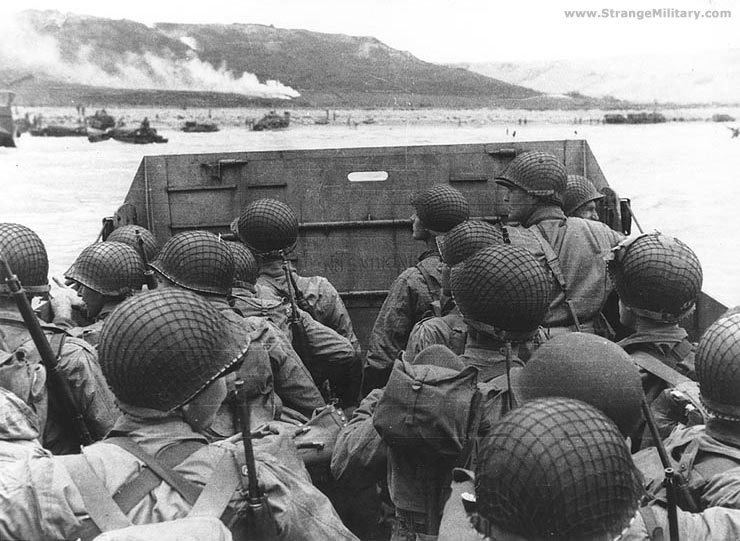
D-DAY, June 6, 1944

Thursday, June 6th, 2013

“Soldiers, Sailors and Airmen of the Allied Expeditionary Force! You are about to embark upon a great crusade, toward which we have striven these many months. The eyes of the world are upon you. The hopes and prayers of liberty loving people everywhere march with you. In company with our brave Allies and brothers in arms on other fronts, you will bring about the destruction of the German war machine, the elimination of Nazi tyranny over the oppressed peoples of Europe, and security for ourselves in a free world.

Your task will not be an easy one. Your enemy is well trained, well equipped and battle hardened, he will fight savagely.

But this is the year 1944! Much has happened since the Nazi triumphs of 1940-41. The United Nations have inflicted upon the Germans great defeats, in open battle, man to man. Our air offensive has seriously reduced their strength in the air and their capacity to wage war on the ground. Our home fronts have given us an overwhelming superiority in weapons and munitions of war, and placed at our disposal great reserves of trained fighting men. The tide has turned! The free men of the world are marching together to victory!

I have full confidence in your courage, devotion to duty and skill in battle. We will accept nothing less than full victory!

Good Luck! And let us all beseech the blessings of Almighty God upon this great and noble undertaking.

— Gen. Dwight D. Eisenhower “

Sixty-nine years ago over 9,000 American men, some hardly older than boys, laid down their lives on the beaches of Normandy in the greatest military operation in the history of the world. The white crosses stand row upon row in Colleville-sur-Mer,  in silent testimony of their supreme sacrifice.

Others who scrambled ashore on bloody Omaha Beach, or who climbed the rocky cliffs of Pointe du Hoc or who parachuted behind enemy lines with the 82nd and 101st Airborne lived to fight their away across France and across the Rhine into the heartland of Germany to break the power of the Third Reich forever. Others who survived the terrible ordeal of D-Day and fought on were not so lucky and did not come home.

The median age of WWII veterans now stands at 92. The “Greatest Generation” is receding into history in increasing numbers with each passing year but their deeds are destined to become legend.

….The men of Normandy had faith that what they were doing was right, faith that they fought for all humanity, faith that a just God would grant them mercy on this beachhead, or on the next. It was the deep knowledge – and pray God we have not lost it – that there is a profound moral difference between the use of force for liberation and the use of force for conquest. You were here to liberate, not to conquer, and so you and those others did not doubt your cause. And you were right not to doubt.

You all knew that some things are worth dying for. One’s country is worth dying for, and democracy is worth dying for, because it’s the most deeply honorable form of government ever devised by man. All of you loved liberty. All of you were willing to fight tyranny, and you knew the people of your countries were behind you.

The Americans who fought here that morning knew word of the invasion was spreading through the darkness back home. They fought – or felt in their hearts, though they couldn’t know in fact, that in Georgia they were filling the churches at 4:00 am. In Kansas they were kneeling on their porches and praying. And in Philadelphia they were ringing the Liberty Bell.

Something else helped the men of D-day; their rock-hard belief that Providence would have a great hand in the events that would unfold here; that God was an ally in this great cause. And so, the night before the invasion, when Colonel Wolverton asked his parachute troops to kneel with him in prayer, he told them: “Do not bow your heads, but look up so you can see God and ask His blessing in what we’re about to do.” Also, that night, General Matthew Ridgway on his cot, listening in the darkness for the promise God made to Joshua: “I will not fail thee nor forsake thee.”

…..Here, in this place where the West held together, let us make a vow to our dead. Let us show them by our actions that we understand what they died for. Let our actions say to them the words for which Matthew Ridgway listened: “I will not fail thee nor forsake thee.”

Strengthened by their courage and heartened by their value [valor] and borne by their memory, let us continue to stand for the ideals for which they lived and died.

Thank you very much, and God bless you all. ”

– Ronald Wilson Reagan, President of the United States, June 6, 1984

Is 4GW Dead?: Point-Counterpoint and Commentary

Tuesday, May 28th, 2013

4GW theory has always attracted overenthusiasts and  raging haters ever since the concept emerged way back in 1989, so debates about the merit of 4GW are nothing new; in fact, the arguments became so routine that they had largely gone sterile years ago.  After T.X. Hammes published his excellent  The Sling and the Stone and John Robb  went to the next level with Brave New War , it seemed that  little new was left to be said. In the late 2000’s, intellectual energies shifted to arguing the nuances and flaws of Pop-centric COINwhich proved in time to be even more bitter than those about 4GW.

Generations of War Theory Visualized by Chet Richards

What is different recently is that the person taking the affirmative on the question “Is 4GW dead?” was Dr. Chet Richards, who for years ran the premier but now defunct 4GW site, D-N-I.net, now archived here by the Project on Government Oversight.  Richards is no Clausewitzian true-believer or Big Army MBA with stars, but a former collaborator with John Boyd and a leading thinker of the 4GW school who had written several books with that strategic theme.

Therefore, not a critic to be dismissed lightly. Here’s Chet:

Is 4GW Dead? 

….The first thing to note is that 4GW is an evolution from 3GW, which they equate to maneuver warfare and the blitzkrieg as defined in MCDP 1 and Boyd’s Patterns of Conflict. These are styles of warfare conducted by state armies against other state armies, although the paper does invoke the notion of transnational terrorists near the end.

At some point in the late 1990s, the theory bifurcated. Bill Lind and Martin van Creveld began to emphasize the decline of the state and focus on transnational guerrilla organizations like al-Qa’ida. Tom Barnett called this the “road warrior” model. T. X. Hammes, on the other hand, characterized 4GW as “evolved insurgency” and envisioned the techniques described in the paragraphs above as also useful for state-vs-state conflicts.

….The 9/11 attacks, by a transnational guerrilla movement, seemed to confirm 4GW in both of its forms. In the last few years, however, everything has gone quiet. Transnational insurgencies, “global guerrillas” as John Robb terms them, have not become a significant factor in geopolitics. “Continuing irritation” might best describe them, whose primary function seems to be upholding national security budgets in frightened western democracies. The state system has not noticeably weakened. So it might be fair at this point to conclude that although 4GW was a legitimate theory, well supported by logic and data, the world simply didn’t develop along the lines it proposed.

A prominent critic of 4GW, Antulio J. Echevarria, may have been correct:

What we are really seeing in the war on terror, and the campaign in Iraq and elsewhere, is that the increased “dispersion and democratization of technology, information, and finance” brought about by globalization has given terrorist groups greater mobility and access worldwide. At this point, globalization seems to aid the nonstate actor more than the state, but states still play a central role in the support or defeat of terrorist groups or insurgencies.

Why? I’ll offer this hypothesis, that the primary reason warfare did not evolve a fourth generation is that it didn’t live long enough. The opening of Sir Rupert Smith’s 2005 treatise, The Utility of Force, states the case….

Chet’s post spurred a sharp rebuttal from William Lind, “the Father of Fourth Generation Warfare”:

4GW is Alive and Well 

So “the world simply didn’t develop along the lines it (4GW) proposed”? How do you say that in Syriac?

The basic error in Chet Richards’ piece of April 19, “Is 4GW dead?” is confusing the external and internal worlds. Internally, in the U.S. military and the larger defense and foreign policy establishment, 4GW is dead, as is maneuver warfare and increasingly any connection to the external world. The foreign policy types can only perceive a world of states, in which their job is to promote the Wilsonian nee Jacobin, follies of “democracy” and “universal human rights.” They are in fact, 4GW’s allies, in that their demand for “democracy” undermines states, opening the door for more 4GW.

In most of the world, democracy is not an option. The only real options are tyranny or anarchy, and when you work against tyranny, you are working for anarchy. The ghost of bin Laden sends his heartfelt thanks.

Third Generation doctrine has been abandoned, de facto, if not de jure, by the one service that embraced it, the U.S. Marine Corps. The others never gave it a glance. The U.S. military remains and will remain second generation until it disappears from sheer irrelevance coupled with high cost. That is coming much sooner than any of them think.

….In many of these cases, including Egypt and Pakistan, the only element strong enough to hold the state together is the army. But the “democracy” crowd in Washington immediately threatens aid cut-offs, sanctions, etc., if the army acts. Again, the children now running America’s foreign policy are 4GW’s best allies.

Fourth generation war includes far more than just Islamic “terrorism,” and we see it gaining strength in areas far from the Middle East. Gangs have grown so powerful in Mexico, right on our border, that I predict the state will soon have to make deals with them, as the PRI has done in the past. Invasion by immigrants who do not acculturate is a powerful form of 4GW, more powerful than any terrorism, and that is occurring on a north-south basis (except Australia) literally around the world. Remember, most of the barbarians did not invade the Roman Empire to destroy it. They just wanted to move in. In fact, most were invited in. Sound familiar?

What should concern us most is precisely the disconnect between the internal and external worlds. Externally, 4GW is flourishing, while internally, in the US government and military, it does not exist. This is the kind of chasm into which empires can disappear….

Fabius Maximus – who is a both a pseudonymous blogger and a group blog, also responded:

Update about one of the seldom-discussed trends shaping our world: 4GW 

One of the interesting aspects of recent history is the coincidence of

  1. the collapse of discussion about 4GW in US military and geopolitical circles,
  2. victories by insurgents using 4GW methods over foreign armies in Iraq and Afghanistan, &
  3. most important, the perhaps history-making victory by Bin Laden’s al Qaeda.

The second point is important to us, but the usual outcome since WW2 (after which 4GW became the dominate form of military conflict; see section C below).  The third point is the big one. Based on the available information, one of Bin Laden’s goals was to destabilize the US political regime. Massive increase in military spending (using borrowed funds). The bill of rights being shredded (note yesterday’s House vote to tear another strip from the 4th amendment). Our Courts holding show trials of terrorists — recruited, financed, supported by our security services. Torture and concentration camps.

….We — the Second American Republic — have engaged in a war with nationalistic, Islamic forces using 4GW.  So far we are losing.  For various reasons we are unable to even perceive the nature of the threat. In DoD the hot dot is again procurement of high-tech weapons — new ships, the F-35, the hypersonic cruise missile, etc.  All useless in the wars we’ve fought for the past 50 years, and probably in those of the next 50 years….. 

A few comments.

4GW has been heavily criticized – and accurately so – for making selective use of history, for unsupported maximal claims, for an excessively and ahistorically linear argument and for shifting or vaguely defined terms. Presented rigidly, it is relatively easy for critics to poke holes in it simply by playing “gotcha” (some of the criticism of 4GW did not get beyond ad hominem level garbage, but more intellectually serious detractors made very effective critiques of 4GW’s flaws).

That said, there were a number of useful elements or insights in the body of 4GW writings that retain their utility and I think are worth recalling:

  • Whatever one thinks of 4GW as a whole, the school drew attention to the threat of non-state irregular warfare, failed states and the decline of state vs. state warfare and did so long before it was Pentagon conventional wisdom or trendy Beltway talking head spiels on Sunday morning news programs.
  • While the state is not in decline everywhere in an absolute sense, it sure is failing in some places and has utterly collapsed elsewhere. Failed, failing and hollowed out states are nexus points for geopolitical problems and feature corruption, black globalization, insurgency, tribalism, terrorism, transnational criminal organizations and zones of humanitarian crisis. Whether we call these situations “irregular”, “hybrid”, “decentralized and polycentric”, “LIC”, “4GW” or everyone’s favorite, “complex” matters less than using force to achieve political aims becomes increasingly difficult as the interested parties and observers multiply. Some of the advice offered by the 4GW school regarding “the moral level of war”, de-escalation and the perils of fighting the weak in such a conflict environment are all to the good for reducing friction.
  • The emphasis of the 4GW school on the perspective of the irregular fighter and their motivations not always fitting neatly within state-centric realpolitik, Galula-ish “Maoist Model” insurgency, Clausewitzian best strategic practice or the Western intellectual tradition, were likewise ahead of their time and contrary to S.O.P. Even today, the effort to see the world through the eyes of our enemies is at best, anemic. Red teams are feared more than they are loved. Or utilized.
  • The bitter criticism the 4GW school lodged of the American political elite being allergic to strategic thinking and ignorant of strategy in general was apt; that American strategy since the end of the Cold War has been exceedingly inept in thought and execution is one of the few points on which the most rabid 4GW advocate and diehard Clausewitzian can find themselves in full agreement.

The lessons of 4GW will still be relevant wherever men fight in the rubble of broken societies, atomized communities and failed states.


Switch to our mobile site