zenpundit.com » authors

Archive for the ‘authors’ Category

Book Review: BRUTE by Robert Coram

Monday, March 28th, 2011

Brute: The Life of Victor Krulak, U.S. Marine by Robert Coram

Robert Coram has taken a different tack with BRUTE, the story of USMC Lt. Gen. Victor H. “Brute” Krulak, the diminutive legendary Marine general with the outsized personality, relentless ambition and far-reaching vision. It is an edgier, more sharply judgmental, more concise Coram who has made a biography of a challenging and not entirely sympathetic subject into a page-turner.

There are two stories in BRUTE. The first is of the life of the book’s namesake and his rise through the ranks of the Marine Corps, a career path that helped determine a critical element of American warfighting in WWII and saw the darkest sides of the wars in Korea and Vietnam before Krulak was denied promotion to Commandant because of the last war. The second story is that of the Marine Corps itself and it’s 20th century struggle for survival as a military branch of service against the bureaucratic machinations of the Army, the Navy and the ill-will of several presidents, a struggle in which Brute Krulak played a key part.

Reading between the lines, I sense that Coram, who delights in chronicling military mavericks, struggled with Krulak as a subject in a way he may not have with previous biographies like Boyd. Brute Krulak was a contradictory and controversial figure. Brilliantly innovative, absolutely dedicated, courageously outspoken, fiercely loyal, intensely driven and a physically brave Marine officer who led by example, Brute Krulak was also extremely and persistently deceptive, given to sins of omission as well as a relish to embellish and a machiavellian capacity to manipulate. The biography makes clear that Coram could not easily rely on the veracity of the anecdotes that an elderly but still mentally keen Brute Krulak grudgingly related to him.

Krulak could also be cold and emotionally abusive in his private life. It is clear that Krulak’s eldest son, Victor bore significant scars from treatment at his hands and Krulak , as much as he was able, effectively banished his extended family, including his parents, from his adult life in order to conceal his Jewish origins from a Marine and Navy hierarchy rife with anti-semitism. Like many young men on the make in the 19th and early 20th centuries, Krulak shed his religious traditions for the enhanced social mobility of the Episcopalian Church, the prestigious Protestant denomination of the Eastern Establishment elite, marrying into a wealthy, socially prominent family. Krulak so thoroughly reinvented himself and obscured his humble origins that late in life, his sons, who included two protestant ministers, were shocked to discover that their paternal grandparents and father were actually Jewish and not “Moravian” as they had been told.

In terms of operational art, Brute Krulak figures prominently in the history of two areas for which the United States Marines are best known: amphibious landings and counterinsurgency ( making this biography exceptionally timely). In both cases, Krulajk’s story intertwines with Coram’s theme of the Marine Corps at war with a predatory Army and Navy, each looking for their own reasons to demote the Marines to the “police force of the Navy” and end forever the role of the Marine Corps as a combat arm of the United States military. It is here that Coram’s pen acquires the sharpest edge.

Criticism of General William Westmoreland is common enough, and he comes in for his share of it in BRUTE, as are negative assessments of General Douglas MacArthur. That breaks little new ground as most historians see both men as flawed military leaders, albeit in different ways.  What is highly unusual is the willingness of Robert Coram as a historian to boldly level audacious charges of undermining civilian control of the military against hallowed figures of the US Army such as General George Marshall, that Marshall and other senior generals of the Army conspired during the postwar creation of the Department of Defense to usurp power over the armed forces properly belonging to Congress and to concentrate it in the hands of a Prussian-style “general staff”; that General Dwight Eisenhower attempted to lie to Congress about his role in the JCS 1478 papers. Unlike in Boyd, where Coram found some key high-ranking Air Force generals who acted as protectors of Colonel John Boyd against a hostile hierarchy, in BRUTE Coram emerges as a squared away partisan for Marines in their battle with “Big Army”.

Robert Coram has written a fast-moving, often sympathetic, at times troubling portrait of Victor “Brute” Krulak, one of the legendary Marine generals who never made Commandant because he told his Commander-in-Chief unwelcome truths about the president’s war and suffered the natural consequences.

Strongly recommended.

Corn’s Caliphates in Wonderland

Saturday, March 26th, 2011


They Just Don’t Make Caliphates Like They Used To….

SWJ Blog featured a lengthy (30 page) essay by Dr. Tony Corn on….well….many things. Corn begins with caliphates and then sort of takes off much like a blown up balloon abruptly released by a child prior to tying a knot in the end.

The Clash of the Caliphates: Understanding the Real War of Ideas by Dr. Tony Corn

….For one thing, within the global umma, there appears to be as many conceptions of the ideal Caliphate as there are Muslims. This grass-roots longing for a symbol of unity should be heard with the proverbial Freudian -third ear,?? and seen for what it really is, i.e., a symptom rather than a disease. For another, by agreeing to establish diplomatic relations with the 57-member Organization of the Islamic Conference (OIC), America and Europe have, in essence, already granted the OIC the status of a Quasi-Caliphate.

More important still, it is time for Western policy-makers to realize that the ideological rivalry between Saudi Arabia and Iran that has been going on since 1979 constitutes nothing less than a Clash of the Caliphates. Through a soft power strategy blurring the distinction between -public diplomacy?? and -political warfare,?? -humanitarian aid?? and -religious propaganda,?? the two states have been the main drivers of the re-Islamization process throughout the Muslim world. The one-upmanship dynamic generated by the rivalry between these two fundamentalist regimes is the main reason why, from the Balkans to Pakistan, the re-Islamization of the global umma has taken a radical, rather than moderate, dimension.

Ok, “caliphates” as a metaphor/analogy for geopolitical rivalry of Muslim states works but it is not really what Islamists or normal Muslims would mean by the term. It is a very odd usage. I’m not overly bothered by that because I tend to like analogies but Corn’s device here is apt to make the heads of area studies and Islamic history scholars explode. The whole essay is in this meandering, idiosyncratic, vein.

Now that is not to suggest that you should not read the piece. Dr. Corn held my attention all the way through and he has a number of excellent observations on many, loosely related, subjects. For example, after discussing the pernicious effects of Saudi donations and Edward Said’s agitprop theory of “Orientalism” on the intellectual objectivity of academia, Corn writes:

…The combined effect of the House of Saud and the House of Said is the first reason why the Ivory Tower has done such a poor job identifying the nature of Muslim Exceptionalism. A more indirect, yet more insidious, reason is that, unlike in the early days of the Cold War, American academics across the board today are trained in social sciences rather than educated in the humanities. For social scientists, Explanation (erklaren) and -theory-building?? take precedence over Understanding (verstehen) and -policy-making. The victory of the -numerates over the -literates in the 1970s has produced a generation of scholars who show a certain virtuosity when it comes to -research design, but display an amazing lack, not just of historical literacy, but of -historical empathy as well. Not to make too fine a point: the Long War is being waged by a generation of policy-makers who, however articulate, never learned anything about history in their college years

Corn is spot on here. Not only is it spot on, it is likely to get much worse. After a brief qualitative “bump” from Iraq-Afghan war  language trained vets, diplos, analysts and spooks peters out, we will have the Gen Y kids with K-12 educations scrubbed free of history, foreign languages and science graduating from college with communication and marketing degrees and entering government service. Hang on to your hat when that happens.

What Corn really requires to vault his essays to the next level are the services of an experienced editor because less would be more. The man is erudite and insightful. He writes forcefully and raises a number of points that are important and with which I agree. Corn, commendably, also makes more of an effort to connect the dots than most. But maybe, if you have an essay that references David Kilcullen, Trotsky, neo-Ottomanism, lawfare, Sam Huntington, neo-COIN, Nasser, Vatican II, the Comintern, the Hapsburgs, Ataturk, public diplomacy, al- Qaradawi, social media, Fascism, Marc Lynch, Youtube, network theory, the UN, hybrid wars and the Protestant Reformation, it might be time to up the Ritalin dosage a notch. Jesus, there’s either a book proposal or four different articles in that kitchen sink of an op-ed!

Read it and take what is useful.

Book Review: Grand Strategies by Charles Hill

Monday, March 21st, 2011

Grand Strategies by Charles Hill

Charles Hill, senior Cold War diplomat, Hoover Institution fellow and a co-founder of Yale’s popular Grand Strategy Program that amounts to a crash course in the kind of classical liberal education that universities once imparted to undergraduates but today pride themselves in doing so no longer. The popularity of Hill’s program,  therefore, is with the students moreso than campus activists or the faculty:

…Despite whispers of words like “elitist,” “conservative,” and “cult”-words considered synonyms by many at Yale-The Grand Strategy seminar, only a few years old, has become one of the university’s marquee classes. Grand Strategy, like Professor Hill, has its own myth. The liberals on campus call the class Grand Fascism. They are kidding, but only in part. Many Yale students and faculty are suspicious of the program. Students awed or repelled by Grand Strategy are the same ones who are awed or repelled by Professor Hill, and for the same reasons: the aura of power, the whiff of elitism, the promise of an answer to life’s messiest questions.

If the Grand strategy Course at Yale is a distillation of classical liberal education, Grand Strategies: Literature, Statecraft and World Order is Hill’s reification of the course as an education for the reader on how the evolution of the Western civilizational worldview makes possible grand strategy. The book is an intellectual tour de force by Hill, at some times an idiosyncratic one and at all times an interesting one. I have read many, though very far from all, of the classic texts that Hill critiques and uses to shape his argument but having a large library under your belt is not a prerequisite from understanding Grand Strategies. Far from it, one suspects Hill wrote the book with his seminar students in mind.

Hill examines the protean and mythopoetic relationship between cultural foundations and expressions of power and political wills in conflict represented by diplomacy and war, both navigated by grand strategy constructed from cultural vision. A recurring theme in Grand Strategies is the heroic structure of the epic tale, with the descent into the Underworld and revelation of the heroic destiny by the shades and an ascent (not always successful or as ideally envisioned) to a creative, transformative new order. The reader meets Achilles in many guises, marches upcountry with Xenophon, is cast out of Heaven by Milton, confronts Hobbes‘ Leviathan, defies Rosseau’s general will and exorcises the evil represented in Dostoyevskii’s The Possessed. And this only is a tenth of the narrative.

While I frequently found myself in agreement with Hill’s discernments of the texts, some of them struck me as strained or highly debatable, such as Hill’s reading of Plato as a wry ironist ( Hill borrows from Leo Strauss here but goes further, if I recall correctly, than Strauss did), something that Carroll Quigley, Karl Popper or many classicists would have disputed. Hill’s final chapter, “The Writer and the State” is entertaining and contains a laudatory anecdote about Hill’s former boss, the impressive SECSTATE George Schultz , but it lacked some of the gravity of earlier chapters.

Erudite and visionary, Grand Strategies is a grand synthesis by Charles Hill with lessons to learn on every page.

(Special hat tip to J. Scott Shipman who pushed me to read and review this book)

The Existence of the Operational Level of War, For and Against

Wednesday, March 16th, 2011

I was involved in a discussion elsewhere regarding the excellent and thought provoking article at SWJ by General Huba Wass de Czege on operation art, design and thinking:

Operational Art is Not a Level of War

Strongly recommend you read the article first. My remarks follow, slightly revised:

I have only read a few pieces by General Wass de Czege, those published at SWJ but the caliber of the general’s self-reflective, professional, thinking is something we should strive to emulate.

Here is what seems to be the crtical point in his article, after which I have a comment:

 “We doctrine writers of the 1980’s inserted operational art as a mid-level of war between tactics and strategy – making it the art of translating the governing strategy into the implementing tactics of the “tactical echelons.” And thus, making operational art the province of “campaigning” generals. Because of the way I was conditioned to think then, that strategy was the business of the upper echelons and tactics the business of the lower ones, I miss-translated an idea borrowed from Soviet doctrine about the mediation between strategy and tactics. I was then a product of indoctrination in the US Army’s War and Command and Staff Colleges. These institutions, and the business schools of the time, taught based on the industrial age organizational model of the head (where strategic decisions are made) and the rest of the body (where tactical decisions implement the strategy). I now believe that, without violating the historical meaning of the terms strategy and tactics, this is a much more useful and natural way to think of the relationship between tactics, strategy and operational art.

In fact, this allows one to close the conceptual gap between our bifurcated way of thinking about warfare between nation states and that between states and armed movements of any kind. It also helps do the same for the two tactical operating modes that have recently surfaced in new Army concepts – “combined arms maneuver” and “wide area security.”

Campaigning, another word for operational art, can occur at any scale, and in any milieu, as a close look at what our best company, battalion, and brigade commanders have been doing in Iraq and Afghanistan. “

I think maybe this should be qualified – re; operational art is not a “level”. It is a level of war and it is not at the same time.
 
The difference between the two I think is *how* we are employing the term: “Operational art” as a historical, taxonomic, description of how a military-political command structure has behaved/behaves as a warfighting institutional culture vs. methodologically how they *could* and *should* think about warfare and in turn behave at any “level”.
 
It is not surprising to me, thinking in terms of history, that Wass de Czege, where he wrote that he was in error, was drawing from Soviet examples. If we think about “operational art” as a “level of war” we are led to military powers where powerful ideological constraints systemically interfered with the “natural” clausewitzian connection between Policy and Strategy.
 
The USSR’s Red Army, from the early days of Commissar-Commander relationships in battle, through the Stalinist era to the more modern and restrained (i.e. non-murderous) controls of the Army’s Political Department and vetting security checks for promotion carried out jointly by the military, State Security and Party organs, created an atmosphere where deferral of political implications caused a) a segregation of an officer’s intellectual initiative to organizational and technical military questions and b) constructing military strategy and operational campaigns to at least nominally reflect Marxist-Leninist dogma and the Party line as a matter of necessity, and for a period, in an effort to try and avoid being physically liquidated.
 
Most of the Soviet Union’s most gifted military strategists and tacticians were unsuccessful in this regard and perished (ex. Svechin, Tukhachevskii, Blyukher). Arguably that left an institutional legacy in it’s wake that narrowed the conceptual framework with which Soviet Marshals and generals approached planning for war, including nuclear war.
 
Germany is another example, with the policy-strategy split favoring a professional military focus on operational art emerging as early as 1870 in tensions between Bismarck and Moltke over the war with France, growing worse during the Great War until during the Third Reich, a state of enforced paralysis occurs after 1942 on the Eastern Front. In theory, Hitler, who was his own war minister and commander-in-chief of the Army in addition to being the Supreme Commander, Fuhrer and Reich Chancellor, could (like Stalin) have resolved any contradictions or discordance between Policy and Strategy. Hitler deliberately chose not to do so and his paranoia led him to eventually limit even his field commander’s tactical flexibility (some generals, like Rommel, resisted this more effectively than others).
 
The US military, in my view, suffers a similar fixation. The reasons are very different – proper constitutional deference to civil authority coupled with a limited or absent capacity of most civilian political authorities to think in a complementary strategic fashion that would allow them to best guide their military commanders in jointly constructing a seamless bridge between policy-strategy-operational campaign. Another reason, though I do not want to go into it here, is a cultural reaction to the experience of the Vietnam War that became embedded in the officer corps during the shift to the AVF starting with the Nixon administration.
 
Tom Ricks had a very interesting post at Best Defense while back on the Hew Strachan article in which Ricks argued against the existence of an operational level of war, but as we are not discussing platonic forms, militaries are at whatever “level” of war for which their culture institutionally encourages officers to think about and plan. So in that sense, Wass de Czege is absolutely correct – they can and should be thinking across the whole range and not in “slots”. However, if they don’t do what he suggests and if they do predominantly focus on one “level” as most of their thinking and planning, be it tactics, operations, strategy. Then that level “exists”, it leaves a bureaucratic “trail”, grows a structure to execute it and will be put into practice during a war – at least initially until events force a change of practice from below (the field) or above ( political leaders).

Currently Reading…

Monday, March 14th, 2011

Making an effort this week to finish up books I have picked up or been sent to me by publishers, PR folks and authors, so I can review them….and two books pulled from the ominous antilibrary.

 Here’s what is currently on my desk and nightstand:

Reading and taking notes:


Grand Strategies by Charles Hill
Narcos Over the Border
by Dr. Robert J. Bunker (Ed.)
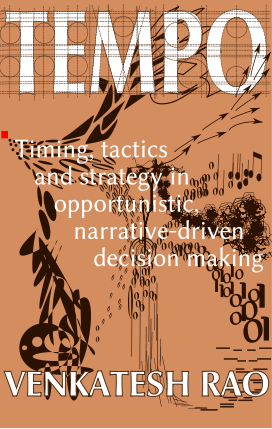
TEMPO
by Dr. Venkat Rao
Mind Wide Open
by Steven Johnson

This would be an interesting group of authors to put on a panel for a strategy-related question, such as – “How can we fix our AfPak policy?” – as you would get a high-level practitioner-policy wonk-cognition expert mix.

TEMPO is not yet available for sale, but Dr. Rao was kind enough to send me a PDF of his manuscript, which I am reading on my iPad along with another author’s manuscript and a screenplay, both of which are embargoed. I’m enjoying them all but reading most of them for review is slower going than just reading one for my own interest. I frequently end up taking detours because the authors bring up so many intriguing points. For example, Charles Hill has a section on Grand Strategies on Montaigne, the brilliant intellectual diplomat of the politically tumultuous French Renaissance and Father of the literary essay. Hill made a number of assertions, so I stopped, pulled a copy of The Essays ( which I have never read) off a shelf, flipped it open to a page, and started reading for and discovered that a) Hill was right and b) it will be a profitable use of my time to go back and read The Essays some day.

Next Up in the Queue:


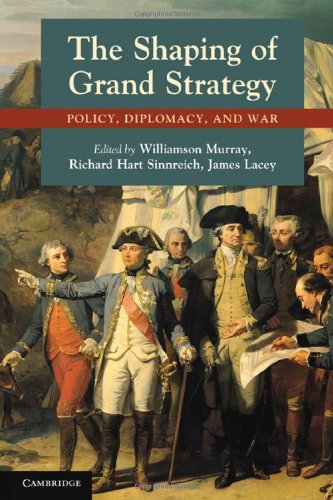
The Shaping of Grand Strategy: Policy, Diplomacy, and War by Drs. Williamson Murray, Richard Hart Sinnreich and James Lacey (Ed.)


Counterinsurgency by Dr. David Kilcullen

The first book I mentioned recently, the second is one I have had sitting unread for quite a while but I need to read for an article I started writing. Among practitioners and policy makers, Colonel Kilcullen is the George Kennan of COIN.

What are you reading?


Switch to our mobile site