zenpundit.com » bin laden

Archive for the ‘bin laden’ Category

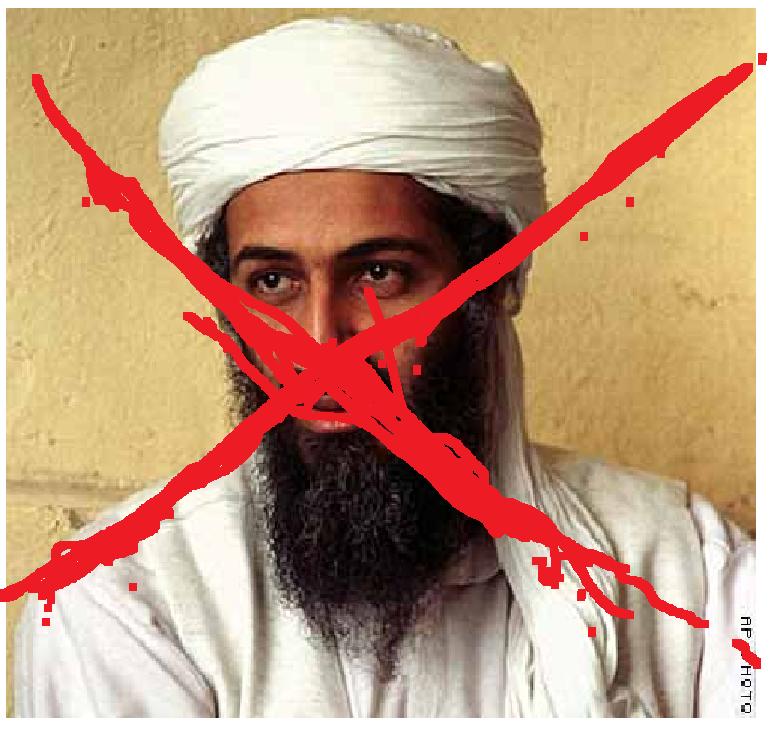
BIN LADEN DEAD

Monday, May 2nd, 2011

binladendead2.jpg

May he rot in Hell. 

Osama Bin Laden, sponsor of 9-11 and founder of al Qaida is dead, killed in Pakistan by a US JSOC-CIA team, possibly with Pakistani cooperation (or…maybe not).

Details will emerge that Bin Laden has not been in a cave for the past decade.

A great day for the United States! The Obama administration deserves credit here and the military and intelligence personnel deserve our deepest thanks!

Cameron on “A Translation of Abu Walid al-Masri’s Reply”

Thursday, June 17th, 2010

Charles Cameron, my regular guest blogger, is the former Senior Analyst with The Arlington Institute and Principal Researcher with the Center for Millennial Studies at Boston University. He specializes in forensic theology, with a deep interest in millennial, eschatological and apocalyptic religious sects of all stripes.

Zen here – some background prior to Cameron’s guest post. As I mentioned previously, Charles, a while back, posted a deeply reflective essay here at ZP and at Leah Farrall’s  All Things Counterterrorism, in response to the unusual dialogue that Farrall, a former Australian counterterrorism official, was having with  Abu Walid al-Masri, an Egyptian strategist of jihad, a sometime critic of al Qaida and an adviser to the Taliban. In other words, al-Masri is an influential voice on “the other side” of what COIN theorists like Mackinlay and Kilcullen call the “globalized insurgency” and a theorist of insurgency himself. After some delay, al-Masri responded to Charles, as Farrall described:

Abu Walid al Masri responds to Charles Cameron

Abu Walid  has responded a letter from Charles Cameron. Abu Walid’s response  to Charles can be found here.  You’ll notice when following the link, that he has a new website.It’s well worth a look. There is also an interesting comment from a reader below Abu Walid’s response to Charles; it’s from “one of the victims of Guantanamo”.

As you’ll see from his website Abu Walid is also engaging in a number of other interesting dialogues at the moment, which I am interested to read as they progress.Charles wrote his letter in response to the dialogue Abu Walid and I had a little while back. For those of you new to the site, you can find this dialogue to the right in the page links section.  The letter from Charles can be found on my blog here.

….These letters may not change anything, but they are important because  in mass media sometimes only the most controversial and polarising views tend to make it into the news.I think person to person contact, especially via mediums like this, can go some way to providing opportunities for all of us to discover or be reminded that there is more than one viewpoint and along with differences there are also similarities. Contact like this humanizes people, and in my book that’s never a bad thing.

With that context in mind, we will now let Charles take it away:

A TRANSLATION of ABU WALID al-MASRI’S REPLY

by Charles Cameron

I asked a native-speaking grad student associate of mine to give me a literal translation of Abu Walid’s response to my post, and then tweaked it to give it a reasonable combination of accuracy and fluency, and my associate has kindly given the result his thumbs up — so what follows is probably fairly close to the sense of Abu Walid’s original.

Is this a return to the Age of Chivalry? — Comments on the Response of Charles Cameron

May 31, 2010

Author: Mustafa Hamed, Abu al-Walid al-Masri

MAFA: The Literature of the Outlaws

Charles Cameron’s words, in his comment on the dialog between myself and Ms. Leah Farrall, were wonderful, both for their humanitarian depth and in their high literary style, which makes it difficult for any writer to follow him. He puts me in something of a dilemma, fearing any comparison that might be made between us in terms of beauty of style or depth and originality of ideas — but in my capacity as one of those adventurous “outlaws”, I will try to contemplate, rather than compete with, his response, since this is what logic and reason call for.

Charles Cameron was deeply in touch with the roots of the problem that the world has (justly or unjustly) called the war on terror: it is a cause that relates to the sanctity of the human individual, and his rights and respect, regardless of any other considerations around which the struggle may revolve.

No one can argue about the importance of peace, or the need all humans have for it, nor can anyone argue that war is not hideous, and universally hated.  And yet wars are still happening, and their scope is even increasing.

And now the West claims: it is terrorism — as if war on the face of the earth were the invention of Bin Laden and al-Qaida — and all this, while many others are arguing ever more forcefully that the opposite is true, that al-Qaida and Bin Laden are the invention of war merchants, and that no one can definitely declare as yet — in an unbiased and transparent way — who caused the events of September 11 and the deaths of three thousand persons.

It is not only the one who pulls the trigger who is the killer, as we know —  the one who set the stage for a crime to be committed, who arranges the theatre, and opens the doors, and lures or hires the one who pulls the trigger is even more responsible. He’s the one, after all, who carries away the spoils of the crime, then chases down the trigger-man and finishes him off — not for the sake of justice, nor for love of humanity, but to hide the evidence of the crime, to erase his own fingerprints, and assassinate the witnesses who could implicate him.

For example: was the execution of Saddam Hussein really about bringing justice? Of course not. They executed him after a travesty of a trial for the most trivial of his crimes. Nobody, however, asked him about his most significant crimes — they killed him before he could admit to them, or name the major partners who brought him to the apex of his power, and provided him with a full range of lethal weaponry including weapons of mass destruction, so he could perform mass murder with confidence in his own impunity.

I personally (and here I speak only for myself, so Ms. Farrall need not get irritated) would have preferred to have Charles Cameron as President of the US and a united Europe and the leader of NATO — then there would have been no wars in Afghanistan or Iraq, and the problem of terrorism would have ended in minutes, along with the problems in the Middle East, and nuclear militarization, and even those of poverty and pollution. Why? Because not a single one of these problems can be solved except through the logic of humanitarianism, of justice, and love for people and peace, and hatred of oppression and discrimination between people in any form — we are all the creatures of God, and to Him we shall all return.

I am reminded of Richard the Lionheart, who came to lead a big crusade to capture Jerusalem from Muslim hands. The bloody wars he led brought fatigue to everyone and benefited neither the religious or nor the day-to-day interests of either party. Leading the Muslim campaign was Sultan Salah al-Din al-Ayyubi (Saladin), King Richard’s peer in courage, chivalry and wisdom.

Both parties finally agreed that Jerusalem should remain in Muslim hands — hands which would guarantee its security and that of its people, and of both the Islamic and Christian sanctuaries, preserving their interests and protecting the sanctuaries of all, in peace.

Thereafter, King Richard retreated from Muslim lands, carrying with him a most favorable impression of the Muslims and of Saladin as he returned to his own country, while leaving a continuing memory of respect and appreciation for himself and his chivalry with Saladin and the Muslims — which is preserved in our history books down to the present day.

It was Mr. Cameron’s spirit of fairness, chivalry and true spirituality that reminded me of King Richard’s character — but sadly, it is very difficult to find a ruler in the west like King Richard, and I find it even more regrettable that Muslims should have even greater difficulty finding among themselves a ruler like Saladin.

This is because things are on the wrong track, and people are not in their rightful positions. The wrong people are in power and leading us, while the best among us are weak and under siege.

No human likes or wants this state of affairs — but are the people who are in control of this planet real human beings? Can we consider those who own 50% of the earth’s wealth human, even though they comprise no more than 2% of the human population?

In my opinion, the situation is much worse than these international statistics suggest. I believe the number of those who rule the world is far fewer, and that they own much more. They are the ones who invest in all kinds of wars wherever, and under whatever name or banner, they may be found. The mention of war translates to these people as an immediate waterfall of gold tumbling into their usurious bank vaults, which hold the world — both leaders and led — by the neck.

I speak here of all wars without exception, whether they be the First and Second World Wars, or the wars in Korea and Vietnam, or the First and Second Gulf Wars, or the Third and Fourth, yet to come — whether it be a war in Afghanistan (to hunt for the “Bin Laden and al-Qaida” mirage) or in Iraq (looking for illusory “weapons of mass destruction”) or in Bosnia, Somalia or Africa — that continent of eternal wars for the sake of gold or oil fields — Africa, that colonized continent of disease, covertly modernized in the labs of the secret services and giant pharmaceutical companies.

I wish we could return to the age of chivalry– of courageous and rightly religious knights — for then wisdom would prevail and peace would spread, and we could leave this age of the brokers and merchants of war behind us.

Muslims always call on God to bless them with a leader such as Saladin , and I think they should also pray for God to bless the West with a ruler such as Richard the Lionheart — because without a Saladin here and a Richard there, the fires of war will continue to blaze. That’s the reason the brokers of wars will not allow the appearance of a Saladdin here, nor a Richard there.

By means of the laws to fight terrorism, the emergency laws, NATO, the Security Council and the International Court of Justice, the various counter-terrorism forces around the world, the CIA and FBI, and the Army and National Guard, the Patriot Act in the US, the jails at Guantanamo and Abu Ghraib and Bagram — and the secret “black sites” and “floating prison ships”– by all these means and many others, they kill and jail and start wars, so that humans (and terrorists) are not threatened by the likes of the two great kings, Saladin and Richard.

Therefore in the situation we find ourselves in now — despite our noble dreams of an age of knighthood and chivalry as an alternative to this age of broker kings — the destiny of all humanity, and even planet earth itself, remains in question. Of course there will be an end to all this someday… but how??… and when?? I do not think any one of us has the answer.

Finally I would like to thank Charles Cameron for his care in writing and commenting, and to express again my thanks to Ms. Leah Farrall, who deserves all the credit for initiating these dialogues.

Signed: Mustafa Hamed, Abu al-Walid al-Masri

The al-Masri Dialogue

Tuesday, February 9th, 2010

Charles Cameron, in his latest guest post here, penned a beautiful essay regarding the ongoing exchanges between Australian counter-terrorism scholar Leah Farrall and Abu Walid al-Masri, an adviser to the Taliban and an experienced strategist of Islamist insurgency. Farrall has translated and posted this dialogue on her blog, All Things Counter Terrorism, which has received much attention, commentary and criticism in the blogosphere and on private listservs and quasi-official bulletin boards.

Generally, I leave this sort of subject to Charles, since he has the academic expertise to drill down to a granular level of Islamic theology and Islamist ideology, but al-Masri is an intriguing figure and his public conversation with Farrall is a novelty worth investigating. It would be hard to imagine during the Cold War, an open media debate between a Western CI official and a Soviet spymaster still engaged in espionage in the field ( Kim Philby hurled public jermiads it is true, but that was in retirement in Moscow and only after his long-suffering KGB handlers had managed to get his severe alcoholism under control). In that spirit, I want to offer a few observations.

While there is artifice present, as al-Masri is consciously speaking to a multiplicity of audiences in his remarks, the idea that we should therefore dismiss the dialogue with Farrall, as some suggest, is an error. There is also posturing in purely intra-Islamist-debates on which we eavesdrop and, frankly, within our own arguments inside government and out. We learn from what people do and do not do, from what they say and what is left unsaid. Being able to speak to multiple audiences is a constraint, as well as an advantage, as it shapes the parameters of the premises to be employed and the extent to which the underlying logic can be permissably extrapolated. To quote a Zen saying, if you wish to fence in a bull, give him a large meadow. 

The constraints, if correctly discerned, are illuminating and are analytically useful in constructing our own tactical responses and message strategy (assuming someone can convince the State Department bureaucracy that IO and public diplomacy are important and persuade Congressional leaders to fund such activities with more than pocket change). They are also useful in helping to understand the worldview and governing paradigms of our opponents in more complex and nuanced manner than reflexively saying “they hate our freedoms”. Well, many jihadi types do in fact, viscerally hate our freedoms or deny that democracy is a legitimate form of government in an abstract sense, much the same way they casually disparage Hindus as “cow worshippers” or Thais as “crazy Buddhists”; however those loose attitudes and spasms of hostility are not akin to operational principles or strategic doctrines.

For that, we have to dig deeper into the politico-religious motivations of violent Islamists and listen closely to what our enemies are saying – particularly when they are making an effort to speak to us directly, as al-Masri is doing, his determination to score propaganda points in his little elicitation dance with Farrall notwithstanding. Americans are not very good at listening and our elites are deeply uncomfortable with the entire subject of religion, tending to view pious expressions of Christianity with contempt and Islam as a completely taboo subject. There is a strong preference in government and academia for analytical models of terrorism or insurgency that dwell on DIME spectrum variables because these fit in the personal comfort zones and the educational, social and professional experiences of the American elite. This would be a perfect approach if al Qaida’s leadership were composed of Ivy League alumni and Fortune 500 CEOs.

Economics and military force are always factors in geopolitical conflict, the war of terror included, but until Islamist extremists oblige us by becoming secular Marxist revolutionaries waving little red books, it would behoove us to look with greater scrutiny at the curiously reified religious ideology with which they justify or eschew courses of action to themselves. Our own strategies might be more focused and effective if the operators across our intelligence, military, diplomatic and law enforcement agencies had something approaching a shared understanding of violent Islamism and if they could communicate this understanding along with the benefit of their experience and current intelligence to help political leaders shape American policy.

Guest Post: Charles Cameron on Khorasan – A Muslim Once and Future Kingdom

Tuesday, January 19th, 2010

 Charles Cameron, my regular guest blogger, is the former Senior Analyst with The Arlington Instituteand Principal Researcher with the Center for Millennial Studies at Boston University. He specializes in forensic theology, with a deep interest in millennial, eschatological and apocalyptic religious sects of all stripes.

Khorasan: A Muslim Once and Future Kingdom

by Charles Cameron

The title of an interview in a Taliban sponsored magazine with Hammam Khalil al-Balawi — the Jordanian jihadist physician and double-agent / informant who signed himself Abu Dujana al-Khorasani on jihadist forums, and carried out the recent CIA bombing in Khost — is intriguing in a self-referential, “Doug Hofstadter might like this” sort of way:

Interview with Brother Abu Dujanah al-Khorasani, a Well-Known Blogger in Jihadi Forums, and a Newcomer to the Land of Khorasan.

In his appearances on the web, al-Balawi / Abu Dujana had given himself the geographic cognomen “al-Khorasani” meaning “from Khorasan” — yet he was a Jordanian by birth, and the interview title calls him a “newcomer” to Khorasan, while the interviewer himself remarks, “Abu Dujanah al-Khurasani (sic) is actually now inside Khorasan, and the decision to travel to the lands of jihad is a divine blessing and a magnificent grace.”

The Khorasan that Abu Dujana “is actually now inside” is presumably Afghanistan on the literal, geographical level — but what of the Khorasan of the mind and heart to which, as his choice of handle indicates, Abu Dujana must have long aspired?

What is the significance of “Khorasan”?

It’s a bit like “Jerusalem” — only yesterday I was reading that Grand Rapids, Michigan is referred to as “Jerusalem” by some folk of Dutch extraction in the Pacific Northwest. I think we’ll get the sense of the idea if we call it of “Khorasan of sacred memory and present hope”.  As the UCLA scholar Jean Rosenfeld puts it (personal communication):

In any event, Khorasan refers to much more than a former region of the Islamic empires.  It has a mythical meaning that is being taken seriously as a “once and future kingdom” in the millennial mindset of al-Qaida.

The territory once called Khorasan — and the borders covered by that name shifted a great deal over the centuries — covered parts of what we now know as Iran (which still has a province named Khorasan), Turkmenistan, Uzbekistan, Afghanistan and NW Pakistan.  I’m finding references that suggest the name originally meant “the place where the sun rises” — the East, the Orient.

Rosenfeld suggests that Khorasan “is code in al-Qaida for the warrior sect itself” — “the army of the (future) caliphate in the mind of the International jihad” and thus, Al-Qaida in Fawaz Gerges’ broad sense.  My own reading ties it in with the ahadith about the “black banners of Khorasan” and the army which will sweep down from Khorasan to Jerusalem…

As I’ve noted before   there are many variant ahadith describing the army of the Mahdi.  Here is one commonly cited version:

If you see the black flags coming from Khurasan, join that army, even if you have to crawl over ice, for this is the army of the Caliph, the Mahdi and no one can stop that army until it reaches Jerusalem.”

Quite how we should align that with actual jihadist entities such as AQ core and or its subsidiaries or the various bodies called Taliban, however, I’m not sure. The clearest implication I can see is to the place of origin of the Mahdi’s army.

It is at least as much an eschatological as a geographic claim.

Since the imagery of Khorasan is closely tied to that of black flags, I would like to take a slight detour here.  We have seen that the black flags signify the army of the Mahdi, but what are its origins, and how widely is it used?

The Islamic Imagery Project at West Point Combating Terrorism Center lists “Black Flag” under the heading “Warfare Motifs“, saying:

The Black Flag (al-raya) traces its roots to the very beginning of Islam.  It was the battle (jihad) flag of the Prophet Muhammad, carried into battle by many of his companions, including his nephew ‘Ali ibn Abi Talib.  The flag regained prominence in the 8th century with its use by the leader of the Abbasid revolution, Abu Muslim, who led a revolt against the Umayyad clan and its Caliphate.  The Umayyads, the ruling establishment of the Islamic world at the time, were seen as greedy, gluttonous, and religiously wayward leaders.  The Abbasid revolution, then, was aimed at installing a new, more properly Islamic ruling house that would keep orthodox Islam at the center of its regime. Since then, the image of the black flag has been used as a symbol of religious revolt and battle (i.e. jihad).  In Shiite belief, the black flag also evokes expectations about the afterlife.  In the contemporary Islamist movement, the black flag is used to symbolize both offensive jihad and the proponents of reestablishing the Islamic Caliphate.

The flag is frequently identified with specific jihadist groups — thus Bill Roggio, writing in Long War Journal, refers to “the al rayah, the black flag of al Qaeda” in his 2007 article, “Musa Qala and the NATO offensive”.

Likewise, the Somalian president Abdullahi Yusuf Ahmed in 2006 is reported to have spoken in 2006 of “the ‘black flag’ of Al-Qaeda and the Taliban” — and as recently as this month, Al-Shabaab “vowed to replace the Somali flag with its (al-Shabaab’s) black flag”.

So the Black Flags or banners represent the Prophet as warrior at one end of Islamic history and the Mahdi’s army from Khorasan at the other — and have been adopted as symbols of jihad by different groups from the Abbasids to al-Shabaab. They are indeed indicative of jihad, but it is their association with Khorasan that gives them a specifically Mahdist reference.

The defeat of the Umayyads and establishment of the Abbasid caliphate, and hence also the golden age of Islamic culture, was strongly supported by forces raised in Khorasan, and David Cook in his Contemporary Muslim Apocalyptic Literature suggests that “the Abbasids sought to present their movement as the fulfillment of messianic expectations, and so they produced a great quantity of materials given in the form of hadith traditions to indicate that the Mahdi would come from this region.”

The tale lives on. As I’ve mentioned before, Cook notes that bin Laden’s mentor, Abdullah Azzam, made fresh use of this line of messianic tradition and “popularized the position of Afghanistan as the messianic precursor to the future liberation of Palestine” in his book, From Kabul to Jerusalem, while bin Laden refers to finding “a safe base in Khurasan, high in the peaks of the Hindu Kush” in his 1996 Declaration of Jihad.

The spiritual geography, then, is clear: Khorasan is that place in the east, somewhere in the general region including eastern Iran and northern Afghanistan, from which the Mahdi’s army will come — and it is very plausibly also a place the jihadist might need to “crawl over ice” to reach.

I think Rosenfeld is right in suggesting that al-Balawi’s geographic cognomen is a significant one, as is “Abu Dujana” — the name of a particularly valiant companion of the Prophet, as I discussed in a previous post.

But which of the various jihadist forces currently deployed in Afghanistan and nearby might be the nucleus of the Mahdi’s forces? The army with black flags from Khorasan has been identified with the Abbasids, with the Iranian revolutionaries, and with the Taliban. Bin Laden would presumably wish for it to be with al-Qaida, and Cook also says, this time in Understanding Jihad:

Since Afghanistan, as Khurasan, has powerful resonance with many Muslims because of the messianic expectations focused on that region, this gave the globalist radical Muslims associated with al-Qa’ida under the leadership of Bin Ladin additional moral authority to proclaim jihad and call for the purification of the present Muslim governments and elites.

In Jordan via the jihadist web forums, al-Balawi signaled his identification with the victorious army of the coming Mahdi and with jihadists in Afghanistan by his choice of the cognomen “al-Khorasani” — but the name alone does not tell us which particular jihadist group he might have been thinking of, and that may not even have been an question he felt the need to resolve at that time.

  Once in Khorasan itself, al-Khorasani left us two “media” items, a magazine interview and a video, and we might hope that they would add to our understanding of the more literal, geographical meaning his name carried, for they clearly indicate his associations.

According to Flashpoint-Intel, who provided the version of the interview I’ve seen, al-Khorasani’s interview was given to “Vanguards of Khorasan” which they describe as “a well-known Taliban propaganda magazine” and released by the Al-Fajr Media Center, which they term “the official online logistical arm of Al-Qaida”. SITE refers to “Vanguards” as “the … magazine of al-Qaeda in Afghanistan”. Others more familiar with the logistics may want to clarify the point.

The video, then, seems to give the clearest indication. Al-Khorasani was taped sitting next to Hakimullah Mehsud, the head of the Terik- i-Taliban Pakistan or TPP (whose death in a drone strike is reported but unconfirmed at the time of writing), and indicated his allegiance with the words, “We will never forget the blood of our emir Baitullah Mehsud” — referring to Hakimullah’s predecessor.

In general, “Khorasan” doesn’t appear to function as code for a particular jihadist organization, but as a more general symbol for victorious jihad — coming from the East, faithful to the truth, unstoppable, ushering in the Caliphate, serving the cause of the Mahdi, and thus heralding the End of Days.

I’m intrigued to note that the Australian analyst / scholar Leah Farrall at All Things Counter Terrorism blogged on Abu Dujana today  (after I’d “completed” this post) and closed her post with an aside. I’ll quote the whole paragraph for context, but it’s the last point that ties in here:

Another point of interest is Khorasani’s  internet history circa 2001- 2003. Despite what Khorasani said in his interview in the Taliban magazine ( I think it was the Taliban mag if memory serves), one does not get to be a forum administrator overnight. I watched another person rise through the ranks this way and he had direct contact with  a mid-level AQ commander. It still took him 18 months or so. This brings me back to my question about Khorsani’s early internet history and possible real world history. As an aside, back then, in the early days you didn’t write Khorasani, Kandahari etc unless you had been there. It was used as an identifier. This has changed in recent years but I do wonder about this with him too.

Leah’s curiosity on this point reminds me that along with the general symbolism of Khorasan, which I have tried to explore here, there are intriguing aspects to the particular use Abu Dujana made of the name.

I look forward to any further thoughts she may have.

Grateful thanks to Jean Rosenfeld for our very helpful conversations around this and related topics, and for the comment that gave me its title.
Saturday, September 8th, 2007

OSAMA BIN WINGNUT?

What to make of Osama Bin Laden sounding less like a radical Salafist in his recent video than the infantile Sean Penn on a hysterical political rant, throwing in an homage to Noam Chomsky and global warming ? Well, government sources are pointing “Azzam the American”, the young Californian convert, Adam Yahiye Gadahn as the origin of the more childish rhetoric that seems to be ripped from the memes of the Lefty Wingnut blogosphere.

In my opinion, that is a stupid interpretation. If it comes from our intelligence agencies, and not some staffer at the White House, all the worse for us.

First of all, such an analysis gives far too much emphasis to the role of Gadahn, a relatively juvenile character. Al Qaida does not lack members with the ability to read English or surf the internet. The radical Islamist-terrorist community have long monitored American websites, particularly those related to military and intelligence circles; one of their favorite theorists appears to be none other than William Lind! Gadahn’s help in video production is a triviality, not a primary concern.

Secondly, the hodgepodge nature of the speech with Bin Laden zooming from Sarkozy to tax rates is indicative of an intentional raising of the noise to signal ratio. Much of this verbiage appears to me to be – well – irrelevant crap. It attracts media attention while distracting observers from two of the more ominous elements present in bin Laden’s speech – his continuing fascination with the atomic bombings of Hiroshima and Nagasaki and the call to embrace Islam. The latter being a religious duty for pious Muslims prior to the unleashing of war and ruin upon an enemy; a call once uttered by the generals of Arab caliphs and Turkish sultans half a millennium ago, before the sacking of infidel cities by Muslim armies.

The Germans just rolled up a major al Qaida cell days before an attack was to take place. Perhaps we should be looking at potential problems just a little bit harder ourselves.


Switch to our mobile site

