zenpundit.com » analytic

Archive for the ‘analytic’ Category

Excessive Complexity = FAIL

Tuesday, August 3rd, 2010

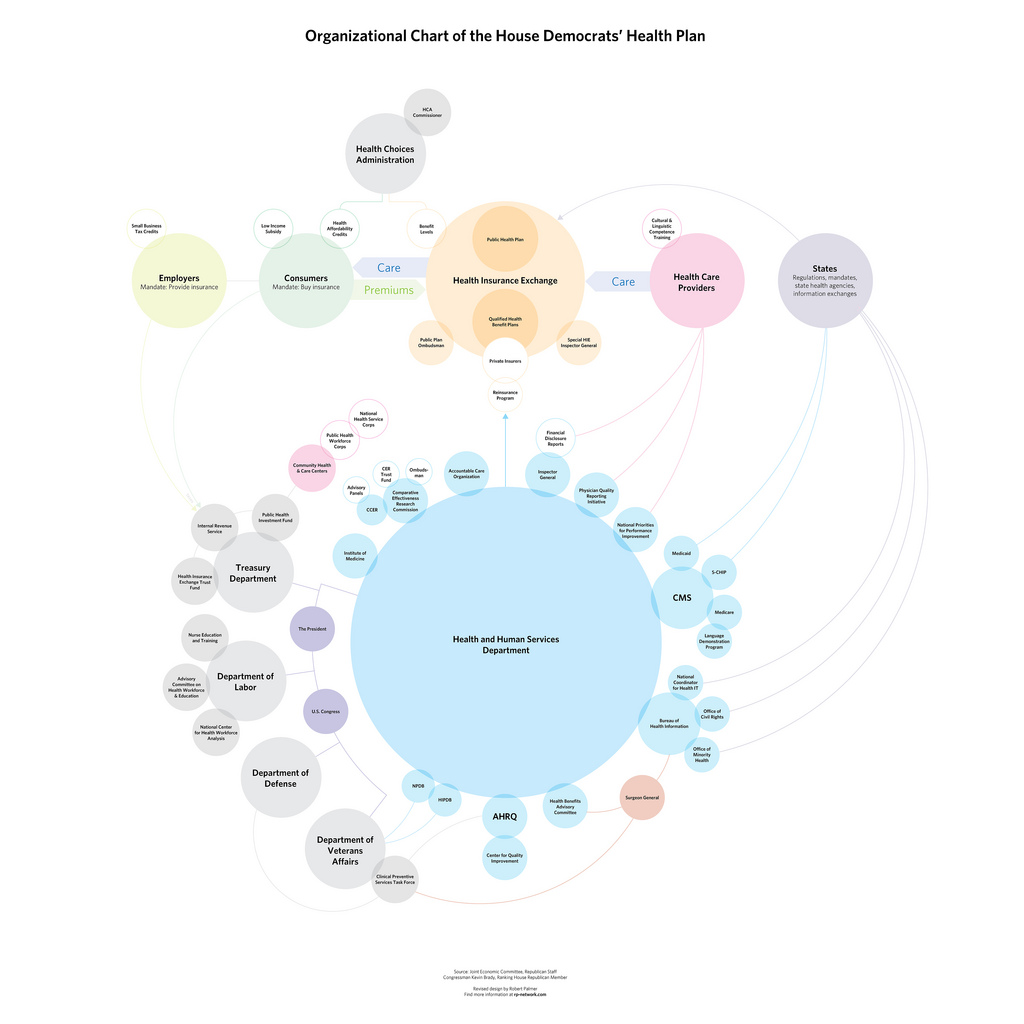
Remember this ?

Now try this:

obama_chart.jpg

Simple, focused and profound trumps ridiculously complex systems designed from technocratic hubris. Even if everything here worked according to plan in these charts, the intrinsic “friction” is a colossal waste of resources.

ADDENDUM:

In the interest of evenhandedness – and because it doesn’t matter in terms of the point of my post – here’s a Democratic take on the House Democratic plan for health care provided by Curtis Gale Weeks in the comments section. While this was not the same as the final Obamacare bill, there’s some congruence. If anyone has a link to a Democratic-produced chart of the final bill, I’ll post that:

demobamaplan.jpg

Armstrong on “Making American Public Diplomacy Safe for Americans”

Tuesday, August 3rd, 2010

Blogfriend and public diplomacy expert Matt Armstrong of MountainRunner has a new op-ed at World Politics Review:

Reforming Smith-Mundt: Making American Public Diplomacy Safe for Americans

American public diplomacy has been the subject of many reports and much discussion over the past few years. But one rarely examined element is the true impact of the Smith-Mundt Act of 1948, which for all practical purposes labels U.S. public diplomacy and government broadcasting as propaganda. The law imposes a geographic segregation of audiences between those inside the U.S. and those outside it, based on the fear that content aimed at audiences abroad might “spill over” into the U.S. This not only shows a lack of confidence and understanding of U.S. public diplomacy and international broadcasting, it also ignores the ways in which information and people now move across porous, often non-existent borders with incredible speed and ease, to both create and empower dynamic diasporas.

The impact of the “firewall” created by Smith-Mundt between domestic and foreign audiences is profound and often ignored. Ask a citizen of any other democracy what they think about this firewall and you’re likely to get a blank, confused stare: Why — and how — would such a thing exist? No other country, except perhaps North Korea and China, prevents its own people from knowing what is said and done in their name.

But in hiding from the public, Congress, and even the rest of the government what the U.S. government says and does abroad, this imaginary separation between foreign and domestic audiences reduces awareness of the State Department’s effectiveness (as well as that of USAID and the Millennium Challenge Corporation), increases the cost of engagement while decreasing overall effectiveness, and limits accountability. Its negative impact on the State Department, in particular, helped propel the militarization of U.S. public diplomacy, as the Defense Department stepped in, clumsily, to fill gaps left by ineffectual or absent civilian efforts. Overall, Smith-Mundt is a lose-lose scenario for the American public and people around the world.

Read the rest here.

The Mob of Virtue

Sunday, August 1st, 2010


Small “r” republican virtue, to be precise.

A wise man once told me that a weakness of our Constitutional system was that the Framers implicitly presumed that people of a truly dangerous character, from bullies to bandits to political menaces to the community, would primarily be dealt with in age-old fashion by outraged neighbors whose rights had been trespassed and persons abused one time too many. They did not prepare for a time when communities would be prohibited from doing so by a government that also, as a whole, had slipped the leash. Indeed, having read LockeMontesquieuCicero, Polybius, Aristotle and Plato, they expected that such a state of affairs was “corruption” of the sort that plagued the Old World and might happen here in time. A sign of cultural decadence and political decay. They gave Americans, in the words of Benjamin Franklin, “A republic, if you can keep it”. It remains so only with our vigilance.

It is happening now.

We have forgotten – or rather, deliberately been taught and encouraged to forget – the meaning of citizenship.

We have let things slip.

Joseph Fouche superbly captures this implicit element, the consequences of the loss of fear of  informal but very real community sanction, in his most recent post:

People Like Us Give Mobs a Bad Name

….A classic American mob could exhibit any or all of these strategies. It could be a saint inciting a mob to attack others who deviated from a shared narrative. It could be a knave in saint’s clothing inciting an attack on personal rivals. It could be a moralist inciting a mob against the local knaves. The one constant is that an American mob was an expression of communal self-government by moralists seeking to punish what they saw as deviant, even if its manifestation was frequently unpleasant. It was a sign the local people were engaged.

Samuel Adams was the Lenin of the American Revolution. He conceived a hatred for the British Empire and a desire for American independence well before anyone else did. Adams skillfully used mobs alongside legal pretense to incrementally spread his agenda. Others followed his example. In the Worcester Revolution of 1774, the local population shut down the normal operations of royal government in west and central Massachusetts and drove royal officials out of those regions (the book to read is Ray Raphael’s The First American Revolution: Before Lexington and Concord). The British crown lost control of inland Massachusetts before Lexington and Concord were even fought.

However, eleven years later, when many of the same local residents attempted to do the same thing in protest of the policies of a now independent Massachusetts, the state government put down their rebellion with Samuel Adams’s strong support. The difference? An apocryphal remark attributed to Adams captures some of the truth behind his attitude: “the man who dares to rebel against the laws of a republic ought to suffer death”. Mobs protesting the actions of an unrepresentative government like the British Parliament, Adams argued, were valid. Mobs protesting the actions of a representative government like Massachusetts’s state government, on the other hand, were treasonous. This doctrine, supported by other Revolutionary leaders, especially the cabal behind the Order of the Cincinnati, was eventually enshrined as the higher law of the land in the slow motion coup d’etat that overthrew the Articles of Confederation and replaced it with the more authoritarian United States Constitution in 1787-1788.

While mobs continued to combine, they were gradually neutered by the conscious agenda of American elites who sought to replace informal norms enforced by communal censure with formal norms applied under the professional supervision of “wiser heads”. This was a collusion between saints and knaves against moralists. Saints got purer standards that were not reliant on the whims of moralists who got stirred up in unpredictable ways that might violate the saints’ prevailing narrative while knaves got credentials that allowed them to entrench their positions and agendas under the cover of serving a higher good. The same sense of community morality and punishment that gave nineteenth century self-government its vigor and occasional excess was weakened as moralists were tuned out by saints embedded in holy isolation and knaves concerned only with advancing personal priorities. Moralists saw the knaves getting away with free riding off of them and began to opt out, leaving room for more knaves to free ride. For a little formal pretense, the returns on rent seeking were enormous.

The ideal went from a citizenry engaged in self-government to a system designed to advance the best and brightest. Meritocracy sounds good in theory and has some positives in reality. However, a perfect meritocracy is a perfect tyranny. All of the leaders are on once side and all the followers are on the other. This tendency toward the separation of the best from the rest may only be checked by the tendency of those on the ascendant to favor their own children, whatever their merit, over strangers that are more meritorious. This will force some aspiring meritocrats to side with the followers and bring about a rotation of elites. But the transition may take a while and its best to start before you have a meritocratic problem….

Read the whole post here.

Today’s circumstances, with the elite determinedly crafting rules for the mass but not for their class, have an ominous portent for the future of America as a democratic republic, but violence is not yet required.

Political engagement is.

Ucko on Counterinsurgency and its Discontents

Friday, July 23rd, 2010

At Kings of War, Dr. David Ucko has a must-read post on the kulturkampf of COIN (hat tip SWJ Blog):

Counterinsurgency and Its Discontents

….It might be interesting to trace how an idea so welcome less than four years ago has since fallen from grace. Was it the perceived confidence with which the concept was rolled out? Was it the perceived automacity of its widespread acceptance? Is it anger at the arguably simplistic explanation that counterinsurgency, and counterinsurgency alone, won the day in Iraq? Or is it due to a perception of counterinsurgency experts gaining power and prestige in DC by peddling a theory that is not working so well in Afghanistan?

I strongly suggest reading Ucko’s post in its entirety, but here are a few highlights:

Attempts to disaggregate theory and practice has in turn engendered the accusation that counterinsurgency is like Marxism, in that its supporters insist on the doctrine’s infallibility and claim it simply hasn’t been implemented properly. It is a powerful analogy: a concept that survives only on paper has very limited worth.

But counterinsurgency principles have shown practical value, not just in ‘counterinsurgency campaigns’, but also in other campaigns concerned with stabilisation, pacification, peacebuilding – call it what you want. This is not wholly surprising, as many of these principles are quite banal, even commonsensical:

Agree with Ucko here. If COIN’s promise has at times been oversold by its advocates, its critics have occasionally swung in the opposite direction, penning highly ideological jeremiads equating the American use of COIN in Afghanistan and Iraq with the history of 19th century  European colonialism, capitalist-imperialism a la Lenin and Hobson, as a Democratic trojan horse for GOP neoconservatism and as Ucko mentioned, even Soviet Communism. This is dressing up the less exciting valid criticisms that can be made about COIN, in theory and execution, with highly polemical nonsense typical of cable TV news shoutfests.

A powerful reason why counterinsurgency today is so unpopular is because its principles are looked upon as strategy in their own right. As should be clear, the principles and theory of counterinsurgency are only relevant as a means toward a strategic end, which itself may be more or less realistic: to help a country recover from protracted conflict; to bolster the legitimacy and reach of a government, etc. Even then, the theory is not a silver bullet but mere guidance – a collection of lessons learned – that may help in the design and implementation of an effective campaign plan, a plan that must, as counterinsurgency theory clearly stipulates, be adapted for specific environments.

Strong agreement. I have written much the same in the past as have many others. Hopefully, if it is repeated often enough the ongoing COIN debate can begin to generate more light and less heat.

But if counterinsurgency theory is just ‘useful guidance’ or ‘some ideas’, what good is it? I think our own Faceless Bureaucrat hit the nail on the head in a previous post: ‘I have suspected for a long time that COIN itself is merely the knee-jerk answer to a previous question, “Do kinetic/conventional/body-count campaigns work?”‘. I’m currently reading Keith L. Shimko‘s The Iraq Wars and America’s Military Revolution, which provides a bitter reminder of the muddy RMA-type thinking on war within the Pentagon as it invaded Iraq. The discovery of counterinsurgency as a body of theory and lessons was definitely a step forward, but today it is no longer the antithesis, but itself the thesis. Its function as a reaction to muddy thinking is still being served, but it is also being held up in its own right and subjected to critical scrutiny.

….So there is definitely a need for criticism, but the aim of such a debate should be to improve on rather than kill the scholarship. There seems to be a desire to resign the whole ‘counterinsurgency’ concept to the intellectual wastebasket, which risks sacrificing what the concept has provided: a useful starting point to understand and discuss armed conflict and political violence, issues that today need to be discussed, whether in terms of ‘counterinsurgency’ or not.

Some of this desire to “resign the whole counterinsurgency concept to the intellectual wastebasket” is actually an indirect political campaign for other things. Namely, a more isolationist/non-interventionist foreign policy and secondly, a Weinberger-Powell military posture where the US is geared up to fight the Soviet Union’s closest facsimile of the moment, is buying a half-dozen aircraft carriers and F-35’s by the hundreds and the military “doesn’t do windows” – i.e. the 95 % of security threats since the end of the Cold War. Well this is policy for a world COIN critics wished we inhabited and not the one in which we have to live.

I’m not excerpting Ucko’s conclusions, to better incentivize your reading them for yourself.

What I would add to Ucko’s list of the reasons COIN is currently under harsh scrutiny are the variables I sugggested in The Post-COIN Era is Here – economics and the tie-in to domestic politics. States like California, Illinois, Michigan, New York, New Jersey are in varying degrees of financial meltdown, as are some EU/NATO nation-states, which has brought belt-tightening back into vogue, whether it is coming from tea party rallies or pious lectures by the German Chancellor. Increased competition for scarcer dollars (or euros) is already impacting defense budgets which have to be weighed with other societal needs.  COIN, which is intensive in terms of both time and personnel, begins to look less attractive to politicians than does FID, CT, drone and cruise missile strikes or the huge contracts going to shipyards and defense companies which employ their constituents back home.

Islamist insurgency may be global but all politics remain local.

Kindle Launch: The Handbook of 5GW

Tuesday, July 20th, 2010

h5gwc_close.png

The Handbook of 5GW Dr. Daniel H. Abbott, Editor

Nimble Books has published the first authoritative book on the competing interpretations of the military and political theory referred to as “Fifth Generation Warfare“, edited by my friend and colleague Dr. Daniel Abbott. The many contributing authors include academics, journalists such as David Axe, and many blogfriends associated with the former theory site, Dreaming5GW.

My chapter was entitled “5GW: Into the Heart of Darkness“. It is oriented more toward historical case studies than theory and is not in any way, shape or form, a “feel-good” piece. Here is a snippet:

“….This brings us to the probability that for the aforementioned states, their actual options for their ruling elites for adapting to the threat of 4GW will be between accepting varying degrees of failure-from conceding a temporary autonomous zone (TAZ) to rebels, to being overthrown, to imploding into anarchy as insurgents encroach-or “taking the gloves off” and using the indiscriminate, unrestricted violence of genocide to annihilate real and potential enemies before the international community can mobilize to prevent it. History suggests they might well succeed.”

The views within The Handbook of 5GW vary widely, as does the disciplinary approach of the authors, intending to stimulate thought, explore possible scenarios that range from the pragmatic and real to the imaginative and ideal.

Hardcover launch in September, 2010.


Switch to our mobile site