zenpundit.com » intelligence

Archive for the ‘intelligence’ Category

WikiLeaks: Critical Foreign Dependencies

Thursday, December 9th, 2010

[ by Charles Cameron ]

The most interesting part of the WikiLeaks-posted State Department Request for Information: Critical Foreign Dependencies, it seems to me, is the part that ties in with Zen’s recent post Simplification for Strategic Leverage.

Zen referenced Eric Berlow‘s recent TED talk to the effect that sometimes a complex network can be made effectively simple by reducing it to the graph of nodes and links within one, two or three degrees of the node you care about and wish to influence.

“Simplicity often lies on the other side of complexity”, Dr Berlow says, and “The more you step back, embrace complexity, the better chance you have of finding simple answers, and it’s often different than the simple answer that you started with.”

*

This resonates neatly with a few things I’ve been thinking and talking about for some time now.

1. There’s the need for visualization tools that don’t operate with as many nodes as there are data points in a database like Starlight — I’ve been wanting to reduce the conceptual “load” that analysts or journos face from thousands, sometimes tens of thousands of nodes, to the five, seven, maybe ten or twelve nodes that the human mind can comfortably work with:

What I’m aiming for is a way of presenting the conflicting human feelings and understandings present in a single individual, or regarding a given topic in a small group, in a conceptual map format, with few enough nodes that the human mind can fairly easily see the major parallelisms and disjunctions, as an alternative to the linear format, always driving to its conclusion, that the white paper represents. Not as big as a book, therefore, let alone as vast as an enormous database that requires complex software like Starlight to graphically represent it, and not solely quantitative… but something you could sketch out on a napkin, showing nodes and connections, in a way that would be easily grasped and get some of the human and contextual side of an issue across.

2. There’s the fact that the cause is typically non-obvious from the effect. In the words of Jay Forrester, the father of stocks and flows modeling:

From all normal personal experience, one learns that cause and effect are closely related in time and space. A difficulty or failure of the simple system is observed at once. The cause is obvious and immediately precedes the consequence. But in complex systems, all of these facts become fallacies. Cause and effect are not related in either time or space… the complex system is far more devious and diabolical than merely being different from the simple systems with which we have experience. Though it is truly different, it appears to be the same. In a situation where coincident symptoms appear to be causes, a person acts to dispel the symptoms. But the underlying causes remain. The treatment is either ineffective or actually detrimental. With a high degree of confidence we can say that the intuitive solutions to the problems of complex social systems will be wrong most of the time.

3. There’s the need to map the critical dependencies of the world, which became glaringly obvious to me when we were trying to figure out the likely ripple effects that a major Y2K rollover glitch – or panic – might cause.

Don Beck of the National Values Center / Spiral Dynamics Group captured the possibility nicely when he characterized Y2K as “like a lightening bolt: when it strikes and lights up the sky, we will see the contours of our social systems.” Well, the lightning struck and failed to strike, a team from the Mitre Corporation produced a voluminous report on what the material and social connectivity of the world boded in case of significant Y2K computer failures, we got our first major glimpse of the world weave, and very few of the possible cascading effects actually came to pass.

I still think there was a great deal to be gleaned there — as I’m quoted as saying here, I’m of the opinion that: “a Y2K lessons learned might be a very valuable project, and even more that we could benefit from some sort of grand map of global interdependencies” – and agree with Tom Barnett, who wrote in The Pentagon’s New Map:

Whether Y2K turned out to be nothing or a complete disaster was less important, research-wise, than the thinking we pursued as we tried to imagine – in advance – what a terrible shock to the system would do to the United States and the world in this day and age.

4. That such a mapping will necessarily criss-cross back and forth across the so-called cartesian divide between body & mind (materiel and morale, wars and rumors of wars, banks and panics):

You will find I favor quotes and anecdotes as nodes in my personal style of mapping — which lacks the benefits of quantitative modeling, the precision with which feedback loops can be tracked, but more than compensates in my view, since it includes emotion, human identification, tone of voice.

The grand map I envision skitters across the so-styled “Cartesian divide” between mind and brain. It is not and cannot be limited to the “external” world, it is not and cannot be limited to the quantifiable, it locates powerful tugs on behavior within imagination and powerful tugs on vision within hard, solid fact.

Doubts in the mind and runs on the market may correlate closely across the divide, and we ignore the impacts of hope, fear, anger and insight at our peril.

*

Getting back to the now celebrated WikiLeak, which even al-Qaida has noticed, here’s the bit — it’s really just an aside –that fascinates me:

Although they are important issues, Department is not/not seeking information at this time on second-order effects (e.g., public morale and confidence, and interdependency effects that might cascade from a disruption).

It seems to me that the complex models which Starlight provides, and Eric Berlow pillories, overshoot on one side of the problem – but avoiding all second-order effects?

One cause, one effect, no unintended consequences?

What was it that Dr Berlow just said? “if you focus only on that link, and then you black box the rest, it’s actually less predictable than if you step back, consider the entire system”…

Avoid all second-order effects?

If you ask me, that’s overshooting on the other side.
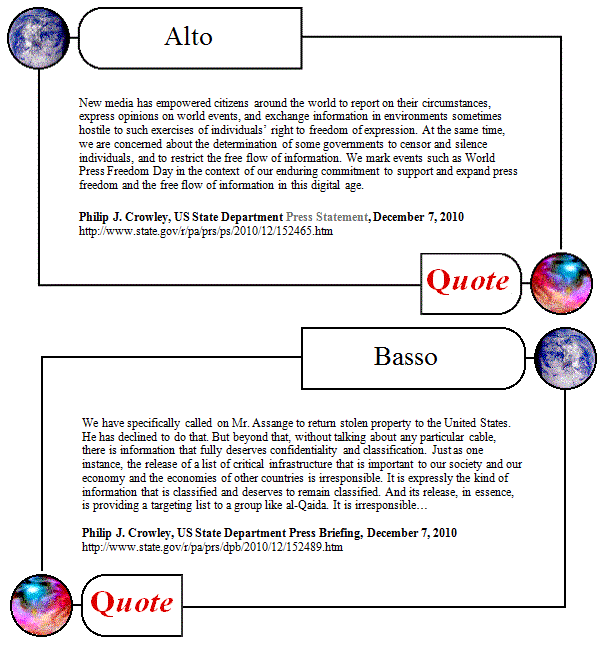
WikiLeaks: Counterpoint at the State Department?

Wednesday, December 8th, 2010

[ by Charles Cameron ]

[ note: all links are to youtube videos ]

The pianist Glenn Gould is celebrated for his ability to bring the different and at times positively oppositional voices in a fugue by Bach to our attention, so that we follow each one separately while hearing all at the same time as a single whole. What is less known is that he liked to sit at a table in a truck stop and listen to the different conversations at the other tables and booths, mentally braiding their pale or brightly colored threads of human together into an analogous tapestry — one voice harmonizing with or conflicting against another, here a new subject introduced, there an echo of an earlier idea heard in a fresh context, with the murmurings of waitresses punctuated by the kaching! of the cash register, the hydraulic hiss of a door closing — conversation as counterpoint.

Organizations and individual alike, we all have different and at times dissonant voices, and strive to bring them to some kind of resolution. The many stakeholders debating an issue in town halls, blogs or letters to the editor, the many drives within each one of us, idealistic, hopeful, defeated, paralytic, angry, evasive, sluggish, vengeful, curious, alert, defiant, all have voices, all constitute an experience of polyphony, a “music of many voices”, in point counter point.

One of my interests is to find a way to score these many fugues, these musics of meaning.

My DoubleQuotes, then, can be considered as two-part inventions, attempts to show the multiple tracking of the mind — whether of a single individual, as in this case, or of a group, a community, a world divided – so that something of the music begins to be visible, and some of the dissonances can move towards necessary resolution.

*

QUOwikileaks

*

I believe there is unresolved irony between these two statements, made on the same day by Philip J Crowley, the US State Department’s Assistant Secretary, Bureau of Public Affairs – but each has its reasons, and there are arguments to be made for both transparency and opacity, diplomacy and publicity, secrets and revelations.

Between them lies the possibility I think of as a virtual music of ideas.

*

Bach published a series of two-part inventions, BWV 772–801, and wrote of them that he intended to offer them as an honest method

by which the amateurs of the keyboard – especially, however, those desirous of learning – are shown a clear way not only (1) to learn to play cleanly in two parts, but also, after further progress, (2) to handle three obligate parts correctly and well; and along with this not only to obtain good inventions (ideas) but to develop the same well; above all, however, to achieve a cantabile style in playing and at the same time acquire a strong foretaste of composition…

Later comes the Art of Fugue.

Simplification for Strategic Leverage

Sunday, December 5th, 2010

Remember this much ridiculed visual monstrosity?:

Excessively complex representations, much less the bureaucratic systems in practice, are poor vehicles for efficient communication of strategic conceptualizations to the uninformed – such as those downstream who must labor to execute such designs. Or those targeted by them for help or harm.  In addition to the difficulty in ascertaining prioritization, the unnaturally rigid complexity of the bureaucracy generally prevents an efficient focus of the system’s resources and latent power. The system gets in it’s own way while eating ever growing amounts of resources to produce less and less, leading to paralysis and collapse.

Does it have to?

Here’s an interesting, very brief take on analytical simplification from a natural scientist and network theorist Dr. Eric Berlow on how to cull simplification – and thus an advantage – out of complex systems by applying an ecological paradigm.

Cognitive simplification will be a critical strategic tool in the 21st century.

A draft of what’s on my mind lately

Sunday, December 5th, 2010

by Charles Cameron
[ cross-posted from ChicagoBoyz ]

I’ve been thinking…

*

Reports, overstatements and underestimates

There are factual reports of violence and threats of violence, which are within the proper province of journalism and intelligence gathering.

There are also overstatements of such reports, generally resulting from paranoia, hatred, recruitment, or the desire to increase sales of advertising or munitions.

And there are understatements of such reports, generally resulting from sheer ignorance or a desire to be diplomatic.

*

Religious sanctions for violence

Similarly, there are factual reports of sanctions for violence in the scriptures, hagiographies and histories of various religions.

There are also overstatements of such reports, attributing to entire religions the beliefs and or activities of a significant subsection or outlier group of that religion

And there are understatements of such reports, avoiding the attribution of violence to religious beliefs regardless of whether the religious correlation is a “cover” for other motives or a sanction powerfully affecting the actions of those who respond to it.

*

Proportional and disproportionate responses

There are actions which represent a balanced and proportional response to threats or acts of violence, whether they be made at home or abroad, by the military or law enforcement, for reasons of just war or of security.

There are actions which present an unbalanced and disproportionate heightened response to acts of violence, into which category I would place both over-reactive military responses and over-reactive domestic security measures.

And there are inactions which are no less unbalanced as responses to acts or threats of violence, as with political wool-gathering or appeasement, bureaucratic failures to implement realistic information sharing and dot-connection within the IC, or public aversion to factual news or intelligent, nuanced analysis.

*

Ideals, kumbaya and skepticism

There are honest statements of aspiration for peaceable outcomes to current and future conflicts.

There are versions of such aspirations which naively overlook the very real correlations between religious sanctions and violence.

And there are skeptical aversions to such aspirations, which no less naively overlook the very real differences which are present between the most angry, the most terrified, the most politically driven, the most financially interested and the most generous members of any and every religious and irreligious viewpoint.

*

Let’s talk…

It is useful to bear these distinctions of category in mind, and to make accurate appraisals of one’s information inputs in terms of which categories they fall under, and how much trust one should therefore place in them.

There: it was on my mind and I have said it.

This is, as my title indicates, a first draft. I hope it will spark some interesting conversations, and lead to further insight and refinement…

Tracking the Mahdi on WikiLeaks

Tuesday, November 30th, 2010

by Charles Cameron

A quick search for “Mahdi” and “Mehdi” and “Twelfth Imam” in the 294 messages so far published in diplomatic Wikileaks reveals some references to individuals with those names, and a couple to Moqtada al-Sadr’s Jaysh al-Mahdi (spelled “Jaysh al-Madhi” in one cable by someone who is perhaps confused by the similarity of the name to that of Mahatma Gandhi), along with three cables in which Mahdism is touched upon.

1

09ASHGABAT1182 of September 16, 2009 reports a comment by an undisclosed source who is “adamant” that the US should not enter into direct talks with Iran’s leadership:

Not only, he insisted, is the Iranian leadership “untrustworthy,” and dominated by a group of “messianics,” who base crucial decisions about domestic and foreign policy on a belief in the imminent return of the “Missing” (Twelfth) Imam.

From my point of view, any foreign policy based on or strongly influenced by belief in the imminent return of a prophesied figure of good or evil, whether that figure be Moshiach or Christ or Mahdi, Antichrist or Dajjal, should be cause for concern: from a religious perspective, because messianic expectations are precisely what Matthew is talking about when he writes that “false Christs and false prophets will rise and show great signs and wonders to deceive, if possible, even the elect” (Matt 24.24) – and from a secular perspective because such identifications have been made again and again across history, often with disastrous results (think Waco, think the 1979 siege of Mecca, think the Taiping Rebellion).

That’s why I’m interested in monitoring the various strands of apocalyptic thinking out and about in the world today.

2

A little over a month earlier, on August 3, 2009, 09RPODUBAI316 under the sub-head “A Benevolent Dictator’s Fall from Grace” discussed the idea that the “Arab street” (both Sunni and Shi’a are mentioned) initially saw some Mahdist qualities in Ahmadinejad:

A Syrian journalist and blogger, who owns a media consultancy firm in Dubai, believes that many in the Arab street initially viewed Ahmadinejad when he came to power in 2005 as a “benevolent dictator.” Citing the tradition of the Mahdi, the media consultant argued that both Shi’a and Sunni Arabs are taught from early childhood to await the arrival of a strong and unimpeachable figure who will lead the Muslim world. The media consultant maintained that even secular Arabs view the world, albeit unintentionally, with this ingrained mindset. Our contact argued that Ahmadinejad played in to this narrative, and when Ahmadinejad arrived on the international stage many Arabs saw him, in contrast to their own flawed leaders, as a humble and pious man who was brave enough to stand up for his people and the greater Muslim world by confronting Israel and the West head on. However, both the intensely competitive campaign period and the forceful reaction by the Iranian people to the official election results have led some moderate Arabs to rethink Ahmadinejad’s true disposition. The election, the media consultant said, led some Arabs to understand that despite his astutely crafted and well-marketed image in the Arab world, Ahmadinejad is resented by many Iranians for domestic mismanagement, incompetence, and corruption. Because of this public fall from grace, so the media consultant told us, Ahmadinejad is no longer the “untouchable, holy figure” in the Arab world he once was — his flaws have brought him down to the level of the Arab world’s own imperfect leaders.

I’m reminded of the way that Steve Davis of Charleston, SC, among others, projected messianic qualities onto then-candidate Obama, when he wrote:

Barack’s appeal is actually messianic, it’s something about his aura, his spirit, his soul, that exudes enlightenment in the making.

I interpret Obama’s Lebanon, NH remarks as making light of that sort of projection (McCain’s video makes light of it, too), whereas Ahmadinejad appears to take his own status within the aura of the Mahdi all too seriously.

3

The last reference allows me to end on a happier note.

The French diplo Jean-Christophe Paucelle is quoted in 09PARIS1046 of July 31, 2009 on the topic of Ahmadinejad’s inauguration.

First he mentions that since non-Muslims had not been invited to previous inaugurations, European members of the diplomatic corps might not know which door to take if they wished to walk out on the ceremony, should such an action be called for… and then he discusses an additional reason why the French would attend the ceremony, despite the contested nature of the election:

Paucelle said that the case of detained French citizen Clothilde Reiss has also influenced the EU decision to attend the inauguration ceremonies. “We think she may be released soon, and we don’t want to create another irritant,” Paucelle said. “There are enough already.” He reported that the French have reason to believe Reiss may form part of a group of detainees likely to be released on the August 7 anniversary of Imam Mahdi. Paucelle noted that a letter released July 29 by Ahmadinejad supported the idea of granting clemency to post-election protesters during Mahdi celebrations. “The Iranians will need to take face-saving measures, and so she will likely transfer to house arrest or some other status,” Paucelle said. He added that, of course, she may not be released at all next week, but the French remain optimistic that she will soon be out of prison.

Clotilde Reiss was indeed not released on that occasion — but she was in fact freed somewhat later, on Sunday, May 16th, 2010.


Switch to our mobile site

