zenpundit.com » extremists

Archive for the ‘extremists’ Category

Systemic Curricular Choices Shape National Cognitive Traits

Thursday, March 10th, 2011

A brief point.

AFJ has a feature article by General Martin Dempsey on the need for the Army in it’s professional military education system to build future leaders who are critical thinkers:

Building Critical Thinkers

….The Army Leader Development Strategy identifies three critical leadership attributes for all Army leaders: character, presence and intellect. In addition to those three foundational attributes, we assert that strategic leaders must be inquisitive and open-minded. They must be able to think critically and be capable of developing creative solutions to complex problems. They must be historically minded; that is, they must be able to see and articulate issues in historical context. Possessed of a strong personal and professional ethic, strategic leaders must be able to navigate successfully in ethical “gray zones,” where absolutes may be elusive. Similarly, they must be comfortable with ambiguity and able to provide advice and make decisions with less, not more, information. While all leaders need these qualities, the complexity of problems will increase over the course of an officer’s career and require strategic leaders to develop greater sophistication of thought….

Read the rest here.

The nation is currently undergoing a debate about public education, of sorts. I say “of sorts” because the debate has largely been very dishonest on the part of proponents of certain kinds of “reforms” in which they hope to have a future financial interest, if radical changes can be legislatively imposed that will a) drastically lower labor costs and b) permit a “scalable” curriculum, to use the grammar of certain equity investor CEOs and lobbyists. The former does not concern this topic as much as the second, though the two will work in unison to create a profitable business model for a for-profit management company desiring to contract with local and state governments to run school systems.

“Scalability” builds upon Bush era NCLB legislation that emphasized standardized testing in basic math and reading skills, with punitive accountability measures for schools and districts failing to make “adequate yearly progress”. Due to the penalties and escalating standards, public schools have frequently narrowed their curriculums considerably, reducing instructional time for history, science, complex literature and the arts to put greater emphasis on basic skill drill instruction in just two subjects.

The net effect is that American public school students, roughly 88 % of all school children, spend a greater proportion of their day at concrete level cognitive activities than they did five or ten years ago and far less time on higher-level “critical thinking” like analysis or synthesis, making evaluative judgments, inquiry based learning or problem solving.

 “Scalability” means expanding on this dreary and unstimulating paradigm with digitally delivered, worksheet-like exercises to comprise the largest percentage of the instructional time for the largest number of children possible. It will be a low-cost, high-profit system of remedial education for would-be contractors, provided students are not able to “opt out”, except by leaving the public system entirely.

But only if their parents can afford it.

The US military relies upon the public schools to deliver the initial k-12 education of the overwhelming majority of their officer corps, to say nothing of the enlisted ranks. The soldiers, sailors, marines and airmen who went to Andover or similar private institutions before enlisting are very, very few. Today some public schools are excellent, some are failing and the rest are in-between. Most make an effort to challenge students of all ability levels, from those needing extra help to those in AP courses and gifted programs. There is systemic resiliency in a diversity of experiences.

What will be the effect on  the military leadership in the future if critical thought is methodically removed from public education by a nationally imposed, remedially oriented, uniform, “scalable” curriculum that is effectively free of science, history, literature and the arts? What kind of cognitive culture will we be creating primarily to financially benefit a small cadre of highly politically connected, billionaire-backed, would-be contractors?

Can inculcating critical thinking really be left entirely to universities and, in the case of the military, mid-career education?

What kind of thinkers will that system produce?

Better?

Or worse?

“What we think, we become” – Buddha
Honor killings

Monday, March 7th, 2011

[ by Charles Cameron — cross-posted from ChicagoBoyz ]

*

I had occasion today to give myself a quick refresher course on honor killings, one form of which is already present in the Torah as of Leviticus 21.9:

And the daughter of any priest, if she profane herself by playing the whore, she profaneth her father: she shall be burnt with fire.

and found myself once again noting that there is a substantial swathe of regions of the world where honor killings are found, and that where it is found (including in immigrant communities from those parts of the world) the practice is not confined to any one religious group.

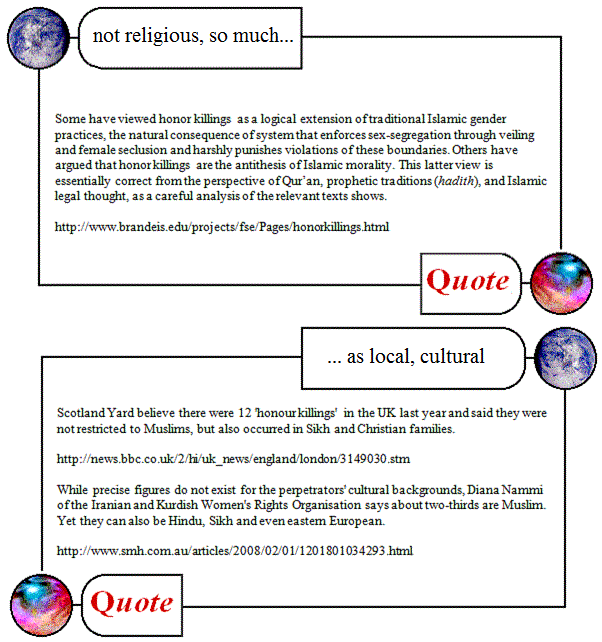
Hence this DoubleQuote:

I think it is appropriate to consider honor killing a form of religious violence when the claim is made by those who do the killing that they are acting in the name of their religion — but that it is also important to distinguish such acts committed in a cultural context in which they are practiced across religions from acts that are the exclusive province of one religious tradition.

There are examples of honor killings which are performed in the name of Islam, and/or advocated by Islamic scholars — and the same could no doubt be said of other religious traditions — but honor killing as a genre is fundamentally more cultural than religious.

Sources: Brandeis studyBBCSydney Morning Herald

The analytic point:

From my point of view as an analyst, it is important to note and compare both religious and cultural drivers — neither avoiding mention of the one out of “correctness” — nor overlooking the other for lack of comparative data.

Government by Assassination

Monday, March 7th, 2011

Pakistani Islamist militants, with the political support of the ISI and some of Pakistan’s higher military leadership, are trodding down a path we have seen before. Assassinations of democratic or tolerant political figures at odds with Islamist extremists and the military elite has become de facto “normalized” in Pakistan.

And popular among many Pakistanis.

Bhatti Killing Should Alarm Pakistan’s Minorities

The murder last week of Shahbaz Bhatti, Pakistan’s minority affairs minister and the only Christian in the cabinet, is a reminder of how dangerous it can be to voice one’s opinion in violence-riddled Pakistan. Bhatti was a liberal who spoke often against Pakistan’s blasphemy laws and their narrow-minded application.

His murder comes just weeks after the assassination of Punjab Governor Salman Taseer, another prominent moderate. Both men were targeted by Islamic extremists because of their calls to reform the blasphemy laws. The purpose of their murders — besides depriving moderates of some of their most courageous leaders — is to frighten moderates and minorities into silence and submission.

What Salman Taseer’s assassination could mean for Pakistan

Experts believe the outpouring of praise for the killer of Salman Taseer, the former governor of Punjab who was slain by his own security detail in Islamabad on Tuesday, reflects deep support for religious intolerance and will have a chilling effect on reform-minded public figures.

“It’s highly dangerous for these religious scholars to say things that do not fit into the legal context of [an] issue. Are they saying Taseer was guilty of blasphemy simply by criticizing a law? In that case, hundreds of thousands are guilty. This is a clear incitement to violence,” says Badar Alam, editor of Pakistan’s Herald magazine and an expert on Islamist groups.

Pakistan’s Bhutto assassinated – World news – South and Central …

NAUDERO, Pakistan – The body of Pakistan opposition leader Benazir Bhutto arrived in her family village for burial on Friday, hours after her assassination plunged the nuclear-armed country into one of the worst crises in its 60-year history.

Enraged crowds rioted across Pakistan and hopes for democracy hung by a thread after the former prime minister was gunned down as she waved to supporters from the sunroof of her armored vehicle.

The death of President Pervez Musharraf’s most powerful opponent threw the nation into chaos just 12 days before elections and threatened its already unsteady role as a key fighter against Islamic terror.

A cadre of military leaders manipulate and orchestrate civilian fanatics to methodically murder and intimidate civilian officials and radicalize the larger society, where have we seen this before? Oh, yes:

Pakistan is a Muslim version of 1930’s Japan.

US policy has hitched itself to a dangerously evolving and increasingly Fascist leadership class in Pakistan that is steadily veering away from any pretense of civilized conduct or partnership with the US, reifying a witch’s brew of Islamist extremism, militarism and anti-Indian and anti-American nationalism.  We need to disengage from and de-fund this monstrosity that bends most of it’s efforts against our interests and values. 

Pakistan is a strategic black hole of an “ally” that is going to blow up in our face someday.

Friend[s] of “Abu Reyyan” the Frankfurt Shooter

Friday, March 4th, 2011

[ by Charles Cameron ]

.

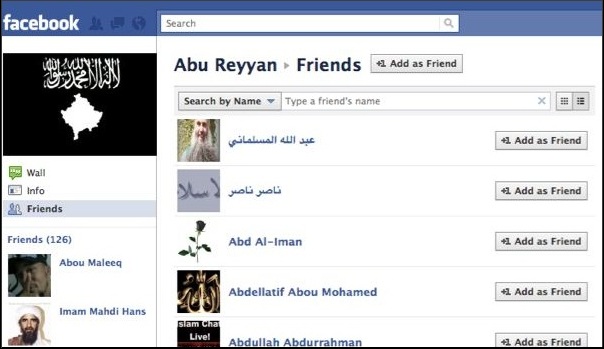
Aaron Weisburd has posted a screen-grab of “Abu Reyyan” the Frankfurt Shooter‘s FaceBook page at Internet Haganah

abu-reyyan-friends-screen-grab.jpg

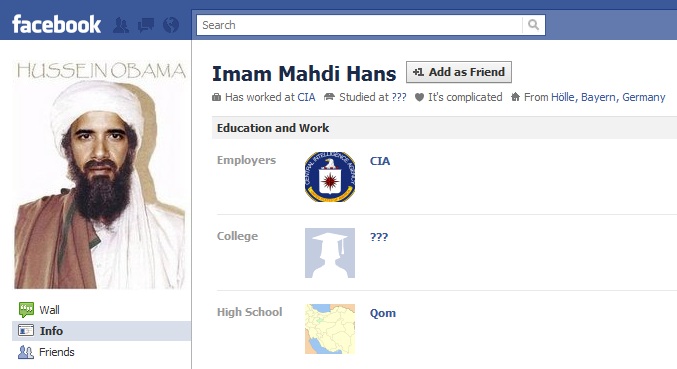
Naturally enough, the name of the second friend listed in the left-hand column, Imam Mahdi Hans, caught my eye. Here’s a screen grab of part of Hans’ own Facebook page, showing his self-image to better advantage:

imam-mahdi-hans.jpg

Okay, I’ve seen that image before — in fact, I blogged about it on my old Forensic Theology site, towards the bottom of a long post, and yes — the image clever Hans is using is a blend of Osama with Obama, and includes a credit to “Phil Dragoo”.  And yes, Hans himself does claim to be the Mahdi on his FB page.

It’s probably just a joke, and a bit of a sideswipe at the Shi’a, Obama, and no doubt the CIA — but since I noticed the connection, and Aaron doesn’t have comments enabled, I thought I should mention it here…

.

UPDATE:

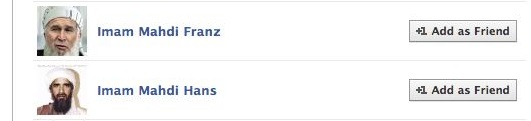
Aaron has kindly pointed out to me that there’s a second Mahdi among Abu Reyyan’s friends: Imam Mahdi Franz.

2-imam-mahdis.jpg

Like Hans, Franz’ avatar is a mashup of two images to generate a face presumably intended to represent bin Laden, but with the features of a US President: in the first case, Obama, and in the second, Bush 43.

In this case, the mashup is one that you’ll find on the cover of Tariq Ali‘s book, Clash of Fundamentalisms (the British hardback has the best version of the image; the US edition credits it to “Mister Hepburn / Slab”.

Here’s where it gets doubly interesting to me:

First, the pair of them taken together make a fine example of the anti-Shi’a strand in Salafism, picking up on the eschatology — which I don’t think they’d be doing quite like that if they felt a strong Salafi-Mahdist current themselves.

So that’s another data point in terms of the strength of what J-P Filiu calls “Apocalypse in Islam” – in Germany, Shi’ite Mahdism can be mocked by Salafis.

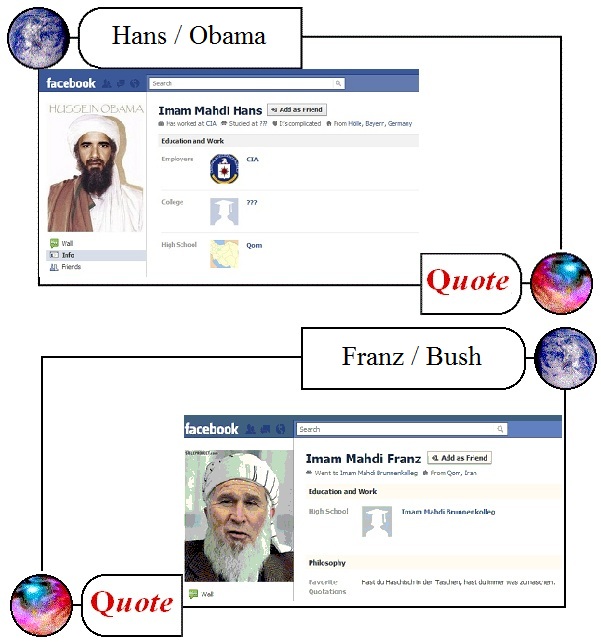
.. and second, for bonus points… the two pages are also pretty strongly “twinned” – Mahdi to Mahdi, Hans to Franz, Obama to Bush – so they’re also a great fit for my more playful side, suggesting an obvious example of my DoubleQuotes genre:

quo-twin-mahdis.jpg

Guest Post: DARPA, STORyNet and the Fate of the War by J. Scott Shipman

Wednesday, March 2nd, 2011

J. Scott Shipman, the owner of a boutique consulting firm in the Metro DC area that is putting Col. John Boyd’s ideas into action, is a longtime friend of this blog and an occasional guest-poster. Scott has an important report regarding the “war of ideas” against the Islamist-Takfirist enemy in Afghanistan after attending a workshop hosted by DARPA.

DARPA, STORyNet and the Fate of the War

by J. Scott Shipman

 I had the opportunity to attend a DARPA workshop yesterday called STORyNet. The purpose was to survey narrative theories, to better understand the role of narrative in security contexts, and to survey the state of the art in narrative analysis and decomposition tools (see below): 

This STORyNET workshop has three goals:

1. To survey narrative theories.

These empirically informed theories should tell us something about the nature of stories: what is a story? What are its moving parts? Is there a list of necessary and sufficient conditions it takes for a stimulus to be considered a story instead of something else? Does the structure and function of stories vary considerably across cultural contexts or is there a universal theory of story?

2. To better understand the role of narrative in security contexts.

What role do stories play in influencing political violence and to what extent? What function do narratives serve in the process of political radicalization and how do theyinfluence a person or group’s choice of means (such as violence) to achieve political ends? How do stories influence bystanders’ response to conflict? Is it possible to measure how attitudes salient to security issues are shaped by stories?

3. To survey the state of the art in narrative analysis and decomposition tools.

How can we take stories and make them quantitatively analyzable in a rigorous, transparent and repeatable fashion? What analytic approaches or tools best establish a framework for the scientific study of the psychological and neurobiological impact of stories on people? Are particular approaches or tools better than others for understanding how stories propagate in a system so as to influence behavior?

I was alerted to the meeting by a member at one of my “groups” at LinkedIn and just barely made the registration cut-off. It was a good meeting, but not reassuring on our situation in Afghanistan—you’ll see why  below.

As a “hobby” I’ve been tinkering with the implications of patterns with respect to language and communications. Just about every presumption I have articulated over the last several months is being pursued in one way or another—which is good news for our guys. While the on-going research is good, I do believe there is room for better and more imaginative thinking, although I didn’t say anything during the meeting for once, I kept my mouth shut and just listened.

This is exceptionally brief and decidedly non-techincal.  Here are some observations of interest:

  • In Afghanistan, stories (those who tell them and those who believe) are central to our geopolitical strategy and policies.
  • There is underway, a “battle of the narratives,” where any “counter” narrative developed by the US must have credibility. This seems obvious, but the speaker observed the “story telling” was more important than the story. Given the high illiteracy rate, this makes sense.
  • We [DARPA] are reviewing chants (which are wildly popular), video, magazines, poetry, the Internet, and sermons as thematic vehicles for analysis.
  • The language of the Taliban is not secular, and not the language of the insurgency—for the Taliban everything hangs on the legacy of jihad and religious struggle.
  • The Taliban not willing to negotiate on matters of jihad. They are using a unified vision of Islam giving their struggle a noble foundation against the corruption of outsiders who want to “Christianize” the nation.
  • The Taliban uses symbology to portray the struggle as a cosmic conflict against Christian invaders and US puppets (those cooperating with the US). Framing this symbology to communicate clearly the frame of the righteous vs. the infidels.
  • The Taliban manipulates the language to connect the current struggle to previous struggles of “warrior poets.” There is hope a “discourse” can be created that will counter this framing [personal note: I’m not optimistic]. The Taliban uses different language to subjugate rural and urban dwellers, and actually have standard operating procedures for dealing with villages that resist.
  • The cognitive patterns of rural Afghanistan are “foreign” to most Westerners and they use alien methods of knowledge transfer (chants, often under the influence of hashish).
  • We are adding a geospatial element to our analysis of local and personal narratives (which includes subject, verb, object) with respect to identified “master narratives.”
  • Internet data is indexed, with an eye toward predictive analysis and situational awareness (and interestingly, “sentiment” analysis). We are finding predictive power from the topology of “networks”  used in models.
  • From a neuroscience perspective, there was an amazing talk on empathy. It turns out, based on fMRI testing that empathy is quite predictable across subjects. Research indicates people “care more” about an “in-group” to which they belong more than an “out group.” The speaker defined the brain as a “parliament” of competing parties and nuanced spectrums [personal note: this elegant description tracks with everything I’ve read on the topic.]. 
  • One presenter observed that after 10 years of war, we’re finally “getting” the importance of Pashtun culture and language. This presenter also noted US is still in need of people with language skills sufficient to adequately support the effort.

– End

COMMENTARY:

Zen here:

First, I’d  like to cordially thank Scott for letting me share his insights gleaned from the workshop here with ZP readers. This is one of those fascinating events largely unavailable to those folks residing outside a reasonable driving distance from the Beltway.

Secondly, I am heartened that the brilliant folks at DARPA are taking the theological-ideological discourse of the enemy seriously in analyzing the power of narrative. Charles Cameron makes that point here with regularity. Michael Scheuer, Gilles Kepel and Olivier Roy did so even before 9/11. Our political appointees and policy makers remain steadfastly allergic to this reality, unable to process or discuss in public with coherence how religious ideas are a root for political extremism. Col. David Kilcullen, who certainly understands political Islam better than most and whose creative and analytical acheivements in structuring a framework for countering insurgency are second  to none, eschews dealing with the topic in his theoretical writings on COIN where it can be avoided. That is the cost imposed by the political correctness to which our ruling elite are psychologically welded.

 It comes as no surprise to me that only after “10 years of war” are we finally “getting the importance of Pashtun culture”. 

Maybe at the dawn of the 22nd century we will be “old hands”.


Switch to our mobile site