zenpundit.com » islamic world

Archive for the ‘islamic world’ Category

Soon soon coming of the Mahdi?

Monday, March 28th, 2011

[ by Charles Cameron ]

*

Okay, I’d say things are heating up. Here’s a screen grab from what we are led to believe is a recent video from Iran, made with government backing as described below the fold.
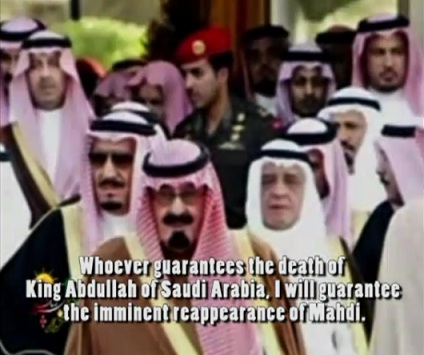
death-of-abdullah-sign-of-mahdi.jpg

This does not bode well…

*

The Christian thriller novelist Joel Rosenberg (author of The Twelfth Imam) has a new blog post up, in which he cites a Christian Broadcasting Network story — which in turn refers to a video posted with some introductory materials on his blog by Reza Kahlili (author of A Time to Betray: The Astonishing Double Life of a CIA Agent Inside the Revolutionary Guards of Iran).

According to Kahlili, who has also posted the full video to YouTube, it is a half-hour long program sponsored by the Basij militia and the Office of the President of Iran, affirming the soon-return of the Mahdi.

And containing “inflammatory language” about King Abdullah of Saudi Arabia (see subtitle above)?  Can I say that?

For what it’s worth, the supposed “hadith” about the death of King Abdullah is discussed in some detail at The Wake-Up Project, so it’s definitely “in the air” — but I don’t recall seeing any references to it in Abbas Amanat, Abdulazziz Sachedina, or any of the lists of Signs of the Coming I’ve read, so my suspicion is that this is an opportunistic addition to the corpus rather than a reliable hadith.

Which brings me to my last point:

I am not posting these materials to encourage panic — that’s what terrorism strives for, and it is the very opposite of what I would wish to see.  If anything, these stirrings of Mahdist sentiment should make us more careful and attentive to the serious scholarly work that has been done in this area.  Jean-Pierre Filiu‘s book Apocalypse in Islam, which I reviewed for Jihadology, would be an excellent place to start.

*

There are plenty of other things going on that I would love to track, blog about or comment on these days, but for the next while I shall try to restrain myself and focus in on this particular issue and its ramifications:

  • Contemporary Shi’ite Mahdist expectation
  • The Iranian nuclear program in the light of Mahdist expectation
  • Iranian attempts to use Mahdism to unite Sunni and Shi’a
  • Mahdism and jihad
  • The role of Khorasan in Mahdist rhetoric
  • Christian apocalyptic responses to Mahdist stirrings
  • Joel Rosenberg‘s book, The Twelfth Imam
  • Joel Richardson‘s book, The Islamic Antichrist
  • Glenn Beck‘s increasing focus on Iranian Mahdism
  • The increasing influence of Islamic and Christian apocalyptic on geopolitics

This is a pretty complex and potent mix of topics, and while I’ll post some individual pieces of the puzzle as I see it, I shall also try to put together a “bigger picture” piece with the whole mosaic laid out.

*

Apart from that, I remain deeply committed to questions of chivalry and peace-making, and will continue to monitor developments and write what I can on those topics as time allows…

Corn’s Caliphates in Wonderland

Saturday, March 26th, 2011


They Just Don’t Make Caliphates Like They Used To….

SWJ Blog featured a lengthy (30 page) essay by Dr. Tony Corn on….well….many things. Corn begins with caliphates and then sort of takes off much like a blown up balloon abruptly released by a child prior to tying a knot in the end.

The Clash of the Caliphates: Understanding the Real War of Ideas by Dr. Tony Corn

….For one thing, within the global umma, there appears to be as many conceptions of the ideal Caliphate as there are Muslims. This grass-roots longing for a symbol of unity should be heard with the proverbial Freudian -third ear,?? and seen for what it really is, i.e., a symptom rather than a disease. For another, by agreeing to establish diplomatic relations with the 57-member Organization of the Islamic Conference (OIC), America and Europe have, in essence, already granted the OIC the status of a Quasi-Caliphate.

More important still, it is time for Western policy-makers to realize that the ideological rivalry between Saudi Arabia and Iran that has been going on since 1979 constitutes nothing less than a Clash of the Caliphates. Through a soft power strategy blurring the distinction between -public diplomacy?? and -political warfare,?? -humanitarian aid?? and -religious propaganda,?? the two states have been the main drivers of the re-Islamization process throughout the Muslim world. The one-upmanship dynamic generated by the rivalry between these two fundamentalist regimes is the main reason why, from the Balkans to Pakistan, the re-Islamization of the global umma has taken a radical, rather than moderate, dimension.

Ok, “caliphates” as a metaphor/analogy for geopolitical rivalry of Muslim states works but it is not really what Islamists or normal Muslims would mean by the term. It is a very odd usage. I’m not overly bothered by that because I tend to like analogies but Corn’s device here is apt to make the heads of area studies and Islamic history scholars explode. The whole essay is in this meandering, idiosyncratic, vein.

Now that is not to suggest that you should not read the piece. Dr. Corn held my attention all the way through and he has a number of excellent observations on many, loosely related, subjects. For example, after discussing the pernicious effects of Saudi donations and Edward Said’s agitprop theory of “Orientalism” on the intellectual objectivity of academia, Corn writes:

…The combined effect of the House of Saud and the House of Said is the first reason why the Ivory Tower has done such a poor job identifying the nature of Muslim Exceptionalism. A more indirect, yet more insidious, reason is that, unlike in the early days of the Cold War, American academics across the board today are trained in social sciences rather than educated in the humanities. For social scientists, Explanation (erklaren) and -theory-building?? take precedence over Understanding (verstehen) and -policy-making. The victory of the -numerates over the -literates in the 1970s has produced a generation of scholars who show a certain virtuosity when it comes to -research design, but display an amazing lack, not just of historical literacy, but of -historical empathy as well. Not to make too fine a point: the Long War is being waged by a generation of policy-makers who, however articulate, never learned anything about history in their college years

Corn is spot on here. Not only is it spot on, it is likely to get much worse. After a brief qualitative “bump” from Iraq-Afghan war  language trained vets, diplos, analysts and spooks peters out, we will have the Gen Y kids with K-12 educations scrubbed free of history, foreign languages and science graduating from college with communication and marketing degrees and entering government service. Hang on to your hat when that happens.

What Corn really requires to vault his essays to the next level are the services of an experienced editor because less would be more. The man is erudite and insightful. He writes forcefully and raises a number of points that are important and with which I agree. Corn, commendably, also makes more of an effort to connect the dots than most. But maybe, if you have an essay that references David Kilcullen, Trotsky, neo-Ottomanism, lawfare, Sam Huntington, neo-COIN, Nasser, Vatican II, the Comintern, the Hapsburgs, Ataturk, public diplomacy, al- Qaradawi, social media, Fascism, Marc Lynch, Youtube, network theory, the UN, hybrid wars and the Protestant Reformation, it might be time to up the Ritalin dosage a notch. Jesus, there’s either a book proposal or four different articles in that kitchen sink of an op-ed!

Read it and take what is useful.

Metz on Libya

Tuesday, March 22nd, 2011

We may have to go “All Libya, All the time” here this week. We won’t, but it is tempting.

Dr. Steve Metz of SSI has a featured op-ed in The New Republic:

Libya’s Coming Insurgency 

….History offers a number of sign posts that an insurgency will occur. Unfortunately Libya has almost all of them. At this point the political objectives of the government and anti-government forces are irreconcilable. Each side wants total victory-either Qaddafi will retain total power or he will be gone. Both sides are intensely devoted to their cause; passions are high. Both have thousands of men with military training, all imbued with a traditional warrior ethos which Qaddafi himself has stoked. The country is awash with arms. Libya has extensive hinterlands with little or no government control that could serve as insurgent bases. Neighboring states are likely to provide insurgent sanctuary whether deliberately-as an act of policy-or inadvertently because a government is unable to control its territory. North Africa has a long history of insurgency, from the anti-colonial wars of the nineteenth and twentieth centuries to more recent conflicts in Chad, Algeria, and Western Sahara. Where insurgency occurred in the past, it is more likely to occur in the future. All this means that there is no place on earth more likely to experience an insurgency in the next few years than Libya.

What is not clear is whether the coming insurgency will involve Qaddafi loyalists fighting against a new regime or anti-Qaddafi forces fighting to remove the old dictator and his patrons. In either case, a Libyan insurgency would be destructive. Because they take place within the population, insurgencies always fuel refugee problems and humanitarian crises. They provide an opportunity for extremists to hijack one or both sides. And insurgency in Libya would destabilize a region undergoing challenging political transitions

Read the rest here.

Honor killings

Monday, March 7th, 2011

[ by Charles Cameron — cross-posted from ChicagoBoyz ]

*

I had occasion today to give myself a quick refresher course on honor killings, one form of which is already present in the Torah as of Leviticus 21.9:

And the daughter of any priest, if she profane herself by playing the whore, she profaneth her father: she shall be burnt with fire.

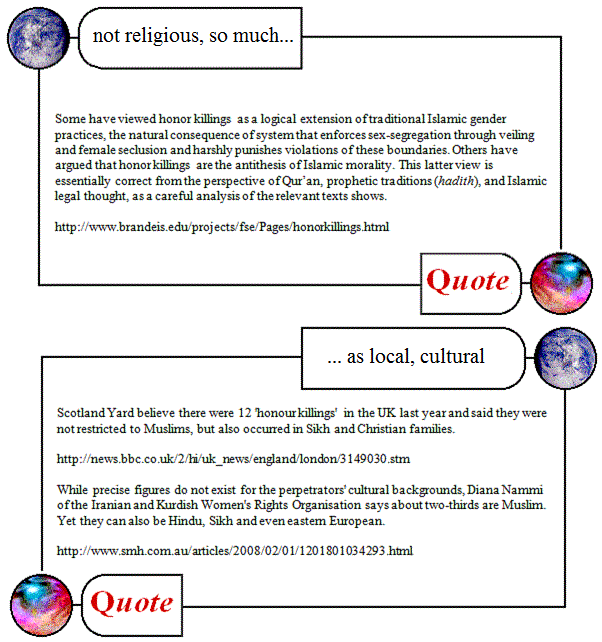
and found myself once again noting that there is a substantial swathe of regions of the world where honor killings are found, and that where it is found (including in immigrant communities from those parts of the world) the practice is not confined to any one religious group.

Hence this DoubleQuote:

I think it is appropriate to consider honor killing a form of religious violence when the claim is made by those who do the killing that they are acting in the name of their religion — but that it is also important to distinguish such acts committed in a cultural context in which they are practiced across religions from acts that are the exclusive province of one religious tradition.

There are examples of honor killings which are performed in the name of Islam, and/or advocated by Islamic scholars — and the same could no doubt be said of other religious traditions — but honor killing as a genre is fundamentally more cultural than religious.

Sources: Brandeis studyBBCSydney Morning Herald

The analytic point:

From my point of view as an analyst, it is important to note and compare both religious and cultural drivers — neither avoiding mention of the one out of “correctness” — nor overlooking the other for lack of comparative data.

Government by Assassination

Monday, March 7th, 2011

Pakistani Islamist militants, with the political support of the ISI and some of Pakistan’s higher military leadership, are trodding down a path we have seen before. Assassinations of democratic or tolerant political figures at odds with Islamist extremists and the military elite has become de facto “normalized” in Pakistan.

And popular among many Pakistanis.

Bhatti Killing Should Alarm Pakistan’s Minorities

The murder last week of Shahbaz Bhatti, Pakistan’s minority affairs minister and the only Christian in the cabinet, is a reminder of how dangerous it can be to voice one’s opinion in violence-riddled Pakistan. Bhatti was a liberal who spoke often against Pakistan’s blasphemy laws and their narrow-minded application.

His murder comes just weeks after the assassination of Punjab Governor Salman Taseer, another prominent moderate. Both men were targeted by Islamic extremists because of their calls to reform the blasphemy laws. The purpose of their murders — besides depriving moderates of some of their most courageous leaders — is to frighten moderates and minorities into silence and submission.

What Salman Taseer’s assassination could mean for Pakistan

Experts believe the outpouring of praise for the killer of Salman Taseer, the former governor of Punjab who was slain by his own security detail in Islamabad on Tuesday, reflects deep support for religious intolerance and will have a chilling effect on reform-minded public figures.

“It’s highly dangerous for these religious scholars to say things that do not fit into the legal context of [an] issue. Are they saying Taseer was guilty of blasphemy simply by criticizing a law? In that case, hundreds of thousands are guilty. This is a clear incitement to violence,” says Badar Alam, editor of Pakistan’s Herald magazine and an expert on Islamist groups.

Pakistan’s Bhutto assassinated – World news – South and Central …

NAUDERO, Pakistan – The body of Pakistan opposition leader Benazir Bhutto arrived in her family village for burial on Friday, hours after her assassination plunged the nuclear-armed country into one of the worst crises in its 60-year history.

Enraged crowds rioted across Pakistan and hopes for democracy hung by a thread after the former prime minister was gunned down as she waved to supporters from the sunroof of her armored vehicle.

The death of President Pervez Musharraf’s most powerful opponent threw the nation into chaos just 12 days before elections and threatened its already unsteady role as a key fighter against Islamic terror.

A cadre of military leaders manipulate and orchestrate civilian fanatics to methodically murder and intimidate civilian officials and radicalize the larger society, where have we seen this before? Oh, yes:

Pakistan is a Muslim version of 1930’s Japan.

US policy has hitched itself to a dangerously evolving and increasingly Fascist leadership class in Pakistan that is steadily veering away from any pretense of civilized conduct or partnership with the US, reifying a witch’s brew of Islamist extremism, militarism and anti-Indian and anti-American nationalism.  We need to disengage from and de-fund this monstrosity that bends most of it’s efforts against our interests and values. 

Pakistan is a strategic black hole of an “ally” that is going to blow up in our face someday.


Switch to our mobile site

