zenpundit.com » social science

Archive for the ‘social science’ Category

Summer Series 2010: Reviewing the Books!

Saturday, September 4th, 2010

Every year I make an effort to increase my reading of books during the summer months. Inevitably, I fail at completing whatever overambitious reading list that I compose while somehow finding time to read other books that were never on the list. This year was no exception.

Starting this weekend, I am going to be reviewing all the books I did read from late May to early September. It was an eclectic collection and I hope to complete this series of posts by mid-September. A few reviews that have already appeared in this time period will be re-posted to make the series complete.

Readers are free to offer comments and recommendations about their own favorite summer books or their idiosyncratic reading habits as the series rolls along……

Fallen Walls and Fallen Towers by Adrienne Redd

Monday, August 30th, 2010

redd.png

Fallen Walls and Fallen Towers: The Fate of the Nation in a Global World by Adrienne Redd

I “met” Dr. Adrienne Redd some years ago through the kind offices of Critt Jarvis, which resulted in a wide-ranging and intermittent email discussion, sometimes joined by John Robb and others, of “virtual states”, “virtual nations”, “micropowers” and evolving concepts of sovereignty and statehood in international relations. It was an intellectually stimulating conversation.

Today, Dr. Redd is Nimble Books’ newest author, and she has just sent me a review copy of Fallen Walls and Fallen Towers, the culmination of approximately seven years of research and writing.  Redd investigates nothing less than the “fate of the state” and I am looking forward to reading her argument in detail.

To be reviewed here soon….

Grand Strategy and Morality II.

Tuesday, August 24th, 2010


After I wrote the post Grand Strategy and Morality, blogfriend T. Greer had a serious objection:

Grand Strategy, I submit, does not provide us with a moral purpose. Rather, grand strategy is the means we use to satisfy the demands of this purpose. You cannot have grand strategy without the purpose – but they are not one and the same. Purpose transcends individual statesmen. It is the work of peoples, not politicians. As I state later in the piece:

Greer cites his erudite essay on the subject, Dreaming Grand Strategy for the full explanatory argument ( here is Greer’s excerpt but you should read the whole thing):

In  Manifest Destiny and Mission in American History Frederick Merk states that the defining feature of the American polity has been its “sense of mission.” Americans, says he, have always been invested in the idea that their Republic served a great purpose. They could never delegate their destiny to the realpoliticking of the upper echelons of power. In times of crisis it is this sense of of purpose that has sustained the Republic, and in achieving national goals it is this sense of purpose that has acted as the unconscious guide of American statesmen and citizens alike. Strip away America’s mission, and you have stripped away America. And in doing so you have stripped away our grand strategy as well.

You will be hard pressed to find a strategy articulated and pursued by American statesmen that was not embedded in a larger sense of American purpose. The isolationism of the early 1800s was rooted in the conviction that America was creating “an Empire of Liberty”, untouched by the despotism of the old world. 50 years later the nation fulfilled its “Manifest Destiny” to “Extend the Area of Freedom” by expanding to the Pacific coast. Before Roosevelt could put “Germany First”, he needed to declare that his country was “The Arsenal of Democracy”.  Kennan’s policy of containment was reliant on the assurance that America was the true and only “Leader of the Free World.”

Phrases like “Manifest Destiny” and “Arsenal of Democracy” were not merely the rhetorical flourish used by canny politicians to justify the exercise of power. They were the reason power was exercised in the first place. These phrases were, in essence, bit-sized distillations of the mission and purpose Americans claimed for their nation. Containment only worked because the American populace believed that it was America’s mission to act as the Leader of the Free World. Cold War grand strategy was an outgrowth of this mission – a means to maintaining the mission’s end.

Purpose provides America with a vision. It prioritizes our interests, informs us of our enemies, and tells us what position we seek to hold on the international scene. A nation without a purpose is a nation without a grand strategy to achieve it.

I’m very sympathetic to much of what is in this post at Scholar’s Stage because we are grasping toward the same point: the relationship between grand strategy and moral purpose. Having reflected on T.Greer’s argument and my own prior post, here is my response:

  • While moral purpose is a constant variable in grand strategy generally, in specific historical cases it’s importance will vary significantly.
  • At times, Greer is right that grand strategy is embedded in a prexisting moral purpose. I certainly agree that that civilizational values and mores govern the nature of the grand strategies that societies will construct.
  • Greer’s essay, albeit persuasive, is too American-centric. The US among a handful of nations ( France, the former USSR, Imperial Japan, etc.) that requires a more explicit and rhetorically robust moral-ideological justification for a grand strategy than is typical. Some states only need a grand strategy that does not flagrantly contradict national moral principles, while other states require a grand strategy that champions them. Americans want America to be the “Citty on a hill”; others just want their country to survive with honor.
  • At other times, when realpolitik reigns, a successful grand strategy can ignite or act as a catalyst for a resurgence of moral purpose rather than be driven by it. Bismarck’s successful articulation of grand strategy went against prevailing elite opinion in the German states that was weighted heavily against Prussian domination of a united Germany, the military arguments of von Moltke’s grossgeneralstab and the preferences of Bismarck’s own monarch, King Wilhelm of Prussia. Bismarck’s wars of choice against Denmark, Austria-Hungary and France made Wilhem Kaiser and unleashed a ferocious dynamism of German nationalism whose consequences were to shake the world. 

My preference would be for strategic theory to be neat and clean, but history is a messy business.

The Strategist as Demiurge

Saturday, August 7th, 2010

“Genius is above all rules” – Carl von Clausewitz

“Creativity is the ability to introduce order into the randomness of nature.” – Eric Hoffer

An intriguing, thought-provoking and frequently on-target paper by Dr. Anna Simons of SSI  (hat tip to SWJ Blog). First the summary excerpt and then some comments:

Got Vision? Unity of Vision in Policy and Strategy: What It Is and Why We Need It (PDF)

….Moving beyond “unity of effort” and “unity of command,” this monograph identifies an overarching need for “unity of vision.” Without someone at the helm who has a certain kind–not turn, not frame, but kind–of mind, asymmetric confrontations will be hard (if not impossible) to win. If visionary generals can be said to possess “coup d’oeil,” then unity of vision is cross-cultural coup d’oeil. As with strategic insight, either individuals have the ability to take what they know of another society and turn this to strategic–and war-winning–effect, or they do not. While having prior knowledge of the enemy is essential, strategy will also only succeed if it fits “them” and fits “us.” This means that to convey unity of vision a leader must also have an intuitive feel for “us.”

[ For the readers for whom military strategic terminology is unfamiliar, “coup d’ oeil” is an instant, intuitive, situational understanding of the military dynamics in their geographic setting. The great commanders of history, Alexander, Caesar, Belisarius, Napoleon – had it]

The key concept  here is “visionary generals” creating a mutually shared “general vision” of policy and its strategic execution. While military figures who hold high command – Eisenhower, MacArthur, Petreaus – are obvious examples, technically, it doesn’t have to be a “general” in immediate combat command, so much as the final “decider”. A figure whose authority is part autocrat and part charsmatic auctoritas. Abraham Lincoln and Winston Churchill epitomized this role, as did George Marshall, the orgainizer and architect of the Allied victory in WWII. On a less exalted scale, we see Edward Lansdale (cited by Simons) or Thomas Mann, LBJ’s behind the scenes, Latin America “policy czar” during the Dominican Crisis of 1965

Simons is arguing for finding “great men” of strategy rather than explaining how to contruct a strategic vision per se. There is a very strong emphasis here of successful strategy as an act of great creativity, with the strategist as a master artist of force and coercion, imposing their will on allies and the enemy to shape the outcome of events. Colonel John Collins, wrote of this article by Dr. Simons at his Warlord Loop:

Be aware that the following article is NOT about unity of vision. It is about visionaries who convinced a majority that their vision was the best available policy at a given time and place in a certain set of circumstances. Implementing plans, programs, and operations follow. Most successful visionaries indeed must be supersalespersons, because priceless theories and concepts otherwise gather dust.  

I agree. There’s a combination of actions here – strategic thought, proselytizing the vision, competent execution, empirical assessment and strategic adjustment – that feeds back continuously (or at least, it should). While Simons argues her point well and draws on several case studies from India from which I learned new things, there is a flaw in one of her premises:

Take Andrew Krepinevich’s and Barry Watts’s recent assertion that it is “past time to recognize that not everyone has the cognitive abilities and insight to be a competent strategist.”4 As they note, “strategy is about insight, creativity, and synthesis.”5 According to Krepinevich and Watts, “it appears that by the time most individuals reach their early twenties, they either have developed the cognitive skills for strategy or they have not.”6 As they go on to write:

If this is correct, then professional education or training are unlikely to inculcate a capacity for genuine strategic insight into most individuals, regardless of their raw intelligence or prior experience. Instead, the best anyone can do is to try to identify those who appear to have developed this talent and then make sure that they are utilized in positions calling for the skills of a strategist.7

Mark Moyar concurs. The point he makes again and again in his new book, A Question of Command: Counterinsurgency from the Civil War to Iraq, is that “counter-insurgency is ‘leader-centric’ warfare, a contest between elites in which the elite with superiority in certain leadership attributes usually wins.”8

Watts and Krepinevich are statistically correct regarding the rarity of strategic thinking and are probably largely correct regarding the effects of professional military education and the career path of most military officers. They are most likely wrong on the causation of the lack of strategic thinking ability. It is not exclusively a matter of winning the genetic lottery or losing it at age thirty, cognitively we are what we frequently do. Discourage a large number of people by regulation or culture from taking the initiative and making consequential choices and you will ultimately have a group bereft of strategic thought. Or possibly, thought.

As with most professionals, military officers tend to be vertical thinkers, or what Howard Gardner in Extraordinary Minds calls “Masters” – as they rise in rank, they acquire ever greater expertise over a narrower and more refined and esoteric body of professional knowledge. This tendency toward insularity and specialization, analysis and reductionism is the norm in a 20th century, modern, hierarchical institutional culture of which the US military is but one example.

However, if you educate differently, force officers out of their field (presumably into something different from military science but still useful in an adjunctive sense), the conceptual novelty will promote horizontal thinking, synthesis and insight – cognitive building blocks for strategic thinking. While we should value and promote those with demonstrated talent for strategic thinking we can also do a great deal more to educate our people to be good strategists.

Excessive Complexity = FAIL

Tuesday, August 3rd, 2010

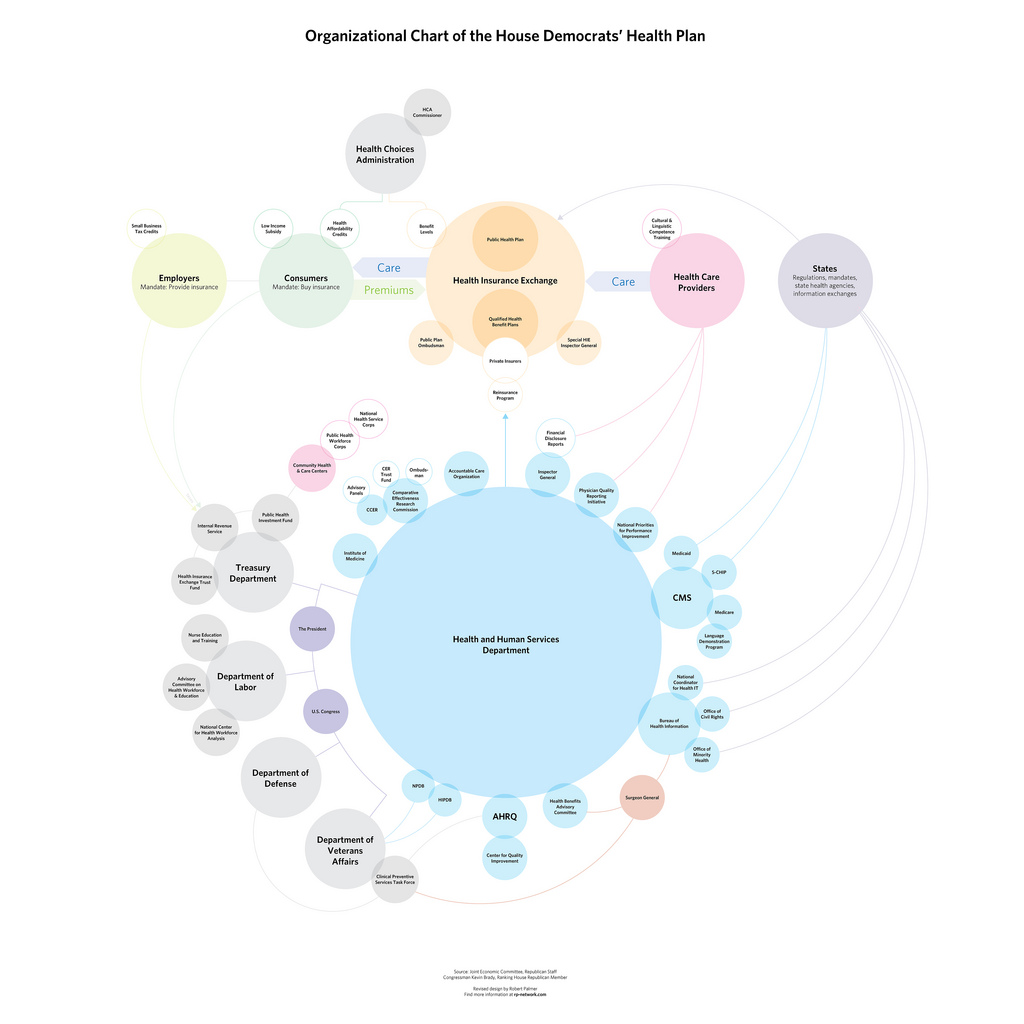
Remember this ?

Now try this:

obama_chart.jpg

Simple, focused and profound trumps ridiculously complex systems designed from technocratic hubris. Even if everything here worked according to plan in these charts, the intrinsic “friction” is a colossal waste of resources.

ADDENDUM:

In the interest of evenhandedness – and because it doesn’t matter in terms of the point of my post – here’s a Democratic take on the House Democratic plan for health care provided by Curtis Gale Weeks in the comments section. While this was not the same as the final Obamacare bill, there’s some congruence. If anyone has a link to a Democratic-produced chart of the final bill, I’ll post that:

demobamaplan.jpg


Switch to our mobile site