zenpundit.com » Perception

Archive for the ‘Perception’ Category

Even a Dancing Fool Can be a Leader

Monday, March 8th, 2010

A big hat tip to John Robb for finding and posting this gem. I guess Nazism, the French and Russian Revolutions, the Spartacus Revolt and several world religions could all have been ignited by an inspired moment of interpretive dance:

Guest Post: Charles Cameron on Abu Muqawama

Thursday, March 4th, 2010

Charles Cameron, my regular guest blogger, is the former Senior Analyst with The Arlington Institute and Principal Researcher with the Center for Millennial Studies at Boston University. He specializes in forensic theology, with a deep interest in millennial, eschatological and apocalyptic religious sects of all stripes.

One blogger’s rant to another: for AbuM

by Charles Cameron

Abu Muqawama seemed a reasonably nice and interesting guy, so I invited him in.  He came into my living room and was holding forth on Afghanistan and Iraq and matters military, and he seemed well informed.  I was glad I’d invited him in, and from time to time I found myself over in that corner of the room, and I listened. 

I think it’s important to learn from reasonably well-informed people, so I invite them into my home.  That’s the basic exchange that happens when you write a worthwhile blog: people invite you into their homes to listen to you.

When I invited Abu Muqawama into my room the other day — Andrew Exum, of the Center for a New American Security, that is — he happened to be talking about Mosab Hassan Yousef, the son of a top Hamas sheikh who converted to Christianity a while back, and was run as an inside agent by the Mossad for years.  Yousef has a new book coming out, and that’s why Exum and others have been taking an interest in him this week.

I turned to Exum and told him my own thoughts on the matter, but Exum didn’t respond, which is not ideal, but he’s a busy guy, okay — and anyway we were interrupted at that point.  Unfortunately, Exum seems to have had a drunken friend with him when he came into my living room this time, a ranting, homophobic drunk who spewed comments across my Bokhara rug (it’s not like it’s a museum piece you know, but I like it, I like it) such as…  well, let me quote his comment on Yousef himself, his conversion and his spying:

He’s probably celebrating Ask and Tell, say it proud, say it loud, it’s raining men in the Military. Hell, he’s probably volunteered to be the first gay in a submarine, along with all the pregnant sea persons. Gay. He probably saw Brokeback Mountain one too many times in that Israeli prison. Them Jews are smart, making gays out of Islamist, letting them sodomize each other.

Utterly charming. The only problem being, it’s not the sort of conversation I really want in my living room.

It is, Andrew Exum, should you ever read this, distinctly uninvited.

If I lived in a rowdy bar, perhaps, and slept in the sawdust during the day?  But I don’t. 

There are, by one count, around 15 such comments on that particular post on Exum’s blog that — what shall I say? will make me think twice about inviting Exum over to my place unless I can find a grownup to vouch for him first?

Look, there was another commenter on that particular blog post who told Andrew — if he was even listening — that that he was letting his blog “be ruined by not IP banning the moron”.  And I excerpted that phrase and put it in quotes because the commenter was plainly annoyed by this time and his own language was getting a little salty.

I think he had a point.  Exum wants into the living rooms and offices of people like myself: that’s why he has a blog.  Exum works for CNAS, which is an interesting group with friends in fairly high places, like Michele Flournoy.  Their logo is atop Exum’s blog these days, though I remember when it was just this young soldier’s blog, and no less interesting for lack of official sponsorship.

But look, today it is part of the web-presence of the much touted Center for a New American Security, so they’re in my living room, too.  And you might think they’d have a concern for their reputation.

I’m a reasonably civil chap — brought up in England, and a bit old school, you know — so I fished up their email address and asked them very politely if they would remove comments like the one from “Bubba loves them Sabra girls”.

Somehow, I don’t see them letting someone stand in their office suite handing our fortune cookies that read “Bubba loves them Sabra girls” — do you?  I don’t want them to think they can encourage that in my home, either.  I tried to tell them that politely via email, but that was almost a week ago, and I don’t think they read all their email.  And almost that long ago, the same comment poster who had complained earlier posted again, this time saying:

Rofl, this is amazing. 1 guy with 15/21 comments in a thread. Exum, you’re being an idiot. I’ve read this blog for well over 3 years now, and this is terrible. You’re letting your blog sink.

It’s truly sad. It would take 2 seconds to moderate this blog.

 He’s right, you know.  Exum isn’t an idiot, but his tolerating this sort of trolling on his blog is idiotic.  Exum would like to make conversation with anyone who’s listening, but he doesn’t appear to be listening himself. 

Look, this is all focused on Abu Muqawama, who doesn’t entirely deserve it.  And I understand: he’s a busy man.  But I love this internets thing, and I happen to think it’s an opportunity for all of us.

There are blogs out there for hatred, blogs for poetry, blogs for discussing issues in Byzantine history or Catholic liturgy, blogs for porn, blogs for someone and the cousins to share photos of their pets and kiddies, lots and lots of blogs.  But within the enormity of the ‘sphere, there’s an opportunity for civilized discourse on matters of significance.

Abu Muqawama aspires to speak in that place, as does Zenpundit, as do I.  We are trying to build a conversation of informed insight across the webs, blog calling to blog, in a project that might make the world a little wiser and less liable to suffer the consequences of ignorance and prejudice.

If, like Abu M, you are a web notable, and you blog — as I see it, you have an opportunity and an obligation.

I want to say this quite clearly, because I invite you and your peers and friends into my living room and into my life, every day:

You have an obligation to listen, as well as speak.  You have an obligation to read the comments in your blog — or if you’re too busy, okay, to have an intern read them for you, and select the best for you to read — and you or your intern have a responsibility to notice when some foul-mouth splashes your pages with regurgitated bile, and to clean up the mess. 
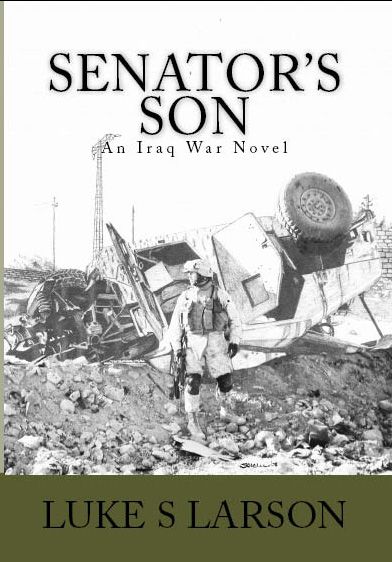
Senator’s Son

Wednesday, February 17th, 2010

larson.jpg

Senator’s Son: An Iraq War Novel  by Luke S. Larson

Just received a review copy of new author Luke Larson’s novel Senator’s Son. I can probably count on the fingers of one hand the number of works of fiction that I have reviewed at ZP, but two things caught my attention about Senator’s Son:

First, the novel is historical realism with a theme of COIN. Secondly, the author Luke Larson is a decorated Marine officer with two tours in Iraq under his belt. Flipping the pages reveals a gritty, sometimes humorous, staccato writing style and military/strategy/policy issues that are discussed here, or at SWJ or Abu Muqawama come to life through the eyes of still learning practitioners. I’m looking forward to reading Senator’s Son and reviewing it in full in late February or early March ( need to finish Carr’s Inside Cyber Warfare first).

Setting aside the book itself, something else occurred to me – that we have reached the point where the war is now appearing not as news, but as literature; Iraq and Afghanistan are proving to be culturally transformative wars for America in ways that the Gulf War or the Korean War were not.

If you consider WWI, the Great War represented an existential crisis for Western Civilization that found expression in the Lost Generation and, in Germany, the polar opposite novels All Quiet on the Western Front and Storm of Steel as well as Hemingway’s A Farewell to ArmsThe Spanish Civil War electrified international opinion, foreshadowing as it did the ideological death-match of the 20th century, and yielded Orwell’s Homage to Catalonia. WWII and the Vietnam War have generated an ocean of histories down to the minutest detail, as well as their share of novels, short stories and movies. It is noteworthy, that most of the time, literature and history followed the conclusion of peace, be it in victory or defeat.

In our time, the books on the war in Iraq, or Afghanistan or against terrorism are arriving while the conflict is still in full throttle, in time to shape the perceptions of policymakers and the public to an unprecedented extent. Something is happening out there, an inchoate need for answers or reassurance that writers are attempting to answer. Most of these books so far have been non-fiction, journalistic instant histories salted with examples of policy analysis and war memoirs.

Senator’s Son marks a new turn toward a wave of fiction addressing the crucible of America’s current wars. Literature can shape a nation’s psyche more profoundly than even the most soberly researched work of history.

A Visual

Saturday, February 13th, 2010

information_design.jpg

This was put up at Thoughts Illustrated by Dave Davison.

Now, Dave knows his stuff when it comes to presentation of ideas, the man has a long established track record, but I have to confess that the meaning of this diagram totally eludes me. Why is the “sweet spot” surrounded by “useless…..boring…..rubbish…..ugly”? What the hell is this supposed to imply? The rest of it has some promise.

Any IO or message experts care to weigh in ?

The al-Masri Dialogue

Tuesday, February 9th, 2010

Charles Cameron, in his latest guest post here, penned a beautiful essay regarding the ongoing exchanges between Australian counter-terrorism scholar Leah Farrall and Abu Walid al-Masri, an adviser to the Taliban and an experienced strategist of Islamist insurgency. Farrall has translated and posted this dialogue on her blog, All Things Counter Terrorism, which has received much attention, commentary and criticism in the blogosphere and on private listservs and quasi-official bulletin boards.

Generally, I leave this sort of subject to Charles, since he has the academic expertise to drill down to a granular level of Islamic theology and Islamist ideology, but al-Masri is an intriguing figure and his public conversation with Farrall is a novelty worth investigating. It would be hard to imagine during the Cold War, an open media debate between a Western CI official and a Soviet spymaster still engaged in espionage in the field ( Kim Philby hurled public jermiads it is true, but that was in retirement in Moscow and only after his long-suffering KGB handlers had managed to get his severe alcoholism under control). In that spirit, I want to offer a few observations.

While there is artifice present, as al-Masri is consciously speaking to a multiplicity of audiences in his remarks, the idea that we should therefore dismiss the dialogue with Farrall, as some suggest, is an error. There is also posturing in purely intra-Islamist-debates on which we eavesdrop and, frankly, within our own arguments inside government and out. We learn from what people do and do not do, from what they say and what is left unsaid. Being able to speak to multiple audiences is a constraint, as well as an advantage, as it shapes the parameters of the premises to be employed and the extent to which the underlying logic can be permissably extrapolated. To quote a Zen saying, if you wish to fence in a bull, give him a large meadow. 

The constraints, if correctly discerned, are illuminating and are analytically useful in constructing our own tactical responses and message strategy (assuming someone can convince the State Department bureaucracy that IO and public diplomacy are important and persuade Congressional leaders to fund such activities with more than pocket change). They are also useful in helping to understand the worldview and governing paradigms of our opponents in more complex and nuanced manner than reflexively saying “they hate our freedoms”. Well, many jihadi types do in fact, viscerally hate our freedoms or deny that democracy is a legitimate form of government in an abstract sense, much the same way they casually disparage Hindus as “cow worshippers” or Thais as “crazy Buddhists”; however those loose attitudes and spasms of hostility are not akin to operational principles or strategic doctrines.

For that, we have to dig deeper into the politico-religious motivations of violent Islamists and listen closely to what our enemies are saying – particularly when they are making an effort to speak to us directly, as al-Masri is doing, his determination to score propaganda points in his little elicitation dance with Farrall notwithstanding. Americans are not very good at listening and our elites are deeply uncomfortable with the entire subject of religion, tending to view pious expressions of Christianity with contempt and Islam as a completely taboo subject. There is a strong preference in government and academia for analytical models of terrorism or insurgency that dwell on DIME spectrum variables because these fit in the personal comfort zones and the educational, social and professional experiences of the American elite. This would be a perfect approach if al Qaida’s leadership were composed of Ivy League alumni and Fortune 500 CEOs.

Economics and military force are always factors in geopolitical conflict, the war of terror included, but until Islamist extremists oblige us by becoming secular Marxist revolutionaries waving little red books, it would behoove us to look with greater scrutiny at the curiously reified religious ideology with which they justify or eschew courses of action to themselves. Our own strategies might be more focused and effective if the operators across our intelligence, military, diplomatic and law enforcement agencies had something approaching a shared understanding of violent Islamism and if they could communicate this understanding along with the benefit of their experience and current intelligence to help political leaders shape American policy.


Switch to our mobile site

