zenpundit.com » visualization

Archive for the ‘visualization’ Category

2011, meet 1997 (and 1995, and 1943…)

Wednesday, May 25th, 2011

[ by Charles Cameron — creativity, IARPA, HipBone Games, h/t Hermann Hesse ]

.
Funny thing, that.

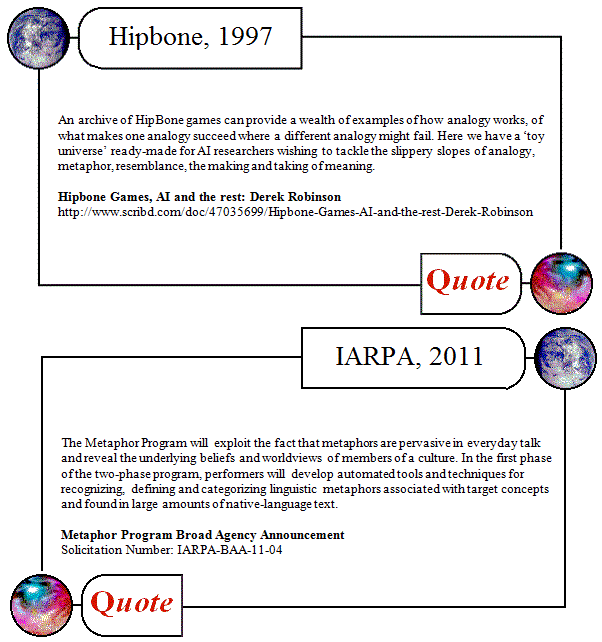
quo-iarpa.gif

In 1997, Derek Robinson wrote a short piece about my HipBone Games, indicating what they were good for. Read it – then read the IARPA solicitation that just came out.

My approach is to lure people into discovering analogies, metaphors, parallels and oppositions by playing a game which elicits them as game moves — a live process, and one that cuts to the very heart of creativity — IARPA wants an automated version, which will be clunky by comparison. And as Derek points out in his piece — pointed out, that is to say, fourteen years ago, quoting an even earlier (1995) comment from Douglas Hofstadter:

If, instead of using the real world, one carefully creates a simpler, artificial world in which to study the high-level processes of perception, the problems become more tractable.

That’s what my games are — “a simpler, artificial world in which to study the high-level processes of perception” — specifically, “of analogy, metaphor, resemblance, the making and taking of meaning”.

I’ve been working on this stuff for at least fifteen years… inspired by a book Hermann Hesse published in 1943.

*

And oh yes, there’s a “future of search engines” hiding in there, too.

Creativity and the laughable

Monday, May 16th, 2011

[ by Charles Cameron — creativity, Taliban, Leonardo, pareidolia, Virgin Mary, Kwan-yin ]
*

.
Sharing, as I do with Zen, a keen interest in the creative process, I am used to the idea that an idea that seems trivial at first, the very expression of which risks making oneself a laughing-stock, may well carry the seed of success.

Whitehead is quoted as saying, “Every really new idea looks crazy at first.” Einstein, “If at first the idea is not absurd, then there is no hope for it.” Nils Bohr, “Your theory is crazy, but it’s not crazy enough to be true.” The idea is not even confined to physicists and mathematicians. Mark Twain observed, “The man with a new idea is a crank – until the idea succeeds.” And Winston Churchill, “No idea is so outlandish that it should not be considered with a searching but at the same time steady eye.”

I was therefore intrigued to read this account of the origins of the Taliban’s recent Kandahar prison break:

One of the surprising mujahideen squad in the city of Kandahar, who by his connections gained full knowledge of the inside and outside of the prison, pondered one day whether it could be possible to dig a tunnel from the inside of a house on the other side of the street to the prison as a means to releasing the prisoners. This fantasy and imagination seemed laughable at first even to its owner; he dared not share his opinion with others. But, after more time and continued thinking, he reached a conclusion. On one of these days, while he was riding a motorcycle with two of his comrades, he shared that view with them. They thought it impossible initially and deemed it a fruitless, dangerous attempt. Finally, they placed their trust on God and shared their opinion with the mujahideen high command in Kandahar. With guidelines from the command, the aforementioned four revealed [to] their trusted comrades their decision to implement this plan regardless of its risks and even if it looked impossible.

The sentence that really got my attention was this one:

This fantasy and imagination seemed laughable at first even to its owner; he dared not share his opinion with others.

*

Leonardo da Vinci once wrote of having “a new and speculative idea, which although it may seem trivial and almost laughable, is none the less of great value in quickening the spirit of the invention.”

His “trivial and almost laughable” idea?

It is this: that you should look at certain walls stained with damp or at stones of uneven colour. If you have to invent some setting you will be able to see in these the likeness of divine landscapes, adorned with mountains, ruins, rocks, woods, great plains, hills and valleys in great variety; and then again you will see there battles and strange figures in violent action, expressions of faces and clothes and an infinity of things which you will be able to reduce to their complete and proper forms. In such walls the same thing happens as in the sound of bells, in whose strokes you may find every word which you can imagine.

Essentially, Leonardo is suggesting that we use what’s effectively the Rorschach technique to induce pareidolia (I think that’s the state) and elicit mental contents – images triggered by the mind’s eagerness to sense meaning – thus imitating the universe itself in bringing something out of nothing, out of the potent void.

*

This is, however, the same psychological mechanism that brought us the sale of a grilled cheese sandwich for $28,000 on eBay – because it “looked like” the Virgin Mary

That’s not a note I’d like to end on, however — so I’ll just remind myself that we don’t “know” what the Virgin Mary looks like, and pass on to the rather charming story of a similar pareidolic image, this one possessing the almost miraculous property of looking simultaneously like the Blessed Virgin and the bodhisattva of compassion, Kuan-Yin:

Situated in the East Bay area, near the lovely city of San Francisco, the Purple Lotus School is witnessing yet another miracle. … In April 1996, when the great “Merit Wall” on campus had just been constructed, a mysterious face appeared on the wall immediately after the cement dried. … Buddhists who have witnessed this phenomenon believe this to be the face of the compassionate Bodhisattva Kuan-Yin. … Others have believed this image to be that of the Virgin Mary. Magia and Junia Chou, the daughters of the Purple Lotus Society’s Master Samantha Chou, attend a Catholic elementary school. Upon seeing the image, both called out earnestly and delightedly, “Look! It’s the Virgin Mary!” … With the essence of Enlightenment and universal wisdom in mind, perhaps one can argue that a distinction between the two is not important after all.

*

It’s laughable, I know — but I must confess I like the “meaning” I can draw from that…
Scientific Method: Perception and Reality

Monday, May 9th, 2011

I am working on a couple of posts and a book review, but in the meantime, I thought this graphic was interesting:

sciencerage.png

From Electron Cafe:

A HipBone approach to analysis VII: world wide spiders & the web

Tuesday, April 19th, 2011

[ by Charles Cameron ]

*

I thought I’d back-track a little, and drag in two blog posts that I made elsewhere back in March of 2008, which may help to explain my basic outlook on the sorts of issues that analysts face.

.

I. The version of the idea as poetry:

I am Charles

.

My concern is the human mind in service
to an open heart, and my problem
is that the heart picks issues rich in ambiguity
and multiplicity of voices, tensions
and torsions tugging not one way but
in many directions, even dimensions, as does
a spider’s web weighed down with dew –
to clarify which a mind’s abacus is required
.
equal in subtlety to subtlety itself, while
in all our thinking and talking, one
effect follows one cause from question
to conclusion down one sentence or white
paper — whereas in counterpoint,
Bach’s fugal voices contain their dissonance.

.

II. The same idea presented in prose — as I say, a few years back — with graphical illustration:

Spiders and dewdrops

Spiders and dewdrops do a pretty convincing job of portraying a certain level of complexity in this node-and-edge diagram of the global situation.

spider_web.jpg

When, say, Castro hands over power to his brother, or Musharraf has to give up control of the Pakistani army, it’s like snipping a couple of threads in that spiders web — and the droplets fall this way and that, carom into one another, the fine threads they’re on swing down and around until a new equilibrium is reached…

But try thinking that through in terms of Cuba and Pakistan before breakfast one morning if you’re Secretary of State, with a linear Cold War mind, Russia going through its own changes, and al-Qaida and associates training and recruiting in the background…

Well, those two instances have been and gone, and the new configurations are now the tired old same old configurations we believe we’ve figured out — until another dewdrop slips, and a thread breaks, and all things are once again new…

.

Funnily enough, I think this spider’s web of mine ties in with the Hokusai quote I posted in response to Zen‘s quote from Steven Pressfield yesterday, and with a piece I read today about intelligence analysts — Martin Petersen, What I Learned in 40 Years of Doing Intelligence.

It’s the web of tensions that constitutes the “complexity” that must somehow be grasped by the analyst, the writer, the historian…

And Hokusai, watching across the years how grasses bend in the winds, reach for sunlight, bow under the weight of dew — and spring back when released — may finally have a mind that’s attuned to that kind of complexity — to a degree that linear thinking will never reach…

Social and Individual Components of Creativity

Thursday, April 14th, 2011

This is very good. And it is fast.

I have enjoyed several of Steven Johnson’s previous books, Emergence and Mind Wide Open and his latest one, Where Good Ideas Come From looks to be a must read, though I think those of you who have read Wikinomics or works like Flow by Mihaly Csikszentmihalyi will find some of Johnson’s points in the video to be familiar as will those long time readers who have seen my views on horizontal thinking   and  insight.

My students watched this and reacted by defining themselves as those who were creative mostly through social collaboration but a decided minority required solitude and an environmental filter to think clearly and creatively – not a catalyst of a series of  social-intellectual stimuli. For them, the cognitive load generated by the environment amounted to an overload, a distracting white noise that short-circuited the emergence of good ideas.

This suggests to me that there are multiple and very different neuronal pathways to creativity in the brain and a person’s predisposition in their executive function, say for example the classic “ADHD” kid at the back of the class, may have different requirements to be creative than a peer without that characteristic. It also means that creativity may be subject to improvement if we can cultivate proficiency in several “styles” of creative thinking.


Switch to our mobile site