zenpundit.com » Buddhist

Archive for the ‘Buddhist’ Category

My latest for Lapido: renewing the power of holiness?

Wednesday, August 12th, 2015

[ by Charles Cameron — The Dalai Lama and the Pope: two saints, sorta, astride a supposedly secular world ]
.

Pope Francis & Dalai Lama 602
HH Pope Francis, HH the Dalai Lama. Photos: Jeffrey Bruno, Christopher (CC BY SA 2.0)

My latest post for LapidoMedia is titled The Dalai Lama and the Pope: renewing the power of holiness. It begins:

TWO figures of undoubted moral stature now dominate world affairs. Each of them is a religious leader. Each is known by the title His Holiness, but seems to wear the title lightly.

For neither of them is virtue a lost ideal, neither is morality a private matter.

Each preaches compassion, consideration for the poor, spirituality above materialism, and the care of the natural world.

What do these two men have in common, that distinguishes their voices from those of other office holders and persons of power and influence?

Certainly, each has been featured in Rolling Stone, which indicates their popular appeal.

Each one’s office has a long pedigree, and each just might be the last of his kind. Perhaps there’s a clue there.

It concludes with:

First contemplation, then action: this is the secret uniting heart, mind and hand which gives these two figures their appeal and stature.

And the need to join together to combat climate change is one arena in which these two men are in strong agreement.

The Guardian reports from Glastonbury, ‘The Dalai Lama has endorsed the pope’s radical message on climate change and called on fellow religious leaders to “speak out about current affairs which affect the future of mankind.”’

The Pope writes, ‘The urgent challenge to protect our common home includes a concern to bring the whole human family together to seek a sustainable and integral development.”

Where will these two religious figures – moral icons of our age – lead our arrogantly secular world?

To raead the whole thing, visit the Lapidoedia site.
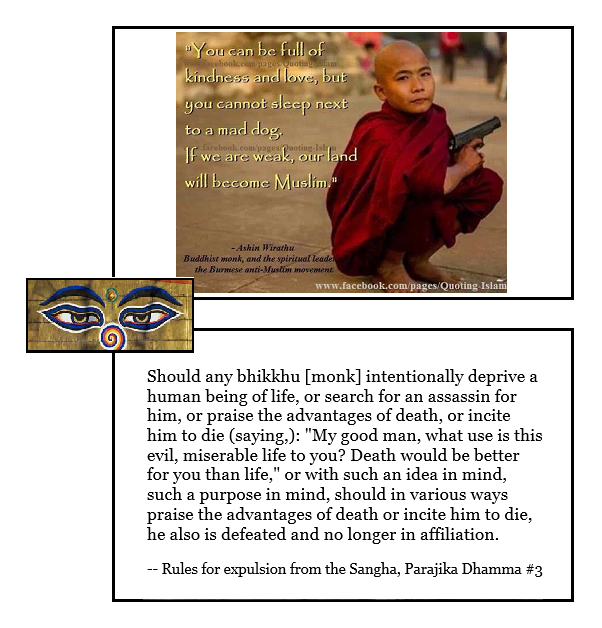
Buddhism and Islam: please note disclaimers

Wednesday, March 4th, 2015

[ by Charles Cameron — on monk Wirathu, also the trickiness of images-with-quotes on social media ]
.

SPEC Wirathu

The quote from Wirathu (upper panel, above) is a direct quote from a NYT interview with him:

You can be full of kindness and love, but you cannot sleep next to a mad dog,” Ashin Wirathu said, referring to Muslims.

The image was posted on a FaceBook page which is either his or named for him, but appears to have been taken from a National Geographic contest. The photographer’s note reads:

At the annual Ananda Harvest Festival in Bagan, Myanmar, thousands of monks from all over Myanmar came to receive alms. While walking around the vast temple grounds, I chanced upon this boy monk who was playing with his toy gun. Even though it was only a toy gun, I found this image a disturbing juxtaposition of the peace that Buddhism embodies and the violence that guns symbolise.

So the gun is a toy gun, and the monk a boy monk, not Wirathu.

FWIW, I searched for “wirathu hoax” and didn’t find this image listed, but did find a hoax photo attributed to a Wirathu FB page: Fake image being circulated by monk Wirathu to incite anti-Muslim violence in Burma (Warning: Graphic Content).

Figuring out what’s genuine, what’s propaganda. and what’s fake or a hoax is getting harder and harder these days, and we need more and more skeptical spectacles when taking in both texts and images.

The text from the Parajika (lower panel, above) is genuine.

**

Edited to add:

Lion’s Roard, the Buddhist site, had a great piece which intro’d me to the Wirathu quote with image, Facebook using Buddhist tools to fight hate speech in Burma. Extract:

As Burma is emerging from fifty years of military dictatorship, its citizens are thronging to social media, particularly Facebook, and anti-Muslim extremists are too. Facebook is addressing the problem of Buddhist anti-Muslim activists promoting violence on Facebook with a new set of features.

When Facebook users flag content they “don’t like,” a box pops up asking “Why don’t you want to see this?” The user can select options like “it’s annoying” or “it promotes violence.” In Burma, Facebook now also includes the options “it’s a rumor or has false information,” and “it disturbs social harmony.” According to readwrite.com, the second option was chosen specifically for its resonance with Buddhist precepts.

“We wouldn’t normally use this language in the U.S.,” Said Kelly Winters, whose Facebook’s title is “Product Manager for Compassion.” Facebook employs language that resonates with the local market, which, in Burma’s case, is largely Buddhist-influenced.

Comparative safety: NSA and Burma

Thursday, December 18th, 2014

[ by Charles Cameron — clear proof that blasphemy is more provocative than ironic protest ]
.

It is apparently safer for the Electronic Frontier Foundation to put headphones on the US bald eagle as featured in the seal of the National Security Agency

SPEC DQ Buddha earphones

… than it is for a Kiwi bar-keeper to put headphones on the Buddha while advertising an event at his bar in Rangoon, Burma.

A little something to chew on.

**

It seems plausible that the Buddha, had he wished to wear headphones, would have chosen the noise-canceling kind.

Creating a web-based format for debate and deliberation: discuss?

Friday, December 12th, 2014

[ by Charles Cameron — Talmud, hypertext, spider webs, Indra’s net, noosphere, rosaries, renga, the bead game, Xanadu, hooks-and-eyes, onward! ]
.

Let me firmly anchor this post and its comments, which will no doubt shift and turn as the wind wishes, in discussion of the possibility of improving on current affordances for online deliberation.

Let’s begin here:

**

There are a variety of precursor streams to this discussion: I have listed a few that appeal to me in the sub-head of this post and believe we will reach each and all of them in some form and forum if this discussion takes off. And I would like to offer the immediate hospitality of this Zenpundit post and comment section to make a beginning.

Greg’s tweet shows us a page of the Talmud, which is interesting to me for two reasons:

  • it presents many voices debating a central topic
  • it does so using an intricate graphical format
  • The script of a play or movie also records multiple voices in discourse, as does an orchestral score — but the format of the Talmudic score is more intricate, allowing the notation of counterpoint that extends across centuries, and provoking in turn centuries of further commentary and debate.

    What can we devise by way of a format, given the constraints of screen space and the affordances of software and interface design, that maximizes the possibility of debate with respect, on the highly charged topics of the day.

    We know from the Talmud that such an arrangement is possible in retrospect (when emotion can be recollected in tranquility): I am asking how we can come closest to it in real time. The topics are typically hotly contested, patience and tolerance may not always be in sufficient supply, and moderation by humans with powers of summary and editing should probably not be ruled out of our consdierations. But how do we create a platform that is truly polyphonic, that sustains the voices of all participants without one shouting down or crowding out another, that indeed may embody a practic of listening..?

    Carl Rogers has shown us that the ability to express one’s interlocutor’s ideas clearly enough that they acknowledge one has understood them is a significant skill in navigating conversational rapids.

    The Talmud should be an inspiration but not a constraint for us. The question is not how to build a Talmud, but how to build a format that can host civil discussion which refines itself as it grows — so that, to use a gardening metaphor, it is neither overgrown nor too harshly manicured, but manages a carefully curated profusion of insights and —

    actual interactions between the emotions and ideas in participating or observing individuals’ minds and hearts

    **

    Because polyphony is not many voices talking past one another, but together — sometimes discordant, but attempting to resolve those discords as they arrive, and with a figured bass of our common humanity underwriting the lot of them.

    And I have said it before: here JS Bach is the master. What he manages with a multitude of musical voices in counterpoint is, in my opinion, what we need in terms of verbal voices in debate.

    I am particularly hoping to hear from some of those who participated in tweeted comments arising from my previous post here titled Some thoughts for Marc Andreessen & Adam Elkus, including also Greg Loyd, Callum Flack, Belinda Barnet, Ken (chumulu) — Jon Lebkowsky if he’s around — and friends, and friends of friends.

    What say you?

    On China vs India — and the Hungry Ghosts

    Tuesday, August 27th, 2013

    [ by Charles Cameron — I’d have put these two “quotes” in my DoubleQuotes format, but wanted to quote quite a gobbit of each, and the print would have been too small ]
    .

    Offering us a fresh angle on two great nations as we (maybe) pivot to Asia

    Excerpted from Hungry Ghost Festival 2013 Begins In China As Spirits Descend On Homes, Wander Streets:

    The gates of hell have opened. Its ghosts have been let loose to roam on earth and visit the homes of their relatives.

    According to traditional Chinese beliefs this happens every year during the seventh month of the lunar year, resulting in a raucous, feast-and-music filled celebration known as the Hungry Ghost Festival. But not all ghosts are good. There are some spirits who wander the streets, ravenous and envious because they died without descendants or were ignored by their kin while alive.

    To appease the hungry spirits, ethnic Chinese step up prayers, aided by giant colorful joss sticks shaped like dragons. They also burn mock currency and miniature paper television sets, mobile phones and furniture as offering to the ancestors for their use in the other world.

    For 15 days, neighborhoods hold nightly shows of shrill Chinese operas and pop concerts to entertain the dead.

    Excerpted from Indian state outlaws profiting on miracles, summoning ‘ghosts’:

    New Delhi – A new law against superstition and black magic in India’s Maharashtra state has triggered a debate between religious groups who say that the state is interfering in personal faith, and rationalists who say religious malpractices violate human rights. [ … ]

    “We will challenge the law as it is ambiguous and interferes with personal faith,” says Abhay Vartak of the Santan Sanstha, a Hindu organization. “The law does not define much of what it outlaws – ghosts, for instance. The government itself is not clear whether ghosts exist! And if belief in ghosts is to be outlawed, then what about the Hindu Scripture the Atharva Veda, which says a lot about how to get rid of ghosts who come to inhabit a body?” he asks.

    The law specifically outlaws 12 practices, making them punishable by a jail term of seven months to seven years. Of the 12 clauses, two relate to belief in ghosts. The first one forbids recommending violent and sexual practices for purging ghosts from the body – including drinking urine or stool, being tied with a rope or chain, and touching heated objects. It also outlaws creating fear by threatening to invite ghosts.

    **

    For a glimpse of how the notion of “hungry ghosts” might be interpreted in terms of Tibetan Buddhist philosophy — as embodied in the Chöd rite — see Tai Situ Rinpoche‘s Introduction to Chod.


    Switch to our mobile site