zenpundit.com » ideas

Archive for the ‘ideas’ Category

Farrall in Foreign Affairs:How al Qaida Works

Thursday, February 24th, 2011

Leah Farrall, the Australian former counterterrorism official who blogs at All Things Counterterrorism (and is a friend of Charles Cameron ) has an important analytical article in Foreign Affairs (hat tip to the oratorical Josh Foust):

How al Qaeda Works

Despite nearly a decade of war, al Qaeda is stronger today than when it carried out the 9/11 attacks. Before 2001, its history was checkered with mostly failed attempts to fulfill its most enduring goal: the unification of other militant Islamist groups under its strategic leadership. However, since fleeing Afghanistan to Pakistan’s tribal areas in late 2001, al Qaeda has founded a regional branch in the Arabian Peninsula and acquired franchises in Iraq and the Maghreb. Today, it has more members, greater geographic reach, and a level of ideological sophistication and influence it lacked ten years ago.

Still, most accounts of the progress of the war against al Qaeda contend that the organization is on the decline, pointing to its degraded capacity to carry out terrorist operations and depleted senior leadership as evidence that the group is at its weakest since 9/11. But such accounts treat the central al Qaeda organization separately from its subsidiaries and overlook its success in expanding its power and influence through them. These groups should not be ignored. All have attacked Western interests in their regions of operation. Al Qaeda in the Arabian Peninsula (AQAP) has also long targeted the United States, but its efforts have moved beyond the execution stage only in the last two years, most recently with the foiled plot to bomb cargo planes in October 2010. And although al Qaeda in the Islamic Maghreb (AQIM) has not yet attacked outside its region, al Qaeda in Iraq (AQI) was reportedly involved in the June 2007 London and Glasgow bomb plots.

It is time for an updated conception of al Qaeda’s organization that takes into account its relationships with its subsidiaries. A broader conceptual framework will allow for a greater understanding of how and to what degree it exercises command and control over its expanded structure, the goals driving its expansion strategy, and its tactics.

AL QAEDA’S LOST DECADE

Although al Qaeda had tried to use other groups to further its agenda in the 1980s and early 1990s, Osama bin Laden’s first serious attempts at unification began in the mid-1990s, when the organization was based in Sudan. Bin Laden sought to build an “Islamic Army” but failed. Al Qaeda had no ideology or manhaj (program) around which to build lasting unity, no open front of its own to attract new fighters, and many of its members, dissatisfied with “civilian work,” had left to join the jihad elsewhere. Faced with such circumstances, bin Laden instead relied on doling out financial support to encourage militant groups to join his army. But the international community put pressure on Sudan to stop his activities, and so the Sudanese government expelled al Qaeda from the country in 1996. As a result, the group fled to Afghanistan.

By mid-1996, al Qaeda was a shell of an organization, reduced to some 30 members. Facing irrelevance and fearing that a movement of Islamist militants was rising outside of his control, bin Laden decided a “blessed jihad” was necessary. He declared war on the United States, hoping this would attract others to follow al Qaeda. It did not. A second effort followed in 1998, when bin Laden unsuccessfully used his newly created World Islamic Front for Jihad Against Jews and Crusaders to lobby other groups to join him. Later that year, al Qaeda launched its first large-scale attacks: the bombings of the U.S. embassies in Kenya and Tanzania, which it hoped would boost its fortunes. But these, too, failed to attract other groups to join, with some instead criticizing al Qaeda for the attacks and its lack of a legitimate manhaj.

With no coherent ideology or manhaj to encourage unification under his leadership, bin Laden instead pursued a predatory approach. He endeavored to buy the allegiance of weaker groups or bully them into aligning with al Qaeda, and he attempted to divide and conquer the stronger groups. In the late 1990s, he tried and failed to gain control over the Khalden training camp, led by the militants Ibn al-Shaykh al-Libi and Abu Zubaydah, and over the activities of Abu Musab al-Suri and Abu Khabab al-Masri, senior militant figures who ran their own training programs. Bin Laden’s attempts in 1997-98 to convince Ibn al-Khattab, a Saudi militant who led an international brigade in Chechnya, to come under al Qaeda’s banner also failed. His efforts in 2000-2001 to gain control over a brigade of foreign fighters in Afghanistan met a similar fate: the Taliban leader Mullah Omar, who had supreme authority over the brigade, instead handed the leadership of it to the Islamic Movement of Uzbekistan, another group bin Laden was attempting to convince to align with al Qaeda. Around the same time, bin Laden also unsuccessfully lobbied the Egyptian Islamic Group and the Libyan Islamic Fighting Group to join al Qaeda’s efforts. And although al Qaeda supported the militant Abu Musab al-Zarqawi in his establishment of an independent training camp in Afghanistan, bin Laden was unable to convince him to formally join the organization.

The only real success during this period was al Qaeda’s mid-2001 merger with Egyptian Islamic Jihad, led by Ayman al-Zawahiri, now al Qaeda’s second-in-command. The merger was possible thanks to Egyptian Islamic Jihad’s weakened position and its reliance on bin Laden for money. The decision was nevertheless contentious within Egyptian Islamic Jihad, and several of its members left rather than join with al Qaeda. In the end, al Qaeda’s only successful merger during its Afghanistan years added just five people to its core membership. Compared to this dismal record, the past decade has been highly successful….

Read the rest here (subscription required) or for a brief time in full, for free, here.

First, I’d like to say congratulations to Ms. Farrall who has been working hard researching the nuances of ideological, theological, tactical and organizational differences and personal rivalries that existed within the mutable and murky subterranean world of professional Islamist revolutionaries. It’s important work. Her recognition in FA is deserved and American terrorism experts should give her arguments close scrutiny.

Secondly, I will say her article shows the extent to which our takfirist enemies, not just al Qaida,  take seriously the ideas behind their global insurgency and that, to them, it is both global and local. The “internationalist” jihadis like Bin Laden seek to weld themselves together with the parochial “Nationalist-Islamists” and David Kilcullen’s local “accidental guerrillas” with a “eucumenical” radical Islamism. As many USG officials seek to ignore or promote an official line of ignoring the ideological and theological motivations of our enemies, they will probably dismiss Farrall unless she gains enough media prominence that this is no longer feasible – at which point, they will make nasty and anonymous criticism about her on background to The New York Times and The Washington Post.

Thirdly, Farrall has a very important point here when she wrote:

….They drew from takfiri thought, which justifies attacking corrupt regimes in Muslim lands, and on materials that outline the Muslim requirement to target the global enemy: in this case, the United States and the West. (This was framed in the context of defensive jihad, the need for which was reinforced by the 2003 U.S. invasion of Iraq.) The hybrid ideology and manhaj that emerged make little distinction between targeting local enemies and targeting global ones and have a one-size-fits-all solution — jihad. Partnering with al Qaeda does not, therefore, require a local group to abandon its own agenda, just broaden its focus. This helped assuage other groups’ fears that merging with al Qaeda would mean a loss of autonomy to pursue their own local goals.

This is what Global Guerrilla theorist John Robb would call “a Plausible Promise“, a required step in building an “open source insurgency” which can attract groups with differing agendas, opportunitic actors and ideologically motivated, socially alienated “lone wolves” to their banner. Al Qaida has tacticians who apparently agree, having formally adopted “Open Source jihad” in late 2010. So far, the executive branch departments of the USG seem to be studiously determined to ignore that as well, a stance that corrupts our analytical integrity and cripples our operational effectiveness. Lying to oneself is rarely a good way to get an advantage over an opponent.

I think I can speak for Charles Cameron in that we here at zenpundit.com hope to see more articles from Ms. Farrall in the near future.

ADDENDUM:

SWJ BlogThe Hasan Slide Presentation A Preliminary Commentary by Charles Cameron
Wikistrat: Barnett on US National Military Strategy

Wednesday, February 23rd, 2011

Dr. Thomas P.M. Barnett on the new US National Military Strategy:

To subscribe to WIKISTRAT for their bulletins, interactive futurist simulation models and client-specific analytical services, go here.

Tom did a very nice job with this piece, particularly his reference to the historically underexamined but diplomatically significant Nixon Doctrine. He’s right. The strategic shift is a radical departure from the previous Bush era and is closely following the mammoth budgetary requests of our high tech services that are gearing up, along with industry lobbyists, to battle for every last dollar of a shrinking defense pie ( one reason I recently asked,  Is COIN Dead?). 

However, the military strategy should be driving acquisitions rather than being a shopping list transformed into a strategy ( see Shape the Future Force section) considering we are in at least two wars, perhaps three depending on how you count, from which we have yet to bring to a satisfactory resolution. That there is a shift here is not bad per se – East Asia is certainly far more significant to American security than is Afghanistan but that shift is so heavily laden with major economic and diplomatic variables, which, frankly, are of much greater longitudinal importance than military operational planning or short term force structure.

Gene Sharp

Monday, February 21st, 2011

[ by Charles Cameron ]

I was impressed by him in London in the early sixties.

Okay, I was young and impressionable. But others have noticed him more recently, too: Hugo Chavez accused him of being a conspirator with the CIA, and the Iranians thought he, George Soros and John McCain were in cahoots.

gene-sharp.jpg

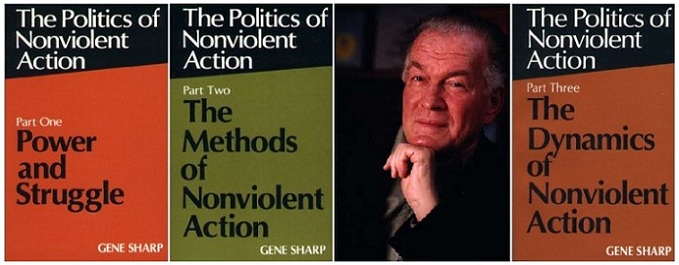
Gene Sharp has been in the news quite a bit recently [1, 2, 3, 4], because he pretty literally wrote the book on non-violent resistance.

The young leaders of the Egyptian revolt that toppled Mubarak studied tactics with members of the Serbian Otpor youth resistance who topped Milosevic, Otpor studied tactics in the writings of Gene Sharp, specifically his 90-page pamphlet From Dictatorship to Democracy [download as .pdf]. Sharp wrote that handbook for use in Burma, where it was apparently translated at the request of Aung San Suu Kyi — who once cautioned her readers that that phrase they kept hearing wasn’t “jeans shirt”, it was “Gene Sharp”.

And before that, he’d penned his masterful 900-page, three-volume work, The Politics of Nonviolent Action

I told you he was impressive.

Recommended reading:

From Dictatorship to Democracy is now available in Amharic, Arabic, Azeri, Belarusian, Burmese, Chin (Burma), Jing-paw (Burma), Karen (Burma), Mon (Burma), Chinese (Simplified Mandarin), Chinese (Traditional Mandarin), English, Farsi, French, Indonesian, Khmer (Cambodia), Kyrgyz, Pashto, Russian, Serbian, Spanish, Ukrainian, Tibetan, Tigrigna, and Vietnamese.

Viewdle is a Two-Edged App

Sunday, February 20th, 2011

Saw this on Shlok’s site:

Viewdle – Photo and Video Face Tagging from Viewdle on Vimeo.

This kind of app is a required step for making augmented reality devices part of the social media ecology. Therefore, this tech will become a standard for all mobile devices – merchants and advertisers want us as an army of data collectors on each other.

OTOH, automatic face-recognition and social media aggregation raises serious concerns about the potential dangers of living under a panopticon state if an app is aggregating and bundling all your online data in real time, while giving out your GPS and home address. A godsend to stalkers, oppo researchers, con men, disgruntled spouses or employees, autocratic governments and other creepy malefactors. Expect businesses, which are already attempting to illegally pry and spy into all areas of employee’s lives, to make surreptitious use of apps of this nature

Puts the protests to revolution in Egypt and Tunisia in perspective, doesn’t it?

If the FCC wanted to do something useful and promoting of liberty, they might consider regs to let individuals exercise greater control the use third parties would have to their collective online IDs – then you could be “out there” or not or to the degree you liked. Some people, do want to be “out there” professional or social reasons. While you cannot control pictures of yourself in a public space, I’m not sure the Supreme Court thought that your presence in public meant that random strangers and government officials should be able to run your credit history as you sit at a table in a restaurant or bar or take in a movie or ball game by taking your photo. A similar logic underlies state laws prohibiting wiretapping or making auditory recording individuals without their knowledge and consent (Illinois being one such state where Chicago aldermen and state legislators have acquired a healthy fear of recording devices).

Speaking of government, I have been told by an authoritative source that the USG rsearch is far advanced in this area. Probably a lot further along than is Viewdle, but perhaps not.

History as a Gen Ed Credit for Engineering Students Aspiring to Naval Leadership

Tuesday, February 15th, 2011

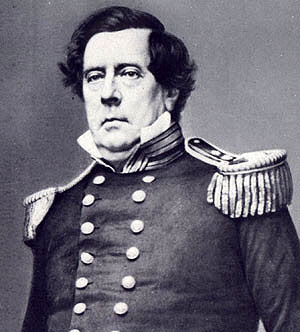
Commodore….errr….what’shisnameagain???

As a rule, I generally do not write about US Navy affairs because it is not an area of expertise for me and I think Galrahn covers that territory admirably well without my poor help. Every so often though, an item from our sea-roving friends catches my eye that I am qualified to speak about and today is one of those days.

Teaching naval history has become an inconvenience to those entrusted with training our nation’s future captains and admirals because they need to get the budgetarily “sexy” topic of “cyber warfare” into the US Naval Academy curriculum. Yes, that’s right. Because someday, in the midst of battle, the combatant commander of PACOM will be furiously barking out HTML code at the bridge of the Eisenhower, above the cries of wounded men.

Gentlemen, gentlemen….in matters of education, fundamentals come before esoterica!

I strongly recommend this post by LCDR Benjamin “BJ” Armstrong, historian, pilot and Navy officer who tackled this subject with an enviable grace and eloquence at the USNI blog:

HH104, WWATMD…

….More than policy or naval strategy, Mahan believed in teaching officers the best ways to approach the challenges of command.  He saw his job as a Naval War College plankowner in those terms, about teaching command, and to do so he turned to history.  But, it wasn’t just senior officers who needed grounding in our naval past.  He wrote in his very first published article, winning third place in “Proceedings” annual essay contest, that history was also a key foundation for learning at the Naval Academy.

When he said that history “lies at the foundation,” it wasn’t just a convenient turn of phrase.  He believed that before subjects like gunnery, engineering, or even cyber-warfare, could be taught a Midshipman needed to know why he was learning them.  Why did any of it matter?  The best way to show a student why hitting the target in gunnery class was important was to teach him the history that showed what happened when crews weren’t drilled properly.  Perhaps he would teach the Midshipman about Captain James Lawrence sailing Chesapeake out of Boston harbor with a green and undrilled crew in 1813 to face HMS Shannon, a short time later uttering his final command, “Don’t give up the ship” just before he succumbed to his wounds and the British boarding party swarmed aboard in victory.  Maybe the Midshipman would recognize the words…from the battle flag bearing the phrase in Memorial Hall that was flown at the Battle of Lake Erie.  Mahan felt that once a Midshipman understood the importance of mastering the craft, of studying their trade, a subject like weapons systems engineering would become important even to the lowly humanities major.

The second part of Mahan’s statement is also important, “all sound military conclusions and practices.”  In our age of checklist leadership and officers educated as engineers there is a desire to approach leadership challenges as equations where certain inputs are guaranteed to give you the desired results.  But Mahan doesn’t say all “correct” military conclusions and practices, he says “sound.”

Mahan recognized that both naval strategy (conclusions) and combat leadership (practices) were art, not science.  In his book “Naval Strategy: Compared and Contrasted with the Principles and Practice of Military Operations on Land,” published in 1911, Mahan compared naval officers to artists.  He wrote that artists had to learn certain techniques, mediums and certain skills, but that wasn’t what made their artwork great.  In the end “art, out of materials which it finds about, creates new forms in endless variety,” artists take those foundation basics and then mix and match them based on inspiration and experience to create a masterpiece.  History helps us understand that frequently there are no right answers to military questions of strategy or leadership.  There are only “sound conclusions,” which are drawn from understanding basics and history.  Demonstrating this great truth to Midshipman early in their education, say as a Plebe before they have taken three years worth of engineering classes that teach them there is always an equation and a correct answer, is much more valuable than having them learn it after years of service.

Bravo!

This decison is wrong on so many levels it amounts to pedagogical malpractice. It should be reversed.

What kind of mind do we want our Navy officers to have in the moment of decision?  An admiral in command of a carrier task force has more destructive power at his disposal than any man on earth except for the ruler of Russia and the President of the United States. At a crisis point, it is too late to roll back the clock to gain the benefit of a career of professional reading, discussion and reflection on the lessons of naval warfare, strategy and statesmanship. EE courses are good things, and demonstrably useful, but they do not inculcate the same habits of mind as does the learning of history.

Historically, the US Navy was the plenipotentiary service of the United States with it’s admirals and commodores assuming extremely sensitive diplomatic or even proconsular duties alongside their responsibilities of military command. The careers of Farragut, Perry, Dewey, Leahy, King, Nimitz and others of lesser rank attest to how naval command has always been deeply entwined in American history with statesmanship and keen political insight. The 21st century will be no different.

The lessons of history are a sword and shield.


Switch to our mobile site