Thursday, February 25th, 2010
John Arqilla, along with David Ronfeldt, was the pioneering military and security theorist who forseaw the rise of networked non-state adversaries, which they detailed in their now classic book, Networks and Netwars. Below, in a Foreign Policy mag article, Arquilla expounds on the failure of the Pentagon to adapt sufficiently to leverage the power of networks or counter those opponents who have done so.
The New Rules of War
When militaries don’t keep up with the pace of change, countries suffer. In World War I, the failure to grasp the implications of mass production led not only to senseless slaughter, but also to the end of great empires and the bankruptcy of others. The inability to comprehend the meaning of mechanization at the outset of World War II handed vast tracts of territory to the Axis powers and very nearly gave them victory. The failure to grasp the true meaning of nuclear weapons led to a suicidal arms race and a barely averted apocalypse during the Cuban missile crisis.
Today, the signs of misunderstanding still abound. For example, in an age of supersonic anti-ship missiles, the U.S.  Navy has spent countless billions of dollars on “surface warfare ships” whose aluminum superstructures will likely burn to the waterline if hit by a single missile. Yet Navy doctrine calls for them to engage missile-armed enemies at eyeball range in coastal waters.
The U.S. Army, meanwhile, has spent tens of billions of dollars on its “Future Combat Systems,” a grab bag of new weapons, vehicles, and communications gadgets now seen by its own proponents as almost completely unworkable for the kind of military operations that land forces will be undertaking in the years ahead. The oceans of information the systems would generate each day would clog the command circuits so that carrying out even the simplest operation would be a terrible slog.
And the U.S. Air Force, beyond its well-known devotion to massive bombing, remains in love with extremely advanced and extremely expensive fighter aircraft — despite losing only one fighter plane to an enemy fighter in nearly 40 years. Although the hugely costly F-22 turned out to function poorly and is being canceled after enormous investment in its production, the Air Force has by no means given up. Instead, the more advanced F-35 will be produced, at a cost running in the hundreds of billions of dollars. All this in an era in which what the United States already has is far better than anything else in the world and will remain so for many decades. 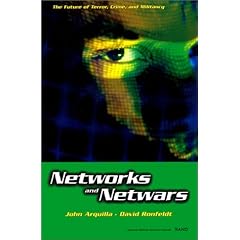
These developments suggest that the United States is spending huge amounts of money in ways that are actually making Americans less secure, not only against irregular insurgents, but also against smart countries building different sorts of militaries. And the problem goes well beyond weapons and other high-tech items. What’s missing most of all from the U.S. military’s arsenal is a deep understanding of networking, the loose but lively interconnection between people that creates and brings a new kind of collective intelligence, power, and purpose to bear — for good and ill…..”
Read the rest here.
It was nice to see Arquilla give some props to VADM Art Cebrowski, who is underappreciated these days as a strategic thinker and is much critricized by people who seldom bothered to read anything he actually wrote. Or who like to pretend that he had said a highly networked Naval task force is a good way to tackle an insurgency in an arid, mostly landlocked, semi-urban, middle-eastern nation.
It also occurs to me that one of the reasons that the USAF resisted drones tooth and nail is that robotics combined with swarming points to en end ( or serious diminishment) of piloted warplanes. Eliminating the design requirements implicit in human pilots makes for a smaller, faster, more maneuverable, more lethal aircraft that will probably be infinitely cheaper to make, more easily risked in combat and usable for “swarming”. Ditto attack helicopters.
Of course, nuclear bombers will probably stay in human hands. Probably.
ADDENDUM:
Contentious Small Wars Council thread on Arquilla begun by “student of war” and defense consultant Wilf Owen. I have weighed in as has Shlok Vaidya.
Posted in 21st century, 3 gen gangs, 4GW, 9/11, academia, Afghanistan, Air Force, al qaida, America, army, authors, Cebrowski, complex systems, connectivity, david ronfeldt, defense, foreign policy, futurism, government, hierarchy, ideas, insurgency, intellectuals, john arquilla, military, military reform, national security, navy, network theory, Network-centric Warfare, networks, non-state actors, organizations, robotics, social networks, theory, war | 6 Comments »
Wednesday, February 17th, 2010
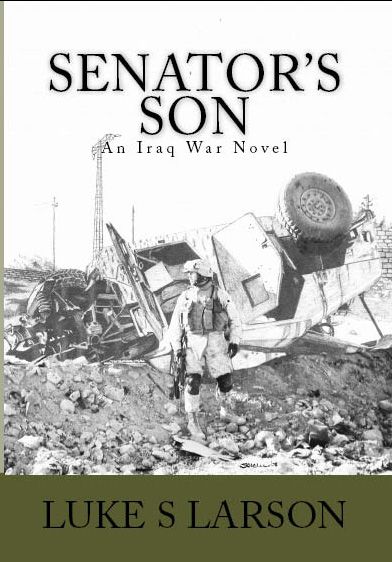
Senator’s Son: An Iraq War Novel by Luke S. Larson
Just received a review copy of new author Luke Larson’s novel Senator’s Son. I can probably count on the fingers of one hand the number of works of fiction that I have reviewed at ZP, but two things caught my attention about Senator’s Son:
First, the novel is historical realism with a theme of COIN. Secondly, the author Luke Larson is a decorated Marine officer with two tours in Iraq under his belt. Flipping the pages reveals a gritty, sometimes humorous, staccato writing style and military/strategy/policy issues that are discussed here, or at SWJ or Abu Muqawama come to life through the eyes of still learning practitioners. I’m looking forward to reading Senator’s Son and reviewing it in full in late February or early March ( need to finish Carr’s Inside Cyber Warfare first).
Setting aside the book itself, something else occurred to me – that we have reached the point where the war is now appearing not as news, but as literature; Iraq and Afghanistan are proving to be culturally transformative wars for America in ways that the Gulf War or the Korean War were not.
If you consider WWI, the Great War represented an existential crisis for Western Civilization that found expression in the Lost Generation and, in Germany, the polar opposite novels All Quiet on the Western Front and Storm of Steel as well as Hemingway’s A Farewell to Arms. The Spanish Civil War electrified international opinion, foreshadowing as it did the ideological death-match of the 20th century, and yielded Orwell’s Homage to Catalonia. WWII and the Vietnam War have generated an ocean of histories down to the minutest detail, as well as their share of novels, short stories and movies. It is noteworthy, that most of the time, literature and history followed the conclusion of peace, be it in victory or defeat.
In our time, the books on the war in Iraq, or Afghanistan or against terrorism are arriving while the conflict is still in full throttle, in time to shape the perceptions of policymakers and the public to an unprecedented extent. Something is happening out there, an inchoate need for answers or reassurance that writers are attempting to answer. Most of these books so far have been non-fiction, journalistic instant histories salted with examples of policy analysis and war memoirs.
Senator’s Son marks a new turn toward a wave of fiction addressing the crucible of America’s current wars. Literature can shape a nation’s psyche more profoundly than even the most soberly researched work of history.
Posted in 21st century, 4GW, America, authors, book, COIN, counterinsurgency, cultural intelligence, culture, fiction, history, ideas, insurgency, intellectuals, iraq, islamic world, mideast, military, non-state actors, Perception, psychology, reading, society, tribes, veterans, war, warriors, Writing | 11 Comments »
Saturday, February 13th, 2010

This was put up at Thoughts Illustrated by Dave Davison.
Now, Dave knows his stuff when it comes to presentation of ideas, the man has a long established track record, but I have to confess that the meaning of this diagram totally eludes me. Why is the “sweet spot” surrounded by “useless…..boring…..rubbish…..ugly”? What the hell is this supposed to imply? The rest of it has some promise.
Any IO or message experts care to weigh in ?
Posted in creativity, davison, freeplay, ideas, intellectuals, IO, Perception, psychology, theory, thoughts illustrated, visualization | 13 Comments »
Tuesday, February 9th, 2010
seydlitz89, the clausewitzian analyst and former Marine Corps officer and US Army intelligence officer who wrote articles in the past for Dr. Chet Richard’s DNI site and participated in two Chicago Boyz Roundtables ( Clausewitz and Xenophon), is now blogging at Milpub.
Here is seydlitz89’s most recent post where he asks some tough questions about how US/NATO strategy in Afghanistan comports with classical COIN theory and a basic need for intellectual coherence:
The Current Crisis in US Counterinsurgency
….To me the crisis reflects much deeper issues. Some of these have to do with the contradictions between the actual theory of Counterinsurgency Warfare as developed by David Galula, and the current wars in Iraq and Afghanistan which are presented to the American people as counterinsurgencies (from our perspective) but are not. This confusion in strategic theory and strategy in turn feeds the political confusion on the US side. What is sorely missing is a honest disclosure of what our actual political purposes are and the best way seen to achieve them.In 1964, a professional French Army officer named David Galula had published a short, but first-rate book on strategic theory entitled Counterinsurgency Warfare. Galula’s conclusion based on his own experiences in Greece, Indochina, China and Algeria, was that to be successful against Revolutionary Warfare (read Maoist-influenced strategies of insurgency), the established state would have to adopt a specific form of warfare based on the realities of this type of conflict, or “counterinsurgency warfare”. Galula’s approach while very coherent and compatible with Clausewitz’s general theory, is specific to a certain political context and thus limited in applicability since the strengths and weaknesses he ascribes to each side refer to this specific political context.
Read the rest here.
Posted in 21st century, Afghanistan, al qaida, America, army, COIN, counterinsurgency, Failed State, ideas, insurgency, intellectuals, islamist, military, national security, strategy, Strategy and War, theory, war | 4 Comments »
Tuesday, February 9th, 2010
Charles Cameron, in his latest guest post here, penned a beautiful essay regarding the ongoing exchanges between Australian counter-terrorism scholar Leah Farrall and Abu Walid al-Masri, an adviser to the Taliban and an experienced strategist of Islamist insurgency. Farrall has translated and posted this dialogue on her blog, All Things Counter Terrorism, which has received much attention, commentary and criticism in the blogosphere and on private listservs and quasi-official bulletin boards.
Generally, I leave this sort of subject to Charles, since he has the academic expertise to drill down to a granular level of Islamic theology and Islamist ideology, but al-Masri is an intriguing figure and his public conversation with Farrall is a novelty worth investigating. It would be hard to imagine during the Cold War, an open media debate between a Western CI official and a Soviet spymaster still engaged in espionage in the field ( Kim Philby hurled public jermiads it is true, but that was in retirement in Moscow and only after his long-suffering KGB handlers had managed to get his severe alcoholism under control). In that spirit, I want to offer a few observations.
While there is artifice present, as al-Masri is consciously speaking to a multiplicity of audiences in his remarks, the idea that we should therefore dismiss the dialogue with Farrall, as some suggest, is an error. There is also posturing in purely intra-Islamist-debates on which we eavesdrop and, frankly, within our own arguments inside government and out. We learn from what people do and do not do, from what they say and what is left unsaid. Being able to speak to multiple audiences is a constraint, as well as an advantage, as it shapes the parameters of the premises to be employed and the extent to which the underlying logic can be permissably extrapolated. To quote a Zen saying, if you wish to fence in a bull, give him a large meadow.
The constraints, if correctly discerned, are illuminating and are analytically useful in constructing our own tactical responses and message strategy (assuming someone can convince the State Department bureaucracy that IO and public diplomacy are important and persuade Congressional leaders to fund such activities with more than pocket change). They are also useful in helping to understand the worldview and governing paradigms of our opponents in more complex and nuanced manner than reflexively saying “they hate our freedoms”. Well, many jihadi types do in fact, viscerally hate our freedoms or deny that democracy is a legitimate form of government in an abstract sense, much the same way they casually disparage Hindus as “cow worshippers” or Thais as “crazy Buddhists”; however those loose attitudes and spasms of hostility are not akin to operational principles or strategic doctrines.
For that, we have to dig deeper into the politico-religious motivations of violent Islamists and listen closely to what our enemies are saying – particularly when they are making an effort to speak to us directly, as al-Masri is doing, his determination to score propaganda points in his little elicitation dance with Farrall notwithstanding. Americans are not very good at listening and our elites are deeply uncomfortable with the entire subject of religion, tending to view pious expressions of Christianity with contempt and Islam as a completely taboo subject. There is a strong preference in government and academia for analytical models of terrorism or insurgency that dwell on DIME spectrum variables because these fit in the personal comfort zones and the educational, social and professional experiences of the American elite. This would be a perfect approach if al Qaida’s leadership were composed of Ivy League alumni and Fortune 500 CEOs.
Economics and military force are always factors in geopolitical conflict, the war of terror included, but until Islamist extremists oblige us by becoming secular Marxist revolutionaries waving little red books, it would behoove us to look with greater scrutiny at the curiously reified religious ideology with which they justify or eschew courses of action to themselves. Our own strategies might be more focused and effective if the operators across our intelligence, military, diplomatic and law enforcement agencies had something approaching a shared understanding of violent Islamism and if they could communicate this understanding along with the benefit of their experience and current intelligence to help political leaders shape American policy.
Posted in 21st century, 4GW, academia, Afghanistan, al qaida, analytic, arab world, bin laden, blogosphere, Charles Cameron, COIN, counterinsurgency, cultural intelligence, DIME, disinformation, extremists, government, IC, ideas, insurgency, intellectuals, IO, islamic world, islamist, mideast, national security, non-state actors, OSINT, Perception, politics, primary loyalties, propaganda, psychology, public diplomacy, Religion, social science, strategy, Strategy and War, synthesis, terrorism, Theology, theory, tribes, war | 4 Comments »


